Health and healing
 83
83

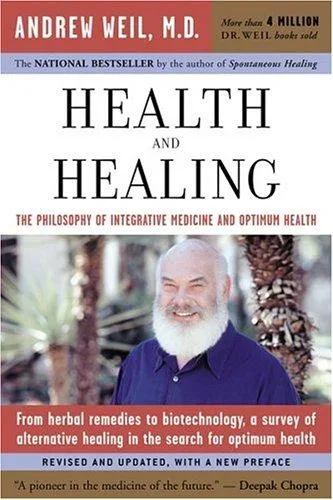
Health and healing
Weil's early exploration of health and healing, particularly his critique of the purely allopathic model, feels prescient even decades later. The strength lies in its accessible synthesis of diverse medical philosophies, challenging readers to consider the body as a complex system rather than a mere machine. However, the 1985 publication date means some of the scientific discussions, while conceptually sound, lack the depth of contemporary research. The section discussing the limitations of pharmaceutical interventions in chronic disease, for instance, is conceptually strong but could benefit from updated examples. Ultimately, "Health and Healing" serves as an important historical marker for the integration of complementary and alternative medicine into mainstream discourse.
📝 Description
83
Andrew Weil's 1985 book, "Health and Healing," questions the limits of biomedical approaches to wellness.
Published in 1985, Andrew Weil's "Health and Healing" looks at wellness not as a fixed condition but as a dynamic relationship between the body's natural abilities and outside factors. The book compares standard medical thinking with different and complementary methods for understanding sickness and getting better. It goes beyond just treating symptoms to look at the deeper reasons for illness, including environmental, mental, and spiritual influences. This book is for people who question the limitations of solely biological views on health. It will appeal to those interested in taking charge of their own healing, combining mind and body, and the history of medical ideas. Anyone wanting to know how culture and history shape our ideas about disease and recovery will find useful material here.
Weil discusses the body's capacity for self-healing, referring to this as the "inner pharmacy." He also examines the "placebo effect," seeing it as a real connection between the mind and body rather than just a psychological phenomenon. The author points out where conventional "allopathic" medicine falls short with long-term and degenerative illnesses. He advocates for a broader approach that brings together different healing practices.
Emerging in the mid-1980s, "Health and Healing" arrived as holistic health and alternative medicine gained momentum, challenging established Western medical paradigms. This period saw a growing interest in integrating mind, body, and spirit for well-being, a movement influenced by various traditions that recognized innate healing capacities. Weil's work engaged with this burgeoning discourse, bridging anthropological observations of healing practices with contemporary scientific understanding of the body's biochemical responses, like the "inner pharmacy" and the significance of the placebo effect.
💡 Why Read This Book?
• Understand the concept of the "inner pharmacy," learning how to potentially harness your body's own healing mechanisms, a core idea introduced in Weil's work. • Grasp the historical context of the holistic health movement's emergence in the 1980s, appreciating how Weil's 1985 publication contributed to shifting medical paradigms. • Explore the limitations of the allopathic medical model as presented by Weil, gaining a critical perspective on symptom-focused treatment versus root-cause analysis.
⭐ Reader Reviews
Honest opinions from readers who have explored this book.
❓ Frequently Asked Questions
What is Andrew Weil's "inner pharmacy" concept?
The "inner pharmacy" refers to the body's innate biochemical and physiological systems that can produce healing responses. Weil suggests that by understanding and influencing these systems through lifestyle, diet, and mindset, individuals can support their own recovery.
When was Andrew Weil's "Health and Healing" first published?
Andrew Weil's "Health and Healing" was first published in 1985. This places it within a significant period of growing interest in alternative and holistic health practices.
What is the historical significance of "Health and Healing"?
Published in 1985, the book is significant for its early integration of conventional and alternative medical perspectives, contributing to the growing discourse on holistic wellness during that era.
Does Weil discuss the placebo effect in "Health and Healing"?
Yes, the work explores the placebo effect, framing it as a demonstration of the powerful connection between the mind and body, and its potential role in healing.
What is "allopathic medicine" according to Weil's 1985 book?
In "Health and Healing" (1985), Weil describes allopathic medicine primarily as a system focused on treating symptoms, often with pharmaceuticals, and sometimes with less emphasis on addressing underlying causes of chronic conditions.
What are the core themes of Weil's "Health and Healing"?
Core themes include the body's self-healing capabilities (the "inner pharmacy"), the mind-body connection, the limitations of purely symptom-based treatment, and the integration of various healing modalities.
🔮 Key Themes & Symbolism
The Inner Pharmacy
This concept posits that the human body possesses an inherent capacity for self-healing, analogous to a pharmacopoeia of natural remedies. Weil, in his 1985 work, suggests that by understanding and harmonizing with these internal systems, individuals can bolster their well-being. It moves beyond the idea of passively receiving treatment to actively engaging the body's own recuperative powers, influenced by factors like diet, stress, and environment, rather than solely relying on external pharmaceuticals.
Critique of Allopathy
Weil's text critically examines the dominant allopathic medical model prevalent in the mid-20th century. He highlights its strengths in acute care but points out limitations in addressing chronic, degenerative, and psychosomatic conditions. The book argues that a focus solely on symptom suppression through drugs, while effective for some ailments, often overlooks the complex interplay of physical, mental, and environmental factors contributing to illness.
Mind-Body Integration
A central tenet of the book is the inseparable connection between mental states and physical health. Weil discusses how psychological factors, beliefs, and perceptions—exemplified by the placebo effect—can profoundly influence biological processes and healing outcomes. This perspective challenges a purely mechanistic view of the body, advocating for therapies that address the whole person, acknowledging the spirit and consciousness as integral components of health.
Holistic Health Models
The work champions a move towards more comprehensive health paradigms. It explores various complementary and alternative medicine (CAM) approaches that were gaining attention in the 1980s, suggesting their integration with conventional practices. The goal is to create a broader understanding of wellness that encompasses nutrition, lifestyle, stress management, and the cultivation of a positive mental state, moving beyond disease prevention to the promotion of vitality.
💬 Memorable Quotes
Direct passages from the work, attributed to the author.
“The body has its own pharmacy.”
— This concise statement expresses Weil's central idea of the 'inner pharmacy,' emphasizing the body's inherent capacity for self-healing and biochemical self-regulation.
“The placebo effect reveals the power of belief.”
— This interpretation highlights Weil's acknowledgment of the significant role of psychological factors and belief systems in influencing physical health outcomes, moving beyond a purely physiological explanation.
“Healing is an active process, not a passive receipt.”
— This interpretation underscores Weil's philosophy of empowering the individual in their health journey, suggesting that recovery involves active participation and engagement with one's own body and mind.
💡 Key Ideas
Editorial paraphrase of the work's core concepts — not direct quotes.
Illness is often a symptom of imbalance.
This paraphrase suggests Weil's view that disease is not an isolated event but an indicator of a broader disruption in the body's systems, requiring attention to underlying causes.
Conventional medicine excels at acute care.
This paraphrase points to Weil's balanced critique, recognizing the strengths of the allopathic model in emergencies and immediate interventions while still questioning its approach to chronic conditions.
🌙 Esoteric Significance
Tradition
While not strictly adhering to a single esoteric lineage, Weil's work draws from and contributes to the broader Western esoteric tradition's interest in vitalism and the interconnectedness of mind, body, and spirit. It echoes themes found in vitalist philosophies and early forms of psychosomatic medicine that sought to understand life force and consciousness beyond purely material explanations, bridging esoteric concepts with accessible scientific discourse.
Symbolism
The concept of the "inner pharmacy" itself functions as a potent symbol, representing the body as a sacred, self-sustaining temple capable of generating its own remedies. The "allopathic model" can be seen symbolically as a mechanistic, reductionist force that often overlooks the holistic, interconnected nature of existence, a common theme in esoteric critiques of materialism.
Modern Relevance
Weil's foundational ideas continue to influence contemporary integrative medicine, functional medicine, and wellness coaching. Thinkers and practitioners in fields like psychoneuroimmunology (PNI) and mind-body therapies directly build upon the groundwork laid by Weil and others in the 1980s, exploring the biological mechanisms behind the mind-body connection he advocated for.
👥 Who Should Read This Book
• Individuals interested in the historical development of holistic health approaches, particularly those seeking to understand the origins of concepts like the "inner pharmacy" as discussed in the 1980s. • Readers critical of purely symptom-focused medical treatments, looking for an alternative perspective that emphasizes the body's self-healing capabilities and mind-body integration. • Students of comparative medicine and wellness philosophies who wish to examine how Weil's 1985 work bridged conventional and alternative health paradigms.
📜 Historical Context
Andrew Weil's "Health and Healing," published in 1985, arrived at an important moment in the burgeoning holistic health movement. The preceding decades had seen a growing public skepticism towards the perceived over-reliance on pharmaceuticals and technological interventions in Western medicine. This era was characterized by intellectual currents exploring mind-body connections, influenced by figures like Hans Selye and his work on stress. Weil's book engaged with these ideas, offering a synthesis that contrasted with the established biomedical paradigm. Contemporaneous authors like Norman Cousins, with his own narrative of healing, were also contributing to this shift in public consciousness. While not facing overt censorship, Weil's work represented a departure from the rigid specialization of medical practice, advocating for a broader, integrative approach that was met with both enthusiasm from alternative health circles and caution from the medical establishment.
📔 Journal Prompts
The concept of the "inner pharmacy" and its relation to your own health.
Reflect on the limitations of the allopathic model as presented in the book's historical context.
How does the idea of mind-body integration manifest in your daily life?
Consider the historical emergence of holistic health in the 1980s.
Analyze the symbolic meaning of the "inner pharmacy" in your personal wellness journey.
🗂️ Glossary
Allopathic Medicine
In the context of Weil's 1985 book, this refers to the conventional Western medical system that primarily uses drugs and surgery to treat diseases by targeting symptoms.
Inner Pharmacy
A concept suggesting the body possesses inherent biochemical and physiological mechanisms capable of producing healing responses, which can be stimulated and supported.
Holistic Health
An approach to wellness that considers the whole person—body, mind, and spirit—and their interconnectedness, rather than focusing solely on the absence of disease.
Placebo Effect
The phenomenon where a patient experiences a perceived or actual improvement in their condition after receiving a treatment that has no therapeutic effect, attributed to belief and expectation.
Mind-Body Connection
The interaction between mental processes (thoughts, emotions) and bodily functions and health, suggesting that psychological states can influence physical well-being.
Vitalism
A philosophical doctrine that the processes of life are not explicable by the same causal laws as those that explain the processes of inanimate matter; often posits a 'vital force' or 'élan vital'.
Complementary and Alternative Medicine (CAM)
A broad range of health practices and products that are not typically considered part of conventional Western medicine, often used alongside or instead of standard treatments.
🔮 Readers Also Liked
Browse all →







More by Andrew Weil
All books →



More Free Occult Philosophy Books
View all →