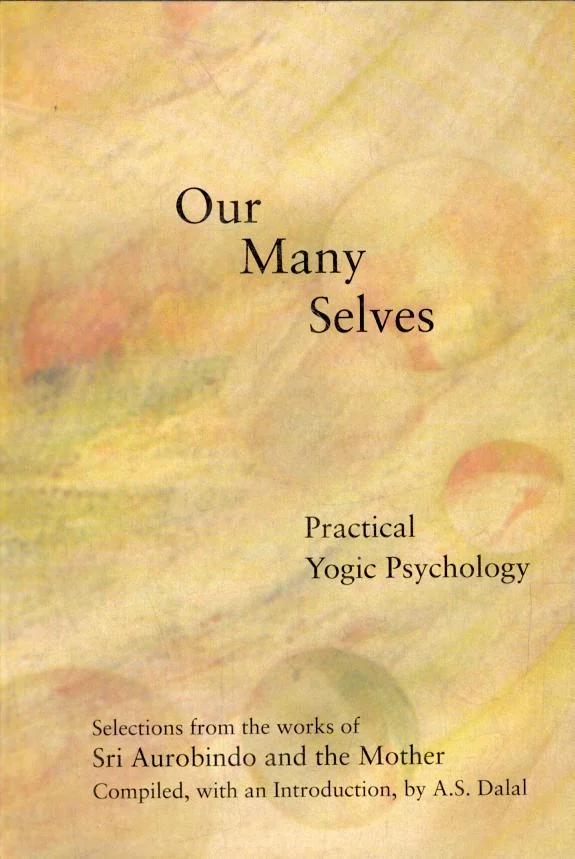
Our Many Selves
 75
75

Our Many Selves
The persistent challenge of internal alteration is the very ground upon which "Our Many Selves" stakes its claim. Instead of offering platitudes about willpower, the book presents a rigorous cartography of the self, detailing its layered architecture. The strength here is the sheer systematicity; Aurobindo and The Mother don't just describe the mind, they delineate its functional subdivisions and its relationship to the vital and physical planes. The concept of the 'psychic being' as the true nucleus of individuality, distinct from the ego-driven personality, offers a compelling anchor for those feeling fragmented. However, the very detail that makes the work precise can also render it dense for the uninitiated. A passage discussing the intricate interactions between the vital being's desires and the mental being's justifications, as seen in the context of achieving a 'calm mind,' highlights both the book's analytical power and its potential for overwhelming the reader with its conceptual density. It demands sustained attention, rewarding the diligent with a sophisticated blueprint for inner work. Ultimately, it is an indispensable, albeit demanding, guide for those serious about radical inner transformation.
📝 Description
75
First published in 2003, Our Many Selves details Sri Aurobindo and the Mother's integral yoga approach to consciousness.
This volume examines the human psyche through the lens of integral yoga, as taught by Sri Aurobindo and the Mother. It breaks down consciousness into distinct planes: physical, vital, mental, psychic, and spiritual. The book explains how these levels interact to shape our personality and create difficulties in personal growth.
It argues that genuine transformation comes not from suppressing parts of ourselves, but from consciously bringing them together and moving upward. The work is for individuals serious about understanding their inner life and pursuing spiritual progress. It offers practical methods for those who find conventional self-help techniques too superficial or temporary. Students of spiritual psychology and those seeking conscious self-discovery will find guidance here.
Emerging from the early to mid-20th century, the teachings of Sri Aurobindo and The Mother stand within a rich period of Western esoteric and Eastern philosophical synthesis. Their integral yoga system, detailed in works like Our Many Selves, offered a comprehensive path for consciousness transformation. This approach differed from purely analytical psychology or ascetic spiritual practices by aiming for a complete change of being, grounded in yogic discipline. Their work engaged with contemporary spiritual and intellectual currents, proposing a distinct method for evolving human consciousness.
💡 Why Read This Book?
• Gain a precise understanding of the layered structure of your consciousness, including the distinction between the ego-personality and the true psychic being, as articulated by Sri Aurobindo and The Mother. This offers a unique framework for self-analysis beyond superficial traits. • Learn to differentiate the functioning of the various planes of action – physical, vital, and mental – and how their interplay creates internal conflict, providing practical insights for addressing personal limitations as detailed in the book's analysis. • Discover the integral yoga approach to transformation, focusing on the conscious ascent of consciousness and the descent of spiritual force, a method distinct from mere psychological adjustment or suppression, as presented in the foundational teachings.
⭐ Reader Reviews
Honest opinions from readers who have explored this book.
❓ Frequently Asked Questions
What is the 'psychic being' as described in "Our Many Selves"?
The 'psychic being' is the true inner self or soul, the divine spark within that is the nucleus of our individuality. It is distinct from the surface personality and ego, acting as the inner guide towards spiritual evolution and embodying the deepest aspiration for truth and divine consciousness.
How does "Our Many Selves" explain the difficulty of changing one's nature?
The book explains that attempts at change often fail because they address only the surface personality. True transformation requires understanding and working with the various planes of being—physical, vital, mental—and the distinct parts within them, rather than attempting to force change from a single, limited standpoint.
What are the 'planes of action' mentioned in the book?
The 'planes of action' refer to the different functional levels within each broader plane of consciousness (physical, vital, mental). For example, within the vital plane, there are actions related to desire, emotion, and instinct, each with its own dynamics and interactions.
Is "Our Many Selves" a practical guide or a philosophical text?
It functions as both. While deeply philosophical in its exposition of consciousness and spiritual evolution, it provides a practical framework for understanding one's inner workings and offers principles for transformation that can be applied in daily life.
Who are Sri Aurobindo and The Mother?
Sri Aurobindo (1872-1950) was an Indian philosopher, yogi, and poet, and The Mother (Mirra Alfassa, 1878-1973) was his spiritual collaborator. Together, they developed the system of Integral Yoga, aiming for the transformation of human consciousness and the creation of a new world.
What is the ultimate goal of the teachings in "Our Many Selves"?
The ultimate goal is the transformation of the entire being—physical, vital, mental, and spiritual—into a divine instrument capable of embodying a higher consciousness. This process is often referred to as the 'descent of the Supermind' or the creation of a 'divine life' on Earth.
🔮 Key Themes & Symbolism
The Multi-Planal Being
The text elaborates on the intricate structure of the human being, positing that we are not monolithic entities but complex compositions of various planes of consciousness: the physical, the vital (emotions, instincts, desires), the mental (thought, intellect, will), and the subtler spiritual planes. Understanding the distinct nature and interplay of these planes is presented as crucial for any genuine self-development. The book details how these levels interact, often creating internal conflict, and how the psychic being acts as the unifying core aspiring towards higher realities.
The Psychic Being and True Individuality
A central concept is the 'psychic being,' understood as the true soul or inner essence of an individual, distinct from the ego and the surface personality constructed by the mind and vital. This psychic entity is the seat of genuine aspiration and the guiding consciousness towards spiritual realization. The book explores how the psychic being can be veiled by the lower nature and outlines methods for its emergence and dominance, leading to a more authentic and divinely aligned existence.
The Process of Transformation
The work details a comprehensive approach to transformation, moving beyond superficial changes. It describes the necessity of both the 'ascent' of consciousness, where the lower self rises towards the higher spiritual planes, and the 'descent' of spiritual forces into the material being. This dynamic interplay is essential for reorienting the entire nature—physical, vital, and mental—to align with the higher will and consciousness, leading to a divinized existence.
Conscious Evolution of Nature
"Our Many Selves" posits that human evolution is not merely biological but a conscious process of transforming our fundamental nature. By understanding the constituent parts of our being and consciously applying spiritual forces, individuals can accelerate this evolution. The book addresses the practical challenges and possibilities inherent in this endeavor, offering a systematic path for those seeking to participate actively in their own spiritual and conscious growth.
💬 Memorable Quotes
Direct passages from the work, attributed to the author.
“The difficulty arises from the fact that the nature we seek to change is not a simple unity, but a complex formation of many elements.”
— This statement expresses the core problem addressed by the book: the illusion of a single, unified self that can be easily altered. It highlights the intricate, multi-layered composition of human consciousness as the reason for the apparent intractability of personal change.
“We are composed of various different 'parts' or 'planes' of action that combine together, interact with one another and impinge upon one another.”
— This is a foundational concept explaining the book's approach. It asserts that our being is a composite, a dynamic interplay of distinct energies and functions operating on different levels, which must be understood individually before they can be harmonized.
“The key to solving this problem actually lies in a deeper understanding of the true nature of our psychological being.”
— This points to the intellectual and spiritual foundation for effective self-transformation. It suggests that mere effort is insufficient; true change originates from a profound, accurate perception of the self's complex structure and underlying reality.
“It is necessary to differentiate between a mental idea, a vital impulse, and a physical urge.”
— This highlights the practical application of understanding the planes of consciousness. The ability to discern the origin and nature of our thoughts, feelings, and physical sensations is presented as a critical step in gaining control and achieving inner harmony.
“The psychic being is the true individuality, the soul that carries the divine spark.”
— This defines the central entity that the book advocates for recognizing and empowering. It distinguishes the permanent, spiritual core of our being from the transient, ego-driven personality and emphasizes its divine essence.
🌙 Esoteric Significance
Tradition
The work is deeply rooted in the yogic and Vedantic traditions of India, synthesizing them into a unique system termed Integral Yoga. It departs from traditional asceticism by aiming for the transformation of the entire being, including the physical, within the context of life and evolution, rather than solely seeking liberation from it. It incorporates elements of evolutionary spirituality, viewing human progress as a conscious participation in the unfolding of divine consciousness on Earth.
Symbolism
While "Our Many Selves" is more conceptual than symbolic in its presentation, the underlying philosophy frequently employs symbols of ascent and descent. The 'ascent' represents the upward movement of consciousness from the material to the spiritual realms, while the 'descent' signifies the bringing down of higher spiritual energies and consciousness into the material world. The 'psychic being' itself can be seen as a symbol of the inner divine spark, the soul's luminous presence within the material form.
Modern Relevance
Contemporary thinkers and practitioners in consciousness studies, transpersonal psychology, and integral theory frequently reference Sri Aurobindo's and The Mother's work. Their emphasis on a holistic transformation of the human being, integrating spiritual realization with evolutionary progress, speaks to modern seekers looking for comprehensive frameworks. Movements focused on conscious evolution, collective transformation, and the practical application of spiritual principles in daily life draw significantly from their articulated vision.
👥 Who Should Read This Book
• Aspiring practitioners of Integral Yoga seeking a clear explication of the fundamental principles of consciousness and transformation as taught by Sri Aurobindo and The Mother. • Students of comparative spirituality and philosophy interested in understanding unique 20th-century developments in Indian esoteric thought and their global impact. • Individuals struggling with personal change who desire a sophisticated, systematic framework for understanding the complexities of the psyche and achieving deep, lasting inner evolution.
📜 Historical Context
The teachings of Sri Aurobindo and The Mother, consolidated in works like "Our Many Selves," emerged from the rich spiritual field of early to mid-20th century India, a period of intense philosophical inquiry and national awakening. Influenced by ancient Vedic and Upanishadic thought, as well as Western philosophies and esoteric traditions, they formulated Integral Yoga. This approach sought a complete transformation of human consciousness, distinguishing itself from purely intellectual philosophies or ascetic yogic paths. While figures like Mahatma Gandhi were leading political change and Rabindranath Tagore was revolutionizing education and art, Aurobindo and The Mother were pioneering a distinct path of inner evolution. Their work gained traction among a global audience interested in spiritual realization, offering a comprehensive system that addressed the totality of human existence—physical, vital, mental, and spiritual—a synthesis that set it apart from contemporary movements focused on specific aspects of consciousness or societal reform.
📔 Journal Prompts
The interplay of the vital being's impulses and the mental being's justifications. Identify one instance today.
The veiled nature of the psychic being. What subtle signs suggest its presence in your daily actions?
Differentiating between a surface reaction and a deeper psychic aspiration. Reflect on a recent significant decision.
The concept of the 'planes of action.' How do your physical, vital, and mental actions align or conflict?
The potential for the descent of higher consciousness. What inner conditions facilitate or hinder this process for you?
🗂️ Glossary
Psychic Being
The true inner self or soul, the divine nucleus of the individual that holds the aspiration for truth and spiritual realization. It is considered the central guiding consciousness distinct from the ego and surface personality.
Planes of Consciousness
The different levels or areas of existence and awareness, typically categorized as physical, vital (emotional/instinctual), mental (intellectual/cognitive), and spiritual. Each plane has its own specific energies, laws, and modes of functioning.
Planes of Action
Specific functional subdivisions within each broader plane of consciousness. For example, within the vital plane, there are distinct actions related to desire, emotion, impulse, and instinct, each interacting with others.
Integral Yoga
The path of spiritual practice developed by Sri Aurobindo and The Mother, aiming for the transformation of the entire being—physical, vital, mental, and spiritual—into a divine manifestation, and the evolution of life on Earth.
Ascent of Consciousness
The upward movement of the individual's consciousness from the lower, material levels towards the higher spiritual realms and planes of existence.
Descent of Consciousness
The bringing down of higher spiritual energies, forces, and consciousness from the higher planes into the lower nature (physical, vital, mental) to transform it.
Ego
The constructed sense of self, often based on identification with the mind, vital desires, and physical being. It is considered a limited and often misleading center of consciousness, distinct from the true psychic being.
This book appears in 1 collection
🔮 Readers Also Liked
Browse all →








From the “Yoga” Collection
View all →



More Free Occult Philosophy Books
View all →