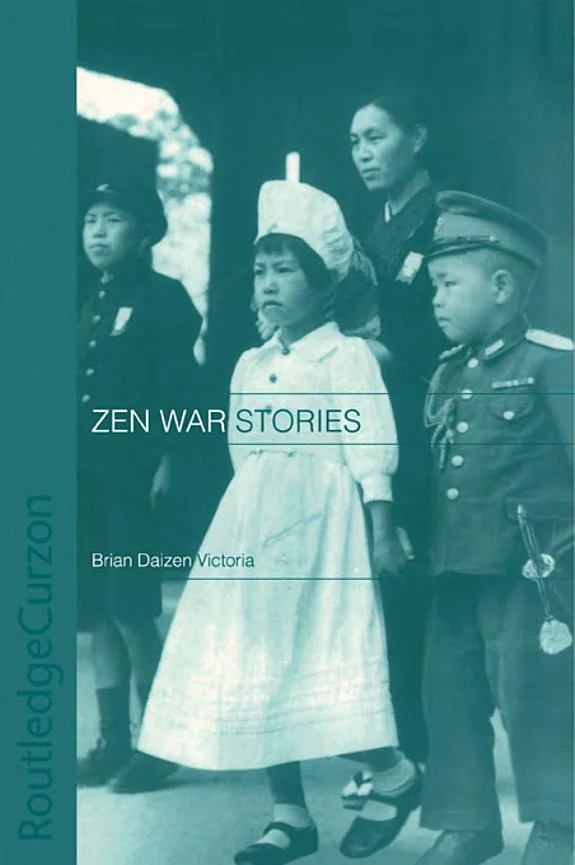
Zen War Stories
 82
82

Zen War Stories
Daizen Victoria's "Zen War Stories" is a commendably sober examination of how Buddhist principles, particularly Zen, confront the grim realities of armed conflict. Instead of offering platitudes, Victoria excavates historical instances and philosophical quandaries with scholarly rigor. The book’s strength lies in its refusal to sanitize the subject matter, presenting complex ethical dilemmas faced by individuals who were both spiritual practitioners and participants in or witnesses to war. One particularly striking section explores the tension between non-attachment and the moral imperative to act in situations of violence. A limitation, however, is that at times the narrative can feel dense, demanding considerable reader engagement to fully unpack the philosophical arguments. Despite this, the work's exploration of concepts like *mu* in the context of extreme duress offers a potent counterpoint to superficial understandings of peace. Victoria's contribution is a vital, unsentimental look at faith under fire.
📝 Description
82
Daizen Victoria's 2003 book examines Zen Buddhism's encounter with violence and war.
Zen War Stories, published in 2003, investigates how Buddhist philosophy confronts the realities of conflict. The book does not simply recount battles; it delves into how individuals navigate violence, suffering, and moral questions within spiritual frameworks. Victoria looks at the human condition under extreme pressure through the lens of Zen practice and its history.
This work is for readers interested in how spiritual disciplines function in difficult situations. It is suited for those who find easy answers about ethics, war, and personal change insufficient. Students of religion, philosophy, and history will find its interdisciplinary method useful. Zen practitioners seeking to understand the tradition's role in worldly affairs will also benefit.
Published in 2003, "Zen War Stories" arrived during a period of global conflict, resonating with contemporary discussions on spirituality and violence. The book connects Zen's engagement with warfare to a historical lineage, referencing figures like Musashi Miyamoto. This work appeared as Eastern philosophies saw renewed interest in the West, often sought for practical wisdom. It positions Zen not merely as a path of meditation but as a tradition that has historically grappled with worldly affairs, including armed conflict.
💡 Why Read This Book?
• Gain a nuanced understanding of how Zen Buddhism historically engaged with warfare, moving beyond simplistic pacifist ideals, as exemplified by discussions on figures within the samurai class. • Explore the philosophical concept of *mu* (emptiness) applied to situations of extreme conflict and suffering, challenging conventional notions of void and non-existence. • Discover practical applications of mindfulness and non-attachment in high-stakes ethical dilemmas, learning how spiritual discipline can inform action amidst violence.
⭐ Reader Reviews
Honest opinions from readers who have explored this book.
❓ Frequently Asked Questions
What is the publication history of Zen War Stories?
Zen War Stories was first published in 2003. It has since been reprinted, making Daizen Victoria's exploration of Zen and conflict accessible to new generations of readers interested in the subject.
Does Zen War Stories focus on specific wars or historical periods?
The book draws on a range of historical examples, touching upon periods of conflict that involved individuals with Zen Buddhist backgrounds, including the feudal era of Japan and potentially later conflicts where Buddhist principles were tested.
Is Zen War Stories a collection of battle accounts?
No, it is not primarily a collection of battle accounts. Instead, it uses historical narratives and figures as case studies to explore the philosophical and ethical challenges Zen Buddhism faces when confronted with violence and war.
What does the concept of 'mu' mean in the context of this book?
In Zen War Stories, 'mu' (emptiness) is explored not as nihilism, but as a state of potentiality and liberation from fixed concepts, offering a framework for understanding and acting within the chaos of war.
Who is the author, Daizen Victoria?
Daizen Victoria is an author and scholar who focuses on Zen Buddhism and its intersections with philosophy, history, and contemporary issues. His work often examines the practical and ethical dimensions of Buddhist practice.
Can Zen War Stories help someone understand modern conflicts?
Yes, by examining the historical application of Zen principles to war and suffering, the book provides a framework for contemplating the ethical and psychological dimensions of contemporary conflicts and the role of spiritual traditions.
🔮 Key Themes & Symbolism
Zen and the Art of Conflict
This theme investigates how Zen Buddhist principles, typically associated with peace and meditation, have historically intersected with the realities of war and violence. It moves beyond romanticized notions of pacifism to explore instances where Zen practitioners faced combat or ethical dilemmas in wartime. The book examines figures and events that challenge the perception of Zen as solely an introspective practice, highlighting its capacity for engagement with the world's harshness. Victoria probes the tension between non-attachment and the necessity of action, offering a complex view of spiritual resilience in extremis.
The Philosophy of Mu
Central to the book is the exploration of 'mu,' the Zen concept of emptiness or non-being. Victoria presents 'mu' not as a void or nihilistic stance, but as a dynamic state of potentiality and liberation from rigid conceptualization. In the context of war stories, this concept becomes a tool for understanding how individuals might navigate chaos and suffering without being consumed by fear or attachment to outcomes. It suggests a way of being present and responsive, even amidst destruction, by transcending dualistic thinking and fixed identities.
Ethical Ambiguity in Practice
The narratives within 'Zen War Stories' often highlight profound ethical ambiguities faced by individuals attempting to live by spiritual precepts in violent environments. The book questions whether traditional Buddhist ethics offer clear-cut answers in situations of extreme duress, such as self-defense or participation in warfare. Victoria explores how practitioners grappled with concepts like compassion, non-harming, and karma when confronted with the stark realities of conflict, revealing the personal and philosophical struggles involved in maintaining spiritual integrity under pressure.
Suffering and Enlightenment
This theme examines the relationship between intense suffering, particularly that experienced in war, and the pursuit of spiritual realization or enlightenment (*satori*). The book suggests that clear insights and transformations can arise not just from secluded meditation but also from direct confrontation with life's most challenging aspects. Victoria implies that the crucible of conflict can serve as a unique, albeit brutal, training ground for developing wisdom, compassion, and a deeper understanding of the human condition, testing the resilience of spiritual practice.
💬 Memorable Quotes
Direct passages from the work, attributed to the author.
“The warrior's path and the path of the Bodhisattva are not mutually exclusive.”
— This interpretation suggests that spiritual development, even within the framework of Zen, does not necessitate withdrawal from worldly responsibilities or conflicts. It posits that ethical action and compassion can be integrated into roles that involve force or confrontation, challenging a simplistic dichotomy between spiritual life and engagement with violence.
“Understanding 'mu' requires confronting the void without flinching.”
— This highlights the active and courageous engagement with the concept of emptiness ('mu') presented in the book. It implies that grasping this fundamental Zen principle involves facing existential uncertainty and the dissolution of ego-structures, particularly relevant when dealing with the ultimate uncertainties of war.
“The discipline of *shojin ryori* mirrors the discipline required in battle.”
— This interpretation draws a parallel between the mindful preparation and execution of monastic vegetarian cuisine (*shojin ryori*) and the focused discipline demanded in combat. It suggests that the principles of mindfulness, intention, and skillful action are transferable across seemingly disparate activities.
“Karma unfolds even on the battlefield.”
— This suggests that the law of karma, the principle of cause and effect, remains operative regardless of the extreme circumstances of war. It implies that actions taken during conflict have consequences, both immediate and long-term, for the individuals involved and the world around them.
💡 Key Ideas
Editorial paraphrase of the work's core concepts — not direct quotes.
Peace is not the absence of conflict, but the presence of wisdom.
This paraphrased concept emphasizes that true peace, from a Zen perspective as explored in the book, is not merely the cessation of hostilities. Instead, it is an internal state cultivated through understanding, clarity, and ethical action, even when external circumstances are turbulent.
🌙 Esoteric Significance
Tradition
While Zen Buddhism is a distinct Mahayana Buddhist tradition, its engagement with martial arts and philosophy in "Zen War Stories" touches upon concepts resonant with broader esoteric currents. The emphasis on mind-body integration, direct experience, and transcending dualistic thinking aligns with certain Hermetic and Gnostic ideals of inner mastery and liberation. The work explores how spiritual discipline can be applied to extreme worldly situations, a theme present in various mystical paths that seek to transform the mundane through dedicated practice and insight, rather than solely through withdrawal.
Symbolism
The book implicitly uses the 'warrior' as a symbol, not necessarily of aggression, but of disciplined engagement with reality, including its most challenging aspects. The concept of 'mu' (emptiness) functions symbolically as a state of pure potentiality and freedom from conceptual limitations, crucial for clear action in chaotic environments. Furthermore, symbols of monastic discipline, like the rigorous preparation of *shojin ryori*, represent the application of mindfulness and intention to all aspects of life, transforming ordinary tasks into spiritual practice, even when juxtaposed with violence.
Modern Relevance
Contemporary thinkers and practitioners interested in mindfulness-based approaches to stress reduction, trauma, and ethical decision-making can find relevance in Victoria's work. Schools of thought exploring the intersection of contemplative practices with psychology and social action, such as certain branches of engaged Buddhism, can draw upon the book's historical case studies. Furthermore, individuals grappling with the moral complexities of modern conflicts or seeking to reconcile spiritual values with pragmatic action in challenging professions may find the book's nuanced perspective valuable.
👥 Who Should Read This Book
• Students of comparative religion and philosophy seeking to understand how distinct spiritual traditions interpret and respond to violence and conflict. • Practitioners of Zen Buddhism who wish to explore the historical and philosophical complexities of their tradition's engagement with martial culture and wartime ethics. • Readers interested in ethics and existentialism, particularly those who appreciate analyses that avoid simplistic moralizing and confront difficult human experiences.
📜 Historical Context
Published in 2003, "Zen War Stories" emerged in a global climate increasingly defined by conflict, notably the ongoing War on Terror. This era saw a renewed public and academic interest in how various spiritual traditions, including Buddhism, grapple with violence and ethics. The work engages with a long lineage of Zen's involvement in Japanese martial culture, dating back centuries to figures like Musashi Miyamoto, whose Five Rings text (c. 1645) also explored martial strategy through a philosophical lens. While Zen is often perceived in the West through the lens of peaceful meditation popularized by figures like D.T. Suzuki in the mid-20th century, Victoria's book counters this by examining historical instances of Zen practitioners in military contexts. This provided a counter-narrative to the dominant, often romanticized, Western image of Zen, offering a more complex and historically grounded perspective during a time when discussions of war and morality were paramount.
📔 Journal Prompts
The warrior's path and the Bodhisattva ideal: explore their potential integration.
Reflect on the concept of 'mu' as applied to a personal moment of intense uncertainty.
Analyze the ethical challenges presented by a specific historical figure in the book.
Consider the symbolic meaning of monastic discipline in contexts of extreme duress.
How does the idea of peace as 'presence of wisdom' inform your view of current events?
🗂️ Glossary
Mu
A fundamental concept in Zen Buddhism, often translated as 'no,' 'not,' or 'emptiness.' It signifies the absence of inherent existence and the potentiality that arises from transcending dualistic thinking and fixed conceptualizations.
Bodhisattva
In Mahayana Buddhism, an enlightened being who delays their own nirvana out of compassion to help all sentient beings achieve enlightenment. The ideal emphasizes altruism and active engagement with suffering.
Shojin Ryori
Traditional Japanese Buddhist cuisine, characterized by its simplicity, seasonality, and avoidance of meat, fish, and strong flavors. It embodies principles of mindfulness, balance, and respect for life.
Satori
A Japanese Buddhist term for sudden enlightenment or comprehension. It refers to a direct, intuitive experience of awakening, often characterized by a shift in perception and understanding.
Karma
In Buddhism, the principle of cause and effect, where intentional actions (karma) lead to future consequences (vipaka). It governs the cycle of rebirth and influences an individual's experiences.
Non-attachment
A core Buddhist principle involving the release of craving and clinging to people, places, ideas, or experiences. It is seen as a path to reducing suffering and achieving mental equanimity.
D.T. Suzuki
A highly influential Japanese author and Buddhist scholar who played a key role in introducing Zen Buddhism to the Western world, particularly through his writings in the mid-20th century.
This book appears in 1 collection
🔮 Readers Also Liked
Browse all →









From the “Zen Buddhism” Collection
View all →








More Free Occult Philosophy Books
View all →