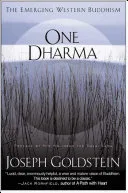
One Dharma
 77
77

One Dharma
Joseph Goldstein’s *One Dharma* offers a lucid and grounded perspective on the emergence of a Western Buddhist tradition. Rather than merely rehashing familiar doctrines, Goldstein thoughtfully dissects how core Buddhist principles like mindfulness and nonattachment are being reinterpreted and lived out in America. He skillfully navigates the terrain between preserving ancient wisdom and adapting it for contemporary sensibilities, a delicate balance he achieves with considerable clarity. The book’s strength lies in its directness; Goldstein avoids jargon where possible, presenting complex ideas with an accessible, almost conversational tone that makes the material readily digestible for both seasoned practitioners and newcomers. A potential limitation, however, is that the focus on adaptation, while necessary, might occasionally lead to a slight dilution of the radical, world-renouncing implications found in some earlier Buddhist texts. Nevertheless, his discussion of how *mettā* (loving-kindness) can inform ethical engagement in a secularized society is particularly compelling. Goldstein presents a mature vision for a Buddhism that is both deeply rooted and dynamically alive.
📝 Description
77
Joseph Goldstein's *One Dharma* (2011) examines how Buddhist practice adapts to Western culture.
Published in 2011, Joseph Goldstein's *One Dharma* addresses the adaptation of Buddhist principles like mindfulness, loving-kindness, and nonattachment within a Western context. Goldstein, a Vipassanā teacher, grounds his discussion in core Buddhist tenets while considering the cultural shifts affecting contemporary practice. The book is for individuals seeking a deeper understanding of Buddhism, especially those interested in integrating traditional teachings with modern life through mindfulness and meditation. It also offers perspectives for those curious about the development of Western Buddhism, its challenges, and its universal aspects. The work emerged during a time of significant growth for Buddhist institutions in the West, following decades of increasing interest and the establishment of meditation centers. It addresses a need for texts that synthesize core Buddhist teachings with the experiences of Western practitioners, participating in a broader discussion about Buddhism's adaptation and its potential for lasting influence.
Joseph Goldstein's *One Dharma* engages with the transmission of Buddhist teachings into Western societies. It acknowledges the historical transformations Buddhism has undergone as it moves across cultures, a process seen in other traditions as well. The book highlights how core concepts are reinterpreted and applied by Western practitioners, reflecting a dynamic interplay between ancient doctrines and contemporary experience. This adaptation is a hallmark of how spiritual traditions evolve when encountering new philosophical and social environments, aiming to retain their essence while becoming relevant to new adherents.
💡 Why Read This Book?
• Gain a nuanced understanding of how core Buddhist principles like mindfulness and nonattachment are being shaped by Western cultural contexts, as explored in Goldstein's analysis of the 'Western Buddhism' phenomenon. • Learn practical applications of loving-kindness (mettā) for ethical engagement in daily life, drawing from Goldstein's insights into cultivating compassion within a modern framework. • Appreciate the historical trajectory of Buddhism in America, understanding its evolution from its initial introduction to the establishment of distinct Western traditions, as contextualized by the book's publication date of 2011.
⭐ Reader Reviews
Honest opinions from readers who have explored this book.
❓ Frequently Asked Questions
When was Joseph Goldstein's 'One Dharma' first published?
Joseph Goldstein's 'One Dharma' was first published on March 15, 2011. This date places it within a period of significant growth and adaptation for Buddhist teachings in Western societies.
What are the central Buddhist principles discussed in 'One Dharma'?
The book centers on three core Buddhist principles: mindfulness (vipassanā), loving-kindness (mettā), and nonattachment. Goldstein explores how these universal tenets are understood and practiced within the context of Western Buddhism.
Who is Joseph Goldstein and what is his background?
Joseph Goldstein is an influential American Buddhist teacher, particularly known for his extensive work in the Vipassanā tradition. He is a co-founder of the Insight Meditation Society in Barre, Massachusetts.
Does 'One Dharma' address the differences between Eastern and Western Buddhism?
Yes, a primary focus of 'One Dharma' is exploring the unique traditions and adaptations of Buddhism taking root on American soil, examining how it evolves while adhering to universal Buddhist principles.
Is 'One Dharma' suitable for beginners in Buddhism?
The book offers clear explanations of foundational Buddhist concepts, making it accessible to beginners. However, its depth in exploring the nuances of Western adaptation also provides valuable insights for more experienced practitioners.
What is the significance of the preface by the Dalai Lama?
The preface by the Dalai Lama, as mentioned in promotional material, signifies the importance and broad acceptance of Goldstein's vision within the global Buddhist community, endorsing its contribution to the development of Buddhist thought.
🔮 Key Themes & Symbolism
Mindfulness and Awareness
Goldstein emphasizes mindfulness (vipassanā) not merely as a technique but as a fundamental way of perceiving reality. The book details how cultivating moment-to-moment awareness is crucial for understanding the nature of suffering and liberation. It moves beyond simple meditation instruction to explore how this sharpened awareness can permeate all aspects of life, leading to greater clarity and equanimity in the face of impermanence and dissatisfaction inherent in existence.
Loving-Kindness (Mettā)
The practice of loving-kindness is presented as an essential counterpoint to the analytical nature of mindfulness, fostering compassion and connection. Goldstein explores how developing mettā—a genuine wish for the well-being of oneself and others—is vital for ethical engagement with the world. This theme addresses how Buddhist ideals of altruism and empathy can be cultivated within a Western societal framework, promoting a more harmonious and less self-centered existence.
Nonattachment and Liberation
Goldstein explores the concept of nonattachment as the key to overcoming suffering. This involves understanding the impermanent nature of all phenomena—thoughts, feelings, and external circumstances—and loosening the grip of craving and aversion. The book posits that true freedom comes not from accumulating or avoiding experiences, but from seeing them clearly without clinging, thereby fostering a profound sense of inner peace independent of external conditions.
The Evolution of Western Buddhism
A central thread is the examination of how Buddhism has adapted to Western cultural and intellectual landscapes since its introduction. Goldstein addresses the emergence of a 'Western Buddhism,' distinct yet rooted in ancient traditions. He discusses the challenges and opportunities presented by this adaptation, focusing on how universal principles are being interpreted and integrated into modern life, moving beyond mere academic study to lived practice.
💬 Memorable Quotes
Direct passages from the work, attributed to the author.
“The Dharma is not a religion to be believed, but a practice to be realized.”
— This statement underscores Goldstein's pragmatic approach, suggesting that the efficacy of Buddhist teachings lies in their direct application and experiential verification rather than in blind faith or adherence to dogma.
“Mindfulness is the awareness that arises from paying attention, on purpose, in the present moment, non-judgmentally.”
— This widely recognized definition, often attributed to Jon Kabat-Zinn but central to Goldstein's teachings, highlights the intentional, present-focused, and accepting nature of mindfulness practice as a path to understanding.
“The path of practice is about cultivating wisdom and compassion simultaneously.”
— This highlights the integrated nature of Buddhist training, suggesting that intellectual understanding (wisdom) and emotional development (compassion) are inseparable and mutually reinforcing on the spiritual journey.
“Attachment is the root of suffering.”
— A core tenet of Buddhist philosophy, this phrase points to the idea that our clinging to desires, possessions, and even our sense of self is the primary cause of dissatisfaction and pain.
“True freedom comes from seeing things as they are.”
— This expresses the goal of Buddhist practice: liberation achieved through clear, unbiased perception of reality, unclouded by personal biases, desires, or aversions.
🌙 Esoteric Significance
Tradition
While not strictly adhering to a single esoteric lineage like Hermeticism or Kabbalah, *One Dharma* draws heavily from the contemplative and philosophical traditions within Buddhism, which themselves contain esoteric dimensions. Its focus on inner transformation, direct experience, and the uncovering of hidden potentials aligns with broader esoteric aims of spiritual liberation and self-realization. Goldstein's emphasis on mindfulness and nonattachment can be seen as practical methods for accessing deeper states of consciousness and understanding the nature of reality, akin to contemplative practices found across various mystical traditions.
Symbolism
The 'Dharma wheel' (Dharmachakra), often associated with Buddhism, symbolizes the Noble Eightfold Path and the Buddha's teachings spreading throughout the world. In the context of *One Dharma*, this symbol represents the universal applicability and adaptive potential of Buddhist principles. The concept of the 'Middle Way,' also implicit, signifies balance—avoiding extremes of asceticism and hedonism—a core principle for navigating spiritual practice without falling into dogmatic rigidity or indulgent materialism.
Modern Relevance
Contemporary thinkers and practitioners in fields ranging from clinical psychology (e.g., mindfulness-based therapies like MBCT and MBSR) to secular ethics and contemplative science frequently reference the core principles articulated in *One Dharma*. Schools and centers that emphasize integral spirituality or the integration of Eastern wisdom with Western thought often draw upon Goldstein's accessible yet profound explanations. His work continues to inform discussions on how ancient contemplative practices can offer profound psychological and ethical resources for working through the complexities of modern life.
👥 Who Should Read This Book
• Students of comparative religion and philosophy seeking to understand the development of Buddhist thought in a Western context, particularly post-2000. • Practicing Buddhists and meditators looking for a clear exposition of core principles like mindfulness and loving-kindness, and how they apply to contemporary life. • Individuals interested in secular spirituality and psychological well-being who wish to explore foundational Buddhist concepts and their practical benefits without necessarily adopting a religious framework.
📜 Historical Context
Published in 2011, *One Dharma* arrived at a central moment for Buddhism in the West. Decades prior, figures like Alan Watts and Gary Snyder had introduced Eastern philosophies, while the 1960s and 70s saw the establishment of major meditation centers like the Insight Meditation Society (co-founded by Goldstein) and Naropa University. By the early 21st century, Buddhism was no longer a fringe interest but a significant spiritual force, engaging with Western psychology, science, and social activism. Goldstein’s work emerged in dialogue with teachers like Jack Kornfield and Sharon Salzberg, who were also instrumental in popularizing Vipassanā. While some scholars debated the authenticity of 'Western Buddhism' versus its traditional Asian forms, Goldstein's book aimed to articulate an authentic synthesis, emphasizing universal principles over cultural specificity. Its reception was generally positive, seen as a mature articulation of Buddhist practice adapted for a contemporary, often secular, audience.
📔 Journal Prompts
The cultivation of loving-kindness (mettā) in relation to perceived obstacles.
Mindfulness as a tool for discerning attachment versus healthy engagement.
Reflecting on the concept of 'Western Buddhism' and its unique contributions.
The practice of nonattachment in everyday decision-making.
Identifying moments of non-judgmental awareness throughout a typical day.
🗂️ Glossary
Vipassanā
A Pali term meaning 'insight' or 'clear seeing.' It refers to a specific form of Buddhist meditation focused on developing awareness of reality as it is, observing impermanence, dissatisfaction, and non-self.
Mettā
A Pali term for loving-kindness, friendliness, or benevolence. It is a meditation practice and a mental state of unconditional goodwill towards all beings, cultivated to counteract anger and aversion.
Nonattachment
The principle of letting go of craving, aversion, and clinging to outcomes, possessions, or ideas. It is seen as essential for reducing suffering and achieving liberation (nirvana).
Dharma
In Buddhism, Dharma refers to the teachings of the Buddha, the universal truths about the nature of reality, and the path to enlightenment. It can also refer to phenomena or the constituent elements of existence.
Eightfold Path
The Noble Eightfold Path is the foundational framework of Buddhist practice, comprising Right Understanding, Right Thought, Right Speech, Right Action, Right Livelihood, Right Effort, Right Mindfulness, and Right Concentration.
Impermanence (Anicca)
One of the three marks of existence in Buddhism, referring to the doctrine that all conditioned phenomena are in a constant state of flux and change; nothing lasts forever.
Non-self (Anattā)
Another of the three marks of existence, asserting that there is no permanent, unchanging, independent self or soul. Understanding this is key to dissolving ego-clinging.