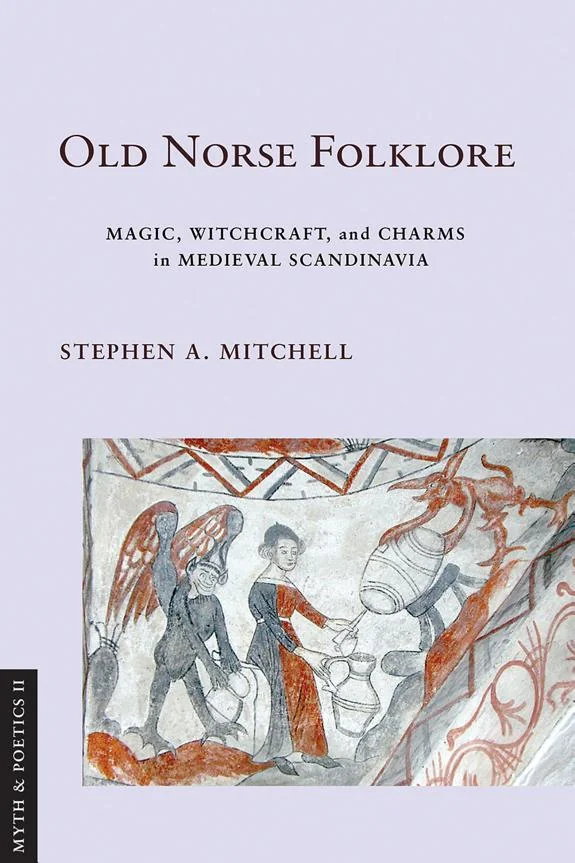
Old Norse Folklore
 76
76

Old Norse Folklore
Stephen A. Mitchell's *Old Norse Folklore* offers a commendable exploration of a frequently mythologized but often poorly understood area of European occult history. The work's strength lies in its rigorous academic approach, drawing on a wide array of primary sources to reconstruct the magico-religious landscape of medieval and early modern Scandinavia. Mitchell's discussion of syncretism, particularly how Christian elements were integrated or resisted within existing pagan frameworks, is nuanced and informative. However, the prose can occasionally become dense, making certain sections challenging for the less specialized reader. A particular passage that stands out is the detailed analysis of runic magic's persistence, demonstrating its adaptation rather than outright extinction. Ultimately, this volume serves as an essential, if demanding, resource for serious students of Northern European esoteric traditions.
📝 Description
76
Stephen A. Mitchell's 2025 study details the magical and witchcraft traditions of medieval and early modern Nordic societies.
Old Norse Folklore, the second volume by Stephen A. Mitchell, published in 2025, examines the magical and witchcraft traditions of medieval and early modern Nordic societies. It addresses the complex interplay of syncretism, continuity, and the survival of pagan beliefs in a region that was among the last in Western Europe to adopt Christianity. The work also uncovers lesser-known aspects of this magico-religious heritage.
This book is intended for scholars of Northern European history, students of comparative mythology, and practitioners of modern paganism interested in historical roots. It will appeal to those seeking a rigorous academic exploration of pre-Christian and syncretic belief systems, particularly those focused on the practical application of magic and ritual in ancient and medieval Scandinavia.
The volume situates its study within the late Christianization of Scandinavia, a process that extended well into the medieval period, leaving a distinct imprint on the region's folklore and magical practices. This context is crucial for understanding the survival and transformation of older beliefs under the influence of Christianity, a phenomenon explored through extensive textual analysis.
This work situates itself within the study of Northern European paganism and its transformation following Christianization. It focuses on the persistence of pre-Christian magical and witchcraft traditions, examining how these practices merged with or survived under the new religious order. The book's approach is grounded in textual analysis, aiming to reconstruct and understand the magico-religious heritage of societies that underwent a prolonged conversion process.
💡 Why Read This Book?
• Gain a scholarly understanding of the persistence of pagan beliefs and practices in Scandinavia, even after Christianization, through Mitchell's detailed analysis of syncretism. • Uncover specific magical techniques and witchcraft traditions from medieval Nordic societies, moving beyond generalized folklore to concrete historical examples. • Explore the reconstruction of pre-Christian cultic practices, learning how scholars like Mitchell piece together evidence from a period of significant religious transition.
⭐ Reader Reviews
Honest opinions from readers who have explored this book.
❓ Frequently Asked Questions
What period does Stephen A. Mitchell's *Old Norse Folklore* primarily cover?
The book focuses on medieval and early modern Nordic societies, a period extending significantly into the time when Christianity was being established across Scandinavia, often into the 14th century and beyond.
How does the book address the Christianization of the Nordic region?
It examines the process of Christianization not as an abrupt end to paganism, but as a period of syncretism, continuity, and survival, exploring how older beliefs and practices adapted or persisted.
Are practical magical traditions discussed in *Old Norse Folklore*?
Yes, the book delves into Nordic magic and witchcraft, uncovering obscure yet important corners of magico-religious tradition and exploring the practical applications of these beliefs.
What is the significance of 'syncretism' in the context of Old Norse folklore?
Syncretism refers to the blending of different religious beliefs and practices. In this volume, it highlights how pagan Norse traditions merged with, or were influenced by, Christian doctrines and rituals.
Who is Stephen A. Mitchell and what is his expertise?
Stephen A. Mitchell is an academic specializing in Old Norse language and literature, with a particular focus on mythology, religion, and magic, as evidenced by his scholarly output in this field.
When was *Old Norse Folklore* first published?
The book was first published on February 15, 2025, making it a recent contribution to the study of Northern European folklore and magic.
🔮 Key Themes & Symbolism
The Survival of Paganism
This volume meticulously documents how pre-Christian beliefs and cultic practices did not simply vanish with the advent of Christianity in the Nordic regions. Mitchell illustrates their remarkable persistence through various forms of syncretism and continuity. The work highlights specific examples of ritual adaptation and the enduring influence of shamanistic or seiðr-like practices, even when cloaked in Christian terminology or integrated into Christian festivals. It argues that the last areas of Western Europe to be Christianized retained a unique spiritual heritage.
Nordic Magic and Witchcraft
Beyond the broader religious landscape, *Old Norse Folklore* pulls back the curtain on more obscure elements of Nordic magico-religious tradition, specifically focusing on magic and witchcraft. Mitchell draws upon a range of materials to reconstruct the understanding and practice of sorcery, healing, and divination in medieval and early modern Scandinavia. The book examines the societal role and perception of those who wielded magical knowledge, differentiating between learned magic and folk practices.
Syncretism in Practice
A central theme is the complex process of syncretism, where Norse paganism and Christianity did not merely coexist but actively influenced and reshaped each other. The book explores how Christian saints and figures were sometimes imbued with older, pre-Christian attributes or how pagan deities and spirits were reinterpreted within a Christian cosmological framework. This dynamic interplay is presented as key to understanding the unique spiritual identity of the Nordic peoples during this transitional period.
Reconstruction of Beliefs
The work engages in the scholarly endeavor of reconstructing pagan beliefs and cultic practices from fragmented historical records. Mitchell utilizes linguistic analysis, comparative folklore, and archaeological evidence where applicable to piece together a picture of what these practices may have entailed. The challenge of this reconstruction is emphasized, given the often biased nature of Christian sources and the oral traditions that were not always written down.
💬 Memorable Quotes
Direct passages from the work, attributed to the author.
“The last area of Western Europe to be Christianized retained a unique spiritual heritage.”
— This statement underscores the distinctiveness of the Nordic region's religious development. It suggests that the prolonged period of transition allowed for a more complex interplay between old and new faiths, resulting in practices and beliefs not found elsewhere in Europe.
“Pulling back the curtain on more obscure, yet important, corners of Nordic magico-religious tradition.”
— This highlights the book's aim to illuminate lesser-known aspects of historical magic and religion in the Norse world. It signals a departure from common narratives, promising to reveal details about practices and beliefs that have often been overlooked by scholarship.
“Continuity and survival of pagan beliefs under Christian influence.”
— This concept is central to understanding how Norse spiritual life evolved. It suggests that rather than a clean break, there was a gradual adaptation and reinterpretation of older traditions, which continued to influence the religious and magical landscape for centuries.
“The complex interplay of syncretism in medieval and early modern Nordic societies.”
— This phrase points to the intricate blending of different religious systems. In the Nordic context, it refers to the merging of pagan Norse traditions with Christianity, creating a unique hybrid spiritual and magical framework.
“Reconstruction of pagan beliefs and cultic practices.”
— This describes the scholarly effort to piece together the lost or fragmented religious systems of the pre-Christian Norse. It involves analyzing available historical, linguistic, and folkloric evidence to understand ancient rituals and belief structures.
🌙 Esoteric Significance
Tradition
This work aligns with the broader esoteric interest in reconstructing pre-Christian European spiritualities, particularly those associated with Northern European paganism and shamanism. While academic in its methodology, it speaks to traditions that seek to understand ancient cosmologies and magical practices as living systems. It departs from purely historical accounts by implicitly validating the significance of these traditions, offering material that can inform modern reconstructionist pagan practices and esoteric philosophies.
Symbolism
The book likely touches upon key Norse symbols such as runes, Yggdrasil, and perhaps specific deities or spirits. Runes, for instance, are often interpreted esoterically not just as an alphabet but as carriers of magical power and cosmic knowledge. The concept of the World Tree, Yggdrasil, symbolizes the interconnectedness of all realms, a potent metaphor in many esoteric traditions for understanding cosmic order and spiritual journeys.
Modern Relevance
Contemporary practitioners of Ásatrú, Heathenry, and other forms of modern paganism draw heavily on scholarly works like Mitchell's to inform their understanding and practice of Norse traditions. Esotericists interested in shamanic practices, folk magic, and comparative mythology find valuable insights into the historical roots of these disciplines, informing their own spiritual paths and theoretical frameworks.
👥 Who Should Read This Book
• Academic researchers of Northern European history and religion seeking detailed analysis of medieval magical practices. • Students of comparative mythology and folklore interested in the survival of pagan traditions in a Christianizing Europe. • Modern practitioners of Norse paganism and esotericists looking for historically grounded information on ancient beliefs and rituals.
📜 Historical Context
Stephen A. Mitchell's *Old Norse Folklore* engages with the historical period when Scandinavia was undergoing profound religious and cultural shifts, primarily the slow but pervasive adoption of Christianity. This process extended for centuries, with significant pagan survivals and adaptations well into the medieval era. Unlike regions that converted earlier, the Nordic lands present a unique case study of how older animistic and polytheistic worldviews interacted with monotheism. The work emerges within a scholarly tradition that has long debated the extent and nature of pagan persistence, often grappling with Christian-centric source materials that may distort or suppress indigenous beliefs. Mitchell's research is situated alongside scholars like Britt-Mari Näsström and Anders Hultgård, who have also explored the complexities of Norse religion and its transformation. The book's meticulous examination of syncretism and the continuity of magical practices provides crucial context for understanding the religious landscape prior to and during the Reformation's impact.
📔 Journal Prompts
The survival of pagan beliefs: how does syncretism reshape their expression?
Nordic magic and witchcraft: what forgotten practices are illuminated?
Reconstructing cultic practices: what evidence is most compelling?
The Christianization of the Nordic region: what continuities persist?
Obscure corners of magico-religious tradition: which remain most intriguing?
🗂️ Glossary
Syncretism
The blending of different religious beliefs and practices, often occurring when cultures come into contact, as seen in the merging of Norse paganism and Christianity.
Seiðr
A form of Norse magic associated with prophecy, fate, and influencing the minds of others, often practiced by women (völva) and sometimes by Odin himself.
Völva
A female seer or sorceress in Norse society, believed to possess knowledge of the past, present, and future, and capable of practicing seiðr.
Cultic Practices
Rituals, ceremonies, and forms of worship associated with a particular religious cult or belief system.
Christianization
The process by which a region or people adopts Christianity, often involving the gradual or forceful replacement of indigenous religious beliefs and practices.
Magico-religious Tradition
A system of beliefs and practices that combines elements of magic and religion, where supernatural powers are invoked for practical or spiritual ends.
Paganism
A term historically used to describe polytheistic or non-Abrahamic religions, often referring to ancient European belief systems like the Norse faith.
This book appears in 1 collection
🔮 Readers Also Liked
Browse all →



From the “Folklore Magic” Collection
View all →





More Free Magic & Ritual Books
View all →