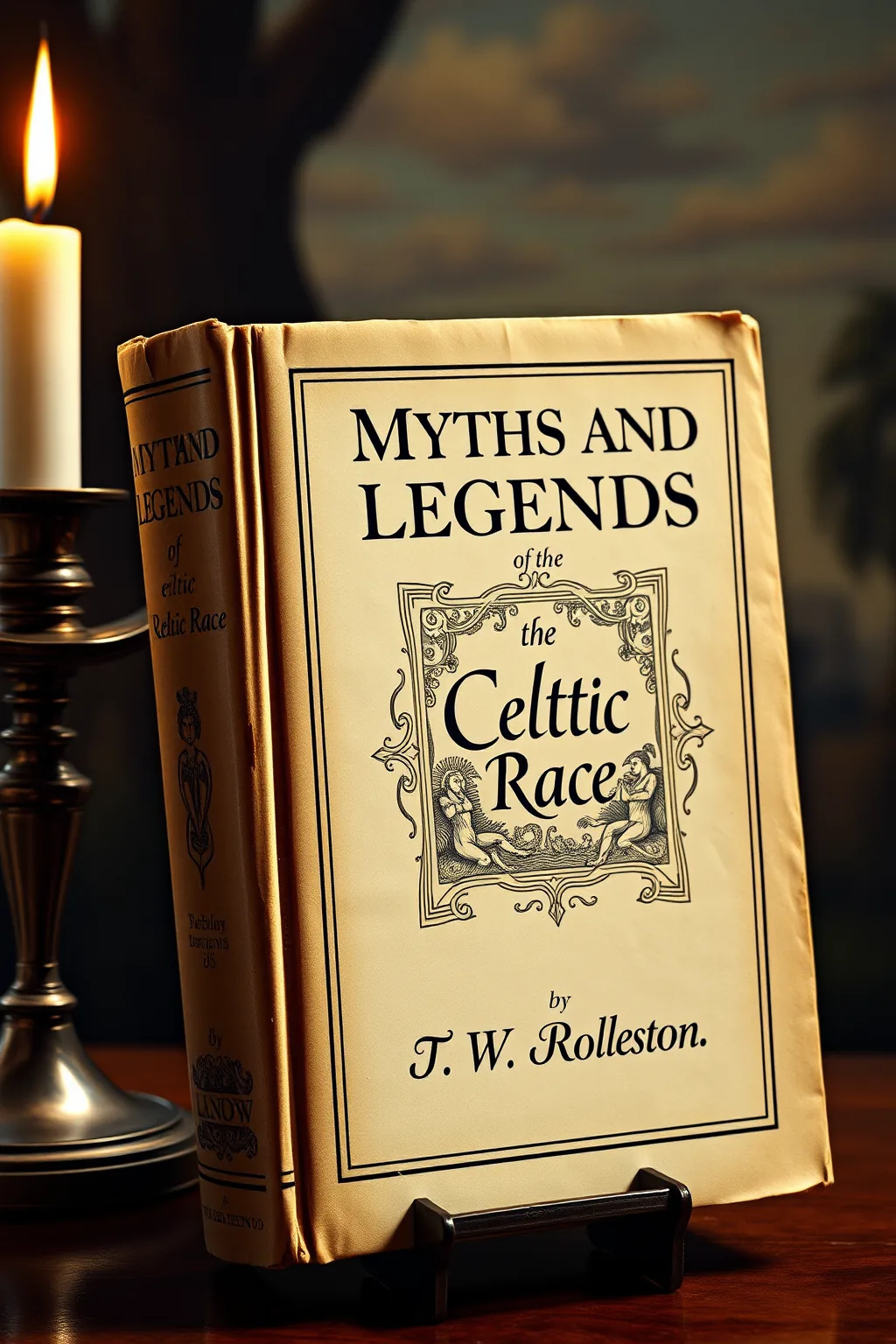
Myths and Legends of the Celtic Race
 72
72

Myths and Legends of the Celtic Race


Marcus Thorne (Esoteric Sciences Reviewer) — T. W. Rolleston's 'Myths and Legends of the Celtic Race' stands as a monumental achievement in the preservation and interpretation of Celtic lore. Rolleston's scholarship is impeccable, yet his prose sings with the vitality of the ancient bards. He masterfully navigates the complex mythic cycles, illuminating the profound esoteric currents that flow beneath the surface of heroic deeds and supernatural encounters. This is a vital resource for anyone interested in the foundational myths of Western esotericism, offering deep insights into druidic philosophy, the nature of consciousness, and the archetypal forces that govern our reality. Essential reading for scholars and sincere seekers alike.
📝 Description
72
T. W. Rolleston's 'Myths and Legends of the Celtic Race' was published in 1911.
This 1911 book collects and retells a wide range of myths and legends from various Celtic traditions. Rolleston organizes the material thematically, covering figures like the Tuatha Dé Danann, the Ulster Cycle heroes, and Arthurian romances as they pertain to Celtic lore. He aims to present these stories not just as folklore, but as reflections of a deeper worldview, touching upon concepts of the Otherworld, the divine, and the relationship between humanity and nature. The book includes detailed accounts of heroes such as Cuchulainn and Fionn mac Cumhaill, alongside the magical exploits of the gods. Rolleston’s approach seeks to illuminate the symbolic richness and underlying spiritual ideas present in the ancient Celtic narratives. He connects these tales to what he perceives as enduring currents in human consciousness and belief systems.
Published in the early 20th century, a period of renewed interest in comparative mythology and ancient traditions, Rolleston's work fits within the broader esoteric milieu. It presented Celtic myths as holding spiritual insights relevant to contemporary seekers of hidden knowledge. The book’s focus on symbolism, archetypes, and the perceived interconnectedness of the natural and supernatural aligns with movements that looked to ancient cultures for wisdom beyond conventional Western thought. It contributed to a growing body of literature that sought to revive or reinterpret pre-Christian European spiritualities.
✍️ Author
💡 Why Read This Book?
Uncover the mystical heart of Celtic civilization. This book offers direct access to the archetypal forces, druidic wisdom, and otherworldly narratives that have shaped Western esoteric traditions. Ideal for seekers of ancient knowledge, scholars of mythology, and practitioners looking to imbue their practice with potent Celtic symbolism and a deeper understanding of the earth's hidden energies.
⭐ Reader Reviews
Honest opinions from readers who have explored this book.
❓ Frequently Asked Questions
What makes this book 'esoteric'?
The book delves beyond simple storytelling, revealing the hidden philosophical and spiritual dimensions of Celtic myths. It explores themes of initiation, the nature of the soul, and the interconnectedness of the physical and spiritual worlds, common in esoteric traditions.
Does it cover all Celtic peoples?
Yes, Rolleston's work comprehensively addresses the myths and legends of the Irish, Welsh, and continental Celts, offering a broad yet detailed overview of their shared and distinct mythic landscapes.
What is the 'Otherworld' in Celtic mythology?
The 'Otherworld' (often referred to as Tír na nÓg or Mag Mell) is a spiritual or supernatural realm in Celtic belief, inhabited by deities, spirits, and the ancestors. It is a place of immortality, magic, and eternal youth, often accessed through mystical portals.
Is this book suitable for beginners?
Absolutely. While rich in depth, Rolleston's accessible prose makes the complex narratives engaging for newcomers to Celtic mythology and esoteric studies.
What is the significance of the Tuatha Dé Danann?
The Tuatha Dé Danann are a supernatural race of gods and goddesses central to Irish mythology. Their stories reveal ancient cosmologies, the origins of magic, and the fundamental forces of creation and destruction within the Celtic spiritual framework.
🔮 Key Themes & Symbolism
The Veil Between Worlds
This book masterfully explores the permeable boundary between the mortal realm and the enchanted Otherworld, a core concept in Celtic spirituality. It reveals how the ancient Celts perceived divine intervention, fae encounters, and the journey of the soul, offering a profound understanding of their dualistic cosmology where magic and reality intertwine seamlessly. The narrative unveils portals, sacred sites, and the spiritual pathways that allowed for communion with the unseen.
Archetypal Heroes and Divine Cycles
Rolleston presents a pantheon of archetypal heroes and divine beings whose stories form the bedrock of Celtic mythology. From the warrior prowess of Cuchulainn to the mystical lineage of the Tuatha Dé Danann, these figures embody primal forces and universal human experiences. Their sagas are not mere tales of valor but allegorical journeys exploring themes of destiny, sacrifice, transformation, and the cyclical nature of life, death, and rebirth within a richly symbolic spiritual framework.
Druidic Wisdom and Nature's Secrets
Embedded within the narratives are profound elements of Druidic philosophy and a deep reverence for the natural world. The book hints at the hidden knowledge of the Druids concerning the cycles of nature, the power of the elements, and the spiritual significance of sacred groves and ancient sites. It illuminates how the Celts viewed the earth as a living entity, imbued with spirit and wisdom, offering readers a glimpse into an ancient, earth-centered spirituality that speaks to modern ecological consciousness.
💬 Memorable Quotes
Direct passages from the work, attributed to the author.
“Heroes are not born, they are forged in the crucible of fate.”
— This highlights the emphasis on destiny and the trials that shape individuals into legendary figures, a common theme in heroic myth cycles.
“The ancient trees whisper secrets to those who listen.”
— This speaks to the animistic beliefs of the Celts, where nature itself holds wisdom and communicates with those attuned to its subtle energies.
“To know the myth is to understand the soul.”
— This suggests that the symbolic narratives of mythology are keys to unlocking deeper truths about the human psyche and spiritual nature.
“The Otherworld is but a breath away.”
— This reflects the belief in the close proximity of the spiritual realm to the physical world, accessible through liminal spaces and altered states of consciousness.
💡 Key Ideas
Editorial paraphrase of the work's core concepts — not direct quotes.
The world is full of magic, things you do not see.
This quote captures the Celtic worldview, where the mundane is interwoven with the mystical, suggesting an ever-present spiritual dimension accessible through awareness.
🌙 Esoteric Significance
Tradition
This work is foundational for understanding Celtic esotericism, a tradition deeply rooted in animism, nature worship, and a profound connection to the spiritual forces of the land. It offers insights into pre-Christian beliefs that influenced later mystical and occult practices, particularly those related to Druidry, earth magic, and the exploration of consciousness through myth and symbolism.
Symbolism
The myths are replete with potent symbolism: the sacred grove representing the axis mundi, the Otherworld as a symbolic dimension of consciousness, the hero's journey as an alchemical process of transformation, and animal totems signifying spiritual guides or primal energies. Rolleston's retelling invites contemplation of these symbols as keys to unlocking universal truths and personal spiritual development.
Modern Relevance
In an age often characterized by disconnection, the Celtic myths offer a powerful reminder of our innate connection to nature and the unseen world. They provide archetypal patterns for navigating life's challenges, understanding the cycles of existence, and fostering a more integrated and spiritually aware approach to living, making them profoundly relevant for contemporary seekers.
👥 Who Should Read This Book
This book is a treasure for spiritual seekers yearning to connect with ancient earth wisdom and explore the mystical roots of Western culture. Scholars of mythology and folklore will find it an invaluable, well-researched compendium. For practitioners of nature-based spiritualities, it offers potent archetypes and symbolic language. Even beginners curious about the enchanting field of Celtic lore will find Rolleston's accessible prose a perfect gateway into this rich and profound tradition.
📜 Historical Context
Published in 1911, T. W. Rolleston's 'Myths and Legends of the Celtic Race' emerged during a period of intense interest in national identity and ancient heritage across Europe, particularly in Ireland, which was experiencing a cultural revival. This era saw scholars and artists looking at folklore and mythology to reconstruct and celebrate a distinct Celtic past, often tinged with romanticism and a search for spiritual authenticity. Rolleston's work contributed significantly to this movement by compiling and presenting these ancient tales in a coherent and accessible manner, aiming to preserve a rich cultural legacy. It coincided with a broader European fascination with the esoteric and the occult, making it resonate with readers seeking deeper, non-mainstream spiritual understandings.
📔 Journal Prompts
What personal 'Otherworld' experiences have you encountered, or how might you seek them?
Reflect on a Celtic hero's journey; how does it mirror your own life's challenges and transformations?
Consider a natural element or place that feels sacred to you, and explore its symbolic meaning in a Celtic context.
How do the archetypes presented in Celtic myths resonate with your own inner landscape or the archetypes you observe in the world?
Imagine you are a modern-day Druid; what ancient wisdom from these myths would you apply to contemporary life?
🗂️ Glossary
Tuatha Dé Danann
A supernatural race of gods and goddesses in Irish mythology, often depicted as masters of magic and the original inhabitants of Ireland before the arrival of the Milesians.
Cuchulainn
The foremost hero of the Ulster Cycle of Irish mythology, renowned for his warrior prowess, his battle-frenzy (ríastrad), and his tragic fate.
Otherworld
A spiritual or supernatural realm in Celtic mythology, often a place of immortality, magic, and bliss, accessible through certain sacred sites or mystical means.
Druid
An ancient Celtic priest, magician, and scholar, who held significant religious and political influence, often associated with wisdom, nature, and spiritual practices.
Rhiannon
A prominent figure in Welsh mythology, often associated with horses, birds, and the Otherworld, known for her beauty and enigmatic nature.
This book appears in 1 collection
🔮 Readers Also Liked
Browse all →









From the “Transcendental Meditation” Collection
View all →





More Free Esoteric History & Biography Books
View all →