Mystical Theology
 80
80

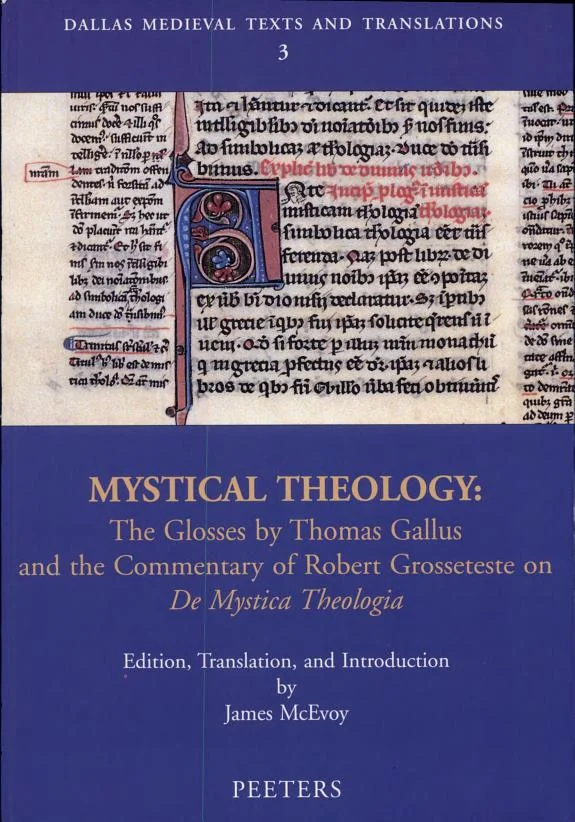
Mystical Theology
McEvoy’s edition of Mystical Theology provides a rigorously prepared translation and commentary on a text that has been a cornerstone of mystical discourse for centuries. The editor’s dedication to utilizing all five known manuscripts, including recent discoveries, lends significant weight to the textual accuracy. A particular strength lies in the meticulous collation of manuscript variations, offering scholars a nuanced view of the text’s transmission. However, the dense scholarly apparatus, while invaluable for specialists, may present a steep learning curve for those less familiar with 13th-century Latinate theological discourse. The discussion surrounding Bishop Grosseteste's commentary, though brief, is illuminating, highlighting the ongoing engagement with Pseudo-Dionysius's work. This edition is an essential scholarly resource, but its primary audience will be academic and advanced practitioners.
📝 Description
80
J. J. McEvoy's 2023 edition translates Pseudo-Dionysius's "De Mystica Theologia" using five manuscripts.
This edition presents a scholarly translation and examination of Pseudo-Dionysius the Areopagite's "De Mystica Theologia." McEvoy's work is based on an analysis of five distinct manuscripts, including recently discovered sources. The translation aims for textual precision, offering a new scholarly perspective on this influential text.
The book is suited for academics in theology, philosophy, and classical studies, alongside dedicated students of Christian mysticism and Neoplatonism. It will interest those tracking the historical evolution of theological language and contemplative practices. Readers who want a detailed, textually grounded interpretation of Pseudo-Dionysius, rather than a general introduction, will find this edition especially useful.
The "De Mystica Theologia," likely written in the late 5th or early 6th century, became a cornerstone of Western esoteric thought. Its Latin translation in the 9th century introduced its concepts to a wider audience. Figures like Thomas Gallus and Bishop Grosseteste engaged with the text through their commentaries, demonstrating its significance within medieval intellectual circles. McEvoy's edition situates itself within this long lineage of interpretation, providing a contemporary scholarly approach.
💡 Why Read This Book?
• Gain a precise understanding of apophatic theology as presented in the original text, informed by the editor's analysis of five manuscripts, allowing for a deeper grasp of the "via negativa" than generalized descriptions. • Explore the concept of the "divine darkness" through direct engagement with the translated text, appreciating its specific theological and contemplative implications as interpreted by scholars like Thomas Gallus in 1233. • Understand the historical reception of Pseudo-Dionysius by examining the commentary by Bishop Grosseteste, offering insight into how this foundational mystical work was integrated into 13th-century scholastic thought.
⭐ Reader Reviews
Honest opinions from readers who have explored this book.
❓ Frequently Asked Questions
What is the significance of the Pseudo-Dionysius "De Mystica Theologia"?
The "De Mystica Theologia" is pivotal for its articulation of apophatic theology, influencing Christian mystical traditions by proposing knowledge of God through negation. Its Latin translation in the 9th century made it accessible to Western thinkers.
Who was Thomas Gallus and what was his connection to this text?
Thomas Gallus, a member of the Victorine School in Paris, provided a significant gloss and commentary on the Latin version of "De Mystica Theologia" in 1233, demonstrating the text's importance during the 13th century.
What makes this specific edition of "Mystical Theology" unique?
This edition by J. J. McEvoy is notable for its critical approach, utilizing all five known manuscripts of the text, including recently discovered ones, to produce a new translation and commentary.
What is "apophatic theology" as discussed in the book?
Apophatic theology, or the "via negativa," is a method of approaching God by what God is not, rather than what God is. It emphasizes transcending positive descriptions to reach a more direct, albeit ineffable, divine encounter.
When was the original "De Mystica Theologia" likely written?
Scholars generally date the original composition of "De Mystica Theologia" to the late 5th or early 6th century CE, though its precise authorship is attributed to Pseudo-Dionysius the Areopagite.
What role did Bishop Grosseteste play regarding this text?
Bishop Grosseteste, a prominent figure in 13th-century English scholarship, also produced a commentary on the "De Mystica Theologia" around the time Thomas Gallus was active, underscoring the text's widespread influence.
🔮 Key Themes & Symbolism
Apophatic Theology (Via Negativa)
This edition centers on Pseudo-Dionysius's radical approach to divinity, known as apophatic theology. The work argues that the highest knowledge of God is attained not through affirmative statements ('God is good') but through negation ('God is not good', 'God is not being'). This "divine darkness" transcends conceptual frameworks, leading to an ineffable union. McEvoy's translation meticulously unpacks these concepts, drawing on manuscript evidence from the 13th century and earlier.
The Divine Darkness
Central to Pseudo-Dionysius's mystical ascent is the concept of "divine darkness." This is not an absence of light but a super-abundance of divine reality that blinds the intellect, much like the sun blinds the eyes. It represents the ultimate unknowing that precedes true mystical apprehension. The commentary by Thomas Gallus in 1233, as explored in this edition, grappled with this profound paradox of knowing through not-knowing.
Hierarchical Ascent
The work implicitly or explicitly references the celestial and ecclesiastical hierarchies described by Pseudo-Dionysius. These hierarchies represent structured pathways for spiritual ascent, moving from the sensible to the intelligible, and ultimately towards the supra-essential divine source. Understanding these structures is crucial for grasping the "Mystical Theology's" practical implications for contemplative practice within the Neoplatonic and early Christian framework.
Textual Transmission and Interpretation
A significant aspect of this edition is its focus on the textual history of "De Mystica Theologia." By analyzing five manuscripts, including recent discoveries, McEvoy offers a refined text. The commentary highlights the critical role of interpreters like Thomas Gallus and Bishop Grosseteste in the 13th century, who shaped the understanding and reception of Dionysian thought in the Latin West.
💬 Memorable Quotes
Direct passages from the work, attributed to the author.
“The divine outpouring surpasses all intellectual conception.”
— This emphasizes the ineffable nature of divine reality. The act of God's self-manifestation or essence is so profound that it cannot be contained or understood by the human intellect.
“The ascent is achieved by proceeding from the highest affirmations to the ultimate negations.”
— This describes the methodological progression in mystical theology. It involves stripping away all conceptualizations, starting from what can be said about God and moving towards what cannot, in order to approach the divine essence.
💡 Key Ideas
Editorial paraphrase of the work's core concepts — not direct quotes.
We pray that we may attain to the radiant excess of the divine darkness.
This line captures the core of apophatic theology, where the ultimate divine encounter is described not as enlightenment in the conventional sense, but as a blinding super-abundance that transcends ordinary perception.
God is beyond affirmation and negation.
This paraphrased concept highlights the transcendence of God. Traditional theological descriptions are seen as inadequate; true divine apprehension requires moving beyond all conceptual categories, both positive and negative.
Union is the transcendence of all duality.
This paraphrased concept points to the goal of mystical practice: achieving a state of oneness that dissolves the subject-object distinction and all other forms of perceived separation.
🌙 Esoteric Significance
Tradition
This work is a central to Christian Neoplatonism, bridging classical Greek philosophy with early Christian mysticism. It established a lineage that profoundly influenced Western esotericism, including Hermeticism, Kabbalah, and later Theosophical movements. Its emphasis on apophatic theology and divine unknowing offers a counterpoint to more scholastic or exoteric theological approaches, providing a direct, albeit challenging, path to the divine.
Symbolism
The primary symbolism revolves around 'light' and 'darkness.' 'Divine darkness' signifies not an absence but a super-abundance of divine reality that overwhelms the intellect, representing the ultimate state of unknowing that precedes mystical union. The 'celestial and ecclesiastical hierarchies' function as symbolic blueprints for spiritual ascent, mapping a structured journey from the created order towards the uncreated source.
Modern Relevance
Contemporary thinkers and practitioners in contemplative Christianity, Hesychasm, and Western esoteric traditions continue to draw heavily from Pseudo-Dionysius's "Mystical Theology." Modern Kabbalists and Hermeticists also find resonance in its apophatic methods and hierarchical models. Its influence can be seen in the works of contemporary mystics and scholars exploring non-dual consciousness and the limits of language in spiritual discourse.
👥 Who Should Read This Book
• Advanced students of theology and philosophy seeking to understand the roots of Christian mystical language and Neoplatonic influence. • Scholars of comparative religion interested in the historical development of apophatic traditions and their cross-cultural impact. • Contemplative practitioners aiming for a deeper, textually informed engagement with the "via negativa" and the concept of divine unknowing.
📜 Historical Context
The "De Mystica Theologia," attributed to Pseudo-Dionysius the Areopagite, emerged from the fertile ground of late antique Neoplatonism, likely in the late 5th or early 6th century. Its transmission to the Latin West via an 9th-century translation ignited a profound intellectual and spiritual movement. By the 13th century, its influence was undeniable, prompting detailed exegesis. Thomas Gallus, a prominent figure of the Victorine School at Paris, produced a significant gloss in 1233, engaging directly with the text’s challenging ideas. Contemporaneously, Bishop Grosseteste in Lincoln was also developing his own commentary. This period saw a flourishing of mystical thought, with figures like Meister Eckhart later building upon these Dionysian foundations, although often engaging with different interpretations and developments within Scholasticism, such as the Aristotelian influences prevalent at the time.
📔 Journal Prompts
The concept of divine darkness as a super-abundant light.
The limitations of affirmative theology in describing the divine.
The structure of Pseudo-Dionysian hierarchies as a path of ascent.
The paradox of knowing God through negation.
The historical interpretation of "De Mystica Theologia" by figures like Thomas Gallus.
🗂️ Glossary
Apophatic Theology
A theological approach that seeks to describe God by referring to what God is not (the "via negativa") rather than what God is, emphasizing God's transcendence beyond human comprehension.
Via Negativa
Latin for "negative way"; synonymous with apophatic theology, it involves stripping away positive attributes to approach the divine through negation and transcendence.
Divine Darkness
A concept describing the ultimate state of divine encounter, where God's reality is so overwhelming it surpasses the intellect, appearing as a blinding, unknowable 'darkness'.
Neoplatonism
A philosophical system originating with Plotinus, emphasizing a hierarchical cosmos emanating from a supreme, ineffable 'One,' influencing early Christian and later esoteric thought.
Pseudo-Dionysius the Areopagite
A 5th or 6th-century writer whose works, presented as by Dionysius the Areopagite (a biblical figure), synthesized Neoplatonic philosophy with Christian theology, profoundly shaping medieval thought.
Thomas Gallus
A 13th-century theologian associated with the Victorine School in Paris, known for his significant commentary on Pseudo-Dionysius's "De Mystica Theologia."
Bishop Grosseteste
A prominent 13th-century English bishop and scholar who also wrote a commentary on Pseudo-Dionysius, contributing to the text's reception in the medieval period.
This book appears in 1 collection
🔮 Readers Also Liked
Browse all →







From the “Mystical Theology” Collection
View all →

More Free Mysticism & Contemplation Books
View all →