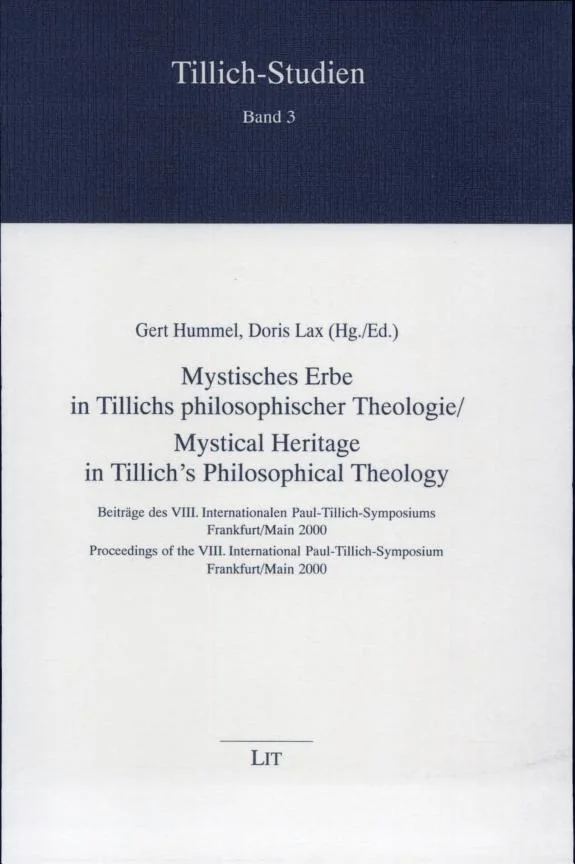
Mystical heritage in Tillich's philosophical theology
 73
73

Mystical heritage in Tillich's philosophical theology
Gert Hummel and Doris Lax's analysis of Paul Tillich's philosophical theology offers a compelling argument for the mystical underpinnings of his system. The strength of the work lies in its meticulous tracing of Tillich's engagement with concepts that echo esoteric traditions, particularly his "Ground of Being." However, the book's density can be a significant hurdle; it assumes a high degree of familiarity with Tillich's oeuvre, making it less accessible to those new to his thought. A particularly insightful passage is the exploration of how Tillich’s "courage to be" can be understood as a spiritual discipline akin to those found in contemplative traditions, offering a fresh perspective on his existential theology. While academically rigorous, the prose occasionally suffers from academic jargon, which, at times, obscures the very mystical connections it seeks to illuminate. It is a valuable, albeit demanding, contribution to Tillich scholarship, particularly for its esoteric lens.
📝 Description
73
Gert Hummel and Doris Lax's 2000 book examines how Paul Tillich's philosophy incorporated mystical traditions.
Published in 2000, Gert Hummel and Doris Lax's work analyzes the integration of mystical concepts within Paul Tillich's philosophical theology. The authors detail how Tillich's ideas on faith, reason, and existence were shaped by and, in turn, shaped a line of spiritual and philosophical thought that extends beyond traditional theological boundaries. This study positions Tillich as a thinker deeply concerned with enduring philosophical questions about the divine, existence, and meaning, drawing links to historical esoteric currents.
The book is written for scholars and advanced students in theology, philosophy, and religious studies who have a solid grasp of Tillich's main writings. It will be of particular interest to those studying the connections between systematic theology and broader philosophical traditions like existentialism and mysticism. Readers interested in the less apparent influences on 20th-century theological thought will find this analysis valuable. It is suited for academics or dedicated independent researchers focused on tracing intellectual histories.
The book situates Paul Tillich's thought within a context that includes thinkers like Carl Jung, who investigated archetypal psychology and its link to spiritual experience. Hummel and Lax connect Tillich's 'Ground of Being' concept to wider metaphysical discussions that were active in the late 20th century. This approach acknowledges a stream of thought that often considers spiritual dimensions within secular culture, engaging with ideas that bridge philosophy, religion, and psychology.
💡 Why Read This Book?
• Gain a nuanced understanding of Paul Tillich's "Ground of Being" by exploring its connections to perennial mystical concepts, moving beyond standard theological interpretations. • Discover how Tillich's "courage to be" is reframed as a spiritual discipline, offering practical insights into confronting existential anxieties through a lens informed by contemplative traditions. • Appreciate the symbolic language Tillich employed to mediate the divine, learning to recognize esoteric resonances in his philosophical theology and its impact on 20th-century thought.
⭐ Reader Reviews
Honest opinions from readers who have explored this book.
❓ Frequently Asked Questions
What is the primary focus of Hummel and Lax's book on Paul Tillich?
The book's primary focus is to examine the mystical and esoteric dimensions within Paul Tillich's philosophical theology, arguing that his concepts are deeply informed by, and resonate with, perennial spiritual traditions.
When was 'Mystical Heritage in Tillich's Philosophical Theology' first published?
The work was first published in the year 2000, placing its analysis within the academic discourse of the late 20th and early 21st centuries.
How does the book connect Tillich's ideas to esoteric traditions?
It connects Tillich's concepts like the "Ground of Being" and "the courage to be" to mystical and esoteric notions of ultimate reality, spiritual fortitude, and symbolic mediation of the divine.
Is this book suitable for beginners in Tillich studies?
No, the book is quite dense and assumes a significant prior knowledge of Paul Tillich's works and philosophical theology, making it more appropriate for advanced students and scholars.
What is the 'Ground of Being' in Tillich's philosophy as discussed in the book?
The 'Ground of Being' is presented as Tillich's concept for an ultimate reality that underpins existence, often discussed in terms that align with mystical philosophies' descriptions of the divine or absolute.
Who are the authors of 'Mystical Heritage in Tillich's Philosophical Theology'?
The authors are Gert Hummel and Doris Lax, who collaborated on this study of Paul Tillich's theological and philosophical contributions.
🔮 Key Themes & Symbolism
The Ground of Being
This theme explores Tillich's concept of the "Ground of Being" as a metaphysical absolute that precedes existence, functioning as the ultimate source and depth of reality. Hummel and Lax argue that this concept draws parallels with mystical traditions that speak of an ineffable, foundational divine presence, transcending anthropomorphic deities. The work examines how Tillich uses this concept to address existential anxiety and the search for meaning, positioning it as a bridge between philosophy and spiritual experience, distinct from traditional theological doctrines.
The Courage to Be
The analysis examines Tillich's existential concept of "the courage to be," interpreting it not merely as psychological resilience but as a spiritual discipline. This theme highlights how confronting finitude, meaninglessness, and guilt requires a profound inner stance that the book links to the fortitude cultivated in contemplative and mystical practices. It suggests that embracing one's existence fully, despite its inherent limitations, is a form of spiritual engagement that speaks to the self-transcendence sought in esoteric paths.
Symbolism and Ultimate Concern
This theme focuses on Tillich's emphasis on "ultimate concern" as the core of religious experience and his view of symbols as essential mediators of the divine. Hummel and Lax demonstrate how Tillich’s understanding of symbols goes beyond mere representation; they are seen as participating in the reality they signify, a perspective common in esoteric thought. The book examines how these symbols, for Tillich, allow access to the "Ground of Being" and are crucial for expressing the inexpressible in the religious life, connecting his systematic theology to a more intuitive and experiential spirituality.
Integration of Philosophy and Mysticism
The overarching theme is the successful integration of philosophical inquiry with mystical intuition within Tillich's work. The authors map how Tillich synthesizes existential philosophy, classical theology, and elements that echo esoteric traditions to create a comprehensive theological system. This integration aims to provide a framework for understanding contemporary spiritual quests and the perennial human search for meaning in a complex world, showing how Tillich’s thought offers a language for both intellectual and deeply felt spiritual engagement.
💬 Memorable Quotes
Direct passages from the work, attributed to the author.
“Tillich’s 'Ground of Being' functions as a concept that bridges ontology and theology, resonating with mystical notions of an ultimate reality.”
— This highlights the book's central thesis: that Tillich's most fundamental concept for God is not a personal deity but an ineffable, foundational reality akin to what mystics describe.
“The 'courage to be' is presented as a spiritual discipline for confronting finitude and meaninglessness.”
— This interpretation reframes Tillich's existentialist idea as an active, inner practice of spiritual fortitude, drawing parallels to the resilience found in contemplative traditions.
“Symbols are crucial for Tillich in mediating the divine and accessing the 'Ground of Being'.”
— This emphasizes Tillich's view of symbolic language as a conduit to ultimate reality, a perspective that aligns with the symbolic methodologies found in various esoteric traditions.
“The work scrutinizes the integration of mystical and theological concepts within Tillich's philosophical framework.”
— This statement expresses the book's analytical approach, focusing on how Tillich's systematic theology is interwoven with spiritual and metaphysical ideas that transcend conventional religious boundaries.
“Tillich's thought engages with perennial philosophical questions concerning the divine, existence, and meaning.”
— This suggests that Tillich's work addresses fundamental human inquiries that have been explored across cultures and epochs, placing his theological contributions within a broader, timeless philosophical context.
🌙 Esoteric Significance
Tradition
This work situates Paul Tillich's philosophical theology within the broader currents of Western esotericism, particularly its mystical and Gnostic-adjacent impulses. It suggests that Tillich’s core concepts, such as the "Ground of Being" and "the courage to be," can be understood as modern articulations of perennial wisdom found in traditions emphasizing direct, unmediated experience of the divine. While not explicitly aligning Tillich with a single esoteric school, the analysis highlights how his thought offers a philosophical language for exploring spiritual realities that often lie beyond conventional dogma, resonating with Hermetic and Neoplatonic underpinnings.
Symbolism
The book identifies the "Ground of Being" as a key symbol, representing an ultimate, ineffable reality that is the source of all existence, mirroring symbolic concepts of the Absolute or Ein Sof in Kabbalah. "The courage to be" functions symbolically as the human capacity to affirm existence amidst existential threat, akin to the spiritual warrior's resolve in esoteric disciplines. Tillich’s emphasis on "ultimate concern" also operates symbolically, pointing towards the individual's deepest engagement with the sacred, a core tenet in mystical paths focused on devotion and inner transformation.
Modern Relevance
Contemporary thinkers and practitioners in fields like depth psychology, existential spirituality, and comparative mysticism find Tillich's work, as illuminated by Hummel and Lax, highly relevant. His conceptual framework provides philosophical grounding for exploring the spiritual dimensions of human experience, offering a bridge between academic theology and the lived spiritual quests of individuals seeking meaning beyond traditional religious structures. His ideas continue to inform discussions on the nature of faith, the confrontation with nihilism, and the search for authentic existence in a secularized world.
👥 Who Should Read This Book
• Advanced students and scholars of Paul Tillich and theological philosophy seeking to understand the esoteric influences and mystical resonances within his work. • Researchers in comparative religion and Western esotericism interested in how 20th-century theologians engaged with perennial philosophical and spiritual concepts. • Individuals exploring existential spirituality and the philosophical underpinnings of confronting meaninglessness, who will find Tillich's concepts, re-examined through a mystical lens, particularly insightful.
📜 Historical Context
Published in 2000, Gert Hummel and Doris Lax's 'Mystical Heritage in Tillich's Philosophical Theology' emerged in a period of renewed academic interest in the spiritual dimensions of 20th-century thought. Following Paul Tillich's death in 1965, scholars continued to interpret his vast body of work, with a growing awareness of influences beyond mainstream Protestant theology. This era saw thinkers like Carl Jung exploring the psychology of religion and the collective unconscious, a parallel interest in the non-rational aspects of human experience that Hummel and Lax leverage. The book engages with Tillich's concepts amidst a philosophical landscape where existentialism, phenomenology, and burgeoning comparative religion studies were prominent. By highlighting Tillich's engagement with mystical thought, the authors position him in dialogue with, rather than opposition to, traditions that emphasize direct spiritual experience, offering a counterpoint to purely rationalist interpretations prevalent in some theological circles of the time.
📔 Journal Prompts
The "Ground of Being" as an ineffable reality: what personal experiences align with this concept?
Reflect on the existential challenges Tillich identifies and how "the courage to be" might manifest in your life.
How do symbols mediate spiritual understanding for you, echoing Tillich's "ultimate concern"?
Tillich's integration of philosophy and theology: what parallels exist in your own intellectual or spiritual journey?
Consider the "mystical heritage" in your understanding of faith beyond dogma.
🗂️ Glossary
Ground of Being
Paul Tillich's concept for the ultimate reality that underlies and sustains all existence, often understood as the divine depth and power of reality, transcending conceptualization.
Courage to Be
Tillich's existential concept describing the human capacity to affirm one's existence and meaning in the face of finitude, guilt, and the threat of meaninglessness.
Ultimate Concern
For Tillich, the essence of religion; that which is of ultimate concern to an individual or group, demanding ultimate commitment and expressing the ultimate nature of reality.
Philosophical Theology
A branch of theology that engages with philosophical methods and concepts to explore religious doctrines, questions of God, and the nature of faith and existence.
Ontology
The branch of metaphysics dealing with the nature of being, existence, or reality.
Existentialism
A philosophical movement emphasizing individual existence, freedom, and choice, often focusing on the human condition, anxiety, and the search for meaning.
Symbol
In Tillich's thought, a symbol participates in the reality it represents, unlike a sign, and is crucial for expressing the inexpressible, particularly concerning the divine.
This book appears in 1 collection
🔮 Readers Also Liked
Browse all →






From the “Mystical Theology” Collection
View all →



More Free Mysticism & Contemplation Books
View all →






![Science Without Bounds [A Synthesis Of Science, Religion And Mysticism].pdf (PDFy mirror)](/img/thumb/science-without-bounds-a-synthesis-of-science-religion-and-mysticism-pdf-pdfy-mirror.webp)