Modern Occultism in Late Imperial Russia
 73
73

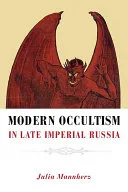
Modern Occultism in Late Imperial Russia
Julia Mannherz’s exploration of occultism in late Imperial Russia offers a necessary corrective to studies that confine esoteric movements to niche intellectual circles. The strength of this work lies in its detailed examination of how occult ideas seeped into broader Russian society, appearing in popular journals and influencing public discourse. Mannherz compellingly describes the 1870s debates on higher mathematics and séance phenomena, demonstrating a society actively engaging with both the rational and the spectral. A limitation, however, is the book's occasional density; while lucid, the academic rigor sometimes makes for a less accessible read for the casual enthusiast. The section on haunted houses, which bridges rural folklore and urban anxieties, is particularly insightful, revealing the deep-seated psychological currents at play. "Modern Occultism in Late Imperial Russia" is a vital scholarly contribution to understanding a complex cultural moment.
📝 Description
73
Julia Mannherz's 2015 study traces occultism's spread in late Imperial Russia.
Julia Mannherz's book examines the growth of esoteric thought and practice in the Russian Empire during its final decades. It shows how these ideas moved beyond small groups to influence popular culture, appearing in private gatherings and cheap magazines. The study highlights public debates in the 1870s about advanced mathematics and spiritualism, illustrating a society trying to understand both scientific and supernatural possibilities.
The book is set during a turbulent time in late Imperial Russia, a period of fast industrialization, social tension, and intellectual change. Occultism grew as traditional religion weakened and new scientific ideas emerged. This era saw widespread interest in spiritualism, psychic research, and mystical traditions, often discussed publicly and even in academic settings. Russian thinkers also developed their own versions of Western esoteric ideas.
Mannherz looks at how intellectual discussions and popular occultism mixed. She analyzes concepts like theosophy, spiritualism, mesmerism, and divination, not as separate beliefs but as connected parts of the cultural environment. The work investigates how these ideas showed up in literature, art, and daily life, reflecting a society seeking meaning amid significant social and political shifts.
This book places itself within the history of Western esotericism's global spread in the late 19th and early 20th centuries. It focuses on how movements like spiritualism, theosophy, and mesmerism took root in a specific national context, Imperial Russia. The work investigates the unique ways Russian society engaged with these currents, blending them with local intellectual and social conditions. It examines how esoteric ideas interacted with contemporary scientific thought and religious questioning during a period of intense societal change.
💡 Why Read This Book?
• Gain a nuanced understanding of how occultism became a significant cultural force in late Imperial Russia, moving beyond private salons to mass media, as detailed in the examination of popular occult journals. • Discover the specific intellectual and social debates of the 1870s concerning higher dimensional mathematics and séance phenomena, providing concrete historical examples of societal engagement with the esoteric. • Explore the connections between rural folklore and urban anxieties through the analysis of haunted houses, revealing how these narratives reflected societal unease in the period.
⭐ Reader Reviews
Honest opinions from readers who have explored this book.
❓ Frequently Asked Questions
What specific occult practices are discussed in "Modern Occultism in Late Imperial Russia"?
The book examines a range of practices including spiritualism, mesmerism, divination, and theosophy. It details their presence in both private intellectual circles and public mass culture, referencing phenomena like séances and instruction manuals.
When did occultism gain traction in Russia according to Mannherz?
Julia Mannherz focuses on the late Imperial period, particularly the 1870s onwards, highlighting the fervent public debates and the subsequent popularization of occult ideas through journals and mass culture.
What was the relationship between science and occultism in late Imperial Russia?
The book illustrates a complex relationship, with public debates in the 1870s grappling with both higher dimensional mathematics and spiritualist phenomena, indicating an era where scientific advancement and esoteric beliefs were often discussed in tandem.
Does the book discuss specific occult organizations or figures?
Yes, it touches upon the influence of movements like Theosophy and their presence in Russia. While not solely focused on biography, it contextualizes the broader appeal of such ideas and their proponents.
How did occultism spread beyond intellectual elites in Russia?
Mannherz shows its dissemination through cheap instruction manuals and popular occult journals, demonstrating a shift from private salons to more accessible forms of mass culture by the turn of the century.
What is the historical significance of studying occultism in this period?
It provides insight into the cultural and intellectual landscape of a society undergoing rapid change, revealing how esoteric beliefs offered alternative frameworks for understanding the world amidst scientific progress and social upheaval.
🔮 Key Themes & Symbolism
Occultism and Mass Culture
This theme explores how esoteric ideas transitioned from exclusive salons to widespread popular consumption. Mannherz details the role of cheap instruction manuals and prolific occult journals in disseminating spiritualist and theosophical concepts to a broader audience. This shift democratized access to occult knowledge, making it a recognizable, albeit often sensationalized, element of everyday life in late Imperial Russia, reflecting a society eager for alternative explanations and experiences.
Science Meets the Supernatural
The work investigates the fervent public debates of the 1870s, where cutting-edge scientific concepts like higher dimensional mathematics were discussed alongside the purported realities of séance phenomena. This highlights a cultural moment where the boundaries between empirical science and the paranormal were actively being explored and contested. Mannherz shows how these discussions reflected a society grappling with new understandings of reality and the limits of human knowledge.
Rural Folklore and Urban Anxieties
A fascinating aspect explored is the role of haunted houses, which served as a cultural nexus connecting traditional rural beliefs with the burgeoning anxieties of urban life. These narratives provided a framework for understanding the unknown and the unsettling aspects of modernization. By examining these localized manifestations of the uncanny, the book reveals deeper psychological currents and societal unease present in late Imperial Russia.
Theosophy's Russian Embrace
The book addresses the significant impact of Theosophy, a major esoteric movement founded by Helena Blavatsky. It examines how Blavatsky's teachings, with their blend of Eastern mysticism and Western occultism, found fertile ground in Russia. Theosophy’s appeal lay in its comprehensive worldview, offering spiritual evolution and esoteric knowledge to those seeking alternatives to both traditional religion and materialistic science.
💬 Memorable Quotes
Direct passages from the work, attributed to the author.
“The world of cheap instruction manuals and popular occult journals.”
— This highlights the democratization of esoteric knowledge, showing how occultism moved from elite circles to become accessible through mass-produced literature, reflecting its integration into everyday culture and the public's growing interest.
“Haunted houses, which brought together the rural settings and the urban anxieties.”
— This points to the symbolic power of the uncanny in bridging geographical and psychological divides, demonstrating how folklore and spectral narratives served to articulate the unsettling feelings associated with Russia's rapid modernization and urbanization.
“The history of occult thought and practice from its origins in private salons to its popularity in turn-of-the-century mass culture.”
— This statement frames the book's central narrative arc, charting the evolution of esoteric ideas from exclusive gatherings to widespread cultural phenomena, indicating a significant shift in their social and intellectual standing.
“Lucid prose examining the intricate range of Russian spiritualism.”
— This emphasizes the author's clear and scholarly approach to a complex subject, suggesting that the book offers an accessible yet rigorous analysis of spiritualist movements within their specific historical and cultural context.
💡 Key Ideas
Editorial paraphrase of the work's core concepts — not direct quotes.
The ferocious public debates of the 1870s on higher dimensional mathematics and the workings of séance phenomena.
This passage captures the era's intellectual dynamism, where abstract scientific theories and direct experiences of the supernatural were subjects of intense public scrutiny and discussion, revealing a society actively engaging with the frontiers of knowledge.
🌙 Esoteric Significance
Tradition
This work primarily engages with the Western Esoteric Tradition, particularly its manifestations in spiritualism and theosophy, as they took root in a non-Western cultural context. While drawing from Hermetic, Gnostic, and Kabbalistic ideas common in Western esotericism, Mannherz focuses on how these were adapted and reinterpreted within Russia. It examines how Russian intellectuals and the public synthesized these imported esoteric streams with local philosophical and religious sensibilities, creating a unique syncretic landscape.
Symbolism
The book implicitly engages with symbolism through its discussion of phenomena like séances and haunted houses. Séances, for instance, often involved symbolic rituals or communication with unseen entities, representing a desire to breach the veil between the material and spiritual worlds. Haunted houses, as discussed, serve as potent symbols of historical trauma, unresolved tensions, and the lingering presence of the past—both personal and collective—within the physical environment.
Modern Relevance
Contemporary interest in the history of esotericism, comparative religion, and cultural studies continues to draw upon detailed regional studies like Mannherz's. Scholars examining the global spread of occult movements, the intersection of belief systems in times of societal change, and the psychological underpinnings of spiritual seeking find this work invaluable. It informs current discussions on how alternative belief systems provide meaning and structure in periods of rapid transformation, a phenomenon relevant to many contemporary societies.
👥 Who Should Read This Book
• Academic researchers in Russian history, cultural studies, and the history of esotericism: They will find detailed primary source analysis and a nuanced contextualization of occult movements within the late Imperial period. • Students of comparative religion and global occultism: This book offers a case study on how Western esoteric traditions were adapted and popularized in a specific national context, moving beyond Eurocentric analyses. • Readers interested in the intellectual and cultural history of the late 19th and early 20th centuries: Anyone seeking to understand the complex interplay of science, spirituality, and societal change during a period of profound transformation will find this work useful.
📜 Historical Context
Julia Mannherz's study is set against the tumultuous backdrop of late Imperial Russia, a period from roughly the 1870s to 1917 characterized by rapid industrialization, social upheaval, and intense intellectual debate. Against a backdrop of waning religious authority and the rise of scientific positivism, various forms of occultism—spiritualism, theosophy, and esoteric philosophy—gained significant traction. These movements offered alternative frameworks for understanding existence, often engaging directly with scientific discourse, as seen in the 1870s debates Mannherz highlights. While competing schools of thought like Marxism gained political momentum, occultism carved out a substantial cultural niche. The reception of these ideas was varied, with some intellectuals embracing them and others, like Leo Tolstoy, engaging critically with spiritualist phenomena. The work illuminates how these esoteric currents were not marginal but deeply interwoven into the fabric of Russian society and culture during this central era.
📔 Journal Prompts
The transition of occultism from private salons to mass culture.
The intersection of higher dimensional mathematics and séance phenomena in 1870s Russia.
The symbolic role of haunted houses in bridging rural and urban anxieties.
The specific appeal of Theosophy within the Russian context.
The relationship between scientific discourse and esoteric beliefs during the late Imperial period.
🗂️ Glossary
Spiritualism
A belief system centered on the idea that the spirits of the dead can communicate with the living, often through mediums. It gained widespread popularity in the 19th century and was a significant component of occult interest in late Imperial Russia.
Theosophy
An esoteric philosophical movement founded by Helena Blavatsky, combining elements of Eastern mysticism, Western occultism, and Gnosticism. It posits a universal spiritual wisdom and a path of spiritual evolution accessible through esoteric knowledge.
Séance
A meeting at which people attempt to make contact with the spirit world, typically through a medium. Séances were a popular form of spiritualist practice in the period studied.
Mesmerism
A pseudoscientific theory of a 'vital magnetic fluid' that could be transferred from one person to another, leading to a trance-like state. It was an early precursor to modern hypnosis and a popular occult phenomenon.
Higher Dimensional Mathematics
Mathematical concepts dealing with spaces having more than three dimensions. In the context of the 1870s debates, these abstract ideas were sometimes linked to esoteric or spiritualist notions of unseen realities.
Esotericism
Belief systems, practices, and teachings that are concerned with the hidden, inner, or secret aspects of reality, often involving mystical or occult knowledge not readily available to the general public.
Late Imperial Russia
The historical period referring to the Russian Empire from the 1870s up to the revolutions of 1917. It was a time of significant social, political, and cultural change, marked by industrialization and intellectual ferment.