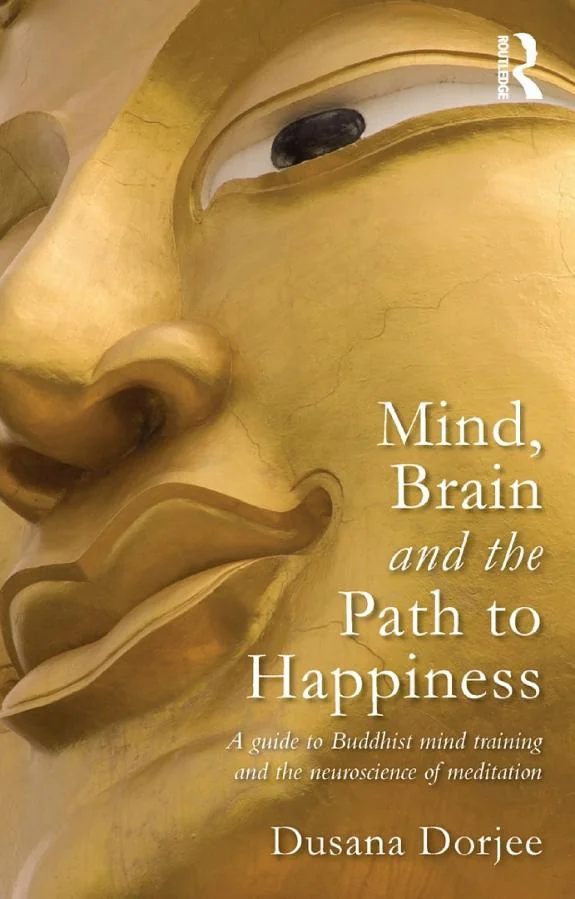
Mind, Brain and the Path to Happiness
 80
80

Mind, Brain and the Path to Happiness
Dusana Dorjee’s "Mind, Brain and the Path to Happiness" presents a compelling synthesis of Buddhist contemplative science and contemporary neuroscience. The book’s strength lies in its clear articulation of the Dzogchen path, demystifying advanced concepts for a modern audience without sacrificing their depth. Dorjee adeptly explains how specific meditative practices, grounded in Tibetan Buddhism, can correlate with observable changes in brain function and psychological states. A particularly insightful passage details the stages of developing equanimity, linking it to the prefrontal cortex's role in emotional regulation. However, the work occasionally feels overly technical for the absolute beginner in either meditation or neuroscience, requiring a certain baseline familiarity. Despite this, it offers a meticulously researched and practically oriented guide for serious practitioners. It is a valuable contribution to understanding the mind's capacity for transformation.
📝 Description
80
Dusana Dorjee's 2013 book connects Buddhist mind training with neuroscience.
Mind, Brain and the Path to Happiness examines Buddhist methods for training the mind, drawing specifically from the Dzogchen tradition. The book connects these ancient contemplative practices with current scientific understanding in psychology and neuroscience. It details practical steps for altering one's mind and brain to achieve lasting balance, well-being, and genuine happiness.
This work is for anyone interested in how contemplative traditions and modern science intersect, especially those looking for practical applications of Buddhist psychology for personal growth. It will appeal to meditation practitioners, students of consciousness, and those curious about the scientific basis for happiness and mental wellness. The book was published in 2013, during a time of increasing scientific inquiry into meditation's effects on the brain. Dorjee's research is situated within this trend, referencing Tibetan Buddhist lineages and their advanced mental cultivation techniques. It responds to a growing need for scientifically supported approaches to mental flourishing.
The book situates itself within Tibetan Buddhism, particularly the Dzogchen tradition. Dzogchen, meaning 'Great Perfection,' is a lineage focused on direct introduction to the nature of mind and spontaneous realization. It emphasizes recognizing one's innate awareness and cultivating it through specific contemplative practices. Dorjee's work translates these sophisticated techniques into language understandable within contemporary scientific frameworks, showing how they can lead to measurable changes in the brain and mind.
💡 Why Read This Book?
• Learn how the specific practices of the Dzogchen tradition, as outlined by Dorjee, can be understood through the lens of 2013 neuroscience research, offering a unique empirical perspective on ancient mind training. • Gain actionable techniques for cultivating genuine happiness and mental balance, moving beyond superficial contentment to achieve deeper states of well-being informed by psychological studies. • Understand the neurobiological underpinnings of Buddhist meditation, connecting the concept of mind-brain transformation to concrete psychological and neurological outcomes.
⭐ Reader Reviews
Honest opinions from readers who have explored this book.
❓ Frequently Asked Questions
What is the primary Buddhist tradition discussed in Mind, Brain and the Path to Happiness?
The book centers on the Tibetan Buddhist tradition of Dzogchen. It explores its sophisticated methods for mind training and mental transformation, linking these practices to modern psychological and neuroscientific research published around 2013.
How does the book connect meditation to neuroscience?
Dusana Dorjee explains how long-term meditation, particularly from the Dzogchen lineage, can induce neuroplastic changes. The book discusses how these practices correlate with improvements in emotional regulation, cognitive function, and overall well-being, supported by contemporary psychology.
Is this book suitable for beginners in meditation?
While it offers practical guidance, the book delves into advanced concepts of Buddhist mind training and links them with scientific research. It may be best suited for those with some existing interest or practice in meditation or psychology.
What is the main goal of the mind training described?
The core objective is to guide practitioners through gradual steps of mental and brain transformation. The ultimate aim is to achieve advanced states of balance, genuine happiness, and profound well-being, moving beyond transient states.
Who is Dusana Dorjee?
Dusana Dorjee is an author and researcher who has studied extensively in both Buddhist contemplative traditions and contemporary psychology. Her work aims to bridge these fields, as demonstrated in her 2013 publication.
What does the book say about achieving happiness?
It presents happiness not as a fleeting emotion but as a stable state cultivated through consistent mind training. The book details how understanding and working with the mind and brain, guided by Dzogchen principles, leads to lasting well-being.
🔮 Key Themes & Symbolism
Dzogchen Mind Training
The book elucidates the profound techniques of Dzogchen, a prominent lineage within Tibetan Buddhism, focusing on direct recognition of awareness. It details how these ancient practices are not merely spiritual exercises but potent methods for reshaping the practitioner's mind and brain, leading to stable states of consciousness and genuine happiness.
Neuroscience of Meditation
Mind, Brain and the Path to Happiness integrates findings from contemporary psychology and neuroscience, particularly research from around 2013. It explores how meditation affects brain structures and functions, offering a scientific validation for the efficacy of contemplative practices in fostering well-being and emotional resilience.
Path to Lasting Happiness
This theme addresses the pursuit of genuine and enduring happiness, distinguishing it from fleeting pleasures. The book posits that through systematic transformation of the mind and brain, guided by both esoteric traditions and scientific understanding, individuals can cultivate a profound and stable sense of contentment and peace.
Gradual Transformation
Central to the book's methodology is the concept of gradual transformation. It outlines a step-by-step approach, rooted in the Dzogchen tradition, for practitioners to progressively alter their mental habits and cognitive patterns. This systematic process is presented as the key to unlocking advanced states of mental balance and well-being.
💬 Memorable Quotes
Direct passages from the work, attributed to the author.
“The transformation of the practitioner’s mind and brain on the path to advanced states of balance, genuine happiness and wellbeing.”
— This statement expresses the book's core thesis: that deliberate mental training, particularly within the Dzogchen framework, leads to tangible changes in both psychological experience and neurological function, culminating in profound well-being.
“Following the Tibetan Buddhist tradition of Dzogchen, the book guides the reader through the gradual steps in transformation.”
— This highlights the specific lineage and methodological approach employed. It emphasizes that the path is structured and progressive, offering a clear roadmap for readers interested in applying these ancient techniques.
“The pursuit of wellbeing and happiness in the context of the latest research in psychology and the neuroscience of meditation.”
— This signifies the book's unique position at the intersection of ancient wisdom and modern science. It promises an exploration of happiness that is informed by both contemplative insights and empirical scientific findings, as understood in 2013.
“Presents a contemporary account of traditional Buddhist mind training.”
— This suggests the book aims to make ancient Buddhist contemplative methods accessible and relevant to a modern audience. It implies a careful explanation of traditional practices within current cultural and intellectual frameworks.
“Explains the practitioner’s mind and brain on the path to advanced states of balance, genuine happiness and wellbeing.”
— This points to the practical, results-oriented nature of the book. It focuses on the *how* – the mechanisms and processes through which mental training leads to concrete improvements in one's state of being.
🌙 Esoteric Significance
Tradition
The work aligns with the Dzogchen lineage within Tibetan Buddhism, a tradition focused on the direct recognition of primordial awareness. While not strictly Western esotericism, Dzogchen represents a profound system of contemplative science and mind training. Dorjee's approach bridges this esoteric lineage with contemporary scientific discourse, framing its advanced practices within the language of psychology and neuroscience.
Symbolism
While the book's primary focus is on direct experiential practice and scientific correlation, the Dzogchen tradition itself is rich with symbolism related to primordial purity, natural liberation, and the nature of mind. Concepts like 'rigpa' (pure awareness) function symbolically, representing an unconditioned state beyond conceptual elaboration, accessible through specific contemplative techniques.
Modern Relevance
Contemporary thinkers and practitioners in fields like contemplative neuroscience, positive psychology, and secular mindfulness continue to explore the integration of Buddhist contemplative methods. Works like Dorjee's are crucial for informing modern approaches to mental health, well-being, and consciousness studies, demonstrating the enduring relevance of ancient mind-training systems.
👥 Who Should Read This Book
• Practitioners of meditation seeking to deepen their understanding of the mind-brain connection, particularly those interested in Tibetan Buddhist traditions like Dzogchen. • Students of psychology and neuroscience interested in the empirical research surrounding meditation and its impact on well-being, especially research published around 2013. • Individuals on a personal development path looking for structured, contemplative methods to cultivate lasting happiness and mental balance, grounded in both ancient wisdom and modern science.
📜 Historical Context
Published in 2013, Dusana Dorjee's "Mind, Brain and the Path to Happiness" emerged during a significant period of increased scientific scrutiny and popular interest in the effects of meditation. This era saw a surge in neuroscientific studies investigating contemplative practices, building on earlier work by figures like Herbert Benson in the 1970s and Jon Kabat-Zinn's Mindfulness-Based Stress Reduction (MBSR) program. The book’s focus on Dzogchen, a specific and advanced tradition within Tibetan Buddhism, positioned it within a niche yet growing field that sought to bridge Eastern contemplative philosophies with Western scientific paradigms. Contemporaries like Richard Davidson were publishing influential research on meditation's impact on the brain during this time, creating an intellectual climate ripe for works that integrated these perspectives. Dorjee's contribution was timely, offering a detailed account of these practices within the context of the latest psychological and neurological understandings available then.
📔 Journal Prompts
Reflections on the nature of 'genuine happiness' as distinct from fleeting pleasure.
Mapping the gradual steps of transformation described in the Dzogchen framework.
Consider the neuroscientific implications of sustained meditative practice.
Exploring the concept of balance in relation to mental states.
Personal insights on the integration of mind training and daily life.
🗂️ Glossary
Dzogchen
A highly advanced tradition within Tibetan Buddhism, focusing on the direct recognition of the primordial nature of mind, often translated as 'Great Perfection' or 'Great Completeness'.
Neuroplasticity
The brain's ability to reorganize itself by forming new neural connections throughout life. This is crucial for understanding how practices like meditation can alter brain structure and function.
Wellbeing
A state of being healthy, happy, and comfortable. In the context of the book, it refers to a deep, stable sense of contentment and mental flourishing beyond mere absence of distress.
Contemplative Practices
Mental exercises, often rooted in religious or spiritual traditions, designed to cultivate specific states of awareness, insight, or emotional balance, such as meditation.
Mind Training
Systematic techniques aimed at developing greater control, clarity, and positive qualities of the mind, often involving discipline, focus, and insight cultivation.
Equanimity
A state of mental calmness and composure, especially in difficult situations. It involves an unbiased and balanced perspective, free from emotional reactivity.
Psychology
The scientific study of the mind and behavior. The book draws on psychological research to support its exploration of happiness and mental transformation.
This book appears in 1 collection
🔮 Readers Also Liked
Browse all →









From the “Dream Yoga” Collection
View all →









More Free Occult Philosophy Books
View all →