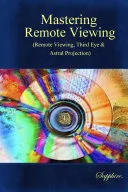
Mastering Remote Viewing:(Remote Viewing,Third Eye & Astral Projection)
 83
83

Mastering Remote Viewing:(Remote Viewing,Third Eye & Astral Projection)
Sapphire’s *Mastering Remote Viewing* attempts to demystify abilities often shrouded in esotericism. The author’s approach is commendably direct, focusing on actionable steps rather than philosophical meandering. The section detailing protocols for remote viewing, particularly the emphasis on sensory feedback and blind analysis, offers a structured framework that distinguishes it from more nebulous guides. However, the book sometimes oversimplifies the challenges inherent in developing these skills, occasionally presenting rapid mastery as a more common outcome than is realistic for most practitioners. The integration of "third eye" activation and astral projection alongside remote viewing feels somewhat compartmentalized; a more unified theoretical underpinning could have strengthened the overall coherence. Despite this, the practical exercises, especially those concerning the initial stages of psychic impression gathering, provide a solid starting point for the dedicated student. It serves as a functional primer, if not a definitive treatise.
📝 Description
83
Sapphire's 2004 book presents actionable techniques for developing psychic perception.
Mastering Remote Viewing offers practical methods for developing psychic abilities and expanding consciousness. The author, Sapphire, moves past theory to provide concrete exercises. The book teaches readers to access information beyond normal senses, framing these skills as cultivable human potentials rather than supernatural gifts. It connects the mind, consciousness, and subtle universal energies.
This guide is for individuals curious about consciousness limits and perception. It suits those interested in parapsychology, precognition, or out-of-body experiences. Aspiring psychics, spiritual seekers, and anyone questioning reality beyond the physical will find it useful. The book requires a commitment to disciplined practice and an openness to non-physical realities.
Sapphire's work draws on centuries of esoteric traditions concerning phenomena like remote viewing and astral projection. While focusing on contemporary applications, the book connects to a lineage of practices found in various mystical orders. It also touches upon the mid-20th century's increased interest in parapsychology, including government research. This book contributes to that ongoing discussion by offering personal development approaches to abilities studied academically and popularly.
💡 Why Read This Book?
• Learn specific protocols for remote viewing, including techniques for target acquisition and data recording, as detailed in the book's practical exercises, to develop verifiable psychic perception. • Understand the mechanics and common experiences of astral projection, as described in Sapphire's guide, to gain insight into controlled out-of-body states. • Explore methods for "third eye" activation, focusing on visualization and energy manipulation techniques presented in the book, to enhance intuition and psychic awareness.
⭐ Reader Reviews
Honest opinions from readers who have explored this book.
❓ Frequently Asked Questions
What is the primary goal of the techniques taught in Mastering Remote Viewing?
The primary goal is to develop and control psychic perception, enabling the reader to access information beyond the normal five senses through practices like remote viewing and astral projection.
Does the book explain how to activate the 'third eye'?
Yes, the book provides specific exercises and visualization techniques aimed at opening and utilizing the 'third eye' for enhanced intuition and psychic awareness.
Are the remote viewing methods described scientifically validated?
While the book draws from practices explored in parapsychology, including research from the 1970s, the methods are presented as esoteric potentials rather than universally scientifically proven phenomena.
Is prior experience with psychic phenomena required to read this book?
No, the book is designed for beginners and assumes no prior experience, offering step-by-step guidance for those new to remote viewing, astral projection, or third eye activation.
What is the difference between remote viewing and astral projection as presented by Sapphire?
Remote viewing focuses on perceiving distant information, while astral projection involves the consciousness temporarily leaving the physical body to travel in non-physical realms.
How does this book relate to traditional esoteric teachings?
It connects modern practices of psychic development to ancient concepts of consciousness and energy centers, such as the 'third eye,' found in various mystical traditions.
🔮 Key Themes & Symbolism
Consciousness Expansion
The book posits that human consciousness is not confined to the physical brain but can extend and interact with subtle energetic fields. It presents techniques like astral projection as methods to explore these non-physical dimensions, challenging the materialist view of consciousness. The emphasis is on the practical cultivation of these expanded states, suggesting that awareness can be trained to perceive realities beyond the ordinary sensory spectrum.
Psychic Perception Techniques
Central to the work are the detailed methodologies for remote viewing, which Sapphire describes as the ability to psychically perceive targets without conventional sensory input. This includes protocols for focusing intent, receiving impressions (visual, auditory, kinesthetic), and interpreting the data. The book treats these abilities as trainable skills, akin to learning a new language or discipline, requiring consistent practice and mental discipline.
The Third Eye
Sapphire explores the 'third eye' not merely as a metaphor but as a functional energetic center within the human subtle anatomy, often associated with intuition and psychic sight. The text provides guidance on how to awaken and utilize this energy vortex, linking its activation to enhanced clairvoyance and the ability to perceive subtle energies and non-physical realities. This concept is presented as a gateway to deeper levels of perception.
Astral Projection Mechanics
The book offers a practical framework for understanding and undertaking astral projection, defined as a controlled out-of-body experience. It addresses the process of separating consciousness from the physical form, working through the astral plane, and safely returning. The emphasis is on the intentionality and control required, distinguishing it from involuntary or uncontrolled experiences, and framing it as a tool for exploration and self-discovery.
💬 Memorable Quotes
Direct passages from the work, attributed to the author.
“The barrier to psychic perception is often internal, a construct of doubt and limiting beliefs.”
— This highlights the book's focus on overcoming mental blocks. It suggests that the primary obstacles to developing abilities like remote viewing are psychological, rather than a lack of innate capacity.
“Visualize the energy flowing through the pineal gland, the seat of inner sight.”
— This refers to the 'third eye' concept, specifically locating it within the pineal gland and suggesting a visualization practice to stimulate psychic awareness and intuition.
“Practice the separation technique nightly, focusing on detachment from the physical form.”
— This is a direct instruction for astral projection, emphasizing the need for regular practice and a mental state of detachment from the body to facilitate the out-of-body experience.
“Record all impressions, however faint, as they form the raw data of psychic information.”
— This underscores the importance of meticulous record-keeping in remote viewing, treating all sensory or intuitive inputs as potentially valid data points for analysis and interpretation.
“The astral realm mirrors the physical, yet operates on different energetic principles.”
— This statement provides a foundational understanding of the astral plane, suggesting it is a distinct reality with its own rules, accessible through practices like astral projection.
🌙 Esoteric Significance
Tradition
Sapphire's work draws from the modern esoteric synthesis, particularly influenced by Theosophy and New Age thought, which sought to integrate Eastern concepts of consciousness with Western occult traditions. It aligns with the Hermetic principle of 'As Above, So Below,' suggesting a correspondence between the macrocosm and microcosm, and the potential for humanity to influence or perceive beyond physical limitations. It departs from more rigid, ritualistic traditions by emphasizing direct, personal experience and psychological techniques.
Symbolism
The "third eye," often symbolized as an eye within a triangle or a lotus, represents heightened intuition, clairvoyance, and spiritual insight. In the context of this book, it signifies the activation of the pineal gland and the opening of a channel for psychic perception. Astral projection is symbolized by the concept of a silver cord, connecting the projected consciousness to the physical body, representing the vital link that ensures a safe return.
Modern Relevance
Contemporary practitioners of consciousness studies, lucid dreaming, and energy healing often reference or utilize techniques similar to those described by Sapphire. The book's focus on practical, self-directed development appeals to modern wellness and self-improvement movements that incorporate spiritual or metaphysical elements. Thinkers and groups exploring non-local consciousness and the frontiers of psychical research continue to find value in its structured approach to subjective experience.
👥 Who Should Read This Book
• Aspiring psychics and sensitives seeking structured techniques to develop clairvoyance and intuitive abilities, moving beyond vague concepts to concrete practice. • Explorers of consciousness interested in out-of-body experiences and astral travel, looking for practical guidance on controlled projection and navigating non-physical realms. • Students of parapsychology and esoteric traditions wanting to understand the practical applications and personal development aspects of phenomena like remote viewing.
📜 Historical Context
The mid-to-late 20th century witnessed a resurgence of interest in parapsychology and esoteric practices, partly fueled by Cold War-era government research into psychic phenomena. Projects like the one at Stanford Research Institute (SRI) in California, commencing in the late 1960s and gaining prominence in the 1970s, explored remote viewing under controlled conditions. This period saw numerous books and movements emerge, attempting to codify and teach abilities like telepathy, precognition, and out-of-body experiences. Sapphire's work, while potentially written later, engages with this lineage, offering practical techniques that echo the aims of earlier researchers and practitioners. This era contrasted sharply with earlier, more purely mystical traditions, seeking to integrate esoteric concepts with empirical observation, even if such observations were unconventional. The reception was often polarized, with mainstream science largely dismissive, while esoteric communities embraced these explorations.
📔 Journal Prompts
Reflect on initial impressions received during a remote viewing practice session.
Describe the sensation of energy flow when attempting 'third eye' activation.
Document the perceived environment during a simulated astral projection exercise.
Analyze the difference between intuitive flashes and ordinary thoughts.
Consider the ethical implications of perceiving information remotely.
🗂️ Glossary
Remote Viewing
A psychic ability to perceive information about a distant or unseen target using non-sensory means. It involves focusing intent and recording impressions.
Third Eye
An esoteric concept referring to an invisible energetic center, often associated with the pineal gland, believed to grant higher perception, intuition, and psychic abilities.
Astral Projection
The intentional separation of consciousness from the physical body to travel in non-physical realms, often referred to as the astral plane.
Pineal Gland
A small endocrine gland in the brain, often linked in esoteric traditions to the 'third eye' and psychic or spiritual experiences.
Psychic Impressions
Subtle sensory or intuitive data (visual, auditory, kinesthetic, emotional) received during psychic practices like remote viewing.
Astral Plane
A non-physical dimension or field of existence believed to be accessible through altered states of consciousness, such as astral projection.
Target
In remote viewing, the specific person, place, object, or event that the viewer is attempting to perceive.