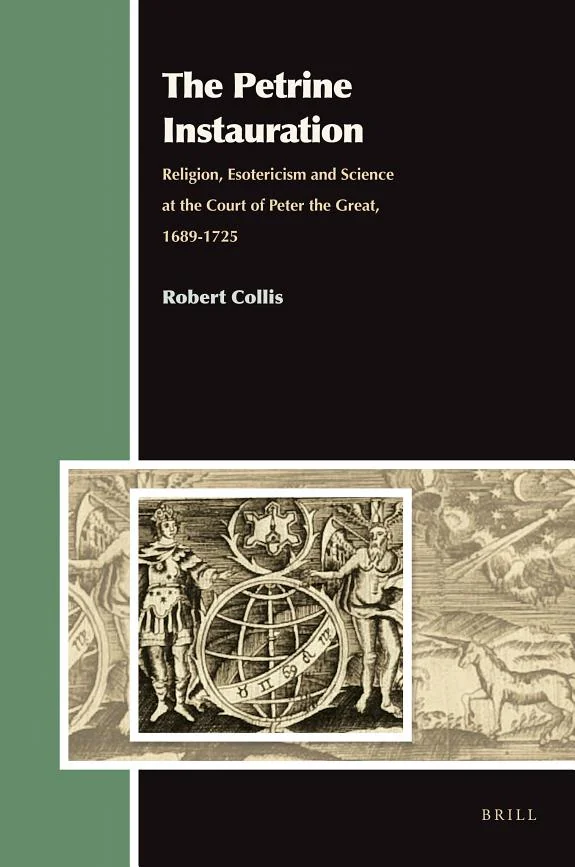
The Petrine Instauration
 79
79

The Petrine Instauration
Robert Collis’s *The Petrine Instauration* presents a compelling argument for viewing Peter the Great’s court not merely as a center of political and military power, but as a crucible for esoteric thought and millenarian prophecy. The book’s signal strength lies in its meticulous engagement with recent scholarship, particularly its integration of Western esotericism studies with the religious history of Early Modern Russia. Collis skillfully demonstrates how figures within the court potentially adopted and adapted mystical frameworks to legitimize imperial ambitions and envision a transformed Russia. A particular passage discussing the alchemical symbolism potentially employed in courtly ceremonies in the 1700s is especially illuminating. However, the dense academic prose, while precise, might present a barrier for readers less familiar with the specialized terminology of religious studies and esoteric history. The work could have benefited from a more explicit outlining of its interpretive framework early on. Despite this, *The Petrine Instauration* offers a significant and original contribution to understanding a complex historical period through a unique lens.
📝 Description
79
Robert Collis's 2019 book reinterprets Peter the Great's court through esoteric and millenarian lenses.
This 2019 study by Robert Collis offers a new view of Peter the Great's court in early 18th-century Russia. It focuses on how millenarian expectations and Western esoteric traditions influenced the court. The book moves beyond standard historical accounts to examine the intellectual and spiritual currents that shaped the Russian Empire during a time of significant reform and expansion. Collis looks at how ideas about an impending transformation manifested within Peter's court. He discusses the use of secret societies, coded language, and symbolic imagery in political and social discussions. The term 'Petrine Instauration' refers to a perceived renewal and spiritual reordering envisioned by certain court factions.
The early eighteenth century in Russia was a time of rapid Westernization and change under Peter the Great. European ideas, scientific progress, and philosophical trends entered Russia and mixed with existing traditions. Collis places Peter's court within the wider context of European intellectual history, especially the renewed interest in alchemy, Kabbalah, and prophetic ideas. This work is for academics in Western esotericism, religious studies scholars of Early Modern Europe, and researchers interested in the connections between politics, religion, and mysticism in imperial Russia. It will also interest those curious about the effect of esoteric ideas on governance and court life.
This book engages with the complex history of Western esotericism, particularly as it intersected with political and religious movements in early modern Europe. It situates the intellectual climate of Peter the Great's court within a broader resurgence of interest in subjects like alchemy, Kabbalah, and prophetic traditions. The study examines how these esoteric currents might have informed the court's perception of its own mission and the future of Russia, linking it to specific historical moments of perceived spiritual or political renewal.
💡 Why Read This Book?
• Learn how millenarian thought, a belief in impending spiritual transformation, influenced the court of Peter the Great, providing a unique lens on early 18th-century Russian statecraft. • Understand the specific ways Western esoteric traditions, such as alchemy and Kabbalah, were potentially adapted and utilized within an imperial Russian context, as detailed in the book's analysis of courtly symbolism. • Gain insight into the scholarly debates surrounding religious studies and Western esotericism, particularly how recent academic approaches reframe our understanding of historical periods like Early Modern Europe.
⭐ Reader Reviews
Honest opinions from readers who have explored this book.
❓ Frequently Asked Questions
What is the primary argument of Robert Collis's 'The Petrine Instauration'?
The book argues that Peter the Great's court in early 18th-century Russia was a significant site for the intersection of Western esoteric thought and millenarian expectations, influencing its political and spiritual direction.
What historical period does 'The Petrine Instauration' focus on?
The book centers on the early eighteenth century, specifically the reign of Peter the Great and the intellectual atmosphere within his court in Russia.
What is 'millenarian thought' as discussed in the book?
Millenarian thought refers to beliefs concerning an impending, significant transformation of society, often with religious or spiritual undertones, which the book explores in the context of Peter's court.
Which academic fields does 'The Petrine Instauration' draw upon?
It draws heavily on recent scholarship in the history of Western esotericism and religious studies, particularly concerning Early Modern Europe.
Who was Peter the Great and why is his court significant to this study?
Peter the Great (reigned 1682-1725) was a Russian Tsar who modernized Russia. His court is significant as the locus of power and intellectual exchange where the esoteric and millenarian ideas discussed in the book were potentially engaged.
What does the term 'Instauration' refer to in the book's title?
In this context, 'Instauration' likely refers to a perceived renewal or re-establishment of order, potentially with spiritual or mystical connotations, envisioned for Russia during Peter's reign.
🔮 Key Themes & Symbolism
Millenarianism in the Imperial Court
The work examines how apocalyptic and utopian expectations, central to millenarian thought, permeated the intellectual climate of Peter the Great's court. It suggests these beliefs were not merely passive reflections but actively shaped perceptions of Russia's destiny and Peter's reform agenda. The study explores how such eschatological frameworks might have been employed to legitimize radical societal changes and to envision a divinely sanctioned future for the Russian Empire.
Western Esotericism and Russian Modernization
Collis investigates the reception and adaptation of Western esoteric traditions—including alchemy, Hermeticism, and Rosicrucianism—within early 18th-century Russia. It proposes that these currents of thought provided a conceptual vocabulary and symbolic language that resonated with certain courtiers and intellectuals, offering alternative models for understanding the universe and human potential amidst rapid Westernization.
Symbolic Language of Power
The book analyzes how symbolic and allegorical language, often derived from esoteric traditions, was utilized within Peter's court. This symbolic discourse served not only philosophical and spiritual exploration but also functioned as a tool for political communication, social cohesion, and the assertion of imperial authority. The work suggests that understanding these symbolic exchanges is crucial to grasping the court's complex internal dynamics.
The Court as a Microcosm
Peter's court is presented as a unique microcosm where diverse intellectual currents converged. The study highlights how the proximity of power, the influx of foreign ideas, and the drive for reform created an environment conducive to the exploration and potential integration of esoteric philosophies and millenarian visions into statecraft and courtly life.
💬 Memorable Quotes
Direct passages from the work, attributed to the author.
“The court of Peter the Great engaged with millenarian thought.”
— This statement expresses the book's core thesis, positing that beliefs about an imminent transformation played a significant role in the intellectual and political life of early 18th-century Russia's ruling elite.
“Western esoteric traditions offered a framework for understanding change.”
— This highlights how esoteric philosophies, such as alchemy, provided conceptual tools and symbolic language that some within Peter's court might have used to interpret and work through the radical reforms occurring in Russia.
“Symbolic language was integral to courtly discourse.”
— This points to the importance of allegorical and esoteric communication within Peter's court, suggesting that understanding these symbolic exchanges is key to deciphering the era's intellectual currents and power dynamics.
“Early 18th-century Russia saw a confluence of diverse ideas.”
— This emphasizes the dynamic intellectual environment of the period, where imported Western philosophies and native traditions interacted, creating a unique cultural and spiritual landscape within the imperial court.
“The study re-examines Peter the Great's court.”
— This indicates the book's scholarly purpose: to offer a fresh perspective on a historically significant setting by applying novel analytical approaches, particularly those from esoteric and religious studies.
🌙 Esoteric Significance
Tradition
This work engages with the broad tradition of Western esotericism, particularly its manifestations during the Early Modern period. It connects currents within Hermeticism, alchemy, and millenarian prophecy to a specific historical and political context in Russia. The study departs from purely theoretical explorations by grounding these esoteric ideas in the tangible setting of an imperial court, suggesting their potential influence on statecraft and societal vision.
Symbolism
The book likely explores symbols such as the phoenix, representing rebirth and transformation, which aligns with millenarian expectations for Russia. Alchemical symbols, representing processes of purification and transmutation, may also be examined as metaphors for societal reform. Additionally, coded language and numerological interpretations, common in esoteric traditions, could be discussed as means of expressing hidden meanings within courtly discourse.
Modern Relevance
Contemporary scholars of comparative religion, intellectual history, and the history of Western esotericism continue to draw on studies that bridge the gap between esoteric thought and political history. Thinkers interested in the role of belief systems in shaping state ideology and societal change, particularly in non-Western contexts influenced by European ideas, find such analyses valuable. The study's approach informs contemporary discussions on how mystical or apocalyptical frameworks can intersect with modernity.
👥 Who Should Read This Book
• Researchers in comparative religious studies and the history of Early Modern Europe, seeking to understand the complex interplay between religious belief, political power, and esoteric thought. • Students of Russian history and imperial studies, who wish to explore perspectives beyond traditional political and economic analyses of Peter the Great's era. • Scholars and practitioners of Western esotericism, interested in tracing the influence and adaptation of mystical traditions in diverse cultural and political settings.
📜 Historical Context
The early eighteenth century in Russia was a period of profound upheaval and Westernization under Peter the Great. His reforms, initiated around the turn of the century, aimed to transform Russia into a major European power. This era saw the influx of Western scientific, philosophical, and religious ideas, clashing and merging with existing Russian traditions. Competing schools of thought included not only the state-sponsored embrace of rationalism and empiricism but also persistent undercurrents of mystical and apocalyptic thinking. Robert Collis's work situates Peter's court within this volatile intellectual landscape. The study's focus on esoteric currents and millenarianism speaks to a broader European trend where these ideas were gaining new traction, often intertwined with political and social reform movements. While direct contemporary engagement with this specific work is not documented, the intellectual milieu it describes was one where figures like Jacob Böhme, though deceased, and later Rosicrucian thinkers, influenced European thought, some of which likely found its way to Russia.
📔 Journal Prompts
The concept of 'Instauration' within Peter the Great's court: how might spiritual renewal have been perceived as a tool for political legitimacy?
Millenarian expectations and their potential impact on the reformist agenda of early 18th-century Russia.
The adaptation of Western esoteric symbolism in a non-Western imperial context.
How might coded or allegorical language have functioned within Peter's court to convey ideas considered sensitive?
Reflect on the relationship between esoteric thought and the drive for modernization in historical periods.
🗂️ Glossary
Millenarian Thought
Belief systems centered on the idea of a coming, transformative era, often characterized by spiritual or societal perfection, frequently linked to apocalyptic events and a messianic figure.
Western Esotericism
A broad category of spiritual, mystical, and philosophical traditions originating in or developed within Western cultures, often including Hermeticism, Kabbalah, alchemy, and various forms of magic and divination.
Petrine Era
The historical period in Russia corresponding to the reign of Tsar Peter the Great (roughly 1682–1725), characterized by extensive reforms aimed at Westernizing the country.
Hermeticism
A philosophical and religious tradition based primarily upon writings attributed to Hermes Trismegistus, emphasizing the unity of all things and the possibility of achieving gnosis (knowledge) through study and spiritual practice.
Alchemy
An ancient tradition practicing the art of transformation, often associated with the pursuit of turning base metals into gold, but also encompassing spiritual purification and the search for universal remedies.
Rosicrucianism
A mystical and esoteric movement that emerged in Europe in the early 17th century, characterized by its emphasis on spiritual wisdom, often associated with a secret brotherhood.
Gnosis
A Greek term meaning 'knowledge,' often referring to a special, intuitive, or spiritual knowledge that leads to salvation or enlightenment in various esoteric and religious traditions.
This book appears in 1 collection
🔮 Readers Also Liked
Browse all →







From the “Western Esotericism” Collection
View all →







More Free Esoteric History & Biography Books
View all →