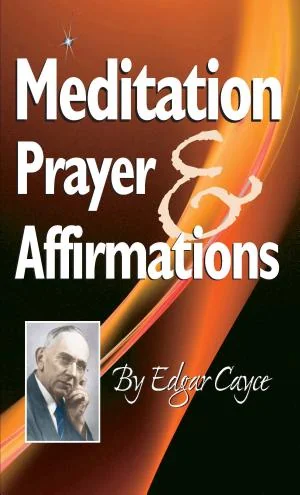
Meditation, Prayer & Affirmations
 84
84

Meditation, Prayer & Affirmations
While the Edgar Cayce readings offer a unique perspective on spiritual disciplines, the organization of 'Meditation, Prayer & Affirmations' can feel somewhat fragmented. The strength lies in the sheer volume of practical advice delivered through Cayce's trance state, particularly his emphasis on the ecumenical nature of these practices. A limitation is the lack of explicit chapter citations for specific readings, which would enhance academic rigor. However, the section discussing the 'vibrations' of prayer offers a concrete, if esoteric, conceptualization of its energetic impact. The book serves as a valuable, albeit sometimes unwieldy, compendium of Cayce's guidance on inner work.
📝 Description
84
### What It Is This compilation presents core teachings from Edgar Cayce's prolific readings concerning the spiritual disciplines of meditation, prayer, and affirmations. Published posthumously in 2010, it gathers directives on cultivating inner peace, seeking divine guidance, and reinforcing positive mental states. The material emphasizes practical application for individuals regardless of their religious affiliation, highlighting these practices as fundamental pathways to spiritual attunement.
### Who It's For This work is intended for individuals seeking accessible, yet profound, methods for personal spiritual growth and mental well-being. It will appeal to those interested in the practical application of spiritual principles, seekers exploring diverse contemplative traditions, and students of the Edgar Cayce phenomena. Those looking for tools to manage stress, enhance intuition, or deepen their connection to a higher power will find relevant guidance.
### Historical Context Edgar Cayce (1877-1945) delivered thousands of psychic readings, many of which were transcribed. His approach to meditation and prayer, particularly his emphasis on their universal applicability across religious divides, was ahead of its time. Emerging from an era where spiritual practices were often sect-specific, Cayce's readings offered a more inclusive model. This book, compiled from readings given primarily between 1920 and 1944, reflects this burgeoning interest in interfaith dialogue and personal spiritual development.
### Key Concepts The central concepts revolve around the power of focused intention, the nature of divine connection through prayer, and the vibrational impact of spoken affirmations. Cayce consistently presented meditation not as an escape, but as a means of aligning the self with universal truths and divine will. Prayer was described as a dynamic exchange, and affirmations as tools to reshape consciousness, aligning one's personal will with spiritual purpose. The work underscores the idea that consistent practice leads to tangible spiritual and psychological benefits.
💡 Why Read This Book?
• Gain practical techniques for spiritual attunement directly from the Edgar Cayce readings, focusing on methods he recommended between 1920-1944 that bypass religious dogma. • Understand prayer not just as supplication, but as a dynamic 'exchange' as described in the readings, offering a new perspective on divine connection. • Learn to utilize affirmations as described by Cayce to consciously reshape your mental and spiritual states, aligning personal will with universal principles.
⭐ Reader Reviews
Honest opinions from readers who have explored this book.
❓ Frequently Asked Questions
When were the Edgar Cayce readings on meditation and prayer originally delivered?
The Edgar Cayce readings, from which this book is compiled, were primarily delivered between 1920 and 1944, reflecting a period of significant interest in spiritual and psychological exploration.
What is the core difference between meditation and prayer according to Edgar Cayce?
Cayce viewed meditation as a form of inner listening and alignment with universal consciousness, while prayer was seen as a more active, conscious 'exchange' or dialogue with the divine.
Can individuals of any religious background benefit from these practices as presented by Cayce?
Yes, a central tenet of Cayce's approach was the universal applicability of meditation and prayer, recommending them to individuals from all religious traditions without requiring adherence to any specific doctrine.
What are affirmations in the context of Edgar Cayce's teachings?
Affirmations, as presented in the Cayce readings, are positive, faith-filled statements used to consciously influence one's thoughts and beliefs, aligning the mind with spiritual purpose and divine will.
What does Edgar Cayce suggest is the primary purpose of meditation?
The primary purpose of meditation, according to Cayce, is to achieve personal attunement and enlightenment by quieting the self and becoming receptive to divine guidance and universal truths.
How does this book relate to the broader Edgar Cayce Foundation?
This book is a collection of material derived from the Edgar Cayce readings, which are archived and studied by the Association for Research and Enlightenment (A.R.E.), founded to preserve and disseminate Cayce's work.
🔮 Key Themes & Symbolism
Universal Prayer
The readings consistently emphasize prayer as a universal language, accessible to all individuals irrespective of their specific religious beliefs or affiliations. Cayce spoke of prayer not as mere petition, but as a dynamic communion, an 'exchange' that fosters a connection between the soul and the divine. This ecumenical perspective highlights the underlying unity of spiritual seeking, suggesting that the intention and vibration behind the prayer are paramount, rather than adherence to ritualistic forms. This theme underscores the readings' inclusive nature, aiming to unify rather than divide seekers.
Meditation for Attunement
Meditation is presented as a foundational practice for spiritual development and personal enlightenment. Cayce's approach frames meditation not as an esoteric or exclusive discipline, but as a practical method for quieting the mind and aligning oneself with higher consciousness or the divine will. The readings suggest that through regular meditative practice, individuals can enhance their intuition, gain clarity, and foster a deeper understanding of their spiritual purpose. It's depicted as a tool for self-discovery and maintaining inner equilibrium amidst life's challenges.
Power of Affirmations
The use of spiritual affirmations is a recurring motif, presented as a potent tool for reshaping one's consciousness and reality. Cayce explained affirmations as positive, faith-based declarations designed to impress upon the subconscious mind constructive patterns and beliefs. By consistently voicing these statements, individuals are encouraged to align their personal will with divine principles, thereby fostering positive change in their physical, mental, and spiritual lives. This theme emphasizes the creative power of thought and speech in the spiritual journey.
Spiritual Self-Help
Underlying all these practices is the concept of spiritual self-help. The readings consistently direct individuals inward, empowering them to find answers and solutions through their own spiritual connection and disciplined effort. Rather than relying solely on external authorities or interventions, Cayce's guidance promotes self-reliance in spiritual matters. This theme underscores the readings' practical, therapeutic orientation, offering accessible methods for personal growth, healing, and the cultivation of a resilient spiritual life.
💬 Memorable Quotes
Direct passages from the work, attributed to the author.
“Meditation is the key, that the soul may hear.”
— This concise statement captures Cayce's view of meditation as a primary method for accessing spiritual intuition and inner wisdom, emphasizing its role in facilitating divine communication.
“Prayer is an exchange between the soul and the Creator.”
— This highlights Cayce's understanding of prayer not as a one-way request, but as a reciprocal interaction, a dialogue that strengthens the spiritual connection between the individual and the divine.
“Make affirmations of that which ye would have.”
— This suggests the active, creative power of positive affirmations, directing individuals to declare their desired spiritual or personal states as a means of manifesting them.
“The spirit of God is within each soul.”
— This interpretation speaks to the immanence of the divine, a core concept in Cayce's teachings, affirming that individuals possess an inherent connection to the spiritual source.
“Practice makes perfect in spiritual living.”
— This emphasizes the importance of consistent effort and discipline in spiritual development, implying that tangible progress is achieved through dedicated, ongoing practice of spiritual principles.
🌙 Esoteric Significance
Tradition
Cayce's work draws heavily from a blend of Judeo-Christian mysticism, Neoplatonism, and elements of Eastern spiritual thought, particularly concepts of karma and reincarnation. While not strictly adhering to any single esoteric lineage like Hermeticism or Kabbalah, his readings align with the broader Western esoteric tradition's focus on inner transformation, divine connection, and the exploration of consciousness. His emphasis on the practical application of spiritual principles for holistic well-being positions him within the 'practical mysticism' strand, aiming for tangible improvements in life through spiritual means.
Symbolism
While Cayce's readings are less symbolic in the dense, codified manner of Hermeticism or Kabbalah, they frequently employ motifs of light, darkness, the body as a temple, and the 'open door' of consciousness. Light often symbolizes divine presence, truth, and healing, while darkness represents ignorance or negative states. The body is consistently portrayed as a vehicle for the soul's expression and learning. The concept of an 'open door' in meditation refers to the state of receptivity where divine guidance can enter consciousness, a common metaphor for spiritual breakthrough.
Modern Relevance
Contemporary movements focusing on mindfulness, integrated wellness, and personalized spirituality echo Cayce's foundational principles. Thinkers and practitioners in fields like consciousness studies, energy healing, and positive psychology often reference or find resonance with Cayce's holistic approach. His emphasis on the mind-body-spirit connection and the power of intention continues to influence self-help literature and alternative healing modalities, making his work relevant to modern seekers interested in practical spiritual tools for everyday life.
👥 Who Should Read This Book
• Individuals exploring practical methods for spiritual growth and self-improvement, seeking guidance applicable across different belief systems. • Students of the Edgar Cayce material interested in understanding his core teachings on inner disciplines and their therapeutic potential. • Seekers of contemplative practices looking for accessible techniques to deepen their connection to the divine and enhance their mental and emotional well-being.
📜 Historical Context
Edgar Cayce's channeled readings, delivered primarily between 1920 and 1944, emerged during a period of intense spiritual and psychological exploration in the Western world. This era saw the rise of New Thought, Theosophy, and various forms of Western esotericism, all seeking to understand consciousness and the human spirit beyond conventional religious frameworks. Cayce's unique contribution was his emphasis on practical application and his ecumenical approach to spiritual disciplines like meditation and prayer, which he presented as universally beneficial, transcending sectarian boundaries. While movements like Christian Science also focused on spiritual healing and mental influence, Cayce's readings offered a broader, more individualized path. His work gained a dedicated following, though it also faced skepticism from both scientific and traditional religious circles, positioning him as a significant, albeit controversial, figure in 20th-century spirituality.
📔 Journal Prompts
The concept of prayer as an 'exchange' with the divine.
Your personal experience with the 'vibrations' of affirmations.
The role of meditation in achieving spiritual attunement.
Aligning personal will with divine purpose through practice.
The idea of the body as a temple for the soul's expression.
🗂️ Glossary
Attunement
A state of alignment or harmony, particularly between the individual consciousness and divine will or universal truths, often achieved through spiritual practices.
Affirmations
Positive, faith-filled statements used to impress constructive patterns and beliefs upon the subconscious mind, aligning one's will with spiritual principles.
Vibrations
In Cayce's context, refers to the energetic frequencies associated with thoughts, emotions, and spiritual states, influencing consciousness and manifesting reality.
Divine Will
The perfect, loving, and guiding intention of God or the Creator, which individuals can align themselves with through spiritual practice for optimal life experience.
Spiritual Enlightenment
A state of profound inner understanding, wisdom, and connection to the divine, often sought through dedicated spiritual discipline and self-awareness.
Subconscious Mind
The part of the mind that operates below conscious awareness, influencing beliefs, behaviors, and health; susceptible to suggestion through affirmations and repetition.
Ecumenical
Promoting or relating to unity among the world's Christian Churches or, more broadly, encompassing diverse religious traditions or beliefs.
This book appears in 1 collection
🔮 Readers Also Liked
Browse all →








From the “Affirmations” Collection
View all →






More Free Occult Philosophy Books
View all →