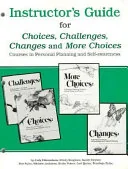
Instructor's Guide for Choices, Challenges, Changes, and More Choices
 84
84

Instructor's Guide for Choices, Challenges, Changes, and More Choices
Judy Edmondson’s Instructor's Guide for Choices, Challenges, Changes, and More Choices from 1987 presents a robust framework for guiding groups through the often-turbulent waters of personal decision-making. Its strength lies in its structured approach, offering clear directives for facilitators rather than abstract philosophical musings. The guide's focus on actionable exercises and discussion prompts, particularly those exploring the 'challenge' phase of decision-making, provides a practical scaffolding for participants. However, its 1987 publication date is evident; some of the psychological underpinnings might feel somewhat dated compared to contemporary cognitive-behavioral approaches. The core concept of 'decision fatigue' as explored through structured group activities, however, remains a potent tool. While not a primary text for deep esoteric study, its utility as a pedagogical tool for understanding the mechanics of choice is undeniable.
📝 Description
84
Judy Edmondson published an Instructor's Guide for Choices, Challenges, Changes, and More Choices in 1987.
Published in 1987, Judy Edmondson's Instructor's Guide for Choices, Challenges, and More Choices is a pedagogical tool for educators. It is designed to accompany a curriculum focused on personal development and decision-making. The guide provides structured exercises and discussion points for facilitators leading group sessions.
This resource is for instructors, facilitators, and educators who lead workshops on personal growth, life transitions, and the impact of choices. Curriculum developers interested in self-awareness and decision-making processes will also find it useful. It is not intended for individual reading but serves as a framework for guided group interaction.
Released in 1987, this guide aligns with a surge in self-help and personal development movements that gained traction in the preceding decades. This period saw increased interest in New Age philosophies and therapeutic models emphasizing individual agency. Authors like Stephen Covey, whose work on personal effectiveness emerged around this time, reflected a broader cultural focus on conscious choice and personal transformation. The guide's approach to dissecting decision-making processes fits within this era's emphasis on self-awareness and empowered action.
💡 Why Read This Book?
• Understand the structured pedagogical approach presented in Judy Edmondson's 1987 guide, gaining insights into how to facilitate discussions on personal decision-making that move beyond abstract concepts to tangible challenges. • Learn specific techniques for dissecting the 'challenges' phase of choice, as outlined in the guide's curriculum, offering practical methods for participants to confront and process the obstacles arising from their decisions. • Explore the 1987 context of personal development literature through this instructor's manual, recognizing how its framework complements contemporary self-help methodologies by focusing on the process of change initiated by specific choices.
⭐ Reader Reviews
Honest opinions from readers who have explored this book.
❓ Frequently Asked Questions
What is the primary purpose of Judy Edmondson's Instructor's Guide for Choices, Challenges, Changes, and More Choices?
This 1987 guide serves as a pedagogical tool for instructors leading workshops on personal development. It provides structured exercises and discussion points to help participants understand the process of making choices, facing subsequent challenges, and adapting to resulting changes.
Who is the intended audience for this 1987 instructor's guide?
The guide is designed for educators, facilitators, and leaders of group sessions focused on personal growth, decision-making, and life transitions. It equips them with the necessary materials to guide their students or participants effectively.
What historical period influenced the creation of this guide in 1987?
Published in 1987, the guide emerged during a surge in the self-help and personal development movements of the 1980s, a time when concepts of individual agency and conscious choice were gaining significant traction in popular psychology.
Does this guide offer new esoteric insights not found in other texts?
As an instructor's guide from 1987, its focus is primarily on the psychological and practical aspects of choice and change. While it touches on personal transformation, it is less about esoteric doctrine and more about structured facilitation of known concepts.
Can this guide be used for individual self-study without an instructor?
No, this is explicitly an 'Instructor's Guide.' It is designed to be used by a facilitator to lead a group. It lacks the comprehensive explanations and narrative structure needed for independent individual study.
What are the core themes explored within the curriculum this guide supports?
The guide supports exploration of the nature of choices, the challenges that arise from them, and the personal changes that follow. It aims to foster understanding of the decision-making process and its impact on an individual's life.
🔮 Key Themes & Symbolism
The Mechanics of Choice
This guide dissects the act of choosing not as a singular event, but as a process. It emphasizes understanding the precursor thoughts and external factors that influence a decision. The curriculum framework aims to help participants recognize patterns in their decision-making habits, distinguishing between impulsive selections and considered actions. The focus is on the cognitive and behavioral steps involved, providing tools for educators to guide individuals toward more conscious and deliberate choices in their lives. The 1987 publication context places this within a growing interest in applied psychology for everyday living.
Confronting Challenges
A significant portion of the guide is dedicated to the phase following a choice: the challenges that inevitably arise. It provides instructors with methods to help participants anticipate, identify, and strategize around obstacles. This isn't about avoiding difficulty, but about developing resilience and problem-solving skills. The structured exercises encourage a practical, step-by-step analysis of potential roadblocks, transforming abstract fears into manageable issues. The goal is to empower individuals to face the consequences of their decisions with greater confidence and preparedness, a key aspect of personal growth.
Facilitating Personal Change
The guide frames 'changes' as the natural outcome of choices and challenges. It equips instructors to guide participants in understanding and integrating these transformations. This involves acknowledging the emotional and psychological shifts that occur and learning to adapt constructively. The curriculum encourages reflection on how decisions shape identity and future possibilities. By providing a structured pathway, the guide helps educators foster environments where individuals can consciously navigate their personal evolution, turning the experience of change into an opportunity for growth rather than a source of anxiety.
The Role of the Educator
This work fundamentally defines the role of the instructor as a facilitator rather than a lecturer. It outlines pedagogical strategies for leading group discussions and activities related to choices, challenges, and changes. The guide provides concrete prompts and exercise structures designed to elicit participant engagement and self-discovery. The emphasis is on creating a safe and supportive environment where individuals can explore their own experiences and learn from one another. The 1987 publication date situates this within a broader shift towards experiential learning methodologies.
💬 Memorable Quotes
Direct passages from the work, attributed to the author.
“The facilitator’s role is to guide, not to dictate the path of choice.”
— This highlights the pedagogical philosophy underpinning the guide, emphasizing participant autonomy and self-discovery over instructor-led pronouncements. The 1987 context suggests a move towards more participatory educational models.
“Understanding the roots of a choice illuminates the field of its consequences.”
— This interpretation emphasizes the importance of self-awareness in decision-making. It suggests that recognizing the underlying motivations and factors behind a choice provides clarity on the potential outcomes.
“Change is the only constant; our response determines its meaning.”
— This core idea underscores the inevitability of transformation following decisions. The guide, through its structured approach, aims to equip individuals with the tools to consciously shape their reaction to these changes.
“Structure provides the container for exploration of the unpredictable.”
— This reflects the guide's purpose: offering a systematic framework to manage the often chaotic and emotional process of personal decision-making and its aftermath, particularly relevant in the 1980s personal growth movement.
💡 Key Ideas
Editorial paraphrase of the work's core concepts — not direct quotes.
Challenges are not roadblocks, but invitations to adapt.
This paraphrased concept frames adversity as a catalyst for growth. It encourages a reframing of difficulties encountered after making a decision, viewing them as opportunities for learning and personal evolution.
🌙 Esoteric Significance
Tradition
While not overtly aligned with a single esoteric lineage, this guide's 1987 publication places it within the broader sphere of practical psychology and self-help that often intersects with New Age thought. It shares an emphasis on personal agency and conscious creation, themes present in Hermeticism and various New Thought movements, albeit approached from a more secular, educational perspective.
Symbolism
The book's core concepts of 'Choices,' 'Challenges,' and 'Changes' can be viewed symbolically. 'Choices' represent agency and the branching paths of destiny. 'Challenges' symbolize the tests and trials inherent in growth, akin to initiatory ordeals. 'Changes' embody transformation and the alchemical process of transmutation, turning the raw material of experience into wisdom.
Modern Relevance
Contemporary life coaches, mindfulness practitioners, and therapists focused on cognitive behavioral techniques often employ methodologies that echo the structured approach to decision-making and change management found in this 1987 guide. Its emphasis on process and structured facilitation remains relevant for those seeking practical tools for personal development.
👥 Who Should Read This Book
• Educators and facilitators leading personal growth workshops who need a structured curriculum for exploring decision-making processes and their consequences. • Students of applied psychology or counseling in the late 1980s, seeking to understand pedagogical approaches to personal efficacy prevalent at the time. • Curriculum developers designing programs focused on life transitions, personal responsibility, and adaptive strategies for navigating life's complexities.
📜 Historical Context
Published in 1987, Judy Edmondson's Instructor's Guide emerged during a flourishing period for personal development and human potential movements. The mid-to-late 1980s saw a significant cultural emphasis on self-improvement, with authors like Stephen Covey gaining prominence with works like *The 7 Habits of Highly Effective People* (1989). This era was characterized by a blend of humanistic psychology, New Age philosophies, and business management principles applied to individual lives. While not strictly an esoteric text, its focus on choice and change resonated with the broader spiritual and psychological exploration of the time, often found in New Age circles influenced by figures such as Werner Erhard and his est training. The guide's structured, pedagogical approach distinguished it from more purely philosophical or spiritual treatises, offering a practical tool for educators navigating this burgeoning field.
📔 Journal Prompts
The structure of 'Choices, Challenges, Changes' as a decision-making model.
Personal identification of recurring 'Challenges' in your decision-making patterns.
The impact of a significant 'Choice' on your subsequent personal 'Changes'.
How the role of the facilitator shapes the exploration of difficult decisions.
Mapping the potential 'Challenges' stemming from a hypothetical future 'Choice'.
🗂️ Glossary
Facilitator
The individual responsible for guiding group discussions and activities, as outlined in this 1987 instructor's guide. Their role is to create a supportive environment and direct the learning process without imposing personal views.
Decision-Making Model
A structured framework or process for analyzing and making choices. This guide provides a specific model involving choices, challenges, and the resulting changes.
Personal Growth Workshop
A group session designed to help participants develop self-awareness, improve skills, and foster positive changes in their lives. This guide is a resource for leading such workshops.
Life Transitions
Significant events or periods in life that require adaptation and adjustment, such as career changes, relationship shifts, or major decisions. The guide addresses navigating these phases.
Pedagogical Tool
An item or resource used in teaching to aid instruction and learning. This instructor's guide functions as a pedagogical tool for educators.
Self-Efficacy
An individual's belief in their capacity to execute behaviors necessary to produce specific performance attainments. The guide aims to bolster this through structured practice.
Adaptive Strategies
Methods and approaches used to adjust to new conditions or changes. The guide helps educators teach participants how to develop these.
This book appears in 1 collection
🔮 Readers Also Liked
Browse all →









From the “Affirmations” Collection
View all →








More Free Occult Philosophy Books
View all →