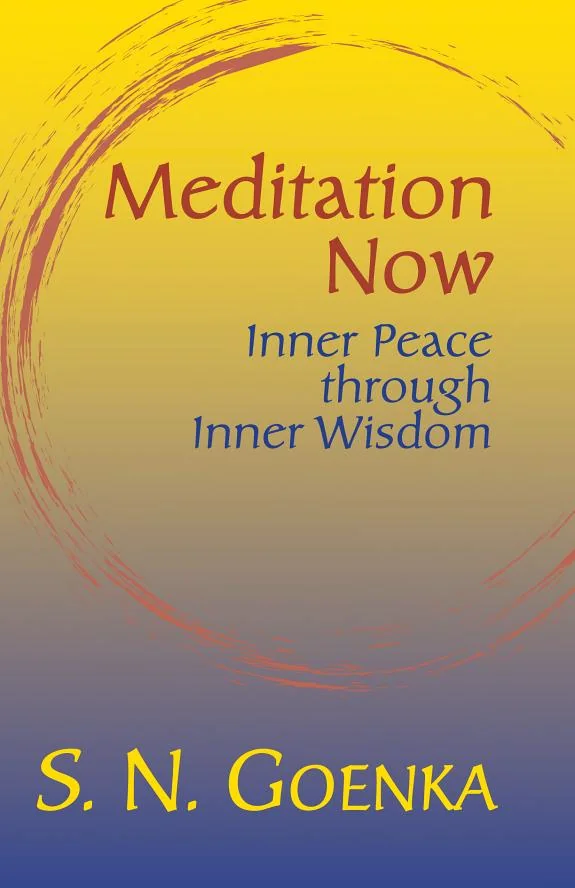
Meditation Now
 84
84

Meditation Now
S.N. Goenka's *Meditation Now* offers a clear, unadorned presentation of Vipassana's core tenets. The strength lies in Goenka's directness; he avoids esoteric jargon, focusing on the practical application of observing sensation to understand the mind. The inclusion of talks given at events like the World Economic Forum in Davos (2000) demonstrates the universal appeal he sought to cultivate for these ancient techniques. However, the collection occasionally feels repetitive, with similar points being reiterated across different formats – lectures, essays, and interviews. A particular passage discussing the nature of suffering through the lens of impermanence, drawn from his World Peace Summit (2000) remarks, stands out for its stark clarity. While the book provides an excellent introduction to Goenka's specific lineage of Vipassana, it necessarily offers a singular perspective, potentially overlooking diverse interpretations within Buddhist meditation. Ultimately, *Meditation Now* serves as a concise, accessible gateway to Goenka's influential approach to mental purification.
📝 Description
84
Meditation Now collects S.N. Goenka's teachings on Vipassana meditation for the modern world.
This book gathers lectures, essays, and interviews from S.N. Goenka, a prominent teacher of Vipassana meditation. It presents his understanding of Buddhist principles as they apply to contemporary life, focusing on the practical use of Vipassana to achieve mental clarity and a more meaningful existence. The volume includes transcripts of talks given at international events, showing Goenka's interaction with global discussions. It is designed for anyone wanting to learn about Vipassana directly from a recognized teacher. The book is useful for those practicing Buddhist meditation, individuals interested in secular mindfulness, or anyone seeking inner peace and ethical conduct. Goenka's clear explanations of complex ideas and his focus on direct experience are valuable assets. It will also interest scholars studying comparative religion and modern Buddhism.
Goenka's method of Vipassana meditation became widely known in the late 20th and early 21st centuries, supported by his extensive global teaching. This book places his teachings within that larger trend, illustrating his role in connecting ancient Indian contemplative practices with a modern, international audience. The core idea is Vipassana, an insight meditation technique that uses the observation of bodily sensations to build awareness and equanimity. Goenka stresses that this practice is universal, not a religious doctrine but a way to purify the mind.
S.N. Goenka's teachings in Meditation Now are rooted in the Theravada Buddhist tradition of Vipassana, an ancient Indian system of insight meditation. This practice, often preserved in monastic settings, was brought to a wider, secular audience through Goenka's efforts. The book emphasizes Vipassana not as a dogma but as a practical method for mental purification, aligning with a lineage that prioritizes direct experiential understanding over intellectual adherence. Goenka's approach bridges the gap between traditional monastic training and the needs of modern individuals seeking inner transformation.
💡 Why Read This Book?
• Gain a direct understanding of Vipassana meditation as taught by S.N. Goenka, focusing on the observation of impermanence (anicca) as described in his lectures. • Learn practical techniques for developing equanimity and mental clarity, as Goenka outlines in his essays on ethical conduct (sila). • Explore the application of meditation for a happier life, drawing from Goenka's interviews and his engagement with global forums like the World Economic Forum in Davos.
⭐ Reader Reviews
Honest opinions from readers who have explored this book.
❓ Frequently Asked Questions
What is Vipassana meditation according to S.N. Goenka?
S.N. Goenka defines Vipassana as a technique of insight meditation that involves observing bodily sensations to understand the mind's impermanent nature and achieve mental purification, as detailed in his lectures and essays.
When was S.N. Goenka's first book published?
While this specific collection, Meditation Now, was first published on November 8, 2012, Goenka's teachings have been disseminated through various formats and lectures for decades prior.
Where did S.N. Goenka give notable talks included in Meditation Now?
The book includes transcripts of talks given at significant international events, such as the World Economic Forum in Davos and the Millennium World Peace Summit, showcasing his engagement with global audiences.
Is Vipassana meditation a religious practice according to Goenka?
Goenka presents Vipassana as a universal, non-sectarian method for mental purification, accessible to all regardless of their religious background, focusing on observation of reality as it is.
What does 'anicca' mean in the context of Goenka's teachings?
'Anicca' is a key concept representing impermanence. Goenka teaches that observing the constant arising and passing of sensations helps one understand the transient nature of all phenomena, leading to detachment.
What is the role of 'sila' in Vipassana meditation?
Sila, or ethical conduct, is presented by Goenka as the essential foundation for effective meditation. Adhering to precepts like abstaining from harming cultivates a calm mind conducive to deep insight.
🔮 Key Themes & Symbolism
Vipassana as Insight
The core of Goenka's teaching in Meditation Now is Vipassana, translated as 'insight' meditation. This practice centers on the systematic observation of one's own physical sensations to develop a deep understanding of reality. Goenka emphasizes that this is not a ritualistic or dogmatic path, but a practical method for purifying the mind of impurities like greed, aversion, and delusion. By observing the arising and passing of sensations, practitioners learn about the impermanent nature of all conditioned phenomena, a crucial step towards liberation from suffering.
Ethics as Foundation
Goenka consistently stresses the importance of sila, or ethical conduct, as the indispensable groundwork for any effective meditation practice. In Meditation Now, he explains that abstaining from harmful actions—such as killing, stealing, sexual misconduct, lying, and intoxicants—helps to calm the mind and reduce agitation. This ethical discipline creates the necessary stability and clarity for the deeper investigation into one's own mind and body that Vipassana requires, ensuring that the path is one of wholesome development.
Universality of the Path
A significant aspect of Goenka's message, reflected throughout Meditation Now, is the universal applicability of Vipassana. He presents the teachings of the Buddha not as a specific religion, but as a path to liberation from suffering that transcends cultural and sectarian boundaries. The technique, rooted in observing natural, universal processes within the body, is accessible to anyone, anywhere. This perspective allowed his teachings to reach diverse global audiences, including at venues like the World Economic Forum.
Impermanence and Non-Self
Central to Goenka's exposition of Vipassana is the understanding of anicca (impermanence) and anatta (non-self). The book elaborates on how the constant flux of physical sensations mirrors the transient nature of all existence. By experiencing this impermanence directly through meditation, practitioners begin to loosen their attachment to the illusion of a permanent, solid self. This realization is presented as key to overcoming ego-driven suffering and achieving genuine peace.
💬 Memorable Quotes
Direct passages from the work, attributed to the author.
“The practice is to observe what is happening, what is arising and passing away, without any reaction.”
— This captures the essence of Vipassana as taught by Goenka: a detached, observational stance towards one's internal and external experiences, focusing on their transient nature rather than getting caught in emotional responses.
“One must develop the ability to face reality as it is.”
— Goenka advocates for a direct, unvarnished confrontation with one's own mind and body. This involves observing sensations and mental states without judgment or distortion, leading to a clearer perception of truth.
“Suffering arises from craving and aversion.”
— This statement highlights a fundamental Buddhist principle that Goenka frequently reiterates. He explains that our unhappiness stems from clinging to pleasant experiences and resisting unpleasant ones, a cycle that Vipassana aims to break.
“Peace is an inner state, not dependent on external conditions.”
— Goenka's teachings emphasize that true peace is cultivated through internal transformation via meditation, rather than being sought through external achievements or circumstances, a concept he shared at global forums.
💡 Key Ideas
Editorial paraphrase of the work's core concepts — not direct quotes.
The path is to observe the body, to observe the mind, and to see the connection.
This paraphrase points to the integrated approach of Vipassana, where the physical sensations are seen as indicators of mental processes, and understanding one leads to understanding the other.
🌙 Esoteric Significance
Tradition
While S.N. Goenka's teachings are rooted in the Theravada Buddhist tradition of Vipassana, his presentation in Meditation Now often strips away overt religious terminology, framing it as a universal, practical method for mental purification. This secularized approach aligns with broader esoteric trends of the late 20th century that sought to extract the psychological and transformative potential from ancient spiritual systems for modern, often Western, audiences. Goenka's lineage traces back through Sayagyi U Ba Khin, connecting it to a monastic tradition, yet his emphasis on a non-sectarian, experiential path places him within the wider esoteric movement seeking direct experience over dogma.
Symbolism
The primary 'symbol' in Goenka's teachings, as presented in Meditation Now, is the body itself, specifically the raw, physical sensations experienced within it. These sensations are not symbolic in the traditional sense but are direct manifestations of impermanence (anicca) and conditioned arising. The breath, often the initial object of focus, serves as a tangible anchor to the present moment, representing the constant flow of life. The act of observation without reaction symbolizes detachment and equanimity, key qualities sought in many esoteric paths for achieving inner stillness.
Modern Relevance
Goenka's approach to Vipassana, as documented in Meditation Now, continues to be highly relevant in contemporary mindfulness and secular meditation movements. Thinkers and practitioners focusing on cognitive behavioral therapy (CBT), acceptance and commitment therapy (ACT), and various wellness programs often draw upon the principles of non-judgmental awareness and sensation observation that Goenka popularized. His emphasis on meditation as a tool for ethical development and inner peace also appeals to contemporary discussions on emotional intelligence and personal growth, making his teachings a continued reference point.
👥 Who Should Read This Book
• Aspiring meditators seeking a clear, practical introduction to Vipassana from a highly respected teacher, particularly those interested in S.N. Goenka's specific lineage and techniques. • Individuals exploring secular approaches to mindfulness and mental well-being, who want to understand the experiential basis of Buddhist contemplative practices without religious dogma. • Students of comparative religion and philosophy interested in the dissemination of Buddhist teachings in the modern era, and the adaptation of ancient practices for global audiences, exemplified by Goenka's work.
📜 Historical Context
Meditation Now emerges from the late 20th and early 21st centuries, a period marked by the globalization of Eastern contemplative practices, particularly mindfulness and Vipassana. S.N. Goenka, an Indian lay teacher, became a globally influential figure in popularizing a specific, secularized form of Vipassana meditation starting in the late 1960s. His method, emphasizing observation of breath and bodily sensations without religious dogma, gained traction in the West, often positioned as a technique for stress reduction and self-awareness. This book's inclusion of talks from the World Economic Forum in Davos (2000) and the Millennium World Peace Summit (2000) exemplifies Goenka's engagement with international elite circles and his attempt to present meditation as a tool for global harmony. During this era, various Buddhist modernists and scholars like Thich Nhat Hanh were also making Buddhist teachings accessible globally, sometimes through different pedagogical approaches, while secular mindfulness programs like MBSR, developed by Jon Kabat-Zinn, further cemented meditation's place in mainstream Western culture.
📔 Journal Prompts
Your experience of observing impermanence (anicca) through bodily sensations.
The role of ethical conduct (sila) in supporting your mental clarity.
How equanimity, cultivated through observing sensations, impacts your daily reactions.
Identifying craving and aversion in your own mind, as discussed by Goenka.
The challenges and rewards of maintaining non-judgmental awareness during meditation.
🗂️ Glossary
Vipassana
A Pali word meaning 'insight' or 'clear seeing'. It refers to a meditation technique focused on observing reality as it is, particularly the impermanent nature of physical sensations and mental phenomena, to achieve liberation from suffering.
Anicca
A fundamental concept in Buddhism, meaning 'impermanence' or 'transience'. Goenka emphasizes observing the constant arising and passing away of all conditioned phenomena, including sensations, to understand their true nature.
Sila
Refers to ethical conduct or morality. In Goenka's teachings, sila forms the foundation for meditation, involving abstaining from harmful actions to cultivate a calm and purified mind conducive to insight.
Samadhi
A state of deep concentration or mental absorption achieved through meditation. Goenka views it as a necessary step for developing the stable mind required for clear insights (Vipassana).
Panna
Wisdom or insight. This is the ultimate goal of Vipassana meditation, arising from direct experience and leading to the eradication of ignorance and suffering.
Dukkha
Often translated as 'suffering', 'dissatisfaction', or 'stress'. Goenka explains that understanding dukkha is central to the path, and Vipassana provides the means to see its causes and cessation.
Anatta
The doctrine of 'non-self' or 'no-soul'. Goenka teaches that through observing the impermanent nature of all phenomena, one realizes the absence of a permanent, independent self.
This book appears in 1 collection
🔮 Readers Also Liked
Browse all →








From the “Vipassana” Collection
View all →






More Free Occult Philosophy Books
View all →