Crop circle classification
 79
79

Crop circle classification
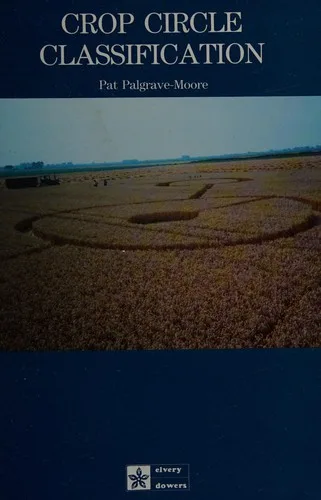
Patrick T. R. Palgrave-Moore's "Crop Circle Classification" attempts a rigorous categorization of a phenomenon often relegated to the fringes of serious inquiry. The strength of the book lies in its methodical approach, seeking order within the apparent chaos of the formations. Palgrave-Moore's detailed breakdown of geometric elements, for instance, in distinguishing between simple circles and more complex arrangements of rings and lines, provides a valuable tool for comparative analysis.
However, the book’s primary limitation is its publication date; the field has evolved considerably since 1991. Developments in digital imaging, drone technology, and the sheer variety of formations that have appeared since its initial release mean that its classifications might feel somewhat dated or incomplete when compared to contemporary analyses. Despite this, the foundational principles of geometric analysis it introduces remain relevant for understanding the structure of many early formations.
Read more ↓
Palgrave-Moore's exploration of the "fractal nature" of some early designs, suggesting a recursive complexity that hints at deliberate design rather than random occurrence, is particularly noteworthy. It’s a sober attempt to apply analytical tools to a subject often mired in speculation.
Overall, "Crop Circle Classification" is a valuable, if dated, reference for serious students of the phenomenon's early history.
📝 Description
79
Patrick T. R. Palgrave-Moore published Crop Circle Classification in 1991, proposing a structured method for analyzing geometric field patterns.
First published in 1991, Patrick T. R. Palgrave-Moore's Crop Circle Classification moves beyond simple observation to offer a systematic method for understanding the geometric patterns appearing in agricultural fields. The book details a structured approach for categorizing these formations, considering their complexity, scale, and underlying geometric principles. It is intended for researchers, investigators, and enthusiasts who want an analytical framework for studying crop circles, appealing to those interested in the mathematical aspects of the designs, potential coded messages, and the historical development of reported appearances.
The early 1990s were a time of heightened public and academic interest in crop circles, with discussions often involving media portrayals and the growing sophistication of the designs. Palgrave-Moore's work appeared when explanations ranged from meteorological phenomena to intentional hoaxes. The book sought to apply a more analytical lens to the accumulating evidence of these formations. Palgrave-Moore's classification system is a core element, likely incorporating parameters such as the number of components, the geometric shapes used, specific features like flattened stalks, and the overall size of the formation. The text may also examine the mathematical ratios and geometric progressions observed in certain designs.
This work engages with the tradition of interpreting anomalous phenomena through systematic analysis, a practice often found in esoteric studies. While not explicitly religious or mystical, crop circle classification taps into a desire to find order and meaning in unexplained events, aligning with esoteric interests in pattern recognition and hidden knowledge. It reflects an approach common in fields that seek underlying structures or intelligence behind complex, often surprising, natural or human-made occurrences. The book addresses the human impulse to decipher symbolic language within the physical world.
💡 Why Read This Book?
• Gain a structured method for analyzing crop circle designs, moving beyond simple observation to geometric principles, as presented in Palgrave-Moore's classification system from 1991. • Understand the historical context of crop circle research in the early 1990s, a period of intense public interest and the emergence of systematic study. • Explore the concept of fractal geometry within crop formations, a key analytical tool discussed by Palgrave-Moore for discerning potential design.
⭐ Reader Reviews
Honest opinions from readers who have explored this book.
❓ Frequently Asked Questions
What is the primary goal of Patrick T. R. Palgrave-Moore's book on crop circles?
The primary goal is to provide a systematic classification system for crop circle formations, moving beyond anecdotal observations to a more analytical and geometric understanding of the patterns.
When was 'Crop Circle Classification' first published?
'Crop Circle Classification' was first published in 1991.
Who is Patrick T. R. Palgrave-Moore?
Patrick T. R. Palgrave-Moore is the author of 'Crop Circle Classification,' a work aiming to bring a structured analytical approach to the study of crop circle phenomena.
Does the book discuss the causes of crop circles?
While the book focuses on classification and geometric analysis, this approach implicitly addresses the question of cause by identifying patterns that suggest deliberate design over random events.
Is this book suitable for beginners interested in crop circles?
Yes, it serves as a foundational text for beginners interested in a more analytical and geometric approach to understanding crop circle formations.
What kind of formations does Palgrave-Moore's classification system cover?
The system likely covers formations based on geometric complexity, scale, and the types of shapes and elements present, reflecting the range of circles observed up to the early 1990s.
🔮 Key Themes & Symbolism
Geometric Systematization
The core of Palgrave-Moore's contribution lies in establishing a framework for classifying crop circles based on their geometric properties. This involves breaking down complex formations into constituent shapes, measuring their scale, and analyzing the relationships between different elements within the pattern. The work aims to move beyond subjective descriptions to an objective, quantifiable analysis, facilitating comparative studies and potentially identifying recurring design principles or signatures across different formations.
Mathematical Underpinnings
This book likely studies the mathematical and geometrical principles that appear to govern many crop formations. Concepts such as fractal geometry, sacred geometry, and algorithmic design may be explored as potential explanations for the intricate and often mathematically precise patterns observed. By examining the prevalence of specific ratios, sequences, or self-similar structures, Palgrave-Moore seeks to understand if these designs possess an inherent mathematical language.
Historical Evolution of Patterns
Palgrave-Moore's work, published in 1991, inherently captures a snapshot of crop circle phenomena as understood at that time. The classification system may implicitly track the evolution of complexity and style in formations from earlier periods to the early 1990s. This historical perspective is crucial for understanding the development of the phenomenon and how researchers began to grapple with its increasing sophistication.
Analytical vs. Anecdotal
A central theme is the shift from purely anecdotal reporting of crop circles to a more rigorous, analytical approach. Palgrave-Moore emphasizes the importance of objective observation and systematic data collection. This focus on analytical methodology aims to elevate the study of crop circles from speculative folklore to a more structured field of inquiry, capable of yielding verifiable insights.
💬 Memorable Quotes
Direct passages from the work, attributed to the author.
“The geometry of a formation is key to its classification.”
— This statement captures Palgrave-Moore's thesis: that the underlying mathematical and geometric structure of a crop circle is the most critical element for its systematic categorization and analysis.
“Complexity often follows discernible mathematical progressions.”
— This highlights the author's observation that intricate crop circle designs are not random but appear to adhere to specific mathematical rules or sequences, suggesting intentionality.
“Distinguishing features must be objectively recorded.”
— This emphasizes the need for precise, unbiased documentation of all aspects of a crop formation, from stalk bending to overall shape, for accurate classification.
“The appearance of fractal-like patterns suggests sophisticated design.”
— This points to the author's interpretation of certain crop formations exhibiting self-similar structures across scales, implying a level of deliberate complexity.
“A standardized nomenclature aids comparative research.”
— This underscores the author's goal: to create a common language and system for describing crop circles, enabling researchers worldwide to share and compare findings effectively.
🌙 Esoteric Significance
Tradition
Palgrave-Moore's work, while analytical, touches upon traditions that seek meaning and order in geometric patterns, aligning with aspects of sacred geometry found in Hermeticism and Pythagorean thought. It attempts to apply rational, systematic analysis to phenomena often relegated to the mystical or paranormal, bridging a gap between empirical observation and the search for underlying, perhaps non-human, intelligence or principles.
Symbolism
The primary symbolism lies within the geometric shapes themselves. Circles, rings, spirals, and complex fractals, as detailed in the classification system, can be interpreted through various esoteric lenses. Circles often represent unity, wholeness, or the divine, while spirals can symbolize evolution, growth, or cosmic cycles. The precision and complexity of these forms, when found in crop circles, suggest a deliberate symbolic language whose grammar Palgrave-Moore sought to decipher through classification.
Modern Relevance
Contemporary researchers and artists interested in sacred geometry, data visualization of complex patterns, and the intersection of mathematics and mystery continue to find value in Palgrave-Moore's systematic approach. His work provides a foundational framework for analyzing geometric anomalies, influencing subsequent studies that explore potential algorithmic or intelligent design aspects of natural and anomalous phenomena.
👥 Who Should Read This Book
• Researchers and investigators of anomalous phenomena seeking a structured methodology for analyzing geometric patterns, particularly those interested in the historical development of crop circle studies. • Students of sacred geometry and mathematical patterns who wish to explore how these principles manifest in observable, real-world phenomena beyond traditional architectural or artistic contexts. • Enthusiasts of early 1990s esoteric literature who are interested in the analytical approaches taken during a peak period of crop circle reporting and investigation.
📜 Historical Context
Published in 1991, Patrick T. R. Palgrave-Moore's "Crop Circle Classification" emerged during a period of intense global fascination with these aerial phenomena. The early 1990s saw crop circles evolve from simple rings to increasingly elaborate geometric designs, capturing media attention and sparking widespread debate. This era was marked by a divide between skeptics, who attributed the formations to elaborate hoaxes often involving planks and ropes, and proponents who explored more unconventional explanations. Notable contemporaries like Colin Andrews were also documenting and analyzing formations, though often with a greater emphasis on eyewitness accounts and the mystery itself. Palgrave-Moore's work distinguished itself by advocating for a rigorous, almost scientific, classification system, attempting to impose order and analytical rigor on a phenomenon frequently characterized by speculation and sensationalism. While mainstream academia largely remained dismissive, Palgrave-Moore's approach contributed to a growing body of literature seeking systematic understanding within the esoteric and ufological communities.
📔 Journal Prompts
The geometric principles of a specific crop formation classified by Palgrave-Moore.
Reflections on the evolution of pattern complexity in crop circles since 1991.
How does the concept of fractal geometry, as applied to crop circles, challenge conventional notions of randomness?
Consider the limitations of objective observation when classifying phenomena like crop circles.
The potential for coded information within the geometric structures discussed by Palgrave-Moore.
🗂️ Glossary
Crop Circle
A large pattern or design that appears in a field of crops, typically wheat, barley, or corn, created by the flattening of the crops.
Classification System
A structured method for categorizing and organizing phenomena based on shared characteristics, in this case, the geometric and structural attributes of crop circles.
Geometric Progression
A sequence of numbers where each term after the first is found by multiplying the previous one by a fixed, non-zero number called the common ratio.
Fractal Geometry
A branch of mathematics that studies fractal objects, which are geometric shapes that exhibit self-similarity, meaning they look similar at different scales.
Flattened Stalks
A characteristic of crop circles where the plant stems are bent and laid down without being broken, often in a spiral or swirling pattern.
Scale
The size or extent of a crop formation, often measured in terms of diameter or area, used as a parameter in classification.
Nomenclature
A system of names or terms used in a particular field, essential for consistent description and classification.
🔮 Readers Also Liked
Browse all →









More Free Occult Philosophy Books
View all →