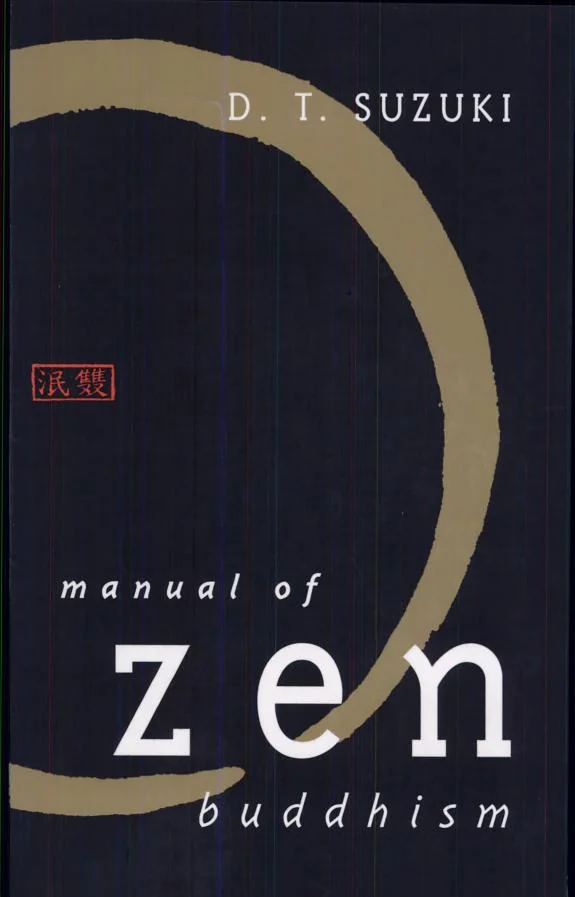
Manual of Zen Buddhism
 81
81

Manual of Zen Buddhism
D.T. Suzuki's Manual of Zen Buddhism is less a narrative and more a meticulously assembled archive. Its strength lies in its comprehensive presentation of primary source material, allowing the reader to encounter sutras and foundational writings directly. The section on 'The Doctrine of Sudden Enlightenment' is particularly illuminating, showcasing the stark contrast between gradual and immediate awakening often debated within Zen schools. However, the sheer density of textual exegesis can be daunting for the absolute beginner; the book assumes a certain familiarity with Buddhist terminology and philosophical concepts. A reader might wish for more explicit guidance on how to approach the translated texts themselves, beyond their presentation. Nevertheless, for dedicated study, it remains an essential reference.
📝 Description
81
Daisetz Teitaro Suzuki's Manual of Zen Buddhism, published in 1960, compiles key Mahayana texts for Western readers.
First published in 1960, Daisetz Teitaro Suzuki's Manual of Zen Buddhism is a collection of source materials and commentary on Mahayana Buddhism, with a specific focus on its Zen form. Suzuki, a significant figure in bringing Zen to the West, organized texts that trace Zen's development from its Indian roots through its transformations in China and Japan. The book gives readers direct access to the philosophical ideas and practical methods that define Zen practice.
This volume is useful for anyone studying Zen Buddhist philosophy and history. It is also relevant for those interested in comparative religion, philosophy, and the study of Eastern spiritual traditions. Readers seeking to grasp the core principles, historical path, and textual foundations of Zen will find its contents thorough.
Emerging in the mid-20th century amidst growing Western interest in Eastern thought, this manual appeared at a time when figures like Alan Watts and the Beat Generation were exploring Zen. Suzuki's work provided a curated selection of texts, illuminating concepts such as emptiness and wisdom. It highlighted Zen's emphasis on direct experience over purely intellectual understanding, a characteristic that resonated with those seeking alternatives to Western philosophical traditions.
💡 Why Read This Book?
• You will gain direct exposure to key Mahayana sutras translated from their original languages, providing a foundational understanding of Buddhist concepts that underpin Zen. • You will learn about the historical transmission of Buddhist thought from India to China and Japan, understanding how Zen developed through the work of figures like Bodhidharma. • You will encounter specific concepts like prajna and sunyata, gaining clarity on their significance within the Zen tradition as explained by a leading scholar of the 20th century.
⭐ Reader Reviews
Honest opinions from readers who have explored this book.
❓ Frequently Asked Questions
When was Daisetz Teitaro Suzuki's Manual of Zen Buddhism first published?
Daisetz Teitaro Suzuki's Manual of Zen Buddhism was first published in 1960, marking a significant point in the dissemination of Zen teachings in the West.
What are the primary source materials included in this book?
The book includes selections from Indian Mahayana sutras, alongside crucial Chinese and Japanese Zen texts, offering a broad textual basis for understanding the tradition.
Is this book suitable for someone new to Buddhism?
While comprehensive, the book is quite scholarly. It is best suited for those with some prior interest or basic knowledge of Buddhist philosophy, offering deeper textual exploration.
What is the significance of the Mahayana sutras mentioned in the book?
The Mahayana sutras are foundational texts of Mahayana Buddhism, which provided the philosophical bedrock upon which Zen developed, influencing its core doctrines.
How does this book differ from other introductions to Zen?
Unlike more introductory guides, this manual prioritizes presenting and analyzing original source texts, offering a more academic and historically grounded perspective on Zen.
What historical period does the book cover regarding Zen Buddhism?
The book traces Zen's development from its Indian roots through its significant transformations in China and Japan, covering centuries of intellectual and spiritual history.
🔮 Key Themes & Symbolism
Textual Foundations of Zen
This work is built upon the careful compilation and presentation of primary Buddhist scriptures. Suzuki includes important Indian Mahayana sutras that laid the philosophical groundwork for later East Asian developments. The manual then moves to examine significant Chinese and Japanese texts, illustrating the evolution of Zen thought and practice. By focusing on these original sources, Suzuki allows readers direct access to the doctrinal and experiential core of Zen, moving beyond secondary interpretations to engage with the very words that shaped the tradition.
The Mahayana Bridge
Suzuki emphasizes Zen's deep roots within the broader Mahayana Buddhist tradition. The book meticulously traces the lineage of ideas from Indian philosophical concepts like emptiness (sunyata) and transcendental wisdom (prajna) to their adaptation and transformation in Chinese Ch'an and Japanese Zen. This section is crucial for understanding that Zen is not an isolated phenomenon but a specific, experiential path emerging from a vast and complex philosophical landscape, demonstrating how core Mahayana principles were reinterpreted through a distinct lens.
Enlightenment and Direct Experience
A central theme is the nature of enlightenment (satori) and the primacy of direct, intuitive experience in achieving it. Suzuki presents texts that highlight the limitations of intellectual analysis and conceptualization in grasping ultimate reality. The manual explores the methods and insights employed by Zen masters to foster this direct perception, often contrasting it with gradualist approaches. This focus underscores Zen's unique pedagogical emphasis on awakening to one's true nature through immediate, unmediated realization.
Cross-Cultural Transmission
The manual serves as a proof of the dynamic transmission and adaptation of Buddhist thought across cultures. Suzuki details how Indian Buddhist philosophy was absorbed, reinterpreted, and synthesized within Chinese cultural and philosophical contexts (Taoism, Confucianism) to give rise to Ch'an. Subsequently, it examines how Ch'an further evolved in Japan, becoming the distinct tradition known as Zen. This narrative highlights the adaptability of spiritual traditions and the creative interplay between universal principles and local cultural expressions.
💬 Memorable Quotes
Direct passages from the work, attributed to the author.
“The ultimate aim of Zen is to see into the nature of one's own being.”
— This statement expresses the introspective and self-realization-oriented core of Zen practice. It highlights that Zen is not primarily about external doctrines or rituals, but about a deep, direct understanding of the self.
“Prajna, or wisdom, is not the accumulation of knowledge, but a direct apprehension of reality.”
— Suzuki emphasizes that true Zen wisdom (prajna) transcends mere intellectual learning. It signifies an intuitive, immediate grasp of the nature of existence, unmediated by concepts or logic.
“Sunyata, often translated as emptiness, is not nihilism but the absence of inherent, independent existence.”
— This interpretation clarifies a key Mahayana concept. Emptiness in Zen signifies that phenomena lack a fixed, unchanging self-nature, which paradoxically allows for interdependence and change.
“The Dharma gate of direct perception is not to be found in scriptures, but in the heart.”
— This highlights Zen's emphasis on personal, experiential realization over textual study alone. The ultimate truth is accessed through inner insight, not solely through external teachings.
“To know the Buddha is to realize one's own Buddha-nature.”
— This points to the non-dualistic understanding in Zen that the Buddha is not an external savior but an inherent potential within oneself, to be awakened to.
🌙 Esoteric Significance
Tradition
While Zen Buddhism is a distinct Mahayana school, its emphasis on direct experience, mind-to-mind transmission, and the realization of emptiness aligns with broader esoteric currents. Within a Hermetic or Gnostic framework, the focus on inner gnosis and direct apprehension of ultimate reality (akin to 'seeing into one's own nature') resonates. Suzuki's work provides a non-Western analogue to paths seeking liberation through self-knowledge and the transcendence of material illusion.
Symbolism
Key symbols within Zen, as presented in texts Suzuki draws upon, include the empty circle (enso), representing ultimate reality, enlightenment, and the void; the Bodhi tree, symbolizing the place of awakening; and the dharma wheel, representing the Buddha's teachings and the cycle of existence. These motifs signify the attainment of clarity, the cessation of suffering, and the fundamental interconnectedness of all things.
Modern Relevance
Contemporary thinkers and practitioners in fields ranging from mindfulness and psychology to contemplative arts and even certain branches of secular philosophy draw inspiration from Suzuki's presentation of Zen. His work continues to inform discussions on consciousness, the nature of self, and the potential for non-conceptual understanding, influencing modern meditation practices and therapeutic approaches seeking to cultivate present-moment awareness and insight.
👥 Who Should Read This Book
• Students of comparative religion and philosophy seeking to understand the textual and historical underpinnings of a major Eastern spiritual tradition. • Scholars of Mahayana Buddhism looking for a curated collection of primary source materials with expert commentary by a seminal 20th-century figure. • Individuals interested in the practice of meditation and mindfulness who wish to explore the philosophical and historical roots of Zen Buddhism.
📜 Historical Context
Published in 1960, Daisetz Teitaro Suzuki's Manual of Zen Buddhism arrived during a period of intense Western fascination with Eastern spirituality. The mid-20th century saw figures like Alan Watts popularizing Zen concepts, and the Beat Generation poets finding inspiration in its anti-establishment ethos. Suzuki himself was instrumental in this cultural exchange, having lectured extensively in the United States and Europe. The book provided a scholarly counterpoint to more popularized accounts, offering direct engagement with foundational Mahayana sutras and key Chinese and Japanese Ch'an/Zen texts. This era also saw ongoing academic discourse in Buddhist studies, with scholars like Edward Conze working on translations of Prajnaparamita literature, providing a comparative scholarly landscape for Suzuki's work. The book's reception was largely positive, cementing Suzuki's status as a preeminent authority on Zen for Western audiences.
📔 Journal Prompts
The concept of prajna as direct apprehension, distinct from accumulated knowledge.
The significance of seeing into one's own nature as the ultimate aim of Zen.
The relationship between Indian Mahayana sutras and later Chinese Ch'an developments.
The interpretation of sunyata as the absence of inherent existence.
The role of direct experience versus textual study in realizing enlightenment.
🗂️ Glossary
Prajna
Sanskrit term for wisdom, particularly the transcendental wisdom that apprehends the true nature of reality, a central concept in Mahayana Buddhism and Zen.
Sunyata
A core Mahayana concept, often translated as 'emptiness' or 'voidness.' It refers to the lack of inherent, independent existence in all phenomena.
Mahayana
One of the two major branches of Buddhism, characterized by its emphasis on the bodhisattva ideal and the goal of achieving enlightenment for all sentient beings.
Satori
A Japanese Buddhist term for awakening or enlightenment, often used to describe a sudden, intuitive realization of the true nature of existence in Zen Buddhism.
Ch'an
The Chinese name for the school of Buddhism that evolved from Indian Mahayana and later developed into Japanese Zen, emphasizing meditation and direct experience.
Bodhidharma
A semi-legendary Buddhist monk credited with transmitting Ch'an Buddhism from India to China in the early 6th century CE.
Dharma
In Buddhism, this term refers to the teachings of the Buddha, the cosmic law and order, and the ultimate truth about reality.
This book appears in 1 collection
🔮 Readers Also Liked
Browse all →









From the “Zen Buddhism” Collection
View all →









More Free Occult Philosophy Books
View all →