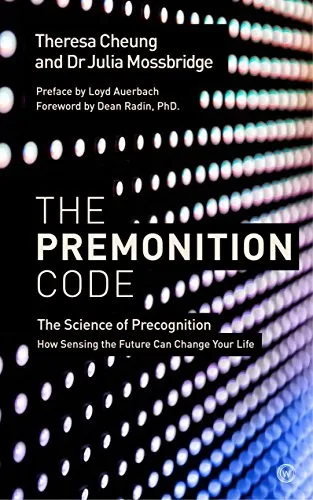
The Premonition Code
 75
75

The Premonition Code
Theresa Cheung and Dr. Julia Mossbridge's "The Premonition Code" offers a sober examination of precognition, moving beyond sensationalism to explore the scientific plausibility of sensing the future. Dr. Mossbridge's background as a cognitive neuroscientist lends a critical, evidence-based perspective that is the book's strongest asset. The work commendably attempts to bridge the gap between anecdotal experience and empirical research, presenting findings from studies on presentiment and anomalous cognition. However, the integration of Cheung's more popular-science narrative style with Mossbridge's rigorous scientific approach sometimes feels uneven, occasionally diluting the impact of the research. A particularly compelling section discusses the methodology of studying precognitive experiences, highlighting the challenges of experimental design. While the book provides a valuable overview for the curious, it might leave those deeply entrenched in parapsychological theory wanting more depth. It serves as an accessible entry point into a complex field, offering a balanced perspective on what science currently understands about foresight.
📝 Description
75
In 2018, Theresa Cheung and Julia Mossbridge published The Premonition Code, examining the science of perceiving future events.
The Premonition Code investigates the scientific basis for precognition, the ability to sense future events. Theresa Cheung, a writer, and cognitive neuroscientist Dr. Julia Mossbridge collaborated on this work to explain the mechanisms behind future perception. The book suggests that ordinary people may have latent abilities to see ahead, presenting research that frames these experiences as a cognitive function rather than mere coincidence. It contrasts personal accounts with current scientific investigation into anomalous cognition.
This book appeals to readers interested in the connections between consciousness, science, and the unexplained. Those drawn to parapsychology, cognitive science, and the nature of intuition will find relevant material. It is also for individuals who have had premonitory feelings and seek a research-based explanation over purely spiritual ones. The content is particularly useful for those wanting to understand the potential scientific basis for foresight, or who approach the subject with skepticism but are open to evidence.
Published in 2018, The Premonition Code emerged during a renewed interest in consciousness studies. It builds on decades of parapsychological research, referencing work at institutions like the Stanford Research Institute and the Institute of Noetic Sciences. This period saw a move towards combining neuroscience with subjective experience, departing from earlier scientific skepticism toward psi phenomena. The book engages with the ongoing scientific inquiry into precognition, a topic with roots in earlier metaphysical and psychological investigations.
💡 Why Read This Book?
• Gain an understanding of 'presentiment,' a scientifically studied subconscious response to future events, as detailed in the research presented by Dr. Julia Mossbridge. • Explore the concept of 'anomalous cognition' and how it is being investigated in labs, moving beyond folklore to empirical study. • Discover practical techniques for recognizing and potentially enhancing your own intuitive capacities, drawing on the collaborative insights of Cheung and Mossbridge.
⭐ Reader Reviews
Honest opinions from readers who have explored this book.
❓ Frequently Asked Questions
What scientific evidence supports the idea of precognition?
The book discusses studies on 'presentiment,' where physiological changes in participants preceded unpredictable stimuli, suggesting a subconscious awareness of future events. Research into 'anomalous cognition' also explores these phenomena.
Can anyone develop precognitive abilities?
While the book suggests that precognition might be a latent human capacity, it focuses on scientific investigation rather than definitive methods for development. It explores how intuition and subconscious processing play a role.
What is the role of Dr. Julia Mossbridge in 'The Premonition Code'?
Dr. Mossbridge, a cognitive neuroscientist, brings a scientific framework to the book, examining research and theoretical underpinnings of precognition from her expertise.
How does 'The Premonition Code' differ from spiritual interpretations of foresight?
It prioritizes scientific research and cognitive mechanisms over purely spiritual or mystical explanations, seeking to understand precognition through empirical study and neuroscientific perspectives.
What year was 'The Premonition Code' first published?
The book was first published on October 16, 2018, making it a contemporary exploration of precognitive research.
Are there practical exercises in the book to test precognition?
The book explores concepts and research findings, offering insights into how intuitive perception might work, rather than providing a step-by-step guide to developing precognitive abilities.
🔮 Key Themes & Symbolism
Cognitive Basis of Foresight
The work systematically examines precognition not as a supernatural gift, but as a potential cognitive function rooted in brain activity. It examines how subconscious processes and subtle environmental cues might contribute to sensing future events, drawing parallels with intuition. The authors explore research that attempts to quantify these abilities, presenting findings that suggest a biological or neurological basis for what is often perceived as psychic phenomena.
Scientific Investigation of Intuition
Central to the book is the application of scientific methodology to subjective experiences of knowing the future. It details experiments designed to test 'presentiment' and other forms of anomalous cognition, aiming to establish empirical validity. This approach challenges purely anecdotal accounts by seeking verifiable patterns and measurable outcomes, positioning precognition within the field of observable phenomena that warrant scientific scrutiny.
Bridging Science and Subjective Experience
The collaboration between Theresa Cheung and cognitive neuroscientist Dr. Julia Mossbridge highlights an effort to synthesize popular interest in the paranormal with rigorous scientific inquiry. The book aims to make complex research accessible, translating findings from fields like neuroscience and parapsychology into understandable concepts for a broader audience, thereby clarifying the 'code' of premonition.
The Nature of Information Fields
While speculative, the book touches upon theoretical concepts like 'information fields' as a potential mechanism for precognition. This idea suggests that information about future events might exist in a non-local or subtle energetic form, accessible through intuitive or precognitive channels. It frames precognition as a form of information processing that extends beyond conventional sensory input.
💬 Memorable Quotes
Direct passages from the work, attributed to the author.
“Sensing the future is possible.”
— This statement expresses the core premise of the book, asserting that precognition is a valid area of study supported by scientific evidence, rather than mere fantasy.
“The research shows we may have a subconscious capacity to perceive future events.”
— This highlights the book's focus on the scientific exploration of intuition, suggesting that our subconscious mind might be more attuned to forthcoming occurrences than we consciously realize.
“Precognition can be understood through cognitive neuroscience.”
— This emphasizes the book's interdisciplinary approach, aiming to explain future-sensing abilities using principles and research from the study of the brain and mental processes.
“Presentiment suggests physiological responses precede known future events.”
— This refers to a specific area of research explored in the book, indicating that the body may react to future occurrences before they are consciously perceived.
“Anomalous cognition challenges conventional explanations of perception.”
— This points to the broader field of study that the book engages with, framing precognition as a phenomenon that pushes the boundaries of current scientific understanding.
🌙 Esoteric Significance
Tradition
While not explicitly tied to a single esoteric lineage, "The Premonition Code" engages with themes common in Western Esotericism, particularly those concerning intuition, foresight, and the subtle energetic or informational aspects of reality. It can be seen as an attempt to map scientific concepts onto phenomena traditionally explored within occult and metaphysical traditions, seeking empirical validation for what mystics have long described. It departs from purely faith-based or ritualistic approaches by grounding its inquiry in cognitive science.
Symbolism
The book's symbolism is less about traditional occult symbols and more about the scientific representation of subtle information. Concepts like 'information fields' can be seen as a modern, scientific interpretation of notions of universal consciousness or Akashic records found in traditions like Theosophy. The 'code' in the title itself suggests an underlying structure or pattern to precognition, akin to deciphering hidden knowledge.
Modern Relevance
Contemporary thinkers in consciousness studies, parapsychology, and even some areas of transpersonal psychology draw on the kind of research presented in "The Premonition Code." It provides a bridge for those interested in the scientific validation of intuitive abilities and precognitive phenomena, influencing discussions about the nature of consciousness beyond the physical brain.
👥 Who Should Read This Book
• Individuals curious about the scientific study of precognition, seeking an evidence-based perspective on sensing the future. • Cognitive science enthusiasts interested in how the brain processes information beyond direct sensory input. • Skeptics and open-minded inquirers looking for research-backed explorations of anomalous cognition and intuition.
📜 Historical Context
Published in 2018, "The Premonition Code" emerged during a period of renewed academic and public interest in consciousness studies, building upon decades of research in parapsychology. It follows in the footsteps of work conducted at institutions like the Stanford Research Institute (SRI) and the Institute of Noetic Sciences (IONS), where Dr. Julia Mossbridge has been involved. This era saw a growing willingness within some scientific circles to consider phenomena like precognition, moving beyond the strict materialism that dominated much of the 20th century. The book's approach, merging cognitive neuroscience with explorations of anomalous cognition, contrasted with earlier, more spiritually-oriented or purely anecdotal accounts. Its publication coincided with discussions around the limitations of purely materialistic models of consciousness and the potential for integrating subjective experience with empirical data, distinguishing it from purely speculative or philosophical treatments of the subject.
📔 Journal Prompts
Precognition as an information processing challenge.
The scientific investigation of presentiment.
The role of subconscious awareness in sensing the future.
Anomalous cognition and its experimental parameters.
Bridging subjective experience with cognitive neuroscience.
🗂️ Glossary
Precognition
The purported ability to perceive future events or information through means beyond the known senses, often considered a form of extrasensory perception (ESP).
Anomalous Cognition
A term used in parapsychology to describe cognitive processes that appear to defy conventional scientific explanations, such as telepathy, clairvoyance, and precognition.
Presentiment
A subconscious physiological response to a future event that occurs before the event itself, often studied as a form of precognition.
Cognitive Neuroscience
An interdisciplinary field that studies the biological processes and aspects that underlie cognition, examining the relationship between brain structures and mental activities.
Information Fields
A theoretical concept suggesting that information about events might exist in a non-local or subtle energetic form, accessible through intuitive or precognitive channels.
Intuition
The ability to understand something immediately, without the need for conscious reasoning; often considered a pathway to precognitive insights.
Noetic Sciences
The study of consciousness and the universe, particularly the relationship between the mind and matter, often exploring phenomena not readily explained by conventional science.