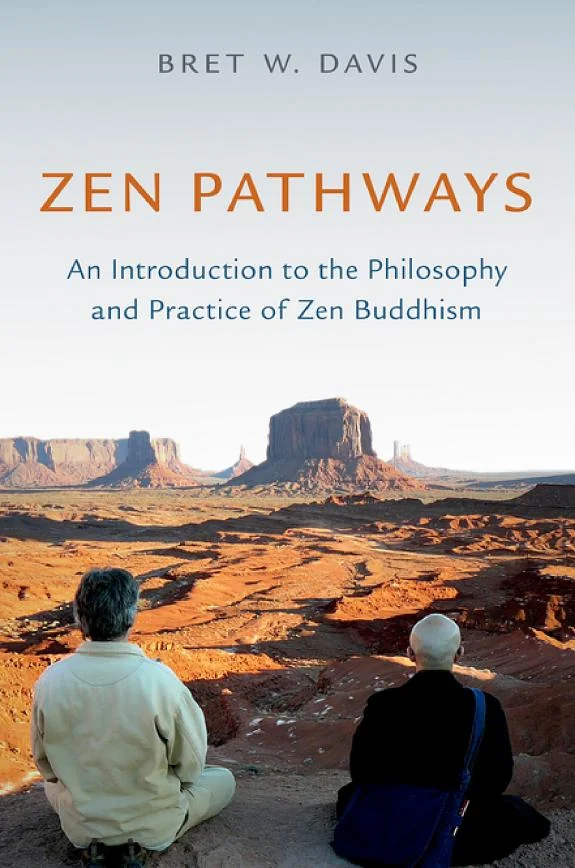
Zen Pathways
 73
73

Zen Pathways
Bret W. Davis's Zen Pathways presents a refreshingly direct engagement with Zen philosophy, eschewing the usual New Age platitudes. His methodical comparison of Zen's epistemological claims with Western philosophical traditions, particularly phenomenology, is a significant strength. Davis doesn't shy away from the intellectual rigor inherent in Zen, offering detailed analyses of koan study and the practice of *shikantaza*. However, the book occasionally feels dense, with sections on Western philosophy sometimes overshadowing the core Zen material for readers less familiar with figures like Husserl. A particularly illuminating passage discusses the non-dualistic nature of Zen consciousness, contrasting it with Cartesian subject-object divides. While dense, it provides a solid intellectual foundation for understanding Zen. Zen Pathways offers a valuable, albeit academically demanding, perspective for serious students.
📝 Description
73
Published in 2022, Zen Pathways examines the philosophical underpinnings of Zen Buddhism.
Bret W. Davis's Zen Pathways offers a scholarly yet accessible look at Zen Buddhism. The book moves past simple introductions to consider the philosophical foundations of Zen teachings. It places Zen within a wider context of Asian and Western thought, noting how it connects with and differs from established religious and philosophical systems. This work is for anyone wanting a thorough grasp of Zen, especially its philosophical aspects. Students of Buddhism, scholars of comparative religion, and practitioners seeking a deeper intellectual connection to their practice will find value here. Those interested in how ancient contemplative traditions apply to today's world will discover much to consider.
Davis engages with the history of Zen masters and scholars from the 20th century, like D.T. Suzuki. He also positions Zen in conversation with modern Western philosophy and psychology. The book acknowledges the widespread popularity of secular mindfulness practices, using this as a point of comparison to highlight Zen's distinct approach. This approach seeks a direct experience and understanding of Zen principles, not just adherence to doctrine.
Zen Pathways enters a contemporary discussion where Eastern religions have long held popular interest, though often at a surface level. Davis's work acknowledges the lineage of Zen masters and scholars, such as D.T. Suzuki, who shaped modern understanding. By connecting Zen to Western philosophy and psychology, the book bridges traditional contemplative practice with contemporary intellectual currents. Its 2022 publication allows for a comparison between traditional Zen's emphasis on direct experience and the prevalent secular mindfulness practices.
💡 Why Read This Book?
• Gain a nuanced understanding of *shikantaza*, moving beyond simple 'mindfulness' to grasp its specific Zen application as detailed in the book's practice sections. • Explore the philosophical implications of koan study, learning how these paradoxical dialogues challenge conventional thought patterns as analyzed by Davis. • Understand Zen's historical and philosophical context through comparisons with 20th-century thinkers like D.T. Suzuki, clarifying its unique place in global spiritual traditions.
⭐ Reader Reviews
Honest opinions from readers who have explored this book.
❓ Frequently Asked Questions
What is the publication year of Zen Pathways by Bret W. Davis?
Zen Pathways by Bret W. Davis was first published in 2022, offering a contemporary perspective on Zen philosophy and practice.
Does Zen Pathways offer practical meditation instructions?
Yes, the book provides concrete instructions for beginning a Zen meditation practice, making it suitable for both academic study and personal application.
How does Zen Pathways compare Zen to other philosophies?
The book systematically compares and contrasts Zen teachings and koans with various Asian and Western religions and philosophies, highlighting its unique attributes.
Is Zen Pathways suitable for beginners in Zen?
While scholarly, the book is structured as an in-depth introduction, making it accessible to dedicated beginners interested in the philosophical underpinnings of Zen.
What is a koan, as discussed in Zen Pathways?
A koan, as explored in Zen Pathways, is a paradoxical anecdote or riddle used in Zen Buddhism to provoke doubt and test a student's progress in Zen practice.
What is shikantaza according to Bret W. Davis?
Shikantaza, discussed in Zen Pathways, is a specific form of Zen meditation often translated as 'just sitting,' emphasizing a state of alert, non-judgmental awareness.
🔮 Key Themes & Symbolism
Koan Study and Paradox
The book meticulously examines the function of koans within Zen Buddhism, moving beyond their reputation as mere riddles. Davis illustrates how these paradoxical statements serve as critical tools for dismantling conceptual frameworks and fostering direct insight into the nature of reality. The work explores the historical development of koan curricula, particularly within the Rinzai school, and discusses their philosophical implications for understanding consciousness and non-duality.
Shikantaza and Awareness
A central theme is the practice of *shikantaza*, or 'just sitting.' Davis elucidates this practice not as passive idleness, but as an active, alert state of being present. The book contrasts this with other forms of meditation, emphasizing its role in cultivating a non-dualistic awareness free from conceptual elaboration. This exploration connects the practice to broader epistemological questions about how we know and experience the world.
Zen in Global Context
Zen Pathways situates Zen Buddhism within a wide intellectual landscape, comparing its core tenets with influential streams of Western philosophy, such as phenomenology and existentialism, as well as other Asian religious traditions. This comparative approach highlights Zen's unique philosophical contributions and its potential for cross-cultural dialogue, demonstrating its relevance beyond its East Asian origins.
Contemporary Application
A significant aspect of the book is its focus on applying traditional Zen teachings to the challenges and realities of twenty-first-century life. Davis addresses how the principles of Zen can inform ethical decision-making, personal well-being, and the cultivation of wisdom in a rapidly changing world. This theme bridges the gap between ancient wisdom and modern existence.
💬 Memorable Quotes
Direct passages from the work, attributed to the author.
“The goal of koan study is not to solve a puzzle, but to exhaust the conceptual mind.”
— This interpretation highlights the Zen emphasis on transcending intellectual analysis. It suggests that koans function as catalysts to break down habitual thinking patterns, leading to a more direct, intuitive understanding.
“Zen's critique of inherent selfhood aligns with certain Western existentialist concerns.”
— This captures Davis's comparative approach, suggesting a philosophical link between Zen's concept of 'no-self' and Western ideas about individual existence and freedom.
“Practice is not a means to an end, but the expression of enlightenment itself.”
— This interpretation emphasizes the integration of practice and realization in Zen, suggesting that the path itself is the manifestation of the goal, rather than a preparation for it.
💡 Key Ideas
Editorial paraphrase of the work's core concepts — not direct quotes.
Shikantaza cultivates a non-objectifying awareness.
This paraphrase points to the core of 'just sitting' practice as described by Davis. It emphasizes a state of consciousness that is not focused on particular objects or thoughts, but rather a broad, open presence.
The true nature of reality is often obscured by our conceptual interpretations.
This paraphrased concept underscores a fundamental Zen teaching: that our everyday understanding is filtered through mental constructs, preventing direct apprehension of reality as it is.
🌙 Esoteric Significance
Tradition
While Zen Buddhism itself is not typically categorized within Western esoteric traditions like Hermeticism or Kabbalah, its emphasis on direct experiential realization and the critique of dualistic thinking aligns with certain Gnostic and mystical currents. Davis's work, by comparing Zen to Western philosophies, implicitly bridges these domains. It explores non-dual awareness, a concept found in various mystical traditions seeking immediate apprehension of ultimate reality.
Symbolism
Key motifs explored include the koan, which functions as a symbolic paradox designed to disrupt rational thought and point towards a reality beyond concepts. Another significant symbol is the empty circle (ensō), often drawn by Zen masters, representing enlightenment, voidness, and the totality of existence—a potent visual metaphor for non-duality.
Modern Relevance
Contemporary thinkers and practitioners in fields ranging from psychology (especially transpersonal and contemplative psychology) to philosophy of mind draw upon Zen concepts. Davis's work provides a philosophical grounding for those exploring embodied cognition, non-dual philosophies, and the integration of contemplative practices into secular ethical frameworks or therapeutic modalities.
👥 Who Should Read This Book
• Students of comparative religion and philosophy seeking to understand Zen's unique place among global traditions. • Dedicated Zen practitioners interested in a deeper intellectual exploration of core concepts like koans and shikantaza. • Western philosophers and psychologists interested in cross-cultural dialogues on consciousness, selfhood, and reality.
📜 Historical Context
Published in 2022, Bret W. Davis's Zen Pathways enters a field long shaped by scholars like D.T. Suzuki, whose popularizations in the mid-20th century brought Zen to Western audiences. Davis's work distinguishes itself by engaging deeply with contemporary Western philosophy, particularly phenomenology, offering a more rigorous intellectual framework than many earlier introductions. While Suzuki engaged with figures like Carl Jung, Davis's dialogue is more directly with thinkers like Edmund Husserl and Martin Heidegger. The book's academic tone reflects a mature phase of Zen studies in the West, moving beyond initial introductions to critical analysis and comparative philosophy. Its publication occurs at a time when secular mindfulness is ubiquitous, allowing Davis to highlight the distinct philosophical and soteriological aims of traditional Zen practice, contrasting it with purely therapeutic or stress-reduction approaches.
📔 Journal Prompts
The nature of conceptual mind as a barrier to direct experience.
Shikantaza as a practice of alert, non-judgmental presence.
The philosophical implications of koan study for understanding reality.
Zen's critique of inherent selfhood in relation to personal identity.
Integrating Zen principles into twenty-first-century ethical living.
🗂️ Glossary
Shikantaza
A form of Zen meditation, often translated as 'just sitting,' characterized by alert, non-judgmental awareness without focusing on any particular object.
Koan
A paradoxical anecdote or riddle used in Zen Buddhism to provoke doubt and test a student's progress, intended to disrupt logical reasoning.
Non-duality
The philosophical concept that reality is not fundamentally divided into opposing pairs, such as subject/object, mind/body, or good/evil.
Epistemology
The branch of philosophy concerned with the theory of knowledge, exploring its nature, scope, and justification.
Phenomenology
A philosophical approach that focuses on the structures of consciousness as experienced from the first-person point of view.
Dukkha
A central concept in Buddhism, often translated as 'suffering,' 'dissatisfaction,' or 'stress,' referring to the inherent unsatisfactoriness of conditioned existence.
Soteriology
The branch of theology or religious studies concerned with the nature and means of salvation or liberation.
This book appears in 1 collection
🔮 Readers Also Liked
Browse all →









From the “Zen Buddhism” Collection
View all →









More Free Occult Philosophy Books
View all →