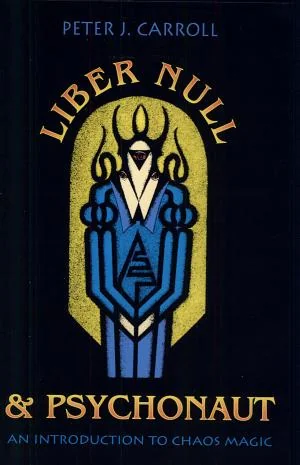
Liber Null & Psychonaut
 81
81

Liber Null & Psychonaut
Peter J. Carroll's Liber Null & Psychonaut remains a stark and potent manual for those willing to engage with its demanding philosophy. Unlike many esoteric texts that rely on historical reverence or complex mythology, Carroll presents a system stripped down to its operational essentials. The directness with which he approaches ritual and belief is its greatest strength. For instance, the section on 'results magick' in Psychonaut, which advocates for clear, measurable goals, cuts through much of the esoteric fog. However, the book's uncompromising stance can also be a limitation. Its focus on individual will and the subjective nature of reality may alienate readers seeking a more communal or traditionally spiritual path. The starkness, while effective, can feel cold to some. Nevertheless, for the practitioner focused on achieving specific magical effects through rigorous personal discipline, Liber Null & Psychonaut provides a robust, albeit challenging, framework. It is a practical guide for the determined sorcerer.
📝 Description
81
Peter J. Carroll published Liber Null & Psychonaut in 1987, a manual for chaos magick.
This 1987 text comprises two parts: Liber Null and Psychonaut. Liber Null details rituals and exercises for solitary practitioners aiming for direct magical will. It focuses on the individual's intent and belief to effect change. Psychonaut expands on this, offering theoretical underpinnings and methods for group magic. It also covers shamanic roles within a community setting.
The book is for occultists who want a practical, results-focused magical system. It suits those committed to altering consciousness and reality. Liber Null is for dedicated solo work, while Psychonaut provides avenues for those interested in leading or joining magical groups. It requires serious study of esoteric ideas and their application.
Emerging in the mid-1980s, Liber Null & Psychonaut presented a pragmatic, results-driven approach to magic, often called chaos magick. This contrasted with older, more dogmatic occult systems prevalent at the time. Carroll emphasized the practitioner's mental state and belief, rather than adherence to specific deities or traditions, as the primary force in magic. This period saw a greater exchange of esoteric ideas, though Carroll's work gained traction through underground channels and word-of-mouth.
💡 Why Read This Book?
• Learn to generate and utilize 'gnosis,' a key technique for achieving altered states necessary for potent spellcasting, as detailed in the 'Liber Null' sections on ritual. • Understand the creation and application of 'sigils,' a core method for imprinting magical intent into the subconscious, a practice explored throughout 'Psychonaut'. • Develop a pragmatic approach to magic by focusing on 'results magick,' learning to define and achieve tangible outcomes through focused willpower, a principle emphasized in 'Psychonaut'.
⭐ Reader Reviews
Honest opinions from readers who have explored this book.
❓ Frequently Asked Questions
What is the core difference between Liber Null and Psychonaut?
Liber Null focuses on individual, intense ritual and occult exercises for the committed practitioner. Psychonaut, conversely, provides a theoretical and practical guide for group magic, shamanic roles, and community-based magical work.
When was Liber Null & Psychonaut first published?
The combined work, Liber Null & Psychonaut, was first published in April 1987, consolidating earlier materials.
What is 'gnosis' in the context of Peter J. Carroll's work?
Gnosis refers to an altered state of consciousness, achieved through various techniques like sensory overload or deprivation, used to bypass the conscious mind and directly influence the subconscious with magical intent.
Is this book suitable for absolute beginners in magic?
While it explains concepts, the work is aimed at 'committed occultists' and assumes a degree of seriousness and willingness to experiment with potentially challenging techniques. Beginners might find it dense without prior grounding.
Does the book advocate for a specific magical tradition?
No, Carroll's approach, often termed 'chaos magick,' emphasizes personal belief and results over adherence to any single tradition, though it draws from various esoteric sources.
Where can I find more information about Peter J. Carroll?
Peter J. Carroll is a prominent figure in modern occultism, particularly associated with the development of chaos magick. Further details about his work and philosophy can be found in his other writings and through online esoteric communities.
🔮 Key Themes & Symbolism
Operational Magic
The book champions 'operational magic,' a pragmatic approach where the effectiveness of a magical act is judged solely by its results. This philosophy, central to chaos magick, posits that the practitioner's belief and intent are the primary tools, rather than adherence to specific dogma or cosmology. Techniques like sigil creation and gnosis induction are presented as functional methods for achieving desired outcomes, emphasizing practical application over theoretical abstraction. The focus is on what works, irrespective of its perceived 'truth' within established esoteric frameworks.
The Power of Belief
Central to Carroll's system is the concept that belief itself is a potent force capable of shaping reality. Liber Null & Psychonaut argues that one can temporarily adopt any belief system or paradigm to achieve magical goals. This 'belief shifting' allows practitioners to harness the power of different mythologies or symbolic systems without necessarily subscribing to them long-term. The work encourages the practitioner to become a 'psychonaut,' exploring the terrain of consciousness and belief with a focus on directed experimentation and verifiable effects.
Gnosis and Altered States
Achieving 'gnosis,' a state of heightened or altered consciousness, is presented as essential for effective magic. The book details various methods for inducing gnosis, including sensory overload, sensory deprivation, and intense focus. This state is crucial for bypassing the conscious mind's analytical filters, allowing magical commands or intentions to be directly impressed upon the subconscious. Understanding and reliably accessing gnosis is a central to the practical exercises presented in both Liber Null and Psychonaut.
Group and Shamanic Practice
While Liber Null focuses on individual work, Psychonaut extends the principles to communal settings. It outlines the theory and practice for group magic, where multiple practitioners can amplify intent and effect. Furthermore, it addresses the role of the 'shamanic priest' to the community, suggesting how magical principles can be applied to serve a collective, whether for healing, protection, or other communal needs. This broadens the scope from personal occultism to socially integrated magical practice.
💬 Memorable Quotes
Direct passages from the work, attributed to the author.
“Gnosis is the key that unlocks the subconscious.”
— This highlights the central role of altered states of consciousness. It posits that by reaching gnosis, practitioners can effectively communicate with and direct their subconscious mind, which is seen as the engine of magical manifestation.
“Magic is the science and art of causing change to occur in conformity with Will.”
— This is a core definition of magic presented in the work, framing it as a disciplined practice focused on directed intent and observable results, akin to a scientific endeavor.
“The magician is the shaman of the scientific age.”
— This interpretation suggests that the modern magician functions similarly to ancient shamans, navigating and influencing the unseen realms (in this case, consciousness and belief) but within a contemporary, often technologically influenced, context.
💡 Key Ideas
Editorial paraphrase of the work's core concepts — not direct quotes.
The only rule is that you must achieve results.
This paraphrased concept captures Carroll's emphasis on pragmatism. It suggests that the ultimate validation of any magical technique lies in its tangible efficacy, prioritizing demonstrable outcomes over adherence to tradition or theory.
Belief is a tool, not a dogma.
This paraphrased concept stresses the flexible nature of belief within chaos magick. Practitioners are encouraged to adopt beliefs as functional tools for specific magical operations, rather than adhering to them rigidly.
🌙 Esoteric Significance
Tradition
Carroll's work is a central to chaos magick, a contemporary esoteric current that emerged in the late 20th century. While drawing inspiration from diverse sources including Western Hermeticism, Tantra, and quantum physics, chaos magick fundamentally departs from traditional lineages by emphasizing operational results and the subjective nature of belief over fixed doctrines or cosmologies. It represents a radical pragmatism within esotericism, prioritizing 'what works' for the individual practitioner.
Symbolism
While chaos magick often eschews fixed symbolism, *Liber Null & Psychonaut* utilizes concepts like 'gnosis' – a key state of consciousness for magical efficacy – and 'sigils' – personalized symbols charged with intent. The 'psychonaut' itself symbolizes the explorer of inner space and consciousness. These elements represent the practitioner's direct engagement with psychological and conscious states as the primary tools for magical manipulation, rather than external divine forces or complex symbolic systems.
Modern Relevance
The influence of *Liber Null & Psychonaut* is profound in contemporary esoteric circles. Chaos magick principles, as codified by Carroll, are widely practiced and adapted by modern occultists, magicians, and even within certain subcultures interested in altered states and reality hacking. Thinkers and practitioners in fields ranging from modern witchcraft to performance art and digital culture often draw upon its emphasis on belief manipulation, sigil magick, and subjective experience.
👥 Who Should Read This Book
• Aspiring chaos magicians seeking a foundational text that outlines core principles like gnosis, sigil magick, and results-oriented practice. • Experienced occultists interested in exploring pragmatic, non-dogmatic approaches to magic that challenge traditional esoteric frameworks. • Individuals curious about the psychology of belief and consciousness exploration, looking for practical exercises to test the limits of subjective reality.
📜 Historical Context
Peter J. Carroll's *Liber Null & Psychonaut*, first published in 1987, emerged during a period of significant diversification within Western Esotericism. The late 20th century saw a move away from the more rigid, hierarchical structures of earlier magical orders towards more eclectic and pragmatic approaches. Carroll's work was instrumental in popularizing what became known as 'chaos magick,' a paradigm that challenged established occult traditions by prioritizing operational results and the subjective power of belief over adherence to specific cosmologies or deities. This contrasted sharply with the enduring influence of figures like Aleister Crowley and the ceremonial magic traditions that often emphasized complex rituals and specific pantheons. Carroll's approach resonated with a generation of practitioners seeking direct experience and demonstrable efficacy, fostering a more experimental and less dogmatic form of occultism that gained traction through underground networks and independent publications, often bypassing mainstream academic or critical reception.
📔 Journal Prompts
Reflect on a personal 'gnosis' experience and its potential for magical application.
Design a sigil for a desired outcome, considering the principles outlined in Psychonaut.
Analyze the concept of 'belief as a tool' in relation to your own convictions.
Consider how 'results magick' could be applied to a non-magical goal in your life.
Explore the potential role of a 'shamanic priest' within your community, inspired by Psychonaut's framework.
🗂️ Glossary
Gnosis
An altered state of consciousness, often characterized by intense focus or a trance-like state, achieved through various techniques to bypass the conscious censor and impress intent upon the subconscious.
Sigil
A symbol created to represent a specific magical intention, designed to be charged with energy (often through gnosis) and then forgotten by the conscious mind, allowing it to work on the subconscious.
Chaos Magick
A contemporary magical paradigm emphasizing practical results and the power of belief, often drawing eclectically from various traditions and focusing on individual experimentation.
Psychonaut
An explorer of consciousness and altered states; in Carroll's work, it refers to a practitioner engaged in magical operations within the range of the mind.
Results Magick
A form of magic focused explicitly on achieving tangible, measurable outcomes, where the efficacy of a technique is determined by its success rate.
Belief Shifting
The practice of adopting and utilizing different belief systems or paradigms temporarily as tools for magical operations, without necessarily committing to them permanently.
Operational Magic
Magic viewed and practiced as a functional system, where the primary criterion for validity is the achievement of desired effects or results.
This book appears in 1 collection
🔮 Readers Also Liked
Browse all →









From the “Occultism” Collection
View all →




More Free Occult Philosophy Books
View all →