Integral Yoga

 80
80

Integral Yoga
Haridas Chaudhuri's "Integral Yoga" offers a robust framework for spiritual seekers who feel the pull of both transcendence and immanence. Unlike many texts that advocate for withdrawal, Chaudhuri insists on the necessity of engaging with the material world, drawing a compelling parallel between the process of spiritual evolution and the unfolding of consciousness. His discussion of the 'Supermind' as an organizing principle for a transformed existence is particularly lucid. However, the sheer density of philosophical concepts, while intellectually stimulating, can occasionally feel overwhelming for the uninitiated. The practical application of these profound ideas, particularly in the later chapters, sometimes lacks the step-by-step guidance one might expect from a purely practical manual. The section detailing the 'Descent of Consciousness' provides a powerful conceptual anchor, but could benefit from more concrete examples of its lived experience. Despite this, the book provides a sophisticated synthesis, aiming to reconcile the inner quest with outer action. It is a substantial contribution to integral philosophy.
📝 Description
80
Haridas Chaudhuri's 2018 book, Integral Yoga, proposes a path unifying spiritual realization with daily life.
Integral Yoga, by Haridas Chaudhuri, presents a method for holistic development, aiming to integrate spiritual growth with the practicalities of everyday existence. The book argues against withdrawal from the world, instead advocating for a synthesis of inner contemplation and outward action as the path to genuine spiritual progress. Chaudhuri details a structured approach to spiritual development that bridges Eastern and Western thought, offering an alternative for those finding traditional spiritual paths either too extreme or too secular. Its interdisciplinary perspective draws from comparative religion, philosophy, and psychology, appealing to individuals keen on deepening their understanding of consciousness and its role in shaping a meaningful life.
This work is for the dedicated inquirer ready to commit to a practice of integral living. It addresses seekers and practitioners who seek a balanced approach to spiritual growth, one that acknowledges both the inner life and the demands of the outer world. Students of philosophy and psychology will find value in its integrated viewpoint. The book provides a detailed exposition for those wishing to advance their spiritual understanding and practice.
Haridas Chaudhuri's Integral Yoga emerged during the mid-20th century, a period of significant intellectual exchange between Eastern spiritual traditions and Western philosophy. Influenced by figures and movements that introduced Vedanta, Yoga, and Buddhism to Western audiences, Chaudhuri, associated with the Sri Aurobindo International Centre of Education, developed a unique synthesis. His work responded to a climate where materialist and rationalist views were being questioned, offering a spiritual framework that incorporated modern psychological and philosophical ideas within a yogic context.
💡 Why Read This Book?
• Understand the concept of the 'Supermind' as presented by Haridas Chaudhuri, offering a unique perspective on divine consciousness that goes beyond typical dualistic thinking. • Learn about the 'Descent of Consciousness' and how spiritual realization is intended to transform the material world, a core tenet of Chaudhuri's integral approach. • Explore the idea of 'Evolutionary Spirituality' as a dynamic process, distinct from static spiritual doctrines, and discover its implications for personal growth and global transformation.
⭐ Reader Reviews
Honest opinions from readers who have explored this book.
❓ Frequently Asked Questions
What is the core philosophy behind Haridas Chaudhuri's "Integral Yoga"?
The core philosophy is the integration of all aspects of human life—physical, mental, emotional, and spiritual—into a unified whole. It emphasizes realizing the divine within while actively engaging with and transforming the material world, rather than seeking to escape it.
When was "Integral Yoga" by Haridas Chaudhuri first published?
"Integral Yoga" by Haridas Chaudhuri was first published in 2018, making it a relatively recent articulation of his lifelong spiritual and philosophical work.
How does "Integral Yoga" differ from traditional forms of Yoga?
Unlike some traditional paths that may emphasize renunciation or withdrawal, Integral Yoga, as presented by Chaudhuri, advocates for a balanced approach that harmonizes spiritual aspiration with active participation in life and society. It seeks a total transformation of being.
What is the significance of the 'Supermind' in Chaudhuri's work?
The 'Supermind' is presented as a principle of divine consciousness and knowledge that can guide human evolution. Chaudhuri posits that integrating this higher consciousness can lead to a more harmonious and enlightened existence, resolving the conflicts inherent in ordinary human awareness.
Is "Integral Yoga" suitable for beginners in spiritual studies?
While "Integral Yoga" offers profound insights, its philosophical depth may be more suited to those with some background in spiritual or philosophical inquiry. Beginners might find it beneficial to approach it after familiarizing themselves with foundational concepts of Eastern thought.
What is the role of the 'Psyche' in Haridas Chaudhuri's Integral Yoga?
In Chaudhuri's framework, the 'Psyche' acts as a crucial intermediary. It is the faculty through which the individual consciousness connects with both the material world and the higher spiritual realms, facilitating the integration process central to Integral Yoga.
🔮 Key Themes & Symbolism
The Supermind Principle
The concept of the Supermind is central to Chaudhuri's Integral Yoga, presented not merely as an abstract ideal but as a functional principle of divine consciousness capable of transforming human existence. It represents a state of unified knowledge and being where duality ceases to exist. Chaudhuri elucidates how this higher consciousness can descend and integrate into the human psyche, offering a blueprint for overcoming limitations and conflicts inherent in ordinary awareness. This theme explores the potential for a radical transformation of consciousness, bridging the gap between the divine and the human.
Integral Evolution
Chaudhuri frames spiritual development not as a static attainment but as a dynamic, evolutionary process. Integral Yoga posits that human evolution is moving towards a state of conscious unity, driven by an inherent spiritual purpose. This theme emphasizes the holistic nature of this evolution, encompassing all levels of being—physical, vital, mental, and spiritual. It suggests that true progress involves the harmonious unfolding of these dimensions, leading to a transformed individual and, ultimately, a transformed world. This perspective challenges views of evolution as purely biological or material.
Psyche and Transformation
The 'Psyche' is explored as the vital intermediary in the process of spiritual transformation. It is the locus where the external world interacts with the inner being and where the descent of higher consciousness can occur. Chaudhuri details the functions of the psyche in mediating experiences and integrating spiritual insights into practical life. The theme focuses on how understanding and consciously working with the psyche are essential for achieving the holistic integration that defines Integral Yoga, enabling individuals to embody spiritual truths in their daily actions and interactions.
Unity of Being
At its heart, Integral Yoga is about achieving a profound unity of being, dissolving the artificial separations between spirit and matter, the individual and the cosmos. This theme underscores the interconnectedness of all existence and the potential for realizing this unity within oneself. Chaudhuri argues that spiritual practice should aim to unify all aspects of life, leading to a coherent and harmonious existence. The goal is not to negate the world but to see and live in it from a perspective of divine wholeness, bringing the spiritual into the material.
💬 Memorable Quotes
Direct passages from the work, attributed to the author.
“Integral Yoga seeks the harmonious unfolding of all the powers of the human being.”
— This statement expresses the core aim of Chaudhuri's philosophy: a comprehensive spiritual development that doesn't neglect any aspect of human life. It suggests a balanced approach, integrating inner spiritual realization with the full expression of one's capabilities in the outer world.
“The Supermind is the principle of divine knowledge and action.”
— This highlights the functional aspect of the Supermind in Chaudhuri's system. It's not just an abstract concept but a direct source of wisdom and effective action, implying that its integration can resolve human problems by bringing divine order into earthly affairs.
“Evolutionary spirituality aims at a total transformation of man and his world.”
— This interpretation emphasizes the grand scope of Integral Yoga, positioning it as a force for collective as well as individual change. It suggests that spiritual growth is not an end in itself but a catalyst for a profound and widespread transformation of human civilization and its environment.
“Realization must express itself in action.”
— This concise concept underscores the practical imperative of Integral Yoga. Spiritual experiences and insights are not meant to remain purely internal; they must be embodied and manifested through one's actions in the world, demonstrating the integration of the spiritual and the mundane.
💡 Key Ideas
Editorial paraphrase of the work's core concepts — not direct quotes.
The psyche is the bridge between the material and the spiritual.
This paraphrase points to the crucial role of the human psyche in Chaudhuri's model. It acts as the essential connector, the interface through which spiritual energies and insights can be received, assimilated, and expressed in the material realm.
🌙 Esoteric Significance
Tradition
Integral Yoga, as articulated by Haridas Chaudhuri, draws heavily from the Yogic and Vedantic traditions of India, particularly the integral philosophy of Sri Aurobindo. It departs from purely ascetic or renunciatory paths by emphasizing the spiritual potential of matter and the necessity of transforming the material world rather than escaping it. It aligns with the Hermetic principle of "As Above, So Below" by seeking to manifest divine principles in earthly existence, though its framework is distinctly Indian in origin.
Symbolism
While not heavily reliant on overt symbolism in the Western Hermetic sense, Chaudhuri's work implies potent symbolic transformations. The 'Descent of Consciousness' can be seen as a symbolic representation of the divine entering the material realm, a reversal of the typical spiritual ascent. The concept of the 'Supermind' itself functions symbolically, representing the ultimate organizing principle and perfect knowledge that humanity strives to embody, bridging the finite and infinite.
Modern Relevance
Chaudhuri's Integral Yoga continues to influence contemporary thinkers and practitioners interested in holistic development and the integration of spirituality with everyday life. It finds resonance with movements in transpersonal psychology, integral theory (as developed by Ken Wilber, who was influenced by Aurobindo's ideas), and ecospiritualism, which seek to reconcile inner growth with outer action and environmental responsibility. His work provides a philosophical basis for those seeking a unified approach to personal transformation and societal change.
👥 Who Should Read This Book
• Students of Sri Aurobindo and The Mother: Those seeking a deeper, more philosophical exposition of the principles of Integral Yoga as developed at Pondicherry, offering scholarly context and systematic elaboration. • Seekers of holistic spiritual paths: Individuals dissatisfied with spiritual practices that compartmentalize life or demand withdrawal from worldly responsibilities, looking for a method to integrate spirit and matter. • Comparative philosophy scholars: Researchers interested in the synthesis of Eastern spiritual thought with Western philosophical concepts, particularly in the areas of consciousness, evolution, and metaphysics.
📜 Historical Context
Haridas Chaudhuri's "Integral Yoga" emerged from the fertile intellectual ground of mid-20th century India and its increasing engagement with the West. Following the independence of India in 1947, there was a surge in philosophical and spiritual discourse seeking to synthesize ancient traditions with modern thought. Chaudhuri, associated with the influential Sri Aurobindo International Centre of Education, was part of a generation grappling with how to present profound Indian spiritual philosophy in a way that resonated with contemporary global concerns. This era saw figures like Aldous Huxley exploring 'The Perennial Philosophy' and a growing academic interest in comparative religion and Eastern psychology. Chaudhuri's work can be seen as a sophisticated response to the perceived fragmentation of modern life, offering an integrated path that contrasted with both purely materialistic scientific outlooks and more ascetic or escapist spiritual models. His approach contributed to the broader movement of integral philosophy, which sought to reconcile diverse fields of knowledge and experience.
📔 Journal Prompts
The concept of the 'Supermind' and its potential integration into daily decision-making.
Reflecting on the 'Descent of Consciousness' in personal experiences of insight.
How the principle of 'Unity of Being' can inform interactions with others.
Mapping the 'Psyche's' role in mediating spiritual aspirations and material realities.
The practical application of 'Evolutionary Spirituality' to current challenges.
🗂️ Glossary
Integral Yoga
A spiritual path aiming for the holistic transformation of the individual by integrating all aspects of life—physical, vital, mental, psychic, and spiritual—under the guidance of higher consciousness.
Supermind
In Chaudhuri's philosophy, the highest principle of consciousness, embodying divine knowledge, will, and action, capable of organizing and transforming existence harmoniously.
Psyche
The inner being or soul, acting as the intermediary between the higher spiritual planes and the lower material existence, crucial for spiritual transformation.
Descent of Consciousness
The process by which higher spiritual realities and consciousness manifest and integrate into the lower planes of existence, including the material world.
Evolutionary Spirituality
A view of spiritual development as a dynamic, progressive unfolding of consciousness throughout the cosmos and humanity, moving towards greater unity and perfection.
Unity of Being
The realization of the interconnectedness and essential oneness of all existence, dissolving perceived dualities between spirit and matter, self and universe.
Vital
Pertaining to the life-force or energy that animates living beings, often associated with desires, emotions, and instinctive drives.
🔮 Readers Also Liked
Browse all →








More by Haridas Chaudhuri
All books →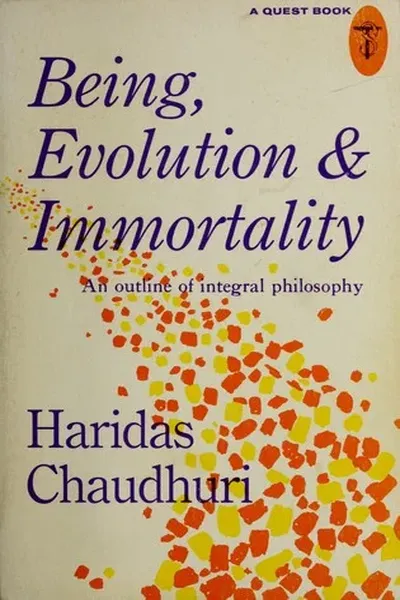
More Free Occult Philosophy Books
View all →