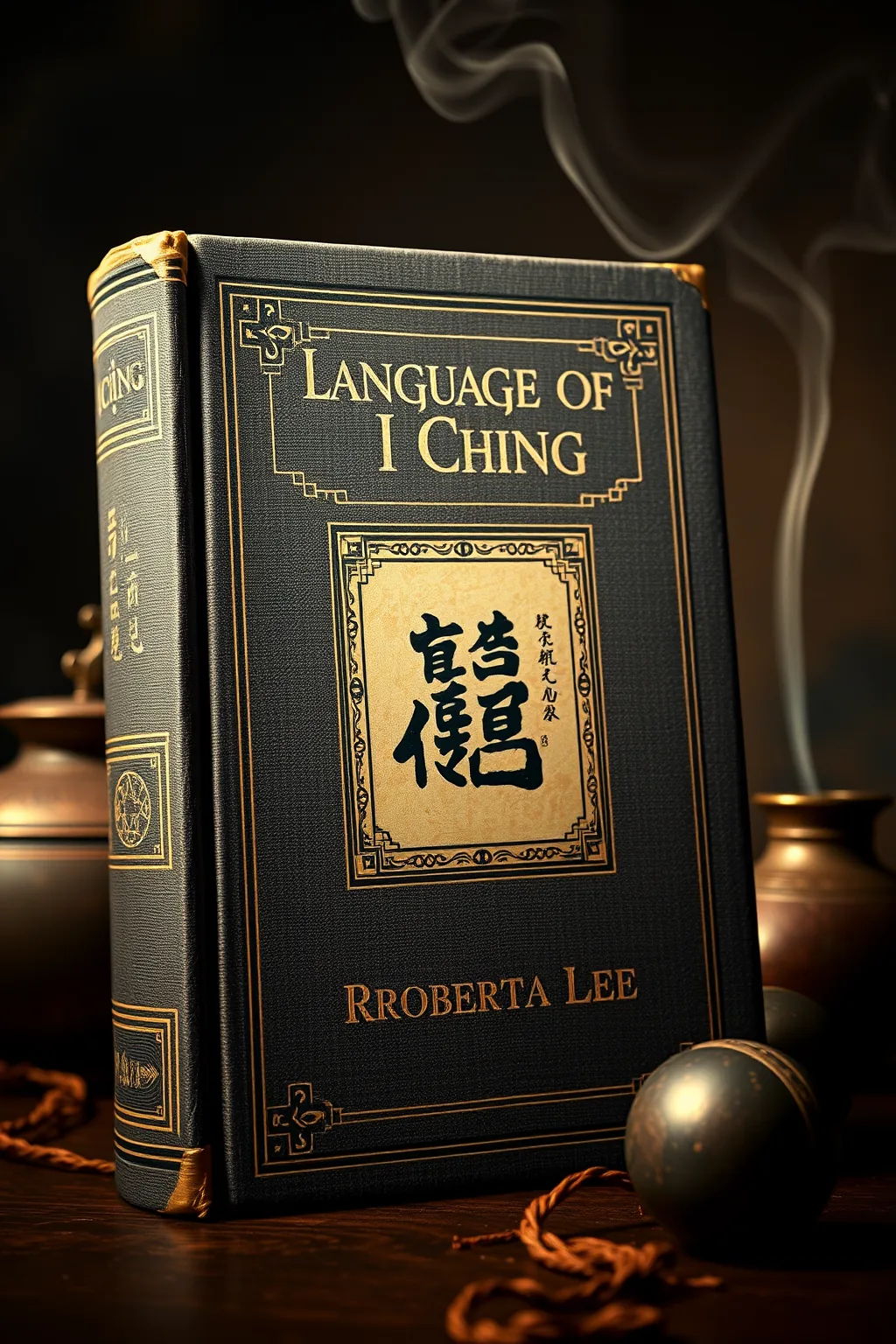
Language of I Ching
 61
61

Language of I Ching



Roberta Lee's 'Language of I Ching' stands as a luminous beacon for those navigating the intricate currents of divination. Sage Lorelei, from her contemplative perch, finds Lee's scholarship both rigorous and deeply intuitive. This work transcends rote interpretation, offering a profound exploration of the Yi Jing's symbolic lexicon and its philosophical resonance. Lee masterfully guides the reader through the oracle's layered meanings, revealing its capacity for profound self-reflection and predictive insight. Essential for serious students of the I Ching and seekers of esoteric wisdom, this book offers a rare blend of academic depth and spiritual illumination. It is a testament to the enduring power of ancient knowledge.
📝 Description
61
Roberta Lee's 'Language of I Ching' (1993) unpacks the oracle's symbolic grammar.
Roberta Lee’s 1993 book, 'Language of I Ching,' moves beyond simple translation to examine the oracle's underlying structure. Lee interprets the hexagrams not as static symbols, but as components of a dynamic system. She focuses on the 'grammar' of the I Ching, suggesting a hidden logic that connects its various elements.
The text aims to show how the I Ching's philosophy, including its concepts of Yin and Yang and cyclical change, can be understood through its symbolic language. Lee connects these ideas to a broader understanding of existence and interconnectedness. The book is intended for those interested in the philosophical and divinatory aspects of the I Ching, seeking a deeper comprehension of its principles and practical application.
This book is situated within the study of Chinese classical thought and its divinatory traditions. The I Ching, or 'Book of Changes,' is a central text in Daoism and Confucianism, used for centuries for divination and philosophical reflection. Lee's work engages with the esoteric dimension of this text, treating its symbols and structure as a form of cosmic language. It connects the I Ching's principles to broader metaphysical concepts, aligning with traditions that seek hidden order and meaning in the universe.
💡 Why Read This Book?
Unlock the profound wisdom of the I Ching, not just as a divinatory tool, but as a philosophical guide to cosmic order. 'Language of I Ching' offers a unique perspective, revealing the oracle's symbolic language as a key to understanding life's patterns and one's place within them. Ideal for seekers of self-knowledge, students of Eastern philosophy, and anyone drawn to the mystical arts.
⭐ Reader Reviews
Honest opinions from readers who have explored this book.
❓ Frequently Asked Questions
What is the I Ching?
The I Ching, or Book of Changes, is an ancient Chinese divination text and philosophical classic, believed to be the oldest Chinese classic. It uses a system of hexagrams to offer guidance on life situations and predict future trends.
Is this book suitable for beginners?
Absolutely. While deeply profound, Roberta Lee's approach makes the 'Language of I Ching' accessible to newcomers while offering rich layers of insight for experienced practitioners.
How does this book differ from other I Ching translations?
This book focuses on the symbolic language and philosophical underpinnings, moving beyond mere literal translation to explore the esoteric meanings and energetic flow within the hexagrams.
Can I use this book for practical divination?
Yes, the book is designed to empower readers to engage in practical divination, offering a deeper understanding of the hexagrams' messages and their application to daily life.
What is the philosophical significance of the I Ching?
The I Ching offers a profound worldview based on balance, change, and interconnectedness, exploring the dynamic interplay of Yin and Yang and the principles governing the cosmos and human experience.
🔮 Key Themes & Symbolism
The Cosmic Dance of Yin and Yang
This theme studies the fundamental principle of duality that underpins the I Ching. It explores how the interplay of Yin (passive, feminine, dark) and Yang (active, masculine, light) creates the dynamic flux of existence. Lee elucidates how these opposing yet complementary forces manifest in the hexagrams, influencing the ebb and flow of events and offering insights into achieving balance and harmony within oneself and the world.
Hexagrammatic Symbolism and Archetypes
Here, the book unpacks the rich symbolic language embedded within the 64 hexagrams. Each hexagram, composed of six lines, acts as a cosmic blueprint, representing specific archetypal situations, energies, and transformations. Lee guides the reader in deciphering these visual and conceptual symbols, revealing how they function as profound metaphors for the human journey and the underlying order of the universe.
The Oracle as a Mirror of the Soul
This theme emphasizes the I Ching's role as a sophisticated tool for self-reflection and inner wisdom. The book illustrates how consulting the oracle is not merely about predicting the future, but about gaining clarity on one's current situation, understanding hidden motivations, and aligning with one's true path. It presents the I Ching as a spiritual dialogue, fostering introspection and personal growth.
💬 Memorable Quotes
Direct passages from the work, attributed to the author.
“Within the stillness, the universe whispers its secrets.”
— This highlights the meditative and introspective aspect of consulting the I Ching, emphasizing that true insight comes from attentive inner listening and quiet contemplation.
“Change is the only constant, and wisdom lies in its embrace.”
— This expresses a core tenet of the I Ching, promoting acceptance of life's impermanence and the development of flexibility and resilience in the face of transformation.
“The hexagram is a map of the soul's terrain.”
— This profound statement positions the I Ching as a tool for deep psychological and spiritual exploration, suggesting that its symbols represent the inner field of human consciousness.
💡 Key Ideas
Editorial paraphrase of the work's core concepts — not direct quotes.
The lines speak not of fate, but of potential.
This quote suggests that the I Ching doesn't dictate a fixed future but rather reveals the energies and possibilities inherent in a situation, empowering the user to shape their destiny.
To know the Way is to flow with its currents.
This quote speaks to the practical application of I Ching wisdom, advocating for alignment with natural principles and a harmonious approach to life's challenges.
🌙 Esoteric Significance
Tradition
The I Ching is a central to Taoist and Confucian philosophy, deeply embedded in the esoteric traditions of ancient China. It represents a sophisticated system of cosmic understanding, aligning the human realm with the celestial order. Its study is considered a path to 'wu wei' (non-action) and the realization of the Tao, emphasizing naturalness, spontaneity, and the harmonious flow of universal energies.
Symbolism
The core symbolism revolves around the Yin-Yang duality, represented by broken (Yin) and solid (Yang) lines. These combine to form trigrams and ultimately 64 hexagrams, each a potent archetype of cosmic phenomena, human situations, and transformative processes. The trigrams (Heaven, Earth, Water, Fire, etc.) are elemental forces, and their combinations within the hexagrams create a dynamic lexicon of universal principles and archetypal energies.
Modern Relevance
In the modern era, the I Ching continues to offer profound relevance as a tool for navigating complexity and uncertainty. Its cyclical view of change provides a framework for understanding personal growth, societal shifts, and global challenges. Esoterically, it serves as a powerful oracle for self-discovery, intuitive development, and the cultivation of inner balance in an increasingly fragmented world.
👥 Who Should Read This Book
This book is an indispensable resource for a diverse audience. **Beginners** seeking an accessible yet profound introduction to the I Ching will find Roberta Lee's explanations clear and clear. **Scholars** of Eastern philosophy and comparative religion will appreciate the depth of her research and the nuanced interpretation of complex concepts. **Seekers** of spiritual guidance and self-knowledge will discover a powerful oracle and a roadmap for personal transformation. **Practitioners** of divination and esoteric arts will find their understanding of the Yi Jing enriched, unlocking new dimensions of insight and application.
📜 Historical Context
The I Ching, originating in ancient China, has a history stretching back over three millennia. Its early forms are associated with shamanic practices and rudimentary divination systems, evolving into a complex philosophical and cosmological text during the Zhou Dynasty. Confucius and his disciples are credited with its further development and interpretation, imbuing it with ethical and moral dimensions. Throughout imperial China, the I Ching served as a foundational text for scholars, statesmen, and mystics alike, influencing military strategy, governance, and personal spiritual development. Its enduring appeal lies in its adaptable wisdom, resonating across dynasties and cultural shifts, and its influence has permeated East Asian thought and, more recently, Western esoteric traditions, offering timeless insights into the human condition.
📔 Journal Prompts
Reflect on a recent challenge: Which hexagram's wisdom resonates most with your current situation, and why?
Consider the balance of Yin and Yang in your daily life. Where do you feel an imbalance, and how can you cultivate greater harmony?
What archetypal energy do you feel is most dominant in your life right now, as represented by a specific trigram?
How does the concept of 'change' as presented in the I Ching influence your perspective on future goals?
If the I Ching were to offer a single piece of advice for your spiritual journey, what might it be, based on its core principles?
🗂️ Glossary
Hexagram
A symbol composed of six stacked lines, either solid (Yang) or broken (Yin), representing a specific situation or cosmic principle in the I Ching.
Trigram
A symbol composed of three stacked lines (Yin or Yang), forming the building blocks of hexagrams, each representing fundamental elemental forces or concepts.
Yin
The passive, feminine, dark, receptive, and yielding principle in Taoist philosophy, often represented by a broken line in the I Ching.
Yang
The active, masculine, light, assertive, and creative principle in Taoist philosophy, often represented by a solid line in the I Ching.
Yi Jing
The ancient Chinese classic of divination and philosophy, also known as the Book of Changes, renowned for its wisdom and predictive capabilities.
This book appears in 3 collections
🔮 Readers Also Liked
Browse all →







From the “Tarot” Collection
View all →







More Free Divination & Tarot Books
View all →