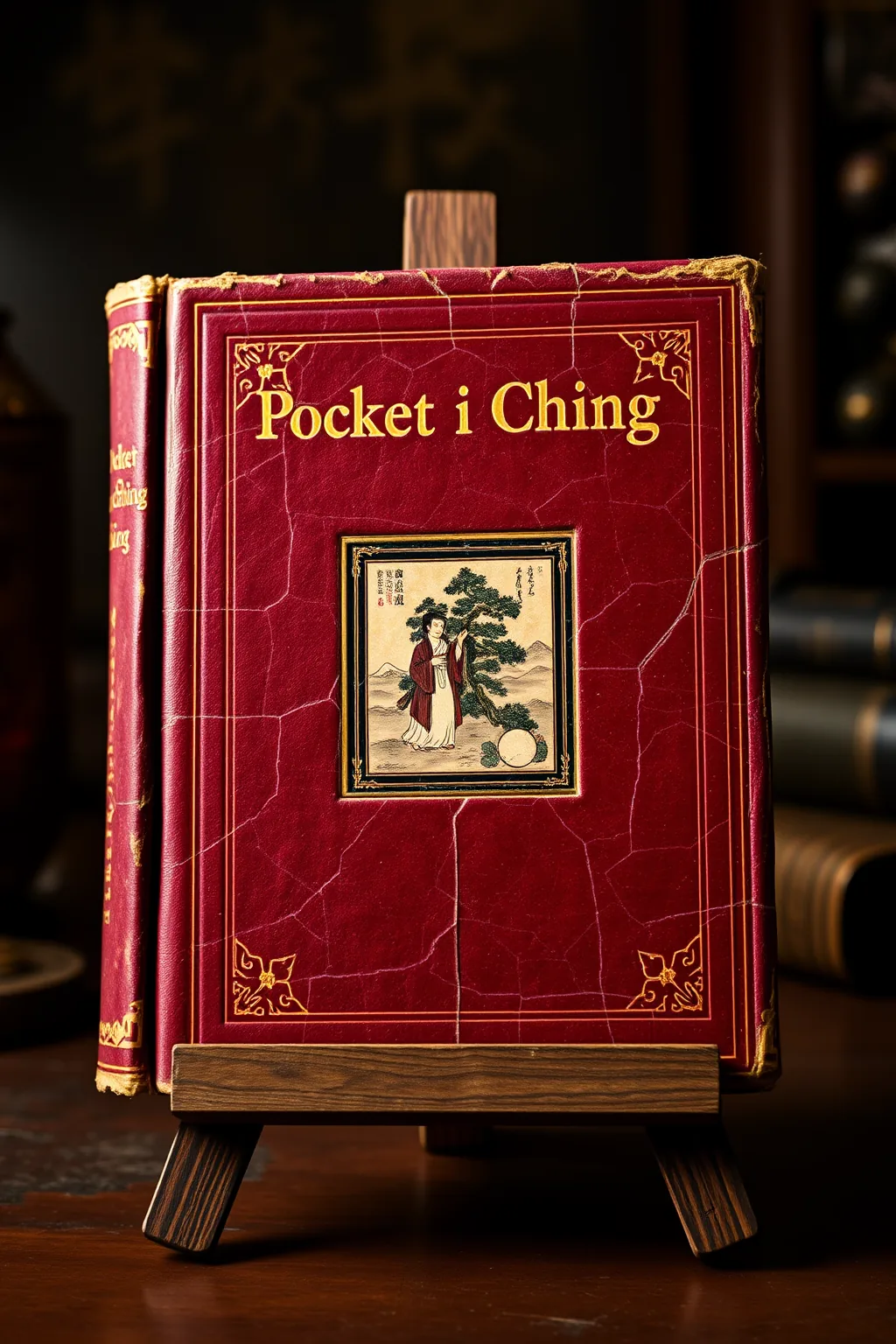
Pocket i Ching
 61
61

Pocket i Ching



Frank MacHovec's "Pocket I Ching" is a beacon for serious students of esoteric knowledge. It transcends mere translation, offering a profound distillation of the I Ching's philosophical depth and divinatory power. MacHovec's expertise shines through, presenting the hexagrams and their interpretations with clarity and a keen eye for esoteric nuance. This edition is particularly valuable for its ability to connect the ancient wisdom of the Yi Jing to modern psychological frameworks of self-actualization, making it an indispensable tool for practitioners seeking holistic growth. It is a treasure for anyone embarking on a journey of inner discovery and seeking authentic guidance from the archetypal patterns of the universe.
📝 Description
61
Frank MacHovec's Pocket i Ching, published in 1992, presents a concise guide to the ancient Chinese oracle.
This small volume offers an introduction to the I Ching, a text used for divination and philosophical contemplation for centuries. MacHovec breaks down the 64 hexagrams, explaining their symbolic meanings and how they relate to life's situations. The book aims to make the core concepts of the I Ching accessible to readers interested in personal growth or understanding deeper universal principles.
It is structured for those who want a direct way to engage with the I Ching's insights. The text focuses on the interplay of yin and yang, the foundational elements of the system, and how these forces influence events. Readers can use it to seek clarity on specific questions or to gain a broader perspective on the cyclical patterns of existence.
The I Ching, or 'Book of Changes,' is a cornerstone of Chinese classical philosophy and esoteric thought. Its origins are traced to ancient China, where it was used by rulers and scholars for divinatory purposes and to understand the underlying order of the universe. The text's structure, based on 64 hexagrams formed by combinations of yin and yang lines, provides a framework for interpreting events and human behavior. MacHovec's work situates itself within the tradition of Western engagement with these Eastern systems, making its complex philosophy and practical application available to a modern audience.
💡 Why Read This Book?
This essential guide invites you to unlock the profound wisdom of the I Ching, a timeless oracle for self-discovery and navigating life's complexities. Ideal for seekers of spiritual insight, students of divination, and anyone yearning for deeper self-understanding, it offers practical guidance and philosophical depth in a portable format. Explore the archetypal patterns of change and gain clarity on your path.
⭐ Reader Reviews
Honest opinions from readers who have explored this book.
❓ Frequently Asked Questions
What is the I Ching?
The I Ching, or "Book of Changes," is an ancient Chinese text and a fundamental classic of Chinese philosophy and divination. It comprises 64 hexagrams, each representing a specific situation or state of being, and offers insights into the natural principles of change and transformation.
How is the "Pocket I Ching" different from other translations?
Frank MacHovec's "Pocket I Ching" distinguishes itself by its focus on the psychological and self-actualization aspects of the hexagrams, alongside their traditional divinatory meanings. It aims to provide a more accessible and personally relevant interpretation for modern readers.
Can I use this book for everyday guidance?
Absolutely. The "Pocket I Ching" is designed for practical application. By casting hexagrams (using methods like coin tossing or yarrow stalks, often explained within the book), you can receive guidance on current situations and potential future developments.
Is prior knowledge of the I Ching required?
No, prior knowledge is not strictly required. The "Pocket I Ching" is structured to be approachable for beginners, offering clear explanations of the core concepts and hexagram interpretations, while still providing depth for experienced practitioners.
What are the primary benefits of studying the I Ching?
Studying the I Ching offers enhanced self-awareness, improved decision-making, a deeper understanding of life's cycles, and a connection to universal principles of change. It fosters a more adaptable and insightful approach to personal challenges and opportunities.
🔮 Key Themes & Symbolism
The Dance of Yin and Yang
At the heart of the I Ching lies the dynamic interplay of Yin and Yang, the fundamental cosmic forces of duality. These opposing yet complementary principles—passive and active, dark and light, feminine and masculine—are not in conflict but in a perpetual state of transformation. The hexagrams are visual representations of their ever-shifting balance, illustrating how their interaction shapes all phenomena. Understanding this primal dance is key to deciphering the flow of events and recognizing the underlying order within apparent chaos. This theme explores how embracing these dualities leads to a more integrated and harmonious existence, fostering balance within oneself and in one's interactions with the world.
The Cycles of Change and Transformation
The I Ching is fundamentally a book about change, chronicling the inevitable cycles that govern the universe and human experience. Each of the 64 hexagrams represents a distinct phase or turning point within these grand cycles. MacHovec's interpretation emphasizes how recognizing and adapting to these shifts is crucial for personal growth and navigating life's challenges. By understanding the archetypal patterns of transformation—from beginnings to endings, from growth to decline—one can learn to act in accordance with the Tao, embracing fluidity and resilience. This theme encourages a proactive rather than reactive approach to life's flux, fostering wisdom through acceptance and timely action.
Self-Actualization Through Archetypal Wisdom
Beyond mere divination, the "Pocket I Ching" offers a profound pathway to self-actualization. The hexagrams serve as mirrors reflecting our inner states and potential, guiding us towards realizing our fullest selves. MacHovec connects the ancient symbolism to modern psychological concepts, illustrating how understanding these archetypal patterns can illuminate our personal journeys. By consulting the I Ching, individuals can gain clarity on their strengths, weaknesses, and the karmic lessons embedded in their life paths. This theme highlights the book's power as a tool for introspection, personal development, and achieving a state of integrated wholeness, aligning inner purpose with outer action.
💬 Memorable Quotes
Direct passages from the work, attributed to the author.
“Within every ending lies the seed of a new beginning.”
— This highlights the cyclical nature of existence as depicted in the I Ching, emphasizing hope and continuity even in moments of apparent cessation.
“To know the flow is to master the current.”
— This speaks to the divinatory and practical application of the I Ching, suggesting that understanding the forces at play allows one to navigate life more effectively.
“The wise person aligns their actions with the cosmic rhythm.”
— This emphasizes the importance of attunement and harmony with universal principles, a central tenet of Daoist philosophy and I Ching practice.
💡 Key Ideas
Editorial paraphrase of the work's core concepts — not direct quotes.
The universe is a range woven with the threads of change.
This quote captures the essence of the I Ching's philosophy: that constant transformation is the fundamental nature of reality, and understanding this is key to wisdom.
Seek not answers, but understanding of the unfolding.
This quote reframes the purpose of consulting the I Ching, moving beyond simple prediction to a deeper, more insightful comprehension of life's processes.
🌙 Esoteric Significance
Tradition
The "Pocket I Ching" is deeply rooted in the esoteric traditions of ancient China, primarily Daoism and its philosophical interpretations of the universe. It draws from the principles of cosmic interconnectedness, the cyclical nature of existence, and the subtle energies that govern all phenomena. Within the Daoist framework, the I Ching serves as a map of the Tao, the fundamental, ineffable principle of the universe. Its esoteric significance lies in its ability to reveal the hidden patterns and underlying order of reality, offering a direct means to commune with these universal forces and align one's life with their natural flow.
Symbolism
The core symbolism of the I Ching resides in its 64 hexagrams, each composed of six lines that are either solid (Yang) or broken (Yin). These lines represent fundamental forces, while their combinations evoke archetypal situations and states of being. The trigrams (three-line combinations) are foundational, symbolizing elements like Heaven, Earth, Fire, Water, Mountain, Lake, Thunder, and Wind. The arrangement and interaction of these trigrams within a hexagram create a rich symbolic language that speaks to the dynamics of change, relationships, and the unfolding of events. The book's esoteric value is in decoding these symbols to gain insight into the subtle workings of the cosmos and one's place within it.
Modern Relevance
In the modern era, the I Ching's esoteric significance has found profound relevance in fields ranging from psychology to systems thinking. Its exploration of archetypal patterns appeals to Jungian psychology, offering insights into the collective unconscious. The book's emphasis on change and adaptation provides invaluable guidance for reading through the complexities and uncertainties of contemporary life. Furthermore, its principles of balance, interconnectedness, and cyclical progression offer a counterpoint to reductionist and linear thinking, encouraging a more holistic and mindful approach to personal development, decision-making, and understanding the intricate web of relationships in our lives.
👥 Who Should Read This Book
This "Pocket I Ching" is an indispensable resource for a diverse range of readers. **Beginners** seeking an accessible entry point into the world of the I Ching will find its interpretations clear and practical. **Scholars and practitioners** of divination, Eastern philosophies, and esoteric traditions will appreciate its depth and nuanced perspective. **Seekers of self-knowledge and personal growth** will discover a powerful tool for introspection and guidance, connecting ancient wisdom to modern psychological insights. **Anyone feeling adrift or seeking clarity** amidst life's transitions will find solace and direction within its pages, making it a valuable companion for continuous learning and spiritual unfolding.
📜 Historical Context
The I Ching, or "Book of Changes," has a lineage stretching back over three millennia, originating in ancient China. Its earliest forms are believed to date from the Western Zhou Dynasty (c. 1046–771 BCE), evolving from earlier divination practices. Initially used by royalty and shamans for state and personal fortune-telling, it gradually developed into a profound philosophical text, deeply influencing Confucianism and Daoism. During the Han Dynasty (206 BCE–220 CE), the I Ching became one of the "Five Classics," solidifying its status as a core part of Chinese intellectual and spiritual life. Its influence spread throughout East Asia, impacting Korean, Japanese, and Vietnamese cultures. In the 20th century, Western scholars and mystics, such as Carl Jung, recognized its psychological depth and universal archetypes, leading to its widespread adoption in Western esoteric and psychological circles. Frank MacHovec's "Pocket I Ching" represents a modern interpretation, bridging ancient wisdom with contemporary understanding, making this timeless oracle accessible to a new generation of seekers.
📔 Journal Prompts
Reflect on a recent change in your life. Which hexagram(s) might represent this transition, and what guidance do they offer?
Consider a recurring challenge you face. How might the principles of Yin and Yang shed light on its underlying dynamics?
If you were to consult the I Ching for guidance on your personal growth, what question would you ask, and what would you hope to learn?
How can the archetypal wisdom of the I Ching be applied to foster greater balance in your daily life?
Explore a situation where you felt 'stuck.' What hexagram's message of transformation could inspire a new approach?
🗂️ Glossary
Hexagram
A symbol composed of six stacked lines, each either solid (Yang) or broken (Yin). The I Ching consists of 64 unique hexagrams, each representing a fundamental situation or state of being.
Yin
The passive, receptive, dark, feminine principle in Chinese philosophy, often represented by a broken line (--) in I Ching hexagrams. It signifies qualities like yielding, stillness, and introspection.
Yang
The active, creative, light, masculine principle in Chinese philosophy, represented by a solid line (—) in I Ching hexagrams. It embodies qualities like dynamism, assertiveness, and outward expression.
Trigram
A symbolic combination of three lines, either solid or broken. There are eight basic trigrams, each associated with specific elements, natural phenomena, and archetypal concepts.
Tao (Dao)
The fundamental, ineffable principle of the universe in Daoist philosophy. It represents the natural order, the way of things, and the source of all existence, often understood through its manifestations in nature and change.
This book appears in 3 collections
🔮 Readers Also Liked
Browse all →









From the “Tarot” Collection
View all →









More Free Divination & Tarot Books
View all →