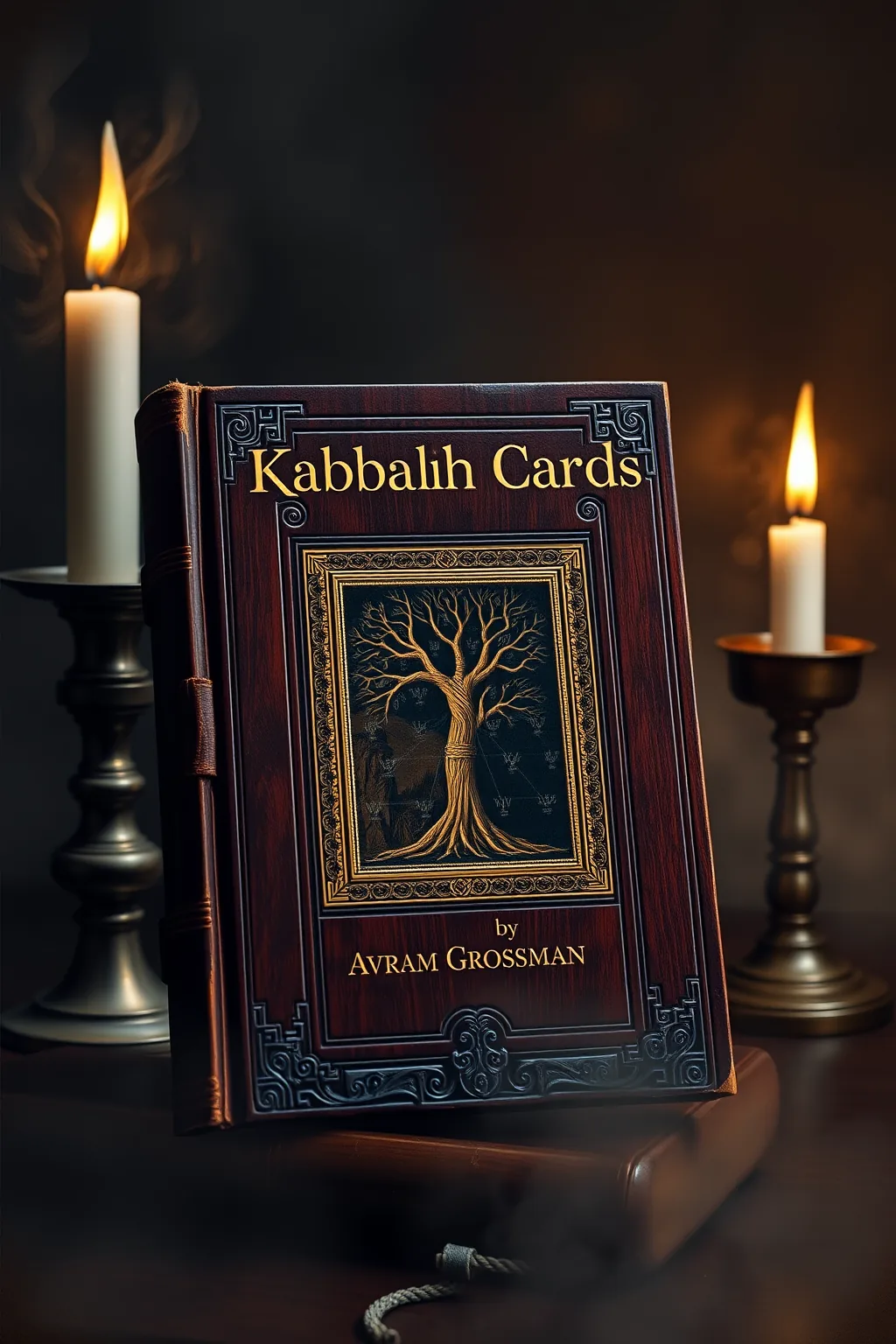
Kabbalah Cards
 61
61

Kabbalah Cards


Balthazar Finch (Senior Critic, Occult Philosophy) — Avram Grossman's 'Kabbalah Cards' is a luminous beacon for students of the esoteric. Grossman possesses a rare gift for distilling the profound complexities of Kabbalistic thought into accessible, yet potent, wisdom. The structure, employing symbolic cards, ingeniously bridges the gap between theoretical knowledge and intuitive understanding. This work offers invaluable insights into the energetic currents of creation and the mechanisms of spiritual ascension. Its strength lies in its ability to empower the reader, transforming abstract dogma into lived experience. Essential for anyone serious about exploring the mystical underpinnings of Jewish tradition and its universal spiritual resonance.
📝 Description
61
Avram Grossman's 'Kabbalah Cards' decodes the Tree of Life for a modern audience.
Published in 2005, Avram Grossman's 'Kabbalah Cards' presents the Kabbalistic Tree of Life through a series of distinct cards. Each card is designed to illuminate specific aspects of this complex mystical system. Grossman aims to translate the abstract principles of Kabbalah into accessible insights for those interested in Jewish mysticism. The book covers concepts such as the Sephirot, angelic orders, and the interconnectedness of the divine and human realms. It offers a structured approach to understanding these esoteric ideas.
The work is structured around individual cards, each dedicated to a specific Sephirah or kabbalistic concept. This format allows for focused study of each element before integrating it into the larger structure of the Tree of Life. Grossman's intention is to make the dense teachings of Kabbalah more tangible. The book guides readers through the symbolic language and cosmology central to this tradition. It encourages a contemplative engagement with the material, aiming to foster a sense of spiritual connection.
This book is situated within the tradition of Kabbalah, a form of Jewish mysticism that developed over centuries. Kabbalah uses symbolic language and exegesis to understand the divine nature and the creation of the universe. The Tree of Life, a central diagram in Kabbalistic thought, represents the structure of the divine emanations and the pathway from the Infinite to the created world. Grossman's work applies this framework, making its complex symbolism and philosophical underpinnings available to a wider readership. It connects with earlier Kabbalistic texts by interpreting their core tenets through a modern lens.
💡 Why Read This Book?
Unravel the profound mysteries of the Kabbalah with 'Kabbalah Cards'. This book offers a unique, card-based approach to understanding the Tree of Life, making complex concepts accessible. Ideal for spiritual seekers, students of mysticism, and practitioners seeking to deepen their connection to the divine. Gain practical insights into cosmic principles and personal transformation.
⭐ Reader Reviews
Honest opinions from readers who have explored this book.
❓ Frequently Asked Questions
What is the central teaching of the Kabbalah explored in this book?
The central teaching is the exploration of the Sephirot on the Tree of Life, representing divine emanations and the structure of creation, as well as the pathways connecting them for spiritual ascent.
Who is the intended audience for 'Kabbalah Cards'?
The book is designed for a broad audience, including beginners curious about Jewish mysticism, students of esoteric traditions, and practitioners seeking to deepen their understanding and application of Kabbalistic principles.
How does the card format enhance learning?
The card format provides a visual and intuitive framework, breaking down complex Kabbalistic concepts into digestible elements that can be contemplated individually or in sequence, fostering a more personal and experiential learning process.
Can this book be used for meditation or personal spiritual practice?
Absolutely. The symbolic nature of the cards and the accompanying explanations are ideally suited for meditation, contemplation, and various forms of personal spiritual practice aimed at self-discovery and divine connection.
What makes this book unique compared to other Kabbalah texts?
Its unique approach lies in its use of structured 'cards' as a pedagogical tool, offering a fresh perspective on the Kabbalah that is both intellectually stimulating and spiritually engaging, moving beyond purely academic or dogmatic presentations.
🔮 Key Themes & Symbolism
The Tree of Life: A Cosmic Blueprint
The Tree of Life, or 'Etz Chaim', is the central organizational structure within Kabbalistic thought, representing the divine emanations (Sephirot) and the pathways connecting them. This book meticulously details each Sephirah, from Keter (Crown) to Malkuth (Kingdom), revealing their unique qualities, correspondences, and their role in the unfolding of creation. Understanding this divine map is crucial for comprehending the mechanics of the universe and the journey of the soul towards its divine source.
Symbolism and Divine Language
Kabbalah is replete with strong symbolism, from Hebrew letters and geometric forms to archetypal imagery. 'Kabbalah Cards' looks at this symbolic language, explaining how it acts as a conduit for divine revelation. Each card embodies specific symbolic meanings that, when understood, unlock deeper layers of spiritual insight. This exploration emphasizes how symbols are not mere representations but living keys to esoteric knowledge, bridging the gap between the manifest and the hidden.
The Path of Spiritual Ascent
Beyond mere intellectual understanding, the Kabbalah offers a practical path for spiritual growth and transformation. This book illuminates the concept of 'ascension' through the Sephirot, detailing how one can navigate these energetic realms within oneself. It explores the challenges and revelations encountered on this journey, encouraging readers to integrate Kabbalistic wisdom into their lives for personal enlightenment and a profound connection with the Divine.
💬 Memorable Quotes
Direct passages from the work, attributed to the author.
“Within each symbol lies an echo of the Infinite.”
— This speaks to the profound depth of Kabbalistic symbolism, implying that even the smallest sign holds a connection to the boundless and ultimate reality.
“The journey inward is the truest path to the stars.”
— This highlights the introspective nature of spiritual seeking within Kabbalah, suggesting that self-knowledge is paramount to understanding the cosmos.
“Wisdom is the bridge between the seen and the unseen.”
— This emphasizes the transformative power of Kabbalistic knowledge, positioning it as the essential element that allows one to perceive beyond the material world.
“To know the self is to begin to know the Divine.”
— This profound statement underlines the core Kabbalistic principle of immanence, suggesting that the divine is not external but discoverable within one's own being.
💡 Key Ideas
Editorial paraphrase of the work's core concepts — not direct quotes.
The Sephirot are not just letters; they are living rivers of divine light.
This quote emphasizes the dynamic and active nature of the divine emanations, suggesting they are more than static concepts, but rather potent forces that shape reality.
🌙 Esoteric Significance
Tradition
This work is firmly rooted in the Western Esoteric tradition, specifically the Jewish Kabbalah, which is one of the most influential and ancient mystical systems. It draws upon the rich symbolic language and cosmological frameworks developed over centuries within Jewish mysticism, offering a pathway to understanding the divine, the universe, and the human soul through the lens of the Tree of Life and its associated principles.
Symbolism
The core symbolism revolves around the Tree of Life (Etz Chaim), a diagram depicting ten Sephirot (divine emanations) and 22 paths. Each Sephirah represents a divine attribute or stage of creation, while the paths symbolize the connections and spiritual journeys between them. Other key symbols include Hebrew letters, divine names, and archetypal imagery, all serving as keys to unlocking hidden spiritual knowledge and facilitating inner transformation.
Modern Relevance
In contemporary times, Kabbalistic principles offer clear insights into consciousness, spiritual development, and the interconnectedness of all things. The concepts of divine immanence, the power of intention, and the journey of self-discovery resonate deeply with modern seekers. 'Kabbalah Cards' provides a structured yet accessible approach to these ancient teachings, making them relevant for personal growth, psychological understanding, and the pursuit of a more meaningful spiritual life in a complex world.
👥 Who Should Read This Book
This book is a treasure for anyone drawn to the mysteries of existence. For the **beginner**, it offers a clear and intuitive introduction to the foundational concepts of Kabbalah. **Students of comparative religion and mysticism** will find its structured approach important for deepening their academic and practical understanding. **Spiritual seekers** yearning for a deeper connection to the divine will discover a roadmap for inner exploration and transformation. **Practitioners** of various esoteric disciplines can integrate its wisdom to enrich their existing practices and gain new perspectives on cosmic principles and personal evolution.
📜 Historical Context
The Kabbalah, as a formalized esoteric tradition within Judaism, saw significant development during the medieval period, particularly in the 12th and 13th centuries in Provence and Spain. Texts like the Zohar, appearing in the late 13th century, consolidated and expanded upon earlier mystical ideas, presenting a complex cosmology centered around the divine emanations (Sephirot) and the Tree of Life. This period was marked by intellectual ferment, the influence of Neoplatonism, and a deep desire among mystics to understand God's relationship with creation and the path to spiritual union. The subsequent centuries saw the spread and adaptation of Kabbalistic thought, influencing not only Jewish philosophy and practice but also spilling over into Christian and later Western esoteric traditions, demonstrating its enduring appeal and transformative power.
📔 Journal Prompts
Reflect on the Sephirah that resonates most strongly with you currently. What aspects of its energy are you experiencing in your life?
How can the concept of divine emanation be applied to understanding your own creative process?
Consider the symbolic meaning of one of the paths on the Tree of Life. How does this path relate to a challenge or transition you are facing?
What does the idea of 'spiritual ascent' mean to you personally, and what steps can you take to cultivate it?
Explore a common object or experience in your daily life through the lens of Kabbalistic symbolism. What hidden meanings might it hold?
🗂️ Glossary
Sephirah
A divine emanation or attribute of God, forming the ten spheres of the Kabbalistic Tree of Life. Each Sephirah represents a distinct aspect of the divine and a stage in the creation of the universe.
Tree of Life (Etz Chaim)
The central diagram in Kabbalah, consisting of ten interconnected Sephirot and 22 paths. It symbolizes the structure of the universe, the divine flow of energy, and the path of spiritual development.
Ein Sof
The unmanifest, infinite, and unknowable aspect of God that exists beyond all creation. It is the primordial divine essence from which all emanations originate.
Tikkun Olam
A Hebrew term meaning 'repair of the world'. In Kabbalah, it refers to the cosmic task of restoring divine harmony and wholeness, often through individual spiritual effort and good deeds.
Malkuth
The tenth Sephirah on the Tree of Life, often translated as 'Kingdom' or 'Malkhut'. It represents the physical world, the feminine principle, and the culmination of divine emanation into manifest reality.
This book appears in 1 collection
🔮 Readers Also Liked
Browse all →







From the “Kabbalah” Collection
View all →




More Free Kabbalah & Jewish Mysticism Books
View all →