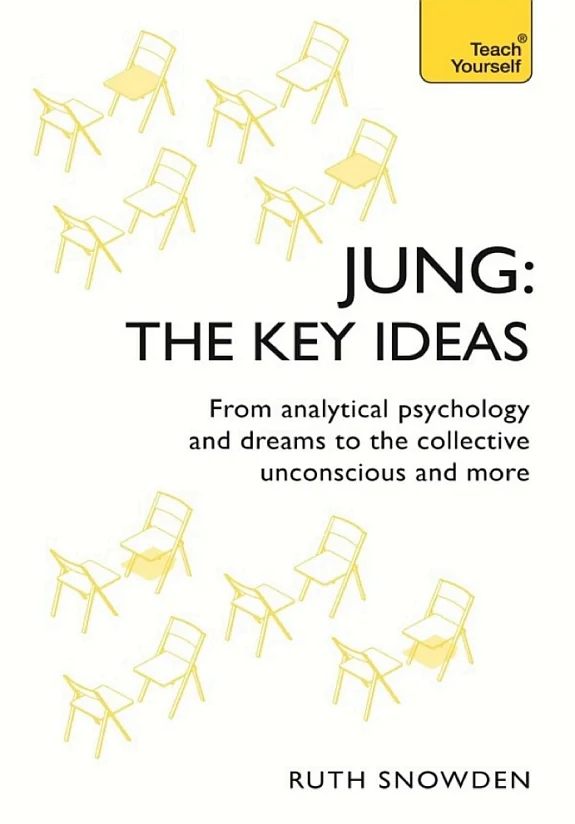
Jung: The Key Ideas
 75
75

Jung: The Key Ideas
Ruth Snowden's Jung: The Key Ideas attempts a formidable task: simplifying the labyrinthine thought of Carl Jung. The book succeeds admirably in its primary goal of clarity, presenting concepts like the collective unconscious and archetypes with commendable directness. The referencing of Jung's own texts, though brief, lends an air of scholarly grounding rather than mere interpretation. A particular strength lies in its concise explanation of Jung's developmental path, contextualizing his ideas within his life experiences. However, the very brevity that makes it accessible can also feel like a limitation; readers seeking deep exploration of Jung's more controversial or nuanced theories, such as his engagement with alchemy or Gnosticism, will find this volume only scratches the surface. The explanation of the anima/animus complex, while clear, could benefit from more detailed examples of its manifestation. Ultimately, Snowden provides a useful, if introductory, map to Jungian landscapes.
📝 Description
75
Ruth Snowden's Jung: The Key Ideas, published December 14, 2017, simplifies Carl Jung's analytical psychology.
This book offers an accessible entry into Carl Jung's analytical psychology. Ruth Snowden distills complex theories into understandable language, making Jung's ideas approachable for newcomers. It references Jung's original texts to clarify concepts like archetypes and the collective unconscious. The work is designed as a concise yet thorough introduction for anyone interested in understanding the human psyche from a Jungian perspective.
Snowden's approach aims to present Jung's core psychological framework without requiring readers to immediately confront his denser writings. It is suitable for students of psychology, philosophy, and esoteric studies who seek a solid grasp of Jungian thought. Readers unfamiliar with concepts such as dream analysis or symbolic language will find this volume a helpful starting point. The book covers essential elements that explain the inner workings of the mind.
Carl Jung's work, particularly his exploration of the unconscious, the collective unconscious, and archetypes, resonated deeply within esoteric and spiritual movements of the 20th century. His theories diverged from purely materialist scientific paradigms, finding common ground with traditions that examine the symbolic and psychic dimensions of human experience. This book helps place Jung's psychological framework within that broader context, acknowledging its influence beyond academic psychology and its connection to spiritual thought.
💡 Why Read This Book?
• Grasp the foundational Jungian concept of the **collective unconscious** and its archetypal inhabitants, understanding how these universal patterns shape human experience beyond individual biography, as detailed in Snowden's accessible summaries. • Learn about Carl Jung's personal intellectual journey, including his early influences and divergence from Freud, offering a specific historical context for the development of analytical psychology as presented in the book. • Understand the core principles of **individuation**, Jung's model for psychological development and self-realization, and how it applies to personal growth, as outlined with clear explanations referencing Jung's work.
⭐ Reader Reviews
Honest opinions from readers who have explored this book.
❓ Frequently Asked Questions
What is the collective unconscious according to Ruth Snowden's 'Jung: The Key Ideas'?
The collective unconscious, as explained in 'Jung: The Key Ideas', is a universal, inherited part of the psyche containing primal images and instincts shared by all humanity. It's a foundational concept for understanding Jung's perspective on dreams and symbols.
How does 'Jung: The Key Ideas' explain Jung's concept of archetypes?
The book defines archetypes as universal, archaic patterns and images derived from the collective unconscious. Snowden illustrates them as fundamental psychic structures that influence our behavior and perceptions, appearing in myths and dreams.
What is individuation in the context of Carl Jung's work, as per Ruth Snowden?
Individuation, according to 'Jung: The Key Ideas', is Jung's term for the process of psychological integration and self-realization. It involves differentiating oneself from the collective unconscious while also integrating its contents into conscious awareness.
Does 'Jung: The Key Ideas' cover Jung's theories on dreams?
Yes, the book touches upon Jung's theories regarding dreams, explaining how they serve as a gateway to the unconscious mind and often reveal archetypal patterns and personal complexes that are crucial for psychological development.
Who was Carl Jung, and why is his work important according to this book?
Carl Jung was the founder of analytical psychology. 'Jung: The Key Ideas' highlights his importance for revolutionizing the understanding of the psyche, introducing concepts like the collective unconscious and archetypes that profoundly influenced psychology and beyond.
Is 'Jung: The Key Ideas' suitable for someone completely new to psychology?
Yes, the book is specifically designed for beginners. It simplifies Jung's complex ideas, making concepts like archetypes and the collective unconscious accessible without prior extensive knowledge of psychological theory.
🔮 Key Themes & Symbolism
The Collective Unconscious
This volume emphasizes the collective unconscious as a bedrock of Jungian thought, presenting it not as a metaphor but as a transpersonal psychic inheritance. Snowden explains how this reservoir of ancestral experience manifests through universal symbols and instincts found across diverse cultures. The book positions this concept as essential for understanding shared human psychological structures and their influence on individual consciousness, dreams, and mythologies. It offers a bridge between personal experience and the broader human psyche.
Archetypes in Psyche and Myth
Archetypes are presented as the fundamental building blocks of the collective unconscious. The book identifies key figures like the Shadow, Anima/Animus, and the Self, illustrating how these primordial patterns structure our perceptions and interactions. Snowden connects these archetypal forms to their appearance in global myths, fairy tales, and religious narratives, suggesting their role in shaping human behavior and providing meaning. Understanding these universal motifs is framed as crucial for psychological insight.
Individuation as a Life Path
The process of individuation is detailed as Jung's central concept for personal development and wholeness. Snowden describes it as the lifelong journey of integrating conscious and unconscious aspects of the self, leading to a more authentic and unique personality. The book suggests that this path involves confronting one's shadow, understanding the anima/animus, and striving towards the realization of the Self. It's depicted as a dynamic, often challenging, but ultimately fulfilling process of becoming oneself.
Psychological Types and Consciousness
This work introduces Jung's influential theory of psychological types, explaining the fundamental dimensions of extraversion/introversion and the four functions: thinking, feeling, sensation, and intuition. Snowden clarifies how these preferences shape an individual's mode of engaging with the world and processing information. The book posits that awareness of one's dominant type, and the less developed functions, is vital for achieving psychological balance and moving towards greater self-understanding within the broader context of Jungian psychology.
💬 Memorable Quotes
Direct passages from the work, attributed to the author.
“The collective unconscious contains the psychic inheritance of humanity.”
— This succinctly captures Jung's radical idea that our psyche is not solely shaped by personal experience but also by the accumulated psychological patterns of our ancestors, forming a universal foundation.
“Individuation is the process of becoming a whole person.”
— This captures the essence of Jung's developmental goal: not perfection, but the integration of disparate psychic elements into a unified, authentic self.
“Dreams reveal unconscious material.”
— This straightforward statement points to Jung's view of dreams as a vital, albeit symbolic, communication channel from the unconscious, offering clues to psychological dynamics.
💡 Key Ideas
Editorial paraphrase of the work's core concepts — not direct quotes.
Archetypes are universal patterns of behavior and imagery.
This paraphrase highlights the core function of archetypes as inherent psychic structures that predispose us to perceive and react to the world in specific, recurring ways, visible across cultures and time.
Psychological types describe fundamental differences in how people perceive and judge.
This paraphrase explains Jung's typology as a framework for understanding inherent variations in human cognition and interaction, rather than fixed personality traits.
🌙 Esoteric Significance
Tradition
Jung's work sits at a fascinating nexus between scientific psychology and esoteric traditions. While not strictly adhering to any single lineage, his concepts of the collective unconscious and archetypes draw heavily from Gnostic cosmology, Hermetic philosophy, and Eastern mysticism, particularly Hinduism and Buddhism. He saw these traditions as expressions of universal psychic truths. His approach departs from purely empirical psychology by validating the symbolic language and visionary experiences often found in esoteric texts and practices, framing them as manifestations of the psyche's deeper layers.
Symbolism
Key symbols within Jung's framework, as explored in this book, include the **Mandala**, representing psychic wholeness and the Self, often appearing in dreams and spiritual practices. The **Shadow** symbolizes the repressed, darker aspects of the personality, whose integration is crucial for individuation. The **Anima/Animus** represent the contrasexual aspects of the psyche (feminine in men, masculine in women), vital for understanding relationships and inner balance. These symbols are not merely decorative but are seen as active forces within the psyche.
Modern Relevance
Contemporary thinkers and practitioners across various fields continue to draw from Jung's insights. His concepts are foundational for modern depth psychology, transpersonal psychology, and various forms of psychotherapy. In esoteric circles, Jung's work is essential for understanding the symbolic language of alchemy, mythology, and spiritual traditions. Artists, writers, and filmmakers frequently employ Jungian archetypes. His emphasis on individuation and the search for meaning remains highly relevant in a postmodern world grappling with identity and existential questions.
👥 Who Should Read This Book
• Aspiring psychologists and therapists seeking to understand the origins and core tenets of analytical psychology beyond introductory textbooks. • Students of comparative religion and mythology interested in the archetypal patterns that underpin global narratives and spiritual beliefs. • Individuals on a path of personal development who wish to explore the unconscious mind, dream analysis, and the concept of psychological wholeness.
📜 Historical Context
Carl Jung's theoretical framework emerged in the early to mid-20th century, a period dominated by Sigmund Freud's psychoanalysis and the rise of behaviorism. Jung, initially a protégé of Freud, broke away in 1913, partly due to disagreements over the nature of the libido and the unconscious. His development of analytical psychology, emphasizing the collective unconscious and archetypes, offered a distinct alternative. This work appeared amidst intellectual currents exploring mythology, anthropology (e.g., Sir James Frazer's *The Golden Bough*), and comparative religion, which heavily influenced Jung's research. While academic psychology often remained skeptical of his more metaphysical explorations, Jung's ideas found fertile ground in the burgeoning fields of depth psychology and esoteric studies, influencing figures like Erich Fromm and later, the mythographers Joseph Campbell and Mircea Eliade, who engaged with his symbolic analyses.
📔 Journal Prompts
The collective unconscious and its inherited patterns.
Archetypal manifestations in personal dreams or cultural myths.
The path of individuation and self-discovery.
Jung's psychological types and personal perception.
The role of the Shadow in personal integration.
🗂️ Glossary
Analytical Psychology
Carl Jung's school of psychology, distinct from Freudian psychoanalysis, focusing on the integration of conscious and unconscious aspects of the psyche through concepts like archetypes and the collective unconscious.
Collective Unconscious
A hypothesized universal layer of the human psyche containing inherited instincts, psychic predispositions, and archetypes shared by all humanity.
Archetype
Universal, archaic patterns and images derived from the collective unconscious that influence human behavior, perception, and understanding. Examples include the Mother, the Hero, and the Wise Old Man.
Individuation
The lifelong psychological process of differentiation of the self, involving the integration of conscious and unconscious elements to achieve wholeness and self-realization.
Shadow
The unconscious aspect of the personality that the conscious ego does not identify in itself. It contains repressed desires, weaknesses, and instincts.
Anima/Animus
The unconscious feminine side in the male psyche (Anima) and the unconscious masculine side in the female psyche (Animus), playing a role in relationships and projections.
Psychological Types
Jung's theory describing fundamental differences in how people perceive the world (Sensing vs. Intuition) and make decisions (Thinking vs. Feeling), combined with Attitude types (Extraversion vs. Introversion).
This book appears in 1 collection
🔮 Readers Also Liked
Browse all →









From the “Collective Unconscious” Collection
View all →




More Free Occult Philosophy Books
View all →