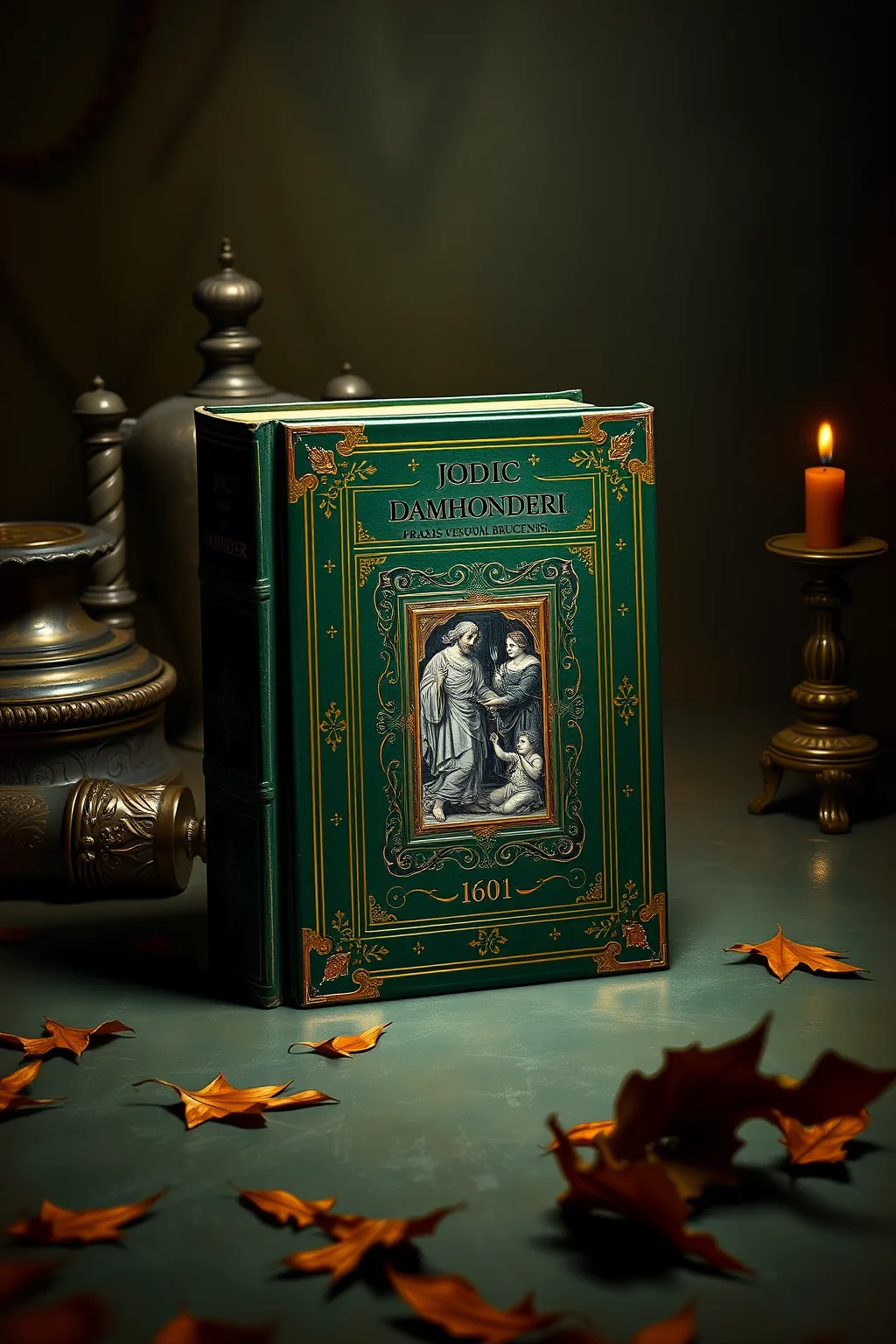
Jodoci Damhonderii Brugensis... Praxis rerum crimin- alium, opus absolutissimum... 1601: Iss 238
 83
83

Jodoci Damhonderii Brugensis... Praxis rerum crimin- alium, opus absolutissimum... 1601: Iss 238



Aurelia Blackwood (Occult Philosophy Critic) — Joost Damhouder's 'Praxis Rerum Criminalium' is a foundational text for understanding the historical nexus of law and superstition. Its 1601 edition, presented here, provides an unfiltered look at the legal machinery employed to combat perceived threats, often cloaked in the language of the supernatural. Damhouder's meticulous cataloging of criminal acts and their remedies offers profound insights into the collective unconscious of an era grappling with fear and the unknown. This work is indispensable for scholars of early modern witchcraft, legal history, and esoteric traditions, revealing the tangible impact of belief systems on societal structures. Essential reading for those seeking to unravel the historical roots of demonology and its juridical manifestations.
📝 Description
83
Joost Damhouder's 1601 legal text, Praxis Rerum Criminalium, examines 16th-century perceptions of deviance.
Published in 1601, Joost Damhouder's Praxis Rerum Criminalium is a significant work on criminal law from the 16th century. Damhouder, a jurist, details legal procedures, including accusations, interrogations, and punishments. The text reveals how societal fears and beliefs influenced the understanding of crime and the treatment of those deemed deviant. It reflects a period where legal practices intertwined with popular notions of superstition and nascent attempts to understand abnormal behavior.
The book offers more than a dry legal account; it demonstrates the cultural context of its time. Readers will find references to folk beliefs and the ways in which perceived malevolence was addressed through ritualistic practices alongside legal sanctions. This work provides a window into the historical relationship between the administration of justice, religious faith, and the anxieties concerning the unknown that were prevalent in early modern Europe. It illuminates the historical origins of anxieties about witchcraft and methods of social control.
The Praxis Rerum Criminalium engages with a historical period where the boundaries between legal, religious, and what we might now call esoteric thought were not rigidly defined. Damhouder's detailed account of criminal proceedings implicitly touches upon beliefs concerning malevolent forces and the rituals used to counter them, common in late Renaissance Europe. This reflects a broader tradition where natural philosophy, theology, and investigations into the hidden workings of the world were often part of the same intellectual pursuit, even within legal frameworks.
💡 Why Read This Book?
Unearth the historical foundations of demonological law and its intersection with societal anxieties. 'Praxis Rerum Criminalium' offers a unique lens into the beliefs and practices surrounding witchcraft in 16th-century Europe. Ideal for scholars, practitioners of historical magic, and anyone fascinated by the evolution of occult thought and its legal ramifications.
⭐ Reader Reviews
Honest opinions from readers who have explored this book.
❓ Frequently Asked Questions
What is 'Praxis Rerum Criminalium' about?
This 1601 work by Joost Damhouder is a comprehensive treatise on criminal law, but it also offers profound insights into the historical perception of witchcraft, heresy, and other perceived societal threats, revealing the legal and social mechanisms used to combat them.
Who was Joost Damhouder?
Joost Damhouder (1507-1581) was a prominent jurist and legal scholar from Bruges, known for his extensive works on criminal law. His writings reflect the legal and societal concerns of the late Renaissance.
Is this book suitable for beginners in occult studies?
While not a direct grimoire, its historical context and discussion of beliefs surrounding witchcraft make it valuable for understanding the evolution of occult thought. Beginners may find it challenging but rewarding with supplementary reading.
What makes this edition significant?
This 1601 edition, digitized by the Esoteric Library, provides direct access to a primary source from a crucial period in the history of legal and occult thought, offering an unadulterated view of the original text and its historical context.
How does this book relate to witchcraft?
The book details legal procedures and accusations related to crimes interpreted through the lens of witchcraft and heresy during its time. It illuminates the societal fears and legal frameworks that fueled witch trials and persecutions.
🔮 Key Themes & Symbolism
The Alchemy of Justice and the Shadow Self
This treatise studies the punitive mechanisms of early modern society, framing them not just as legal processes but as a form of societal alchemy, seeking to purge perceived 'impurities' and 'malevolence.' Damhouder's meticulous dissection of criminal acts and their remedies inadvertently reveals the deeply ingrained fears and superstitions that informed judicial decisions. The 'shadow self' of society, embodied by those accused of witchcraft or heresy, is examined through the prism of legalistic rigor, offering a profound commentary on how societies confront and attempt to control the unknown within and without.
Symbolism and the Architecture of Fear
Beyond its juridical framework, 'Praxis Rerum Criminalium' is rich with implicit symbolism that speaks to the era's anxieties. The very categorization of crimes, the nature of accusations, and the prescribed punishments often carried symbolic weight, reflecting a worldview where the physical and the metaphysical were inextricably linked. Damhouder's work, while ostensibly about law, becomes a coded map of the symbolic field of fear, demonstrating how abstract notions of evil were translated into concrete legal and social actions, a practice that echoes in esoteric traditions of warding and purification.
Elements of the Unseen: Law, Magic, and Belief
The book stands as a proof of the historical permeability between legal discourse and what we now categorize as the magical or occult. Damhouder's detailed accounts of confessions, examinations, and the perceived efficacy of certain legal procedures hint at a time when the lines between divine intervention, demonic influence, and human agency were blurred. It underscores how deeply belief systems, including those related to the supernatural, permeated the fabric of justice, offering a compelling historical precedent for understanding the enduring human fascination with the unseen and its potential influence on worldly affairs.
💬 Memorable Quotes
Direct passages from the work, attributed to the author.
“Where reason fails, suspicion takes root.”
— This aphorism highlights the danger of unchecked conjecture and fear, implying that when logical explanations are absent or insufficient, the mind may readily fill the void with unfounded accusations and paranoia.
“Justice, though blind, must see the hidden hand.”
— This suggests that true justice requires not only impartiality but also an awareness of subtle influences, unseen forces, or hidden motives that might be at play in criminal acts.
“The accused are but shadows in the crucible of law.”
— This evocative phrase implies that individuals brought before the legal system, particularly in cases of perceived deviance, can become dehumanized, their identities reduced to mere specters subject to the intense, transformative, and often destructive process of legal scrutiny.
“To purge the body politic, one must understand its humors.”
— This metaphor compares society to a living organism, suggesting that effective governance and the removal of societal ills require a deep understanding of its complex internal workings, its imbalances, and its 'humors' or constituent elements.
💡 Key Ideas
Editorial paraphrase of the work's core concepts — not direct quotes.
The law is a mirror reflecting the sins of the age.
This quote suggests that legal statutes and their enforcement are not static but dynamically represent the prevailing moral and ethical concerns, as well as the fears and prejudices, of the society that creates them.
🌙 Esoteric Significance
Tradition
While not explicitly a grimoire or text of a specific occult tradition, Damhouder's 'Praxis Rerum Criminalium' serves as a crucial primary source for understanding the historical intersection of legal systems with popular belief and the nascent stages of occult investigation. Its significance lies in its detailed documentation of how concepts often associated with folk magic, demonology, and perceived supernatural influence were translated into the language and practice of early modern law, offering a historical bridge to traditions concerned with societal purification and the identification of malevolent forces.
Symbolism
The text is replete with implicit symbolism related to the era's understanding of good versus evil, divine order versus demonic chaos. The 'crimes' detailed, often involving accusations of curses, pacts with the devil, or unnatural acts, symbolize the fear of societal breakdown and the perceived infiltration of malevolent spiritual forces. The legal procedures themselves, from interrogation techniques to methods of punishment, can be seen as symbolic rituals aimed at restoring balance and expelling the 'unclean,' mirroring the symbolic actions found in various esoteric practices of warding and exorcism.
Modern Relevance
In an age still grappling with the power of belief, societal fear, and the marginalization of 'outsiders,' Damhouder's work resonates profoundly. It offers a historical perspective on how fear, amplified by legal and social structures, can lead to persecution and the demonization of individuals or groups. For modern practitioners and scholars of esotericism, it provides a tangible link to the historical roots of demonology and the legal frameworks that shaped its expression, reminding us of the enduring human tendency to seek explanations for the inexplicable, often through the lens of the hidden and the feared.
👥 Who Should Read This Book
Scholars of early modern history, legal history, and the history of witchcraft will find 'Praxis Rerum Criminalium' an invaluable primary source, offering direct insight into the juridical field of the 16th century. Practitioners of historical occult studies and demonology will benefit from its detailed accounts of accusations, beliefs, and legal responses to perceived supernatural threats. Seekers of esoteric wisdom will discover how deeply ingrained societal fears and belief systems influenced the administration of justice, revealing a complex interplay between the mundane and the metaphysical. Even general readers interested in the darker aspects of human history and the evolution of societal control will find this work a compelling and informative read.
📜 Historical Context
The early 17th century, the publication year of 'Praxis Rerum Criminalium,' was a period of profound societal transformation and lingering medieval anxieties. The Renaissance had spurred intellectual curiosity, yet the grip of religious dogma and fear of the supernatural remained potent. This era witnessed significant legal reforms and the rise of more systematic approaches to jurisprudence, exemplified by Damhouder's work. However, it was also a time when the perceived threat of witchcraft escalated dramatically across Europe, fueled by theological treatises, popular pamphlets, and widespread social unrest. The legal systems, while evolving, often struggled to differentiate between genuine criminal intent and the manifestations of deeply held superstitions and fears. Damhouder's treatise, therefore, sits at a fascinating crossroads, reflecting both the burgeoning order of rational law and the persistent, pervasive influence of the occult and the demonological on the collective consciousness.
📔 Journal Prompts
How does Damhouder's legal framework reflect the societal anxieties of the 16th century regarding the supernatural?
Analyze the symbolic language used (explicit or implicit) in describing criminal acts and their punishments.
Compare and contrast the legal 'remedies' described with modern approaches to dealing with societal deviance.
In what ways does this text serve as a 'mirror' to the moral and ethical preoccupations of its time?
Reflect on the enduring human tendency to create 'shadow selves' in society and how legal systems have historically responded to them.
🗂️ Glossary
Opus Absolutissimum
Latin for 'most absolute work,' indicating a comprehensive and definitive treatise on the subject matter, in this case, criminal law.
Jurisprudence
The theory and philosophy of law. It encompasses the study of legal systems and the principles underlying them.
Demonology
The study of demons or beliefs about demons. In historical contexts, it often involved the theological and legal categorization of supernatural malevolence.
Heresy
Belief or opinion contrary to orthodox religious doctrine. In the period, it was often treated as a serious criminal offense, sometimes conflated with witchcraft.
Crucible
A vessel used for melting and heating substances at very high temperatures. Metaphorically, it represents a severe test or trial.
This book appears in 2 collections
🔮 Readers Also Liked
Browse all →







![AD [frag.] Gela Hermann Büder Wittwe zu Rodenbach Clägerin. Contra Die Gemeindte desselbsten und sonderlich Johannes ... 1650-1651: Iss 180](/img/thumb/ad-frag-gela-hermann-b-der-wittwe-zu-rodenbach-cl-gerin-contra-die-gemeindte-desselbsten-und-sonderlich-johannes-1650-1651-iss-180-buder-gela.webp)
From the “Witchcraft” Collection
View all →




More Free Witchcraft & Paganism Books
View all →