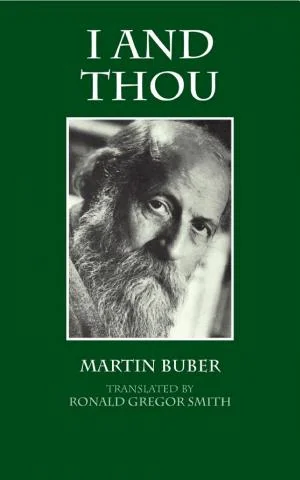
I and Thou
 76
76

I and Thou
Martin Buber's "I and Thou" is less a systematic argument and more a series of philosophical meditations on the nature of human encounter. Its central thesis, the distinction between the "I-It" and "I-Thou" modes of relation, is a powerful lens through which to examine our interactions. Buber's prose, particularly in its original German, possesses a poetic quality that elevates the philosophical content. A particularly striking passage discusses how even in nature, the "I-Thou" encounter can occur with a tree, moving beyond mere botanical classification to a relationship of being.
However, the work's abstract nature can sometimes make its application feel elusive. Buber's critique of modernity's objectifying tendencies, while valid, can feel somewhat idealized in its presentation of the "I-Thou." Despite these minor reservations, "I and Thou" remains a pivotal text for understanding the philosophical basis of authentic connection.
📝 Description
76
Martin Buber's 1923 book distinguishes between two fundamental ways of relating to the world: the 'I-It' and the 'I-Thou'.
Martin Buber's "I and Thou," published in 1923, proposes a dualistic framework for human experience. The 'I-It' mode describes our interaction with the world as objects, where we analyze, categorize, and use things and people for utility or understanding. This is the perspective of science and instrumental reason. In contrast, the 'I-Thou' mode represents an immediate, reciprocal encounter. It is a state of genuine connection where we meet the other person or the world in its wholeness, without reducing it to its components or functions. Buber argues that a meaningful spiritual life arises from these authentic 'I-Thou' moments, which are characterized by directness and presentness.
This work speaks to those seeking a deeper understanding of genuine human connection and existence itself. It is particularly relevant for individuals who feel disconnected by purely instrumental relationships or fragmented knowledge. Readers interested in existential philosophy, theology, and the spiritual dimensions of interpersonal dynamics will find Buber's ideas thought-provoking. The book emerged from early 20th-century German intellectual life, a time of significant philosophical shifts, and Buber sought to integrate insights from Hasidic Judaism with contemporary thought.
Buber's work draws significantly from Hasidic Judaism, a tradition emphasizing direct, personal experience of God and the spiritual significance of everyday life. The 'I-Thou' concept echoes the Hasidic focus on present moment awareness and the potential for divine encounter in all relationships. He bridges this mystical tradition with Western philosophical currents, including existentialism, to articulate a vision of human existence centered on genuine relation rather than objective analysis. This positions the book within a broader contemplative tradition that seeks to understand the divine not through abstract theology but through lived experience and interpersonal encounter.
💡 Why Read This Book?
• Understand the "I-Thou" encounter: Learn how to distinguish between treating beings as objects (I-It) versus engaging them in direct, present relationship (I-Thou), a core concept articulated by Buber in the early 20th century. • Grasp Buber's critique of modernity: Discover why Buber, influenced by thinkers like Nietzsche, found modern society prone to objectification and how this impedes genuine human connection. • Explore existential theology: Gain insight into how Buber integrated existentialist thought with Judeo-Christian traditions, offering a unique perspective on faith and existence first articulated around 1923.
⭐ Reader Reviews
Honest opinions from readers who have explored this book.
❓ Frequently Asked Questions
When was Martin Buber's "I and Thou" first published?
Martin Buber's seminal work, "I and Thou," was first published in Germany in 1923, making it a foundational text of 20th-century existential philosophy.
What is the central philosophical concept in "I and Thou"?
The central concept is the distinction between the "I-It" and "I-Thou" modes of human relationship. The "I-It" treats the other as an object, while the "I-Thou" engages in a direct, mutual relationship of being.
How did Nietzsche influence Martin Buber's "I and Thou"?
Buber was influenced by Nietzsche's critiques of traditional morality and metaphysics, which likely contributed to his own examination of modern alienation and the need for more authentic forms of human connection.
What is the "I-It" relationship according to Buber?
The "I-It" relationship, as described by Buber, is one where the subject perceives the object as separate, analyzed, and experienced. It is the realm of scientific observation and instrumental use.
What is the significance of the "I-Thou" relationship?
The "I-Thou" relationship is where the subject encounters the other in their wholeness, without objectification. It is characterized by directness, mutuality, and a sense of the eternal present, forming the basis for spiritual life.
Is "I and Thou" a theological or philosophical text?
It is both. While deeply philosophical in its exploration of existence and relationship, it is also considered a major work of Western theology, reinterpreting faith and the divine in modern terms.
🔮 Key Themes & Symbolism
The I-It Relation
This mode of being treats the world and others as objects to be experienced, analyzed, and used. It is the domain of science, utility, and detached observation. In the "I-It" framework, the individual perceives separate entities, categorizing them by their attributes and functions. Buber suggests that much of modern life, particularly its scientific and technological advancements, operates primarily within this relational sphere, leading to a sense of alienation and instrumentalization of human existence.
The I-Thou Encounter
The "I-Thou" represents a relationship of direct, mutual, and holistic encounter. It is not about experiencing or using, but about *being* with another. In this mode, the individual addresses the other as a whole, unique being, entering into a relationship of presence and immediacy. This encounter is spiritual, transcending the ordinary categories of understanding and experience, and is where true meaning and life are found according to Buber's philosophy.
The Eternal Thou
Buber posits that every "I-Thou" relationship, however fleeting, contains a glimpse of the "Eternal Thou," which is God. This does not imply a direct, personal address from God in every instance, but rather that the intensity and authenticity of any genuine "I-Thou" encounter point towards a divine reality that grounds all being. It is through the full acceptance of the other in the "I-Thou" that one can touch the infinite.
Authenticity and Meaning
The search for meaning and authenticity is central to "I and Thou." Buber argues that a life lived solely in the "I-It" mode, focused on detached observation and utility, leads to a superficial existence. Genuine meaning emerges from the willingness to engage in "I-Thou" relationships, to embrace the risks and responsibilities of direct encounter with others and the world, thereby affirming one's own being and the reality of existence.
💬 Memorable Quotes
Direct passages from the work, attributed to the author.
“The world is to the man of the "I-It" twofold.”
— This highlights Buber's core distinction: for the individual operating in the "I-It" mode, reality is divided into subjective experience and objective phenomena, to be dissected and understood rather than encountered.
“The life of a man is not one event but the event of the world's meeting him.”
— This emphasizes Buber's view that existence is not merely a series of isolated occurrences but a continuous process of relational encounters that shape our being and perception.
“In every sphere of life, in every relation, we can be in the "I-It" or in the "I-Thou."”
— This underscores the pervasive nature of Buber's dichotomy, suggesting that the choice between objectifying and relating authentically is available to us in all circumstances, from personal interactions to professional dealings.
“When Thou is spoken, the I of the pair comes into being.”
— This statement points to the reciprocal nature of the "I-Thou" relationship. The self, the 'I,' is not a pre-existing entity but is actualized and comes into being through the act of addressing and relating to the 'Thou.'
“All actual life is encounter.”
— This concise declaration captures Buber's existentialist stance, asserting that genuine life is not found in solitary introspection or detached observation but in the active, dynamic process of meeting and engaging with the world and its inhabitants.
🌙 Esoteric Significance
Tradition
While not fitting neatly into a single esoteric lineage like Hermeticism or Kabbalah, "I and Thou" draws from mystical interpretations of Jewish thought, particularly Hasidism, which emphasizes direct experience of the divine in the everyday. Buber's work can be seen as an existentialist reinterpretation of the concept of 'Devekut' (cleaving to God), secularizing and universalizing the mystical encounter into a principle applicable to all human relationships.
Symbolism
The primary symbolic motif is the duality of "I-It" versus "I-Thou." The "I-It" symbolizes the alienated, fragmented self and world of objects, akin to the Gnostic concept of the material world as a prison. The "I-Thou" symbolizes direct spiritual apprehension and unity, echoing Kabbalistic ideas of divine immanence and the potential for human beings to participate in the divine flow through pure relationship.
Modern Relevance
Contemporary thinkers in humanistic psychology, existential therapy, and even process philosophy continue to engage with Buber's ideas. His emphasis on authentic relationship and the critique of objectification finds echoes in fields concerned with intersubjectivity, mindfulness, and relational ethics. Practices that focus on presence and genuine connection often implicitly or explicitly draw from the foundational concepts laid out in "I and Thou."
👥 Who Should Read This Book
• Seekers of authentic connection: Individuals grappling with feelings of isolation or superficiality in relationships will find Buber's framework for genuine encounter informative. • Students of existential philosophy: Those studying existentialism and phenomenology will gain a crucial perspective on intersubjectivity and the nature of being-in-the-world. • Theological and philosophical scholars: Researchers interested in the intersection of modern philosophy, Jewish thought, and theology will find "I and Thou" an essential text for understanding 20th-century intellectual history.
📜 Historical Context
Published in 1923, "I and Thou" emerged during a period of intense intellectual ferment in Germany, shortly after the devastation of World War I. The era was characterized by the rise of existentialist thought, with figures like Heidegger and Jaspers exploring themes of being, freedom, and anxiety. Buber, deeply rooted in Hasidic Judaism and influenced by philosophical currents that included Nietzsche's critique of traditional values, sought to offer a corrective to the atomistic and instrumentalist tendencies of modernity. His work stood in contrast to dominant positivist and idealist philosophies. The book quickly gained recognition, becoming a significant contribution to the discourse on human existence and spirituality, influencing theologians and philosophers alike, though its abstract nature also invited debate and interpretation.
📔 Journal Prompts
The "I-Thou" encounter: Reflect on a recent moment where you experienced true mutuality.
The "I-It" as a tool: Consider how objectification aids in specific tasks or studies.
The Eternal Thou: Where have you sensed a presence beyond the ordinary in your interactions?
Buber's critique of modernity: Identify an instance where society prioritizes 'It' over 'Thou'.
Actual life as encounter: Describe an experience that felt profoundly real due to its relational quality.
🗂️ Glossary
I-It Relation
A mode of experience where the subject perceives the object as a separate entity, to be analyzed, classified, and used. It is the area of detached observation and instrumental interaction.
I-Thou Relation
A mode of being where the subject encounters the other in their wholeness, through direct, mutual, and present engagement. It is a relationship of reciprocal being, not of experience or utility.
The Eternal Thou
Buber's concept of a divine reality that is the ultimate source and ground of all being. Every genuine "I-Thou" encounter is seen as a momentary glimpse or address from this Eternal Thou.
World of the "I-It"
The area of phenomena and objects that are experienced, analyzed, and manipulated. This is the domain of scientific knowledge and practical action, where the self is distinct from its surroundings.
World of the "I-Thou"
The area of genuine relationship and encounter, where the self confronts and is confronted by the other in their full reality. This is the sphere of meaning, spirit, and authentic existence.
Inclusion
The ability of the "I" to embrace the "Thou" in its entirety, without reducing it to its parts or imposing its own preconceived notions. It is a fundamental aspect of the "I-Thou" relationship.
Limitation
The inherent boundaries and constraints that define any particular relationship or entity. Buber acknowledges that both "I-It" and "I-Thou" involve limitations, but the nature of engagement differs.
🔮 Readers Also Liked
Browse all →









More Free Occult Philosophy Books
View all →