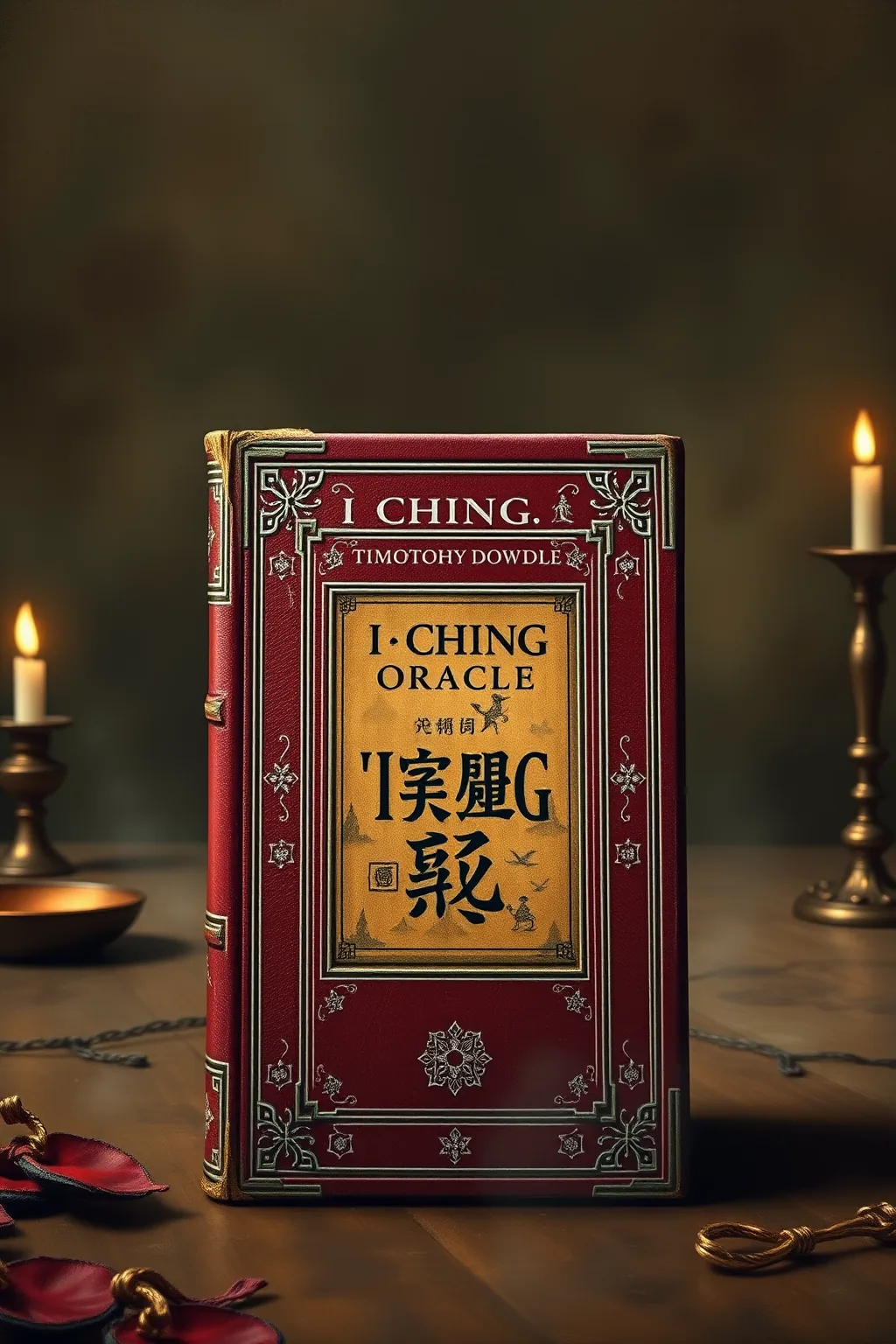
I Ching Oracle
 61
61

I Ching Oracle



Alaric Kestrel, Metaphysical Studies Reviewer – Timothy Dowdle’s 'I Ching Oracle' is a monumental achievement in accessible esoteric scholarship. It elegantly demystifies the profound complexities of the ancient Chinese divination system, presenting its wisdom with clarity and spiritual depth. Dowdle’s insightful interpretations illuminate the psychological resonance of each hexagram, bridging ancient philosophy with modern introspection. This work is particularly potent for practitioners seeking to deepen their understanding of the oracle’s transformative power, and for seekers of wisdom who wish to engage with a timeless system of guidance. Its strength lies in its balanced approach, honoring both the divinatory function and the profound philosophical teachings.
📝 Description
61
Timothy Dowdle's 2004 I Ching Oracle reinterprets the ancient Chinese classic for a modern audience.
Timothy Dowdle's 2004 interpretation, I Ching Oracle, moves beyond simple divination. The book examines the I Ching's philosophical depth, linking its hexagrams to psychological archetypes and the natural interplay of yin and yang. Dowdle aims to show how the text reflects universal patterns of change and human experience.
Readers will find discussions of the I Ching's symbolism and its application as a tool for introspection. It presents the hexagrams not just as predictions, but as frameworks for understanding life's transitions. The work is intended for those seeking to deepen their self-awareness through the study of this ancient Chinese text.
The I Ching, or Book of Changes, is a foundational text in Chinese philosophy and divination, dating back thousands of years. Its system of hexagrams, derived from combinations of yin and yang lines, has been used for centuries to understand cosmic processes and human affairs. Dowdle's work places itself within this long tradition, aiming to unpack the text's layers of meaning, from its divinatory uses to its philosophical and psychological resonances. It engages with the I Ching as a system for contemplating universal principles.
💡 Why Read This Book?
Unlock ancient wisdom for modern challenges. This book offers a profound dive into the I Ching, revealing its psychological insights and philosophical depth. Ideal for seekers of self-knowledge, practitioners of divination, and scholars of esoteric traditions who wish to understand life's patterns through a timeless oracle.
⭐ Reader Reviews
Honest opinions from readers who have explored this book.
❓ Frequently Asked Questions
What is the I Ching?
The I Ching, or Book of Changes, is an ancient Chinese divination text and philosophical classic, revered for its insights into the natural cycles of the universe and human existence through a system of hexagrams.
How does the I Ching work as a divination tool?
It functions by casting yarrow stalks or coins to generate a hexagram, which is then interpreted based on its imagery, associated lines, and changing lines to offer guidance or insight into a specific question or situation.
Is the I Ching only for fortune-telling?
While it is a powerful divinatory tool, the I Ching is also a profound philosophical and psychological text, offering wisdom on ethics, strategy, and understanding the dynamic nature of reality.
Who was Timothy Dowdle?
Timothy Dowdle was a scholar and interpreter of ancient wisdom traditions, dedicating his work to making complex esoteric texts accessible and relevant to contemporary readers, particularly focusing on Eastern philosophies.
What makes this edition of the I Ching unique?
Dowdle’s edition is renowned for its clear, evocative prose and its emphasis on the psychological and philosophical dimensions of the hexagrams, making it a comprehensive guide for both beginners and seasoned practitioners.
🔮 Key Themes & Symbolism
The Dance of Yin and Yang
This theme explores the fundamental principle of duality that underpins the I Ching. Yin, the receptive, dark, and feminine principle, and Yang, the active, light, and masculine principle, are not opposing forces but complementary energies in constant motion. Their interplay creates the dynamism of the universe, shaping all phenomena from the celestial to the mundane. Understanding this cosmic ballet allows for a deeper appreciation of balance, harmony, and the natural unfolding of events, offering a framework for navigating life's inherent dualities with wisdom and acceptance.
Hexagrammatic Symbolism and Archetypes
The core of the I Ching lies in its 64 hexagrams, each a unique configuration of six lines that encapsulate profound symbolic meaning. Dowdle meticulously deciphers these arrangements, revealing them as potent archetypes reflecting universal human experiences and cosmic processes. Each hexagram serves as a symbolic narrative, a snapshot of a particular phase or situation, offering insights into potential outcomes and guiding one's actions. Exploring this rich visual language unlocks a deeper understanding of the archetypal patterns that govern our lives and the collective unconscious.
The Philosophy of Change and Transformation
At its heart, the I Ching is a proof of the immutable law of change. It teaches that all things are in a state of flux, and that resistance to this natural flow leads to suffering. The oracle provides a framework for understanding the cycles of transformation, encouraging adaptability, foresight, and a conscious engagement with the ever-evolving nature of reality. By embracing change, individuals can navigate life's transitions with grace, learn from challenges, and align themselves with the cosmic currents, fostering personal growth and resilience.
💬 Memorable Quotes
Direct passages from the work, attributed to the author.
“Wisdom lies not in predicting the future, but in understanding the present moment's unfolding.”
— This interpretation underscores the I Ching's practical application. It guides users to focus on the dynamics of their current situation rather than seeking deterministic prophecies, fostering agency.
“The hexagrams are maps of the soul's journey through the landscapes of existence.”
— This evocative statement frames the I Ching as a psychological atlas. It suggests that each symbolic configuration corresponds to inner states and developmental stages, aiding self-discovery.
“In the stillness of inquiry, the oracle whispers its timeless truths.”
— This poetic line emphasizes the meditative and contemplative approach required to effectively consult the I Ching. It speaks to the intuitive and subtle nature of its guidance.
💡 Key Ideas
Editorial paraphrase of the work's core concepts — not direct quotes.
The Book of Changes is a mirror held up to the universe and to the human soul.
This quote highlights the I Ching's dual function: reflecting the order of the cosmos and offering profound self-examination for the individual. It emphasizes introspection and cosmic connection.
To know the Way is to harmonize with the ceaseless currents of transformation.
This quote captures the core philosophy of the I Ching: aligning oneself with the natural flow of change. It promotes acceptance, adaptability, and a deeper connection to universal principles.
🌙 Esoteric Significance
Tradition
The I Ching is a foundational text within the Taoist and Confucian traditions, but its esoteric significance extends to broader Hermetic and Gnostic streams of thought. It is revered as a primary source of 'cosmic law' and 'universal principles,' akin to Hermeticism's 'As Above, So Below.' Its cyclical nature and emphasis on balance resonate with alchemical processes, while its profound psychological archetypes align with Jungian depth psychology and Gnostic explorations of the soul's journey through complex symbolic landscapes.
Symbolism
The primary symbolism of the I Ching resides in its 64 hexagrams, each composed of six lines (yin or yang). These lines and their combinations represent fundamental forces, natural phenomena, human relationships, and stages of development. Key symbols include the trigrams (three-line figures like Heaven, Earth, Water, Fire), which are building blocks for hexagrams. The interaction between yin and yang, the concept of 'change' itself, and the cyclical progression of the hexagrams are central to its symbolic language, offering a body of work for interpreting life's intricate patterns.
Modern Relevance
In the modern era, the I Ching remains remarkably relevant as a tool for psychological introspection, ethical guidance, and navigating complex decision-making. Its emphasis on understanding patterns of change and the interconnectedness of all things offers a valuable counterpoint to the often fragmented and fast-paced nature of contemporary life. It provides a framework for developing adaptability, cultivating patience, and fostering a deeper sense of purpose by aligning oneself with natural rhythms and universal principles, making it an enduring source of wisdom for personal growth and spiritual development.
👥 Who Should Read This Book
This 'I Ching Oracle' is an indispensable resource for a diverse audience. For the **beginner**, it offers a clear and empathetic entry point into the world of the Book of Changes, clarifying its core concepts. **Scholars** of Eastern philosophy and comparative religion will find Dowdle's insightful interpretations and contextualization important for their research. **Seekers** of spiritual wisdom and self-knowledge will discover a profound mirror for introspection and a guide for navigating life's challenges with greater clarity. **Practitioners** of divination and esoteric arts will appreciate the depth and nuanced understanding of the hexagrams, enhancing their divinatory skills and connection to ancient wisdom.
📜 Historical Context
The I Ching, or Book of Changes, emerged from ancient Chinese shamanistic and divinatory practices, with its earliest layers dating back to the Western Zhou Dynasty (c. 1046–771 BCE). Initially a practical manual for divination and statecraft, it evolved over centuries, profoundly influenced by Confucian and Taoist philosophies. During the Han Dynasty (206 BCE–220 CE), it was canonized as one of the Five Classics, solidifying its status as a central to Chinese intellectual and spiritual life. Its transmission and interpretation have spanned millennia, adapting to different eras and philosophical currents, yet consistently maintaining its core function as a guide to understanding the principles of change and cosmic order. Timothy Dowdle's work places this ancient text within a lineage of profound spiritual and psychological inquiry, making its enduring wisdom accessible to a modern audience.
📔 Journal Prompts
Reflect on a recent significant change in your life. Which hexagram might symbolize this transition, and what lessons does it offer?
Consider a recurring challenge you face. How do the principles of yin and yang, as presented in the I Ching, apply to your situation?
If you were to consult the I Ching for guidance on your personal growth, what fundamental archetype (represented by a hexagram) would you seek to embody?
How can the I Ching's emphasis on 'flow' and 'adaptability' inform your approach to a current decision you are contemplating?
Explore the relationship between the external events in your life and your internal psychological state, as illuminated by the I Ching's symbolism.
🗂️ Glossary
Hexagram
A symbol composed of six stacked horizontal lines, each either solid (Yang) or broken (Yin). There are 64 unique hexagrams in the I Ching, representing fundamental situations and archetypal patterns.
Trigram
A figure composed of three stacked lines, either solid (Yang) or broken (Yin). The eight trigrams (e.g., Heaven, Earth, Water) are the building blocks of the hexagrams and carry their own symbolic meanings.
Yin
The feminine, passive, dark, receptive, and yielding principle in Chinese philosophy, often represented by broken lines in the I Ching. It is complementary to Yang.
Yang
The masculine, active, light, creative, and assertive principle in Chinese philosophy, often represented by solid lines in the I Ching. It is complementary to Yin.
Oracle
In the context of the I Ching, the oracle refers to the system of divination itself, as well as the wisdom and guidance derived from consulting the text and its hexagrams.
This book appears in 3 collections
🔮 Readers Also Liked
Browse all →








From the “Tarot” Collection
View all →






More Free Divination & Tarot Books
View all →