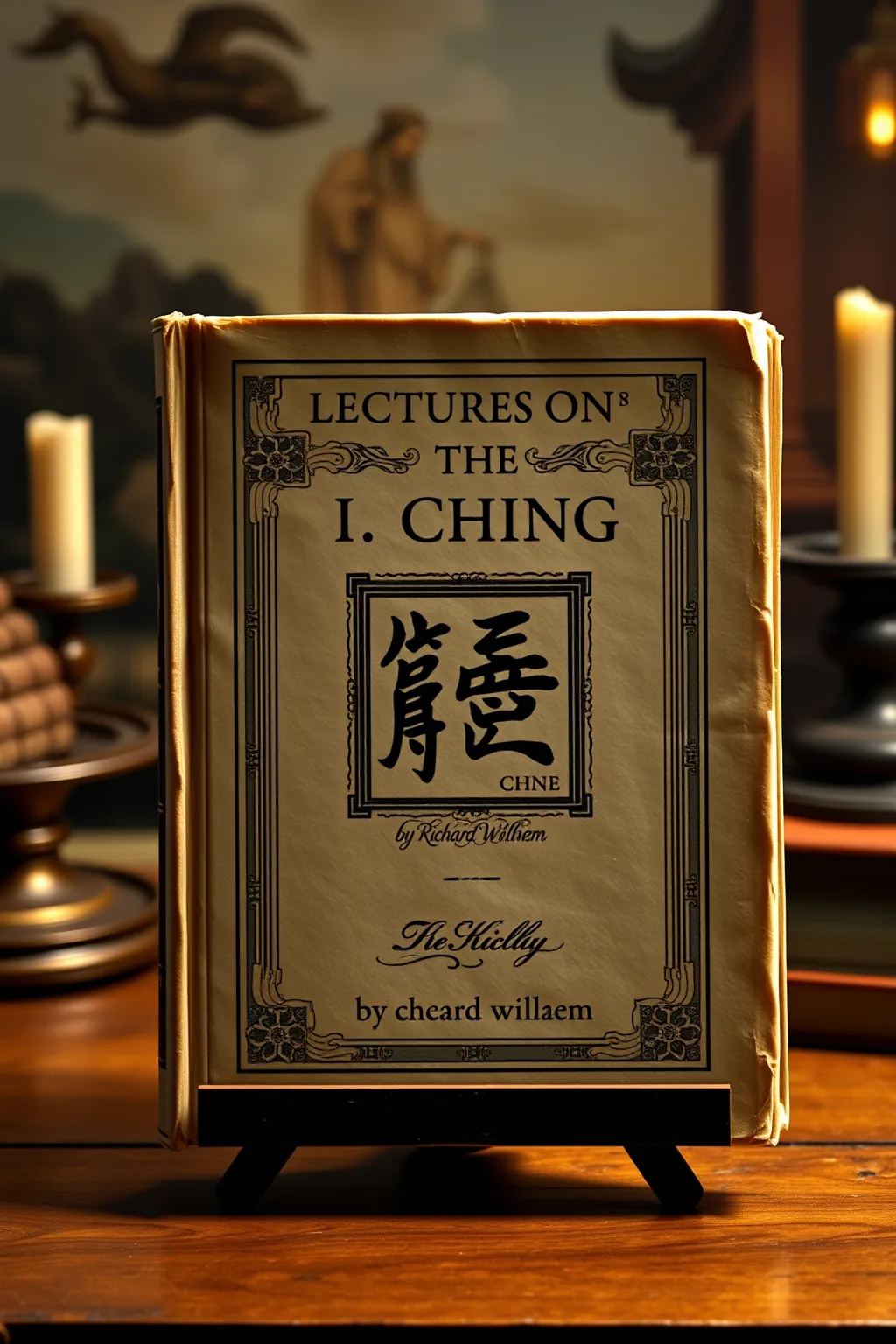
Lectures on the I Ching
 62
62

Lectures on the I Ching



Lorelei Sage (Contemplative Literature Editor) — Richard Wilhelm's "Lectures on the I Ching" stands as a monumental achievement in bridging Western understanding with Eastern esoteric thought. Wilhelm's deep immersion into the text allows him to articulate the I Ching's profound philosophical and spiritual dimensions with unparalleled clarity. He masterfully demystifies the hexagrams, revealing them not merely as oracular pronouncements, but as dynamic symbols of cosmic and human transformation. This work is essential for serious students of divination, philosophy, and mysticism, offering a rich, contemplative experience that resonates with timeless truths. Its enduring strength lies in its ability to inspire introspection and foster a holistic understanding of life's intricate patterns.
📝 Description
62
Richard Wilhelm's "Lectures on the I Ching" unpacks the "Book of Changes" for a Western audience.
Richard Wilhelm's "Lectures on the I Ching" examines the ancient Chinese text, presenting it as more than a simple divination manual. Wilhelm, a noted sinologist, translated and annotated the "Book of Changes," making its complex symbolism accessible. He guides readers through the hexagrams, explaining their meanings and their relation to a broader cosmic structure.
These lectures focus on the philosophical and ethical dimensions of the I Ching. Wilhelm connects its principles to human psychology and the patterns of existence. He encourages a view of the world as an interconnected system, perceivable through the text's symbolism. The book aims to foster self-awareness and a greater understanding of universal forces.
This work places the I Ching within a tradition of esoteric thought that seeks to understand universal order through symbolic systems. Richard Wilhelm's approach bridges Eastern texts with Western psychological and philosophical frameworks. His lectures frame the "Book of Changes" not just as a historical document but as a living source of wisdom for personal and spiritual alignment. It connects the text's insights to concepts of cosmic law and human experience, positioning it as a tool for perceiving underlying patterns in existence.
💡 Why Read This Book?
Unlock the profound wisdom of the ancient Chinese oracle, the I Ching. Richard Wilhelm's lectures offer a scholarly yet accessible gateway to understanding its symbolic language, philosophical depth, and divinatory power. Ideal for seekers of self-knowledge, practitioners of Eastern philosophies, and anyone wishing to deepen their connection to universal patterns and cosmic harmony. Discover a timeless guide for navigating life's complexities.
⭐ Reader Reviews
Honest opinions from readers who have explored this book.
❓ Frequently Asked Questions
What is the I Ching?
The I Ching, or Book of Changes, is an ancient Chinese text used for divination and as a source of philosophical wisdom. It comprises 64 hexagrams, each representing a different situation or state of being, offering guidance and insight.
Who was Richard Wilhelm?
Richard Wilhelm was a German sinologist and missionary who dedicated his life to studying and translating Chinese classics. His translations, particularly of the I Ching and Tao Te Ching, are considered definitive in the Western world.
How is the I Ching used for divination?
Divination with the I Ching typically involves casting yarrow stalks or coins to generate a hexagram, which is then interpreted using the text's commentary and symbolism to gain insight into a specific question or situation.
Is prior knowledge of Chinese philosophy required?
No, Richard Wilhelm's lectures are designed to be comprehensive. While prior knowledge can enhance understanding, his clear explanations and focus on universal themes make the I Ching accessible to newcomers.
What are the main philosophical themes in the I Ching?
Key themes include the interplay of Yin and Yang, the concept of cosmic change and transformation, the importance of balance and harmony, and the ethical principles for living a virtuous and fulfilling life.
🔮 Key Themes & Symbolism
The Dance of Yin and Yang
Study the fundamental principle of Yin and Yang, the primal forces of duality that shape all existence. Wilhelm elucidates how these seemingly opposing energies are, in fact, interdependent and complementary, creating the dynamic flux of the universe. Understand their manifestation within the hexagrams and how their balance or imbalance reflects the state of affairs, offering useful insights into personal and cosmic harmony. This exploration reveals the underlying unity in apparent contradiction, a central to Taoist philosophy and the I Ching's profound wisdom.
Cosmic Cycles and Transformation
Discover the I Ching as a map of universal cycles and continuous transformation. Each hexagram represents a specific phase within these ever-shifting patterns, from growth and flourishing to decline and renewal. Wilhelm's lectures guide the reader to perceive the inherent impermanence of all things and the wisdom found in adapting to change. Understanding these cosmic rhythms allows for a more profound engagement with life's events, fostering resilience and the ability to navigate transitions with grace and foresight.
The Art of Harmonious Living
Beyond mere divination, the I Ching offers a profound ethical framework for living a life of balance and integrity. Wilhelm's interpretations highlight the practical wisdom embedded in the hexagrams, emphasizing virtues such as sincerity, perseverance, and adaptability. Learn how to align your actions with the natural order, cultivating inner peace and fostering harmonious relationships. This theme explores the I Ching as a guide to self-cultivation and the attainment of a fulfilling existence, grounded in the principles of cosmic order.
💬 Memorable Quotes
Direct passages from the work, attributed to the author.
“The hexagrams are symbols of the forces of nature.”
— This interpretation points to the core of the I Ching's symbolic power, suggesting that each configuration of lines mirrors the dynamic processes and elemental forces that govern the natural world.
“The superior man acts in accordance with the times.”
— This highlights a key ethical principle within the I Ching: the importance of adaptability and acting with consideration for the prevailing circumstances and opportune moments.
“The I Ching is a mirror for the soul.”
— This evocative statement suggests that consulting the I Ching is not merely about external prediction, but a process of introspection that reveals one's inner state and guides personal growth.
💡 Key Ideas
Editorial paraphrase of the work's core concepts — not direct quotes.
The Book of Changes is the oldest of all Chinese classics.
This quote emphasizes the foundational and ancient nature of the I Ching, highlighting its status as a primary source of wisdom and philosophical inquiry in Chinese civilization.
Wisdom consists in seeing the connections between all things.
This quote underscores the holistic perspective of the I Ching, promoting the understanding that individual events and circumstances are interconnected within a larger cosmic web.
🌙 Esoteric Significance
Tradition
The I Ching is intrinsically linked to Taoism and Confucianism, serving as a foundational text for both. Esoterically, it is viewed as a key to understanding the Tao, the underlying principle of the universe, and its manifestations through the interplay of Yin and Yang. It represents a sophisticated cosmological system that maps the patterns of change, offering insights into synchronicity, fate, and the interconnectedness of all phenomena, aligning with broader hermetic and mystical traditions.
Symbolism
The hexagrams, composed of six lines (broken for Yin, unbroken for Yang), are the primary symbols. Each of the 64 hexagrams is laden with rich symbolic meaning, representing archetypal situations, natural phenomena, and human experiences. The trigrams (three-line combinations) are building blocks, each associated with elemental forces (heaven, earth, thunder, etc.) and family relationships. The commentary provides layers of interpretation, revealing the dynamic interplay and evolutionary potential within each symbolic configuration.
Modern Relevance
In an age of rapid technological advancement and information overload, the I Ching offers a profound counterpoint—a call for introspection, balance, and attunement to natural rhythms. Its principles of change, adaptation, and interconnectedness are remarkably relevant for navigating personal and global challenges. The I Ching provides a framework for ethical decision-making, understanding complex systems, and cultivating a deeper sense of purpose, serving as a timeless guide for self-awareness and harmonious living in the modern world.
👥 Who Should Read This Book
This key work is indispensable for seasoned practitioners of divination and those deeply immersed in Eastern philosophies, offering exceptional depth and scholarly insight. It is also a vital resource for scholars of Chinese culture, comparative religion, and mysticism seeking authoritative interpretations. Furthermore, spiritual seekers and contemplative individuals yearning to understand the fundamental patterns of existence, unlock profound self-knowledge, and cultivate a more harmonious relationship with the universe will find "Lectures on the I Ching" to be an informative and transformative guide.
📜 Historical Context
Richard Wilhelm's "Lectures on the I Ching" emerged during a period of intense Western interest in Eastern philosophies, particularly in the early 20th century. As the world grappled with rapid industrialization and ideological shifts, many intellectuals and spiritual seekers turned to ancient wisdom traditions for solace and understanding. Wilhelm, a dedicated sinologist living in China for decades, was uniquely positioned to interpret the I Ching for a Western audience. His work, deeply informed by his lived experience and scholarly rigor, arrived at a time when concepts like psychoanalysis and existentialism were also gaining traction, creating a fertile ground for the I Ching's exploration of human psychology and cosmic order. His translation and lectures provided an accessible yet profound entry point into a tradition that offered a holistic worldview distinct from prevailing Western paradigms, influencing generations of scholars, mystics, and philosophers.
📔 Journal Prompts
Reflect on a recent situation where the principles of Yin and Yang were clearly at play. How did their interplay affect the outcome?
Consider a significant life change you have undergone. How did this transition mirror the cyclical nature of transformation described in the I Ching?
Identify a moment when acting in accordance with the 'times' led to a positive outcome. What did this experience teach you about adaptability?
Explore a personal challenge through the lens of a specific hexagram. What insights or guidance does the symbolism offer for navigating this difficulty?
How can the I Ching's emphasis on balance and harmony be integrated more consciously into your daily decisions and interactions?
🗂️ Glossary
Hexagram
A figure composed of six horizontal lines, either solid (Yang) or broken (Yin), representing a specific situation or state of being within the I Ching's system of wisdom.
Trigram
A figure composed of three horizontal lines, solid or broken. There are eight trigrams, each representing fundamental elements, forces, or concepts, which combine to form hexagrams.
Yin
The feminine, passive, dark, and receptive principle in Chinese philosophy, often associated with the moon, water, and earth.
Yang
The masculine, active, light, and creative principle in Chinese philosophy, often associated with the sun, fire, and heaven.
Tao (Dao)
The fundamental, ineffable principle of the universe in Taoist philosophy, representing the natural order and the source of all existence.
This book appears in 3 collections
🔮 Readers Also Liked
Browse all →









More by Richard Wilhelm
All books →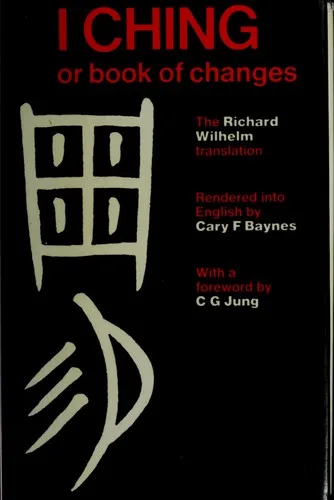





From the “Tarot” Collection
View all →




![CIA Reading Room cia-rdp78t05439a000400230090-7: MENSURATION OF THE [ ]-BUKHARA CANAL, USSR](/img/thumb/cia-reading-room-cia-rdp78t05439a000400230090-7-mensuration-of-the-bukhara-canal-ussr-cia-reading-room.webp)



More Free Divination & Tarot Books
View all →