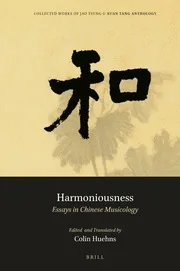
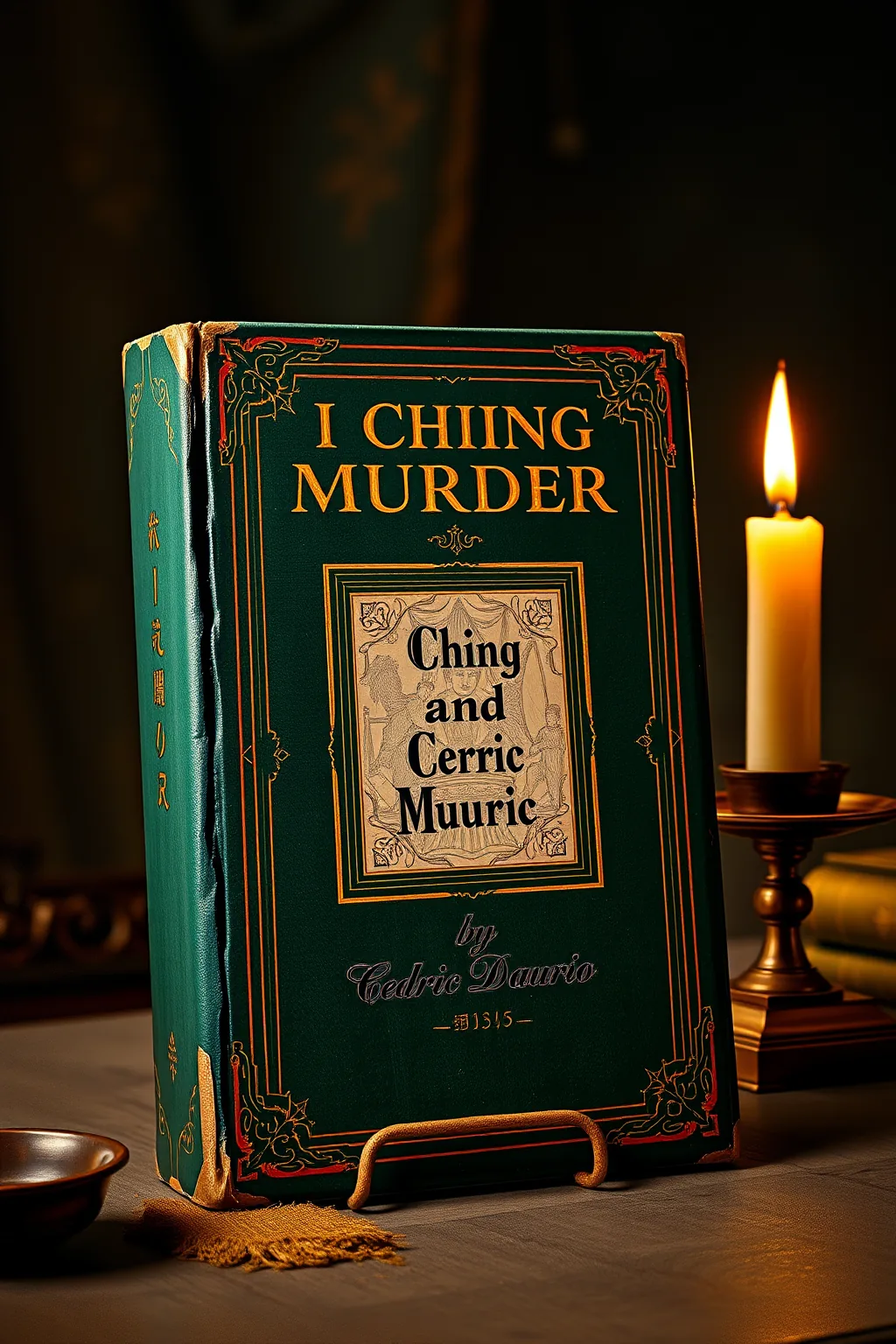
I Ching and Murder
 61
61

I Ching and Murder



By Isolde Whitaker (Sacred Texts Editor) — 'I Ching and Murder' by Cedric Daurio is a groundbreaking exploration that boldly marries the ancient Chinese divination system with the profound mystery of human malice. Daurio's incisive prose illuminates the I Ching's hexagrams not just as predictive symbols, but as a framework for understanding the roots of crime and the inescapable arcs of consequence. This work offers a rare and potent synthesis, revealing hidden layers of meaning for seasoned practitioners and curious scholars alike. It challenges readers to confront the ethical dimensions of divination and the cosmic justice woven into the fabric of existence. A truly singular and illuminating contribution to esoteric literature.
📝 Description
61
Cedric Daurio's 'I Ching and Murder' connects the ancient oracle to the motivations behind violent acts.
Cedric Daurio's 'I Ching and Murder' examines how the principles of the I Ching can illuminate human actions and their outcomes. The book proposes that the Chinese oracle's hexagrams are not just for predicting the future but for understanding the roots of transgression and the resulting consequences. Daurio details how the cyclical nature of the I Ching's wisdom can reveal hidden intentions, the flow of fate, and the karmic ties that connect individuals.
The text aims to uncover the philosophical basis of cause and effect, suggesting that the universe's inherent order delivers final judgment. It is written for those who seek deeper esoteric understanding, divination practitioners interested in the ethical implications of their practice, and academics studying the overlap between ancient thought and persistent questions about human behavior. The work presents a distinct view on the philosophical weight of actions and their repercussions.
This work sits within the tradition of applying classical divination systems to contemporary human issues. It follows a line of thought that views tools like the I Ching not simply as predictive instruments but as lenses for understanding psychological and moral dynamics. The book engages with the concept of cosmic order and its relation to human agency, a recurring theme in many esoteric traditions that seek to find underlying patterns in events and individual behavior. It aims to bridge the gap between ancient symbolic systems and the concrete realities of human conflict and accountability.
💡 Why Read This Book?
Uncover the profound connection between cosmic patterns and human actions. 'I Ching and Murder' offers a unique lens to understand causality, intent, and consequence through the wisdom of the I Ching. Ideal for seekers of deeper divination insights, practitioners exploring ethical dimensions, and scholars interested in the philosophical underpinnings of justice and fate.
⭐ Reader Reviews
Honest opinions from readers who have explored this book.
❓ Frequently Asked Questions
What is the primary focus of 'I Ching and Murder'?
The book examines how the I Ching's hexagrams can be interpreted to understand the motivations behind criminal acts and the subsequent karmic repercussions, bridging ancient divination with the study of human transgression.
Is this book suitable for beginners to the I Ching?
While it delves into complex themes, Daurio's explanations are accessible. Beginners can gain a unique perspective on the I Ching's depth, though prior familiarity with basic I Ching principles would enhance understanding.
Does the book provide practical methods for using the I Ching in criminal investigations?
The book focuses on the philosophical and symbolic interpretation of the I Ching in relation to crime, rather than offering practical investigative techniques. It is more about understanding the underlying forces at play.
What makes this approach to the I Ching unique?
Its uniqueness lies in applying the ancient oracle to the specific, often taboo, subject of murder and crime, revealing the I Ching as a tool for contemplating consequence and cosmic justice beyond simple fortune-telling.
Who would benefit most from reading this book?
Practitioners of divination seeking to expand their interpretive horizons, students of esoteric philosophy, and anyone fascinated by the interplay of fate, free will, and the darker aspects of the human psyche will find this book invaluable.
🔮 Key Themes & Symbolism
The Oracle as Witness and Judge
This theme explores the profound concept of the I Ching transcending its traditional role as a mere divinatory tool. Daurio posits that the hexagrams can act as a cosmic witness, reflecting the hidden intentions and the inevitable unfolding of events surrounding acts of violence. It studies how the ordered symbolism of the I Ching can mirror the justice system, not in a legalistic sense, but in the karmic balancing of deeds. The book suggests that by consulting the oracle, one can gain insight into the energetic signatures of transgression and the universe's inherent response, offering a unique perspective on accountability and cosmic order.
Causality and Karmic Echoes
Fundamentally, , 'I Ching and Murder' dissects the intricate web of causality that leads to transgression and its subsequent karmic echoes. Daurio meticulously traces the lines of influence, demonstrating how seemingly disparate events and psychological states can converge to precipitate acts of violence. The book elucidates the I Ching's cyclical nature, showing how past actions reverberate through time, impacting future outcomes. It encourages readers to contemplate the interconnectedness of all things, suggesting that every decision, especially those involving harm, creates ripples that return to the originator, guided by the fundamental laws of cause and effect.
The Shadow Self and the Hexagrams
This theme probes the shadowy aspects of the human psyche and how they are reflected within the symbolic language of the I Ching. Daurio suggests that the hexagrams, with their inherent duality and dynamic transformations, can offer useful insights into the primal urges, repressed desires, and internal conflicts that may drive individuals towards destructive behavior. By examining specific hexagrams, the book illuminates the archetypal patterns of the shadow self, providing a framework for understanding the psychological field of violence. It encourages a contemplative approach to confronting these darker energies, both within oneself and in the wider world.
💬 Memorable Quotes
Direct passages from the work, attributed to the author.
“In the stillness of the oracle, the traces of transgression find their voice.”
— This highlights the I Ching's ability to reveal hidden truths and the consequences of harmful deeds, portraying it as a silent confidante that speaks volumes about the unseen forces at play.
“Every act of violence casts a shadow, and the I Ching maps its return.”
— This succinctly captures the book's central thesis: that the I Ching serves as a guide to understanding the repercussions of harmful actions, illustrating the principle of karma and cosmic balance.
“To understand murder is to understand the deepest fissures in the human soul, revealed by the ancient wisdom.”
— This suggests that the study of extreme human acts, when viewed through the lens of the I Ching, offers useful insights into the fundamental nature and complexities of the human psyche.
💡 Key Ideas
Editorial paraphrase of the work's core concepts — not direct quotes.
The hexagrams are not mere symbols; they are cosmic fingerprints of consequence.
This quote emphasizes the deep, inherent connection between the I Ching's imagery and the inevitable outcomes of actions, suggesting an almost forensic quality to its wisdom regarding cause and effect.
The patterns of fate are etched in the lines, awaiting interpretation by the seeker of truth.
This quote underscores the idea that destiny is not arbitrary but follows discernible patterns, which the I Ching can help reveal to those who approach it with a genuine desire for understanding.
🌙 Esoteric Significance
Tradition
This work draws deeply from the Taoist philosophical tradition, specifically the ancient Chinese system of the I Ching (Book of Changes). Its esoteric significance lies in applying the I Ching’s principles of dynamic change, balance, and interconnectedness not just to personal growth or future prediction, but to the profound and often unsettling field of human transgression and its karmic consequences. It elevates the oracle from a tool of fortune-telling to a philosophical instrument for contemplating cosmic justice and the intricate web of causality.
Symbolism
The primary symbolism revolves around the 64 hexagrams of the I Ching. Each hexagram, composed of six lines (broken or unbroken), represents a specific situation, archetype, or stage of change. In 'I Ching and Murder,' these symbols are reinterpreted to represent the underlying forces, motivations, and inevitable outcomes associated with crime and violence. The interplay of Yin (broken lines) and Yang (unbroken lines) symbolically reflects the duality of human nature, the conflict between good and evil, and the inherent balance that the universe seeks to restore.
Modern Relevance
In an age grappling with understanding the roots of violence and seeking deeper frameworks for justice and accountability, 'I Ching and Murder' offers a timeless perspective. Its relevance lies in providing a philosophical and esoteric lens through which to examine causality, intent, and consequence beyond purely secular or legalistic interpretations. The book encourages introspection and a broader understanding of interconnectedness, prompting readers to consider the karmic implications of actions and the inherent order that governs existence, offering a pathway to deeper self-awareness and ethical contemplation in a complex world.
👥 Who Should Read This Book
This book is a compelling read for several distinct groups. For **practitioners of divination**, it offers an advanced perspective, expanding the interpretive scope of the I Ching beyond personal fortune to encompass profound ethical and karmic considerations. **Scholars of esotericism and philosophy** will find its unique synthesis of ancient Chinese wisdom and the study of human darkness a rich area for academic exploration. **Spiritual seekers** interested in the deeper workings of karma, causality, and cosmic justice will discover a thought-provoking framework for understanding the universe's intricate balance. Finally, **writers and creatives** looking for novel ways to explore themes of motive, consequence, and fate in their work will find inspiration in Daurio's insightful approach.
📜 Historical Context
Cedric Daurio's 'I Ching and Murder' emerges within a wide range of esoteric thought that has long sought to unify ancient wisdom with contemporary human concerns. The mid-to-late 20th and early 21st centuries have witnessed a resurgence of interest in divination and Eastern philosophies in the West, often accompanied by attempts to apply these systems to complex psychological and societal issues. Daurio’s work builds upon a legacy that includes Carl Jung's exploration of archetypes and synchronicity, which provided a bridge between Western psychology and Eastern thought, and the counter-cultural embrace of the I Ching as a tool for self-discovery and philosophical inquiry. This era saw a growing desire to find deeper meaning and interconnectedness in a rapidly changing world, leading many to explore ancient texts for guidance on profound existential questions, including the nature of justice and human fallibility. 'I Ching and Murder' stands as a unique product of this intellectual climate, offering a bold synthesis of venerable tradition and a stark confrontation with the darker aspects of human experience.
📔 Journal Prompts
Reflect on a time when you felt a strong sense of cosmic justice or injustice. How might a hexagram from the I Ching describe that situation?
Consider the concept of 'karmic echoes.' How might past actions, personal or collective, be influencing present circumstances, and which hexagrams might illustrate this?
Explore the 'shadow self' within you. If the I Ching were to represent your shadow, which hexagrams would be most prominent, and why?
Daurio links the I Ching to understanding motivations for crime. What hexagrams do you associate with greed, anger, or fear, and what are their potential consequences?
Contemplate the balance between free will and fate. How does the I Ching, as presented in this book, illustrate this dynamic in relation to significant life events or choices?
🗂️ Glossary
Hexagram
A symbol composed of six stacked horizontal lines, each line being either solid (Yang) or broken (Yin). The I Ching uses 64 distinct hexagrams to represent fundamental situations and archetypes.
Yin
In Taoist philosophy and the I Ching, Yin represents the passive, dark, feminine, receptive, and yielding principle, often depicted by a broken line (--) .
Yang
In Taoist philosophy and the I Ching, Yang represents the active, light, masculine, creative, and assertive principle, often depicted by a solid line (—).
Karmic Echoes
The reverberations or consequences of past actions that manifest in the present or future, stemming from the principle of cause and effect in spiritual and philosophical traditions.
Synchronicity
Meaningful coincidences; events that are not causally related but appear to be meaningfully related, a concept explored by Carl Jung in relation to the I Ching.
This book appears in 3 collections
🔮 Readers Also Liked
Browse all →








From the “Tarot” Collection
View all →







More Free Divination & Tarot Books
View all →