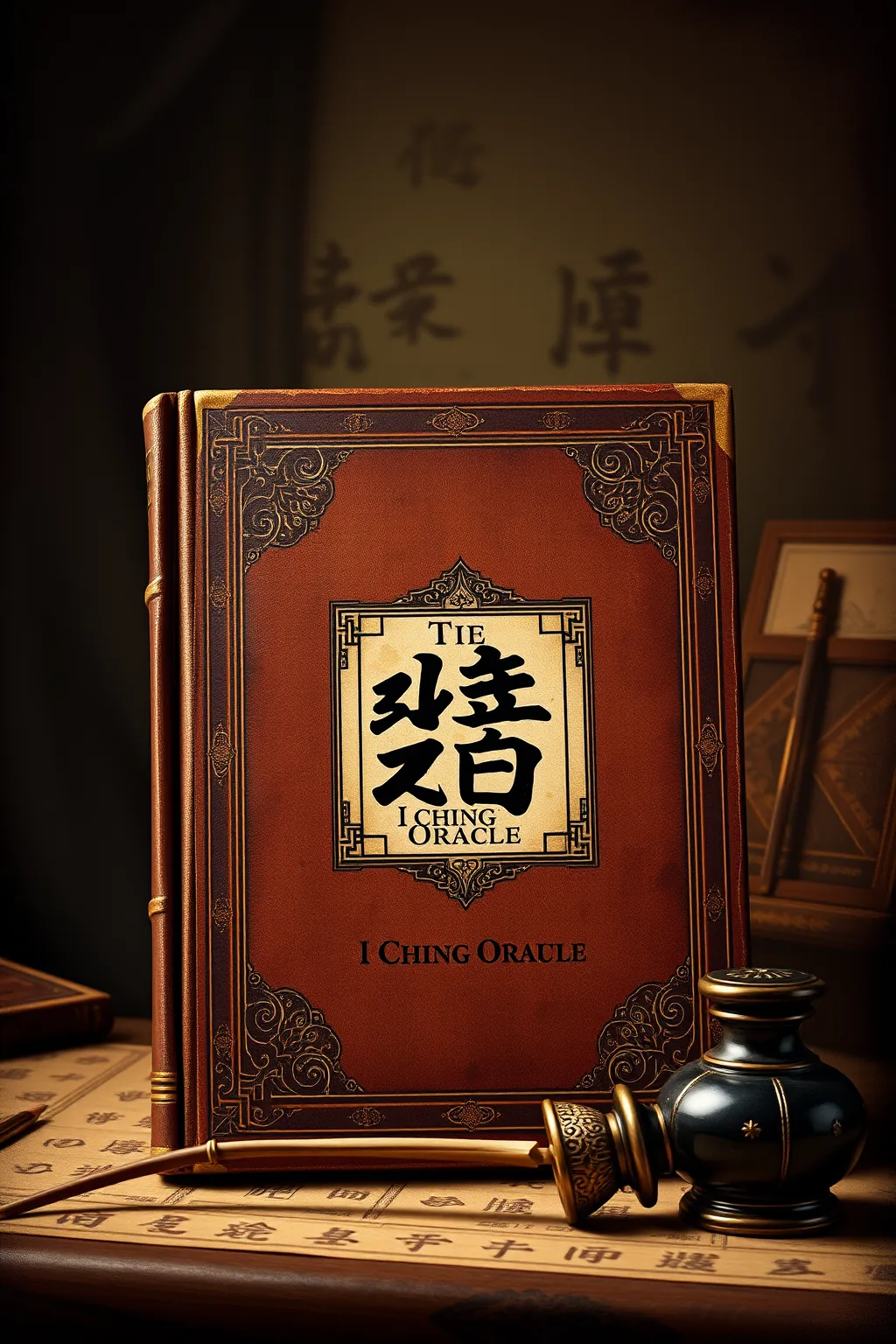
I Ching Oracle
 61
61

I Ching Oracle



Cassian Rothmann (Senior Critic, Ancient Wisdom) — Timothy and Johanna Dowdle’s rendition of the I Ching Oracle is a luminous beacon for modern seekers. Eschewing superficial interpretations, they illuminate the profound esoteric underpinnings of this ancient Chinese classic. The Dowdles masterfully translate the dense symbolism into accessible yet potent insights, revealing the I Ching not merely as a divination system, but as a living philosophy of change and cosmic harmony. Their work is a testament to the enduring power of this oracle, offering a robust framework for self-discovery and ethical guidance. This edition is indispensable for serious practitioners and scholars alike who wish to engage deeply with the 'Book of Changes.' It’s a profound spiritual resource that resonates with enduring wisdom.
📝 Description
61
Timothy and Johanna Dowdle's 2008 edition of the I Ching Oracle deciphers the ancient Chinese text for modern readers.
This edition of the I Ching Oracle, presented by Timothy and Johanna Dowdle, offers a structured approach to the classic Chinese divination text. It focuses on the system of change, illustrating how its sixty-four hexagrams and their constituent trigrams function as symbolic representations of universal forces. The book aims to move beyond simple fortune-telling, presenting the I Ching as a method for understanding the dynamics of life and making informed decisions. The Dowdles' presentation is intended for individuals seeking a deeper comprehension of the text, encouraging personal reflection and the development of self-awareness. It guides readers through the symbolism and philosophical ideas that have informed Chinese thought for centuries, connecting these concepts to contemporary life. The goal is to foster clarity and a sense of equilibrium by engaging with the text's principles.
The I Ching, or Book of Changes, is one of the oldest Chinese classic texts, dating back over two millennia. It is a central work in Taoism and Confucianism, revered not just for its divinatory methods but also for its philosophical insights into natural law and human conduct. The text's sixty-four hexagrams are formed by combinations of eight trigrams, each representing fundamental elements and states of being. These symbols are believed to mirror the patterns of change occurring in the universe, providing a framework for understanding and responding to life's circumstances. Its influence extends across East Asian cultures and has been studied by Western scholars and esoteric practitioners interested in its cosmology and practical wisdom.
💡 Why Read This Book?
Unlock the secrets of cosmic change and personal transformation. This edition offers clear guidance for deciphering the I Ching's profound symbolism, making ancient wisdom accessible. Ideal for spiritual seekers, contemplative practitioners, and students of divination who desire a deeper connection to universal patterns and inner guidance for navigating life's challenges with wisdom.
⭐ Reader Reviews
Honest opinions from readers who have explored this book.
❓ Frequently Asked Questions
What is the I Ching?
The I Ching, or 'Book of Changes,' is an ancient Chinese divination text and philosophical classic. It is comprised of 64 hexagrams, each representing a situation or archetype, used to gain insight into the past, present, and future.
How does the I Ching work?
It functions by casting yarrow stalks or coins to generate a hexagram, which is then interpreted using the text's commentaries and symbolic meanings to provide guidance on a specific question or situation.
Who were Timothy and Johanna Dowdle?
Timothy and Johanna Dowdle are respected scholars and practitioners who have dedicated themselves to translating and interpreting esoteric texts, bringing clarity and depth to ancient wisdom traditions for a modern audience.
Is the I Ching only for divination?
While widely used for divination, the I Ching is also a profound philosophical text offering insights into ethics, strategy, and the nature of change, applicable to personal growth and understanding life's dynamics.
What makes this edition special?
This edition is celebrated for its clarity, its faithful preservation of the I Ching's esoteric essence, and its ability to make the complex symbolism and philosophical depth accessible to both novice and experienced practitioners.
🔮 Key Themes & Symbolism
The Philosophy of Change
Fundamentally, the I Ching is a profound exploration of change as the fundamental constant in the universe. It posits that all phenomena are in a perpetual state of flux, governed by cyclical patterns and dynamic interplay of opposing forces. Understanding these shifts is key to navigating life effectively. The text provides a framework for recognizing the nature of these changes, from subtle beginnings to dramatic transformations, encouraging adaptability and foresight. It teaches that by aligning oneself with the natural flow of events, one can achieve greater harmony and success, transforming challenges into opportunities for growth and evolution.
Cosmic Interconnectedness and Harmony
The I Ching posits a deep interconnectedness between the microcosm of human experience and the macrocosm of the universe. Its hexagrams and their constituent trigrams symbolize universal archetypes that reflect the fundamental forces at play in both nature and human affairs. By studying these symbols, individuals can gain a profound awareness of their place within the greater cosmic order. The aim is to achieve harmony not only within oneself but also with the surrounding environment and the Tao. This interconnectedness emphasizes that actions have ripple effects, urging conscious participation in the unfolding of reality.
Symbolism and Archetypal Wisdom
The power of the I Ching lies in its rich and layered symbolism. The 64 hexagrams, formed from combinations of two trigrams, represent a comprehensive map of human experience and universal principles. These symbols are not merely abstract representations but potent archetypes that resonate with deep psychological and spiritual truths. Each hexagram carries a unique message, offering guidance, warnings, and clear insights into the nature of situations. Deciphering this symbolic language unlocks access to a reservoir of ancient wisdom, allowing individuals to understand the underlying patterns and energies influencing their lives.
💬 Memorable Quotes
Direct passages from the work, attributed to the author.
“Confusion is the beginning of wisdom.”
— This highlights that moments of uncertainty and not knowing are fertile ground for genuine learning and deeper understanding to emerge.
“When you are in doubt, be still.”
— This advice encourages introspection and patience during times of uncertainty, suggesting that stillness allows for clarity to arise naturally.
“To know the Tao is to know oneself.”
— This profound statement suggests that understanding the fundamental principles of the universe (Tao) is inextricably linked to achieving self-awareness and inner clarity.
💡 Key Ideas
Editorial paraphrase of the work's core concepts — not direct quotes.
The superior man acts before he speaks, and in this way becomes a master of his words.
This quote emphasizes the importance of action and integrity over mere rhetoric, suggesting that true leadership and influence stem from demonstrated deeds rather than empty promises.
The wise man does not fret about what is gone, nor does he worry about what is to come.
This quote promotes living in the present moment, free from the burdens of past regrets and future anxieties, fostering peace and acceptance.
🌙 Esoteric Significance
Tradition
The I Ching is a foundational text within the Taoist tradition, deeply intertwined with Chinese cosmology and philosophy. It embodies the principles of Yin and Yang, the ceaseless dance of complementary opposites that drive all creation. Its hexagrams can be seen as symbolic representations of the universal forces and archetypes described in Taoist texts like the Tao Te Ching. The practice of consulting the I Ching is a form of engaging with the Tao, seeking alignment with its natural flow and understanding the subtle energies that govern existence, thus fostering personal harmony and spiritual development.
Symbolism
The core symbolism of the I Ching resides in its 64 hexagrams, each composed of six lines that are either broken (Yin) or solid (Yang). These lines combine to form trigrams, representing fundamental elements like Heaven, Earth, Thunder, Water, Mountain, Wind, Fire, and Lake. The interplay of these trigrams and hexagrams symbolizes the dynamic interactions of all phenomena in the universe, from the smallest particle to the grandest cosmic cycle. The symbolism offers a profound language for understanding change, relationships, and the underlying order of reality.
Modern Relevance
In contemporary times, the I Ching remains remarkably relevant as a tool for introspection, decision-making, and spiritual guidance. Its emphasis on the inevitability and nature of change resonates deeply in our rapidly evolving world. For many, it serves as a non-dogmatic oracle, offering profound psychological insights and ethical considerations rather than deterministic prophecies. Its philosophical underpinnings of balance, adaptability, and interconnectedness provide a timeless framework for navigating personal challenges, fostering mindful living, and cultivating a deeper understanding of one's role within the greater cosmic collection.
👥 Who Should Read This Book
This edition of the I Ching Oracle is a treasure for a diverse array of seekers. **Beginners** will find the clear explanations and structured approach useful for their first steps into this ancient system. **Scholars and practitioners** of esoteric traditions will appreciate the nuanced interpretations and fidelity to the original text. **Spiritual seekers** yearning for deeper self-understanding and guidance on their life path will discover a profound source of wisdom. **Anyone** interested in philosophy, Eastern thought, or the art of divination will find this book an enriching and transformative read, offering timeless insights into the nature of change and existence.
📜 Historical Context
The I Ching, or 'Book of Changes,' emerged from ancient Chinese shamanistic practices and philosophical thought, with its origins traceable to the Shang Dynasty (c. 1600–1046 BCE). Its foundational text, the 'Book of Changes,' evolved over centuries, with significant contributions from Confucian scholars like King Wen and the Duke of Zhou, who are credited with developing the hexagram system and its commentaries. During the Han Dynasty (206 BCE–220 CE), the I Ching solidified its status as one of the Five Classics of Confucianism, influencing governance, ethics, and personal conduct. Its philosophical depth and divinatory applications made it a central text in Chinese intellectual and spiritual life for millennia, shaping not only Chinese culture but also influencing thought across East Asia and beyond.
📔 Journal Prompts
Reflect on a recent significant change in your life. How did the I Ching's principles of waxing and waning apply?
Consider the interplay of Yin and Yang in a current challenge. Where can you find balance?
What archetypal energy does the hexagram representing your current situation embody? How can you work with it?
How can the wisdom of the I Ching inform your decision-making process in the coming week?
Explore the concept of 'pre-heaven' vs. 'post-heaven' arrangements in relation to your personal goals.
🗂️ Glossary
Hexagram
A symbol composed of six lines, either solid (Yang) or broken (Yin), representing a specific situation, archetype, or phase of change in the I Ching.
Trigram
A symbol composed of three lines, forming the eight fundamental elements (Heaven, Earth, Thunder, Water, Mountain, Wind, Fire, Lake) that combine to create hexagrams.
Yang
The active, masculine, bright, and assertive principle in the I Ching, represented by a solid line (—).
Yin
The passive, feminine, dark, and receptive principle in the I Ching, represented by a broken line (--).
Tao
The fundamental, ineffable principle of the universe in Taoism, representing the natural order, the Way, and the source of all existence.
This book appears in 3 collections
🔮 Readers Also Liked
Browse all →









From the “Tarot” Collection
View all →






More Free Divination & Tarot Books
View all →