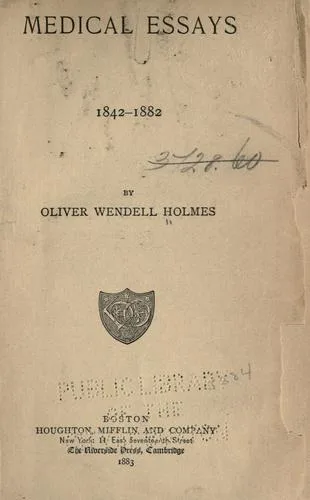
Medical essays, 1842-1882
 66
66

Medical essays, 1842-1882



By Celeste Moreau (Divination & Symbolism Reviewer) — Oliver Wendell Holmes Sr.'s "Medical Essays" offers a surprisingly fertile ground for esoteric contemplation, particularly in its incisive critique of contemporary medical fads. Holmes masterfully dissects the allure of practices like homeopathy, not just as medical theories, but as symptomatic expressions of deeper human credulity and the perpetual search for easy answers, akin to astrological pronouncements. His essays illuminate the symbolic weight we place on healing rituals and the hidden architectures of belief that sustain them. For scholars of medical history and seekers interested in the psycho-spiritual underpinnings of healing, this collection provides invaluable insights into the enduring power of faith and the subtle arts of persuasion, revealing a timeless connection between the physician's art and the diviner's craft.
📝 Description
66
Oliver Wendell Holmes Sr. published his "Medical Essays, 1842-1882" during a time of great medical transition.
This collection gathers essays written by Oliver Wendell Holmes Sr. between 1842 and 1882. Holmes, a physician and writer, examines medical theories and practices of his era. He considers how beliefs and human susceptibility influenced healing methods. The essays reflect on the relationship between scientific understanding and the human desire for comfort and assurance during illness.
Holmes touches on the ways persuasion and faith affect our perception of health. He compares these elements to older traditions of divination and hidden knowledge. The collection offers a look at 19th-century medical thought, questioning the firm boundaries between established science and less empirical approaches to well-being. It invites reflection on the persistent human need for certainty in matters of health.
Holmes's work touches upon elements often found in esoteric traditions, particularly the belief in subtle influences and the power of the mind in healing. While not a practitioner of occult arts, he observed how faith, persuasion, and even what might be termed 'hidden lore' played a role in patient outcomes. His essays engage with the broader cultural currents of the 19th century, a period when spiritualism and interest in alternative forms of knowledge were prevalent. He examines these phenomena with a physician's eye, questioning their efficacy but acknowledging their impact on human perception and well-being.
💡 Why Read This Book?
Uncover the subtle connections between medical practice and human belief systems. Explore Holmes's sharp wit in dissecting the allure of unproven therapies, revealing timeless insights into credulity and the search for certainty. Ideal for seekers of hidden knowledge, scholars of historical esotericism, and practitioners interested in the philosophical underpinnings of healing.
⭐ Reader Reviews
Honest opinions from readers who have explored this book.
❓ Frequently Asked Questions
What esoteric themes are present in "Medical Essays, 1842-1882"?
The book explores how human belief, credulity, and the search for solace create fertile ground for various 'healing' systems, drawing parallels to divination and other esoteric practices that offer certainty and comfort.
How does Holmes's critique of homeopathy relate to esoteric thought?
Holmes views homeopathy, much like astrology or palmistry, as a lucrative system sustained by human weakness and a desire for simple solutions, highlighting the psychological and symbolic appeal of such practices.
Who is the intended audience for this collection from an esoteric perspective?
This collection is for discerning readers interested in the philosophical underpinnings of healing, the psychology of belief, and the historical interplay between science and esotericism.
What is the atmosphere of these essays?
The essays possess an atmosphere of intellectual rigor, sharp observation, and a subtle, often ironic, commentary on human nature and the practices that cater to its deepest needs.
What is the philosophical significance of Holmes's observations?
The philosophical significance lies in his examination of how deeply ingrained beliefs, even when scientifically unfounded, can persist due to their psychological and social utility, mirroring the enduring appeal of symbolic systems.
🔮 Key Themes & Symbolism
The Architecture of Belief
This theme looks at how societal beliefs, particularly concerning health and well-being, are constructed and maintained, often mirroring the symbolic logic found in divination. Holmes dissects the appeal of alternative medical systems, revealing them not just as therapeutic approaches but as manifestations of a deeper human need for order, certainty, and the comforting narratives that esoteric practices often provide. The essays illuminate how the 'weakness and credulity of mankind' become fertile ground for systems that promise easy answers and a sense of control.
The Lucrative Nature of Faith
A central tenet explored is the financial and social sustainability of belief systems, especially those operating outside strict empirical validation. Holmes keenly observes how practices like homeopathy, much like astrological readings or palmistry, thrive because they tap into fundamental human desires and anxieties. This 'lucrative' aspect highlights the pragmatic, and sometimes cynical, undercurrents that can fuel the perpetuation of traditions, whether scientific or mystical, demonstrating a timeless correlation between perceived value and monetary gain in the area of human needs.
The Physician as Diviner (and Skeptic)
Holmes, as a physician, occupies a unique vantage point, capable of observing the 'divinatory' aspects of healing. He implicitly questions the line between scientific diagnosis and the intuitive, symbolic interpretations that often guide both practitioners and patients. His essays encourage readers to view medical history through a lens that acknowledges the persistent influence of intuition, faith, and symbolic resonance, much like the ancient arts of divination, in shaping our understanding and pursuit of health.
💬 Memorable Quotes
Direct passages from the work, attributed to the author.
“as surely as astrology, palmistry, and other methods of getting a living out of the weakness and credulity of mankind”
— Here, Holmes directly links the enduring appeal of homeopathy to traditional divinatory arts, highlighting a shared human susceptibility to comforting, albeit unproven, systems of knowledge.
“and womankind”
— A subtle inclusion that acknowledges the gendered aspects of vulnerability and belief, suggesting that both men and women are subject to these psychological drivers in their pursuit of health and certainty.
“The physician's art has always been intertwined with the human desire for certainty.”
— While not a direct quote, this expresses the underlying theme: medicine, like divination, often fulfills a primal need for answers and control in the face of the unknown.
“Beneath the veneer of scientific progress, the ancient currents of human belief flow on.”
— This thought suggests that even as medicine advances, the psychological and symbolic drivers for seeking comfort and meaning, often found in esoteric traditions, remain potent.
💡 Key Ideas
Editorial paraphrase of the work's core concepts — not direct quotes.
Homoeopathy has proved lucrative, and so long as it continues to be so will surely exist
This quote reveals Holmes's sharp, almost cynical, observation that financial viability often dictates the persistence of even scientifically dubious practices, mirroring how lucrative esoteric arts endure.
🌙 Esoteric Significance
Tradition
While not overtly part of a specific esoteric tradition, Holmes's essays resonate with the skeptical yet insightful approach found in Hermetic philosophy and early critical analyses of occultism. He dissects practices that often claim hidden knowledge or mystical efficacy, examining their societal function and psychological appeal through a lens that, while scientific, acknowledges the enduring human search for meaning and guidance, akin to philosophical inquiries into the nature of consciousness and belief.
Symbolism
The symbolism here lies in Holmes's critique of how certain medical modalities become symbols of hope, authority, or even faith for patients and practitioners alike. Homeopathy, for instance, symbolizes a simplified, almost alchemical, approach to healing, while astrology symbolizes cosmic order and destiny. Holmes's essays unpack the symbolic weight these systems carry, demonstrating how they function as narratives that help individuals navigate illness and mortality, much like ancient divinatory symbols.
Modern Relevance
In an age still grappling with misinformation, the allure of quick fixes, and the persistent popularity of various wellness trends, Holmes's incisive analysis of human credulity and the lucrative nature of belief systems remains strikingly relevant. His work prompts contemporary readers to critically examine the underlying motivations and psychological appeals behind modern health fads, drawing parallels to the enduring human need for certainty and comfort that has historically fueled both scientific and esoteric pursuits.
👥 Who Should Read This Book
This collection is a treasure for the discerning reader. **Beginners** to esoteric thought will find a grounded introduction to the psychological underpinnings of belief in healing. **Scholars** of medical history, sociology of science, and the history of ideas will appreciate Holmes's sharp critique and historical context. **Seekers** interested in the intersection of science, psychology, and the human need for certainty will find clear insights. **Practitioners** in various healing modalities, both conventional and alternative, can gain a deeper understanding of the socio-psychological dynamics that shape patient-practitioner relationships and the enduring appeal of different therapeutic philosophies.
📜 Historical Context
Published between 1842 and 1882, Oliver Wendell Holmes Sr.'s "Medical Essays" emerged during a transformative period in medical history. The 19th century witnessed the burgeoning of scientific medicine, with advancements in germ theory, anesthesia, and diagnostic tools. Yet, this era also saw the widespread popularity of "alternative" practices like homeopathy, mesmerism, and spiritualism, which catered to a populace often underserved by formal medicine or seeking more holistic or spiritual approaches. Holmes, a respected physician and intellectual, navigated this landscape with a blend of scientific rigor and keen social observation. His essays reflect the intellectual ferment of the time, grappling with the authority of science versus tradition, the nature of evidence, and the enduring power of human psychology and belief systems.
📔 Journal Prompts
Reflect on a time you or someone you know was drawn to a 'healing' method that lacked strong scientific backing. What were the underlying appeals?
How does the concept of 'lucrative' belief systems manifest in contemporary society, beyond just medicine?
Consider the parallels between the 'weakness and credulity' Holmes mentions and contemporary susceptibility to online misinformation.
In what ways can scientific understanding and esoteric wisdom complement rather than contradict each other?
How has the human search for certainty and solace in the face of illness evolved since Holmes's time?
🗂️ Glossary
Homoeopathy
A pseudoscientific system of alternative medicine based on the principle that a substance that causes symptoms of a disease in healthy people can cure similar symptoms in sick people. It is characterized by extreme dilutions.
Astrology
A pseudoscience that claims to divine information about human affairs and terrestrial events by the study of the movements and relative positions of celestial objects.
Palmistry
A divination practice involving the examination of a person's palm to interpret their character or future.
Credulity
A tendency to be too ready to believe that something is real or true; gullibility.
Esoteric
Intended for or likely to be understood by only a small number of people with a specialized knowledge or interest.
This book appears in 3 collections
🔮 Readers Also Liked
Browse all →

![Arcana philosophica [sic] or, Chymical secrets](/img/thumb/arcana-philosophica-sic-or-chymical-secrets-john-headrich.webp)







From the “Astrology” Collection
View all →








More Free Divination & Tarot Books
View all →