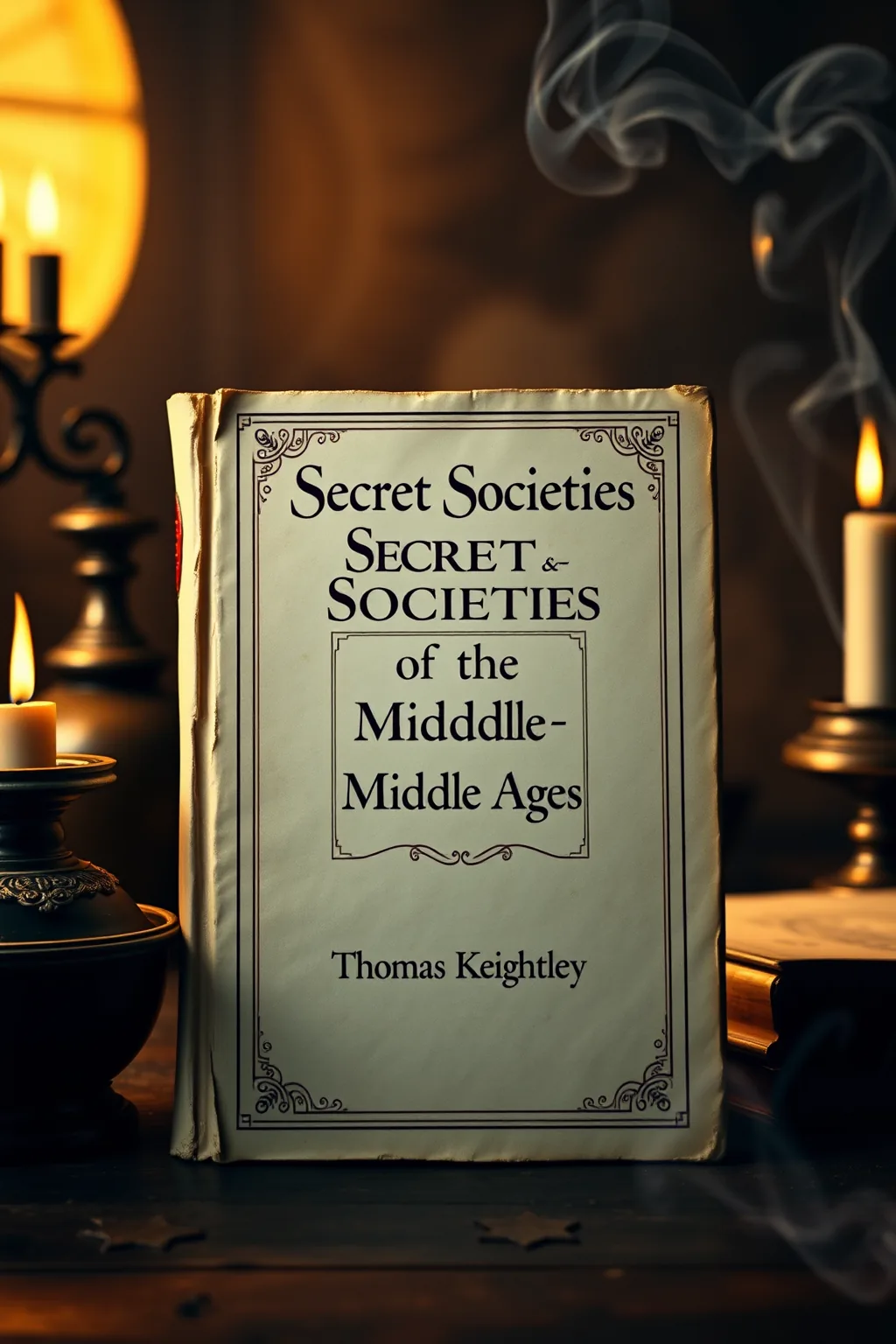
Secret Societies of the Middle Ages
 80
80

Secret Societies of the Middle Ages
Thomas Keightley's "Secret Societies of the Middle Ages" offers a refreshing antidote to the sensationalism that often clouds discussions of historical clandestine groups. Rather than recounting lurid tales, Keightley meticulously traces the likely origins of such societies to the very human impulse to protect and control knowledge. His argument that secrecy often stemmed from a desire to preserve accumulated wisdom, particularly within craft guilds or early scholarly circles, is compelling. A notable strength is the book's grounded approach, eschewing fanciful speculation for a more analytical perspective on medieval social structures. However, the work occasionally suffers from its 19th-century prose, which can be dense and demanding for a modern reader. While Keightley presents a solid framework for understanding the *why* behind these societies, the specific *who* remains somewhat elusive, a limitation inherent in the scarcity of direct evidence for many medieval clandestine bodies. The discussion surrounding the potential for early monastic orders to function as conduits for protected knowledge, for instance, highlights both the book's insightful analysis and the challenges of definitive proof. Ultimately, Keightley provides a valuable, if somewhat dry, historical foundation for comprehending the roots of organized secrecy.
📝 Description
80
Thomas Keightley's 1838 book examines medieval secret societies beyond sensationalism.
Thomas Keightley's "Secret Societies of the Middle Ages" investigates the origins and functions of clandestine groups in the medieval period. The work moves beyond sensationalized conspiracy theories to consider the practical and intellectual motivations for their formation. Keightley suggests that secrecy often arose from a need to safeguard accumulated knowledge, a pattern seen in various fields. He details how elites and specialized guilds protected exclusive access to information, skills, or power, thus influencing the era's social and intellectual climate.
The author bases his analysis on careful study of available historical records. This approach provides a scholarly perspective on a topic often misunderstood. The book is for readers interested in the historical roots of secret societies, particularly within medieval Europe. It appeals to students of history, sociology, and comparative religion seeking a factual understanding beyond popular myths. Those studying historical knowledge transmission, guild evolution, or the social dynamics of exclusion and inclusion will find significant material. It also suits individuals curious about the historical precedents for modern organizations focused on shared interests or doctrines.
Published in 1838, Keightley's work emerged during a 19th-century surge of historical inquiry and fascination with hidden traditions. This era saw scholars applying rigorous methods to subjects previously confined to folklore. Keightley contributed to this trend by applying historical analysis to secret societies. His book sought to understand these groups not as mere myth, but as historical phenomena shaped by social and intellectual forces. It represents an early attempt to provide a structured, evidence-based account of subjects often shrouded in speculation.
💡 Why Read This Book?
• Understand the historical impetus for secrecy: Learn how the desire to safeguard specialized knowledge, as discussed in relation to medieval craft guilds, drove the formation of early exclusive groups. • Gain insight into medieval social structures: Discover how secret societies functioned within the broader context of the Middle Ages, moving beyond myth to historical analysis. • Appreciate a scholarly approach to esoteric history: Engage with a 19th-century academic examination of clandestine traditions, offering a counterpoint to more modern, speculative interpretations.
⭐ Reader Reviews
Honest opinions from readers who have explored this book.
❓ Frequently Asked Questions
What is the primary argument of Thomas Keightley's "Secret Societies of the Middle Ages"?
The book's central thesis is that secret societies primarily emerged from the human impulse to protect and control accumulated knowledge, skills, or social status, rather than from inherently nefarious motives. Keightley suggests this was common in medieval craft guilds and scholarly circles.
Does this book focus on specific secret societies like the Illuminati or Freemasons?
No, "Secret Societies of the Middle Ages" predates many of the more famous secret societies. Keightley's focus is on the general historical origins and functions of clandestine groups during the medieval period, using examples like guilds and early scholarly fraternities.
What historical period does Keightley primarily cover?
Thomas Keightley focuses on the Middle Ages, examining the social, intellectual, and economic conditions that fostered the development of secret societies during this era, roughly from the 5th to the 15th century.
Is "Secret Societies of the Middle Ages" based on primary source evidence?
Yes, Keightley's work is grounded in historical scholarship and attempts to draw conclusions based on available medieval records, though he acknowledges the inherent difficulties in documenting clandestine organizations.
What is the author's perspective on the nature of medieval secret societies?
Keightley views them largely as functional entities, often created for the preservation of knowledge or professional secrets within specific trades or intellectual communities. He emphasizes practicality over sensationalism.
When was "Secret Societies of the Middle Ages" first published?
While Esoteric Library lists a 2013 publication date, Thomas Keightley's original work on secret societies was published much earlier, reflecting 19th-century scholarship on the subject.
🔮 Key Themes & Symbolism
Knowledge Preservation
The core thesis posits that secret societies arose from the necessity of protecting specialized knowledge. Keightley illustrates how guilds, for instance, maintained exclusive access to craft techniques through strict apprenticeship rules and hidden rituals. This concept extends beyond mere trade secrets, encompassing philosophical and potentially religious doctrines that were considered too potent or exclusive for general dissemination. The work suggests that this hoarding of knowledge was a fundamental driver, shaping the very structure and purpose of these clandestine groups throughout the medieval period.
Social Exclusivity and Status
Beyond knowledge, secret societies served to maintain social and professional exclusivity. Membership conferred status and privilege, differentiating practitioners from the uninitiated. Keightley implies that the secrecy surrounding certain orders or guilds was intrinsically linked to preserving their elevated position within medieval society. This exclusivity was often reinforced through initiation rites and oaths, creating strong bonds among members and a clear demarcation between insiders and outsiders. The desire to maintain these social hierarchies is presented as a significant factor in the perpetuation of clandestine practices.
Medieval Guild Structures
Craft guilds represent a primary example used by Keightley to illustrate the function of secret societies. These organizations controlled trade standards, training, and membership, often employing secret practices and symbols to signify mastery and exclusivity. The progression from apprentice to journeyman to master involved processes that were not fully transparent to the public. Keightley analyzes how these internal structures, with their inherent need for controlled information transfer, mirrored the broader characteristics of secret societies, providing a tangible link between everyday medieval life and clandestine organization.
The Nature of Secrecy
Keightley's work approaches secrecy not as an end in itself, but as a tool. He differentiates between secrecy born of necessity (protecting trade secrets or vulnerable doctrines) and secrecy potentially driven by malice. The book suggests that in the medieval context, the former was far more prevalent. It explores how oaths, veiled language, and specific symbols were employed to maintain this secrecy, ensuring the integrity of the group and its objectives. This analytical perspective helps explain the concept of secret societies within their historical context.
💬 Memorable Quotes
Direct passages from the work, attributed to the author.
“If we had the means of investigating historically the origin of Secret Societies, we should probably find that they began to be formed almost as soon as any knowledge had been accumulated by particular individuals beyond what constituted the common stock.”
— This foundational statement frames Keightley's core argument: secrecy is intrinsically linked to the possession of exclusive knowledge. It suggests that from the earliest stages of intellectual or skill-based development, humans naturally sought to protect that advantage, leading to the formation of groups.
“The same thing has happened to knowledge that has happened to all other human possessions,—its actual holders have striven to keep it to themselves.”
— This highlights the economic and social parallel Keightley draws between knowledge and material possessions. Just as people guard wealth, those with valuable information or skills historically sought to monopolize it for personal or group benefit.
“It is true that in this case the possessor of the advantage does not seem to have the same reason...”
— This fragment suggests Keightley is contrasting the motivations for secrecy in different contexts. While some secrets might be held for obvious gain (like trade secrets), others might have less apparent, perhaps more philosophical or spiritual, reasons, prompting further historical inquiry.
“The historical evidence suggests medieval guilds utilized secrecy as a mechanism for maintaining professional standards and market control.”
— This interpretation focuses on a key example. It illustrates how the practices of trade organizations, like guilds, inherently involved secrecy to regulate quality, training, and economic competition within their specific crafts.
💡 Key Ideas
Editorial paraphrase of the work's core concepts — not direct quotes.
The work explores how the 'common stock' of knowledge was often insufficient for specialized pursuits, necessitating the creation of exclusive learning environments.
This paraphrased concept emphasizes the practical limitations Keightley identifies. When general knowledge proved inadequate for complex crafts or esoteric studies, dedicated groups formed to cultivate deeper understanding through controlled instruction.
🌙 Esoteric Significance
Tradition
Keightley's work doesn't align neatly with a single esoteric lineage like Hermeticism or Kabbalah. Instead, it operates as a historical and sociological examination of the *mechanisms* that underpin many esoteric traditions: the formation of exclusive groups for knowledge preservation. It provides a foundational understanding of how groups dedicated to preserving and transmitting specialized, often non-mainstream, knowledge might have originated and functioned within historical societal frameworks.
Symbolism
While Keightley focuses more on the socio-historical function than explicit symbolism, his discussion of medieval craft guilds implicitly touches upon symbolic elements. The progression through guild ranks (apprentice, journeyman, master) often involved symbolic gestures, hidden signs, and specific rituals. These elements served not only to denote status but also to reinforce group identity and the exclusivity of the knowledge being passed down, acting as markers of initiation and shared understanding within the society.
Modern Relevance
Contemporary scholars and practitioners interested in the historical sociology of knowledge, the evolution of professional organizations, and the roots of Western esotericism find Keightley's work relevant. His analysis of knowledge hoarding and group exclusivity provides a framework for understanding how traditions, whether mystical, scientific, or artisanal, maintained their integrity and continuity over centuries, often operating outside mainstream acceptance.
👥 Who Should Read This Book
['• Students of medieval history: Those researching social structures, guilds, and the transmission of knowledge in the medieval period will find a factual, analytical perspective.', '• Researchers of esoteric traditions: Individuals interested in the historical precedents for organized secret knowledge systems will gain foundational context.', "• Sociologists of knowledge: Readers exploring how societies create and protect specialized information will benefit from Keightley's examination of historical group dynamics."]
📜 Historical Context
Thomas Keightley penned his analysis of "Secret Societies of the Middle Ages" during the 19th century, a period marked by intense historical inquiry and a romantic fascination with the past's hidden aspects. This era saw the rise of academic history, but also a popular appetite for tales of chivalry, mystery, and esoteric traditions, fueled by authors like Sir Walter Scott. Keightley's work emerges within this intellectual climate, attempting to apply a more rigorous, evidence-based approach to a subject often sensationalized. His focus on the practical origins of secrecy, particularly within medieval craft guilds, offers a counterpoint to more speculative theories. While not directly engaging with a specific contemporary who debated medieval secret societies by name in this particular text, his scholarly method was influenced by the developing historiography of the time. The reception of such works often varied; while academic circles might have appreciated the analytical approach, popular sentiment frequently leaned towards more fantastical interpretations of medieval clandestine groups.
📔 Journal Prompts
The medieval guild's need for 'knowledge hoarding'.
Reasons for protecting accumulated knowledge in the Middle Ages.
The social function of exclusivity in historical groups.
Evidence of secrecy within medieval craft practices.
Comparing historical knowledge protection to modern practices.
🗂️ Glossary
Secret Societies
Groups whose membership, activities, or knowledge are intentionally concealed from the general public. In Keightley's context, often formed for knowledge preservation or professional exclusivity.
Craft Guilds
Medieval associations of artisans or merchants organized to maintain standards of work, control membership, and protect economic interests. Often employed secret practices.
Knowledge Hoarding
The practice of restricting access to information or specialized skills, keeping it within a select group to maintain an advantage or preserve its integrity.
Initiation Rites
Ceremonies or rituals marking a person's formal entry into a group, often involving symbolic actions and the revelation of select knowledge.
Common Stock
Refers to the general body of knowledge or information readily available to the public, as contrasted with specialized or secret knowledge.
Esoteric
Intended for or likely to be understood by only a small number of people with a specialized knowledge or interest; often relating to mystical or spiritual subjects.
Fraternities
Brotherhoods or societies, often with shared religious, academic, or social aims. In medieval times, could include clandestine elements focused on specific doctrines or practices.