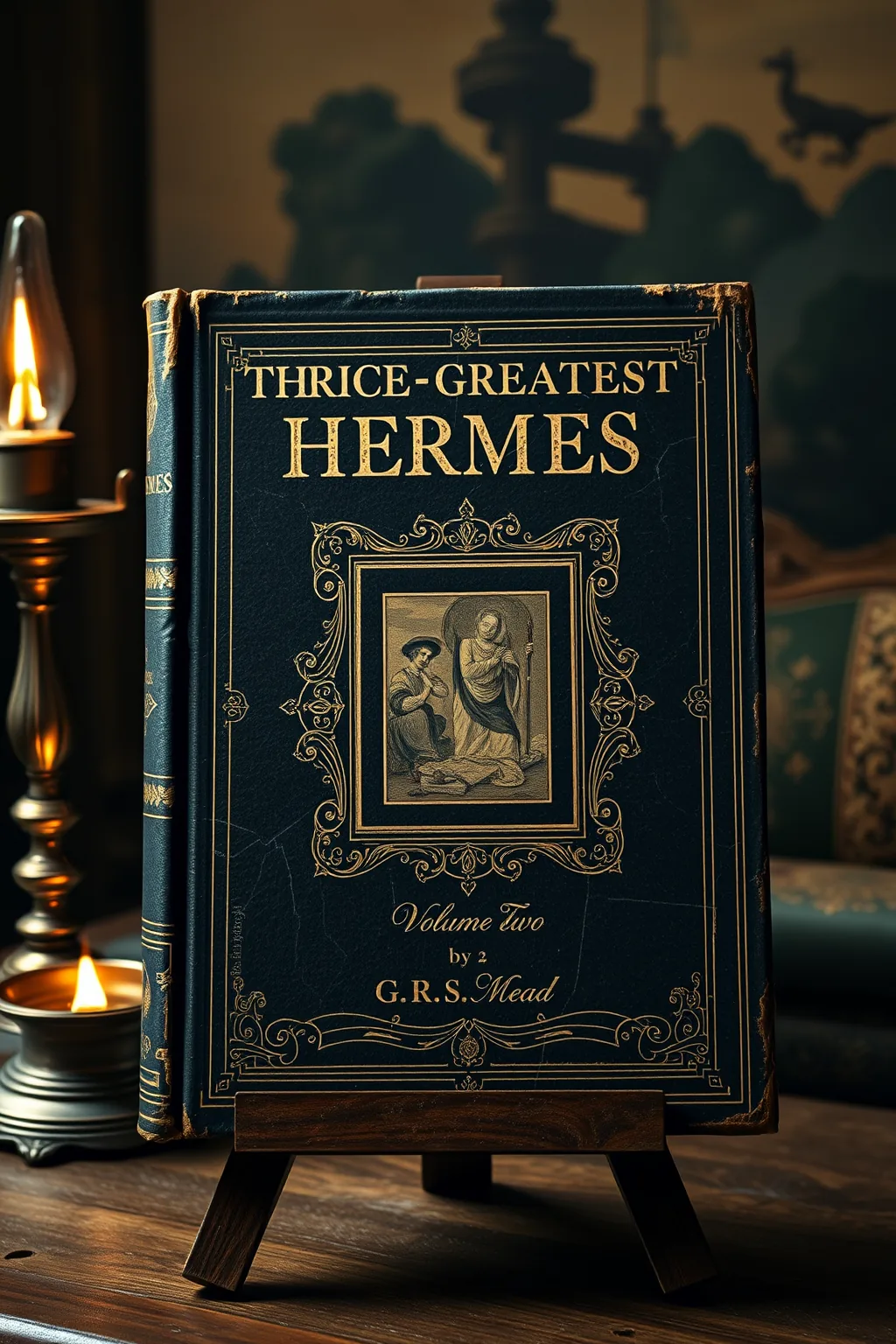
Thrice-Greatest Hermes, Vol. 2
 81
81

Thrice-Greatest Hermes, Vol. 2



Aurelia Blackwood (Occult Philosophy Critic) — G.R.S. Mead's *Thrice-Greatest Hermes, Vol. 2* is an indispensable cornerstone for any serious student of Western esotericism. Mead's scholarly dedication brings forth the *Corpus Hermeticum* with unparalleled clarity, making these foundational Gnostic texts accessible yet retaining their profound mystery. The translations of *Poemandres* and *To Asclepius* are particularly revelatory, offering direct access to the archaic dialogues on creation, cosmology, and the ascent of the soul. This volume is essential for understanding the philosophical underpinnings of Gnosticism and its enduring influence on mystical traditions. Its strength lies in its fidelity to the original sources, providing seekers and scholars alike with an authoritative and deeply insightful resource.
📝 Description
81
Volume Two of G.R.S. Mead's *Thrice-Greatest Hermes* (1906) presents translations of key Hermetic texts.
This second volume of G.R.S. Mead's work focuses on the *Corpus Hermeticum*, a collection of philosophical and religious writings attributed to Hermes Trismegistus. Mead provides translations of several significant treatises within this corpus. These include the *Shepherd Poemandres*, a foundational text often considered the introduction to Hermetic thought; the *To Asclepius*, a dialogue that covers cosmology and theology; and the *Secret Sermon on the Mountain*, which discusses spiritual ascent and divine knowledge.
Mead's translations are accompanied by his own commentary, aiming to illuminate the esoteric doctrines contained within these ancient writings. The texts address fundamental questions concerning the nature of God, the structure of the universe, the human soul, and the path toward spiritual enlightenment, or gnosis. The volume serves as a resource for understanding the historical Hermetic tradition and its specific philosophical and mystical teachings.
The *Corpus Hermeticum* is a central text in Western esotericism, influencing Neoplatonism, Gnosticism, alchemy, and Renaissance magic. Attributed to the legendary figure Hermes Trismegistus, these Hellenistic writings blend Greek philosophical ideas with Egyptian religious concepts. They articulate a cosmology where the divine mind emanates the cosmos and the human soul seeks to return to its source through knowledge. Mead's translation and commentary place these texts within the broader context of ancient mystery traditions and early Christian and Gnostic thought.
💡 Why Read This Book?
Delve into the ancient heart of Western esotericism. This volume offers direct access to the foundational Hermetic texts, revealing secrets of creation, soul, and divine union. Ideal for spiritual seekers, Gnostic scholars, and practitioners aiming to integrate ancient wisdom into modern understanding. Uncover the roots of mystical thought and your own inner divinity.
⭐ Reader Reviews
Honest opinions from readers who have explored this book.
❓ Frequently Asked Questions
What is the primary focus of Volume Two?
Volume Two of G.R.S. Mead's 'Thrice-Greatest Hermes' focuses on providing authoritative translations of key Hermetic treatises, including the *Corpus Hermeticum*, *Poemandres*, and *To Asclepius*, illuminating core Gnostic and mystical doctrines.
Who is Hermes Trismegistus?
Hermes Trismegistus is a legendary syncretic figure, a fusion of the Greek god Hermes and the Egyptian god Thoth. He is traditionally credited with authoring the Hermetic texts, a body of esoteric literature central to Hellenistic religion and Western esotericism.
Are these texts considered part of Gnosticism?
Yes, the texts translated in this volume are central to understanding Hellenistic Gnosticism, exploring themes of divine origin, the soul's journey, and the pursuit of knowledge (gnosis) for spiritual liberation.
What is the significance of the *Corpus Hermeticum*?
The *Corpus Hermeticum* is a collection of philosophical and religious dialogues attributed to Hermes Trismegistus. It offers profound insights into cosmology, theology, alchemy, and the nature of reality, forming a foundational text for Western esoteric traditions.
Is this volume suitable for beginners?
While scholarly, Mead's translations and introductions provide a solid foundation. Beginners interested in esoteric philosophy and Gnosticism will find it an illuminating, albeit challenging, entry point into these ancient wisdom traditions.
🔮 Key Themes & Symbolism
The Divine Mind and Creation
This volume delves deeply into the Hermetic concept of the Divine Mind (Nous) as the ultimate source of all existence. It explores the process of creation not as a singular event, but as a continuous emanation from the Godhead, detailing the ordering of the cosmos and the generation of various spiritual and material realms. The interconnectedness of all things, stemming from this singular, all-encompassing intelligence, is a recurring motif, inviting readers to contemplate their own divine spark and place within the universal fabric.
The Ascent of the Soul and Gnosis
Central to the Hermetic teachings presented here is the soul's journey from its material encasement back to its divine origin. The texts outline the obstacles and lessons encountered on this path, emphasizing the crucial role of gnosis – direct, intuitive knowledge of the divine – as the key to spiritual liberation. Through philosophical contemplation and ethical living, the soul can shed its ignorance and ascend through the celestial spheres, ultimately reuniting with the One.
Hermetic Philosophy and Symbolism
This volume is a rich repository of Hermetic philosophy, a system that blends Platonic, Pythagorean, and Egyptian religious thought. It explores profound symbolism, from the cosmic egg and the seven planetary spheres to the allegory of the Shepherd Poemandres. Mead’s work illuminates these symbols not as mere decorations, but as potent keys to understanding the hidden laws of nature and the spiritual architecture of the universe, offering a language for the ineffable.
💬 Memorable Quotes
Direct passages from the work, attributed to the author.
“The mind of God is the fountain of all.”
— This highlights the primordial nature of the divine intellect as the ultimate origin from which all creation flows, emphasizing a monistic and immanent divine principle.
“The spiritual realm is the true reality.”
— This statement points to the Hermetic emphasis on the transcendent and eternal over the transient material world, advocating for a focus on higher, spiritual truths.
“Man is a god in disguise.”
— This profound assertion speaks to the inherent divinity within humanity, positing that the divine essence is veiled by the material form, waiting to be recognized and awakened.
💡 Key Ideas
Editorial paraphrase of the work's core concepts — not direct quotes.
Know thyself, and thou shalt know the universe.
A core part of Hermetic wisdom, this quote underscores the microcosm-macrocosm principle, suggesting that self-understanding is the key to comprehending the greater cosmic order.
Seek the truth within.
A call to introspection and inner exploration, this quote directs the seeker's attention away from external dogma towards the innate spiritual wisdom residing within the individual soul.
🌙 Esoteric Significance
Tradition
This volume is a foundational text for Western Esoteric Traditions, particularly Hermeticism, Gnosticism, and Neoplatonism. It provides direct access to the philosophical and theological underpinnings that have influenced alchemy, astrology, Kabbalah, and various mystical paths for centuries. The teachings offer a framework for understanding the divine nature of reality and humanity's potential for spiritual transformation.
Symbolism
The Hermetic texts are replete with strong symbolism, including the divine Mind (Nous), the Demiurge, the seven planetary spheres, the elements, and allegorical figures like Poemandres. These symbols are not merely decorative but serve as keys to understanding complex metaphysical concepts, the structure of the cosmos, and the intricate workings of the soul's journey. Mead's scholarship helps to decipher these ancient visual and conceptual languages.
Modern Relevance
In an age often characterized by materialism and disconnection, the Hermetic wisdom presented here offers a powerful counterpoint. It speaks to the perennial human yearning for meaning, purpose, and spiritual connection. The emphasis on self-knowledge, the divine spark within, and the interconnectedness of all things resonates deeply with contemporary seekers exploring mindfulness, consciousness, and holistic philosophies. The texts provide timeless guidance for navigating life's challenges and cultivating inner peace.
👥 Who Should Read This Book
This volume is essential for anyone drawn to the deep currents of Western esoteric thought. **Spiritual Seekers** will find useful insights into the nature of God, the soul, and the path to enlightenment. **Scholars of Religion and Philosophy** will appreciate Mead's meticulous translation and scholarly apparatus, offering a critical resource for understanding Gnosticism and Hellenistic mysticism. **Practitioners of Esoteric Arts** such as alchemy, astrology, and contemplative prayer will discover the ancient roots of their disciplines. Even **curious beginners** with an appetite for profound philosophical inquiry will find this volume a challenging yet immensely rewarding exploration of timeless wisdom.
📜 Historical Context
Volume Two of G.R.S. Mead's *Thrice-Greatest Hermes* emerges from a wide range of late antiquity and the Renaissance, periods marked by a fervent rediscovery of classical wisdom. The original Hermetic texts, primarily composed in Greek in Egypt during the Roman era, were largely lost until their translation into Latin during the 15th century, sparking a profound intellectual and spiritual revolution. This Renaissance revival, fueled by figures like Marsilio Ficino, saw Hermeticism integrated into Neoplatonism, Christian mysticism, and early alchemical practices. Mead's work, published in the early 20th century, stands as a monumental scholarly effort to compile, translate, and contextualize these influential texts for a modern audience, bridging the gap between ancient esoteric traditions and contemporary seekers.
📔 Journal Prompts
Reflect on the concept of the Divine Mind as presented in Poemandres. How does this idea resonate with your personal understanding of the divine or ultimate reality?
Consider the soul's journey as described in the Hermetic texts. What are the 'obstacles' or 'passions' you currently face on your own spiritual path?
The Hermetic tradition emphasizes 'gnosis' or direct knowledge. What experiences or practices have led you to moments of profound inner knowing?
Analyze a specific symbol from the texts (e.g., the Shepherd, the spheres). How does its interpretation offer insight into your own life or the world around you?
The Hermetic adage 'As above, so below' suggests interconnectedness. How do you see the macrocosm (universe) reflected in your microcosm (personal life)?
🗂️ Glossary
Nous
The Greek term for 'Mind' or 'Intellect,' often referring to the Divine Mind or the highest spiritual principle from which all creation emanates in Hermetic philosophy.
Gnosis
Greek for 'knowledge.' In a spiritual context, it refers to direct, intuitive, or salvific knowledge of the divine, often considered the key to liberation from ignorance and the material world.
Corpus Hermeticum
A collection of twenty-one treatises written in Greek during the Hellenistic period, attributed to the legendary Hermes Trismegistus, forming a core text of Hermetic philosophy.
Poemandres
The first and most famous treatise of the Corpus Hermeticum, describing a vision of the cosmic Mind and the creation of the universe, often referred to as 'The Shepherd of Men'.
Demiurge
In some Gnostic and Platonic traditions, the Demiurge is the creator or craftsman god, often seen as subordinate to the supreme God, responsible for forming the material world.
This book appears in 6 collections
🔮 Readers Also Liked
Browse all →






From the “Transcendental Meditation” Collection
View all →



More Free Sacred Texts & Gnosticism Books
View all →