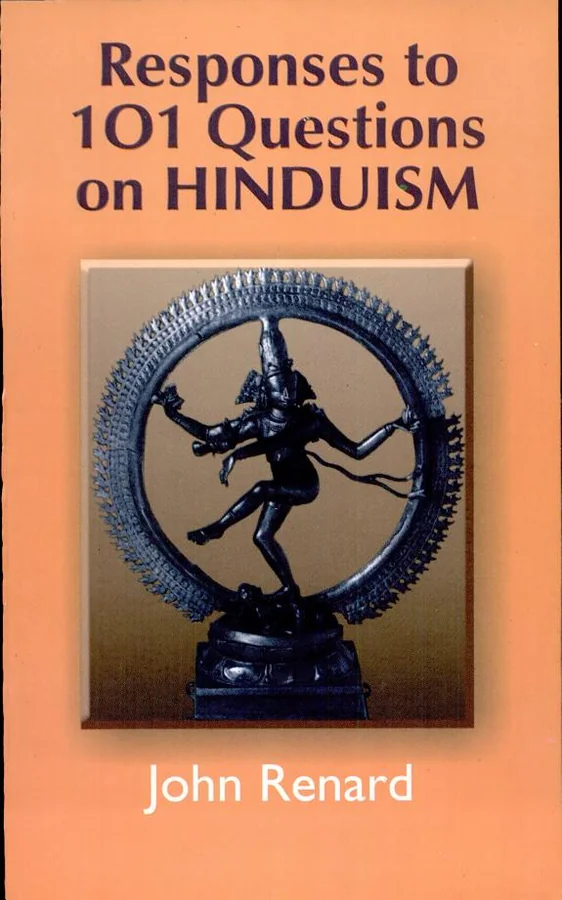
Responses to 101 Questions on Hinduism
 71
71

Responses to 101 Questions on Hinduism
John Renard’s "Responses to 101 Questions on Hinduism" succeeds admirably in its stated goal of providing a user-friendly introduction. The Q&A format is a significant strength, allowing readers to pinpoint specific areas of curiosity without wading through extensive narrative. Renard’s explanations of concepts like *dharma* are particularly clear, grounding abstract principles in relatable terms. However, the book's brevity, while an asset for accessibility, sometimes limits the depth of exploration. For instance, the section on devotional practices, while informative, could benefit from more detailed examples to convey the emotional and communal aspects of *bhakti*. The work is most effective as a first encounter, a reliable primer before one moves to more specialized studies. It serves as a competent guide for those seeking foundational knowledge without academic jargon.
📝 Description
71
John Renard's 1999 book answers 101 questions about Hinduism.
Published in 1999, John Renard's "Responses to 101 Questions on Hinduism" serves as a clear introduction to this ancient religious tradition. The book is structured as a direct question-and-answer format, making complex theological and cultural aspects accessible for those new to its philosophies and practices. It systematically addresses fundamental inquiries, offering a straightforward path to understanding Hinduism's diverse elements without relying on a narrative flow. This approach encourages focused learning on specific topics of interest.
The work is designed for individuals new to Hinduism, students of comparative religion, and anyone seeking a basic grasp of its historical development and core beliefs. Readers who prefer a question-driven method of learning will find this format particularly useful. It is also a good resource for those interested in the spiritual and cultural dimensions of South Asia. Renard's presentation is factual and avoids dogmatic pronouncements, appealing to readers who value a straightforward exposition of religious traditions.
This book engages with Hinduism, a tradition often explored within esoteric studies for its philosophical depth and spiritual practices. While presented here as an accessible introduction, the concepts of dharma, karma, and reincarnation are central to many esoteric interpretations of existence and consciousness. The text's focus on scriptures like the Vedas and Upanishads also touches upon texts that have historically informed esoteric thought in both Eastern and Western traditions. It provides a factual grounding for understanding these elements, which can then be further examined through more specialized esoteric lenses.
💡 Why Read This Book?
• Gain clarity on the concept of *dharma*, understanding its multifaceted meaning as cosmic order, duty, and moral law, as explained in Renard's direct answers. • Distinguish between major historical periods and regional variations within Hinduism, moving beyond a singular, monolithic perception of the faith as presented in the historical context sections. • Grasp the fundamental theological distinctions between various Hindu deities, recognizing their roles and symbolism as detailed in the Q&A format.
⭐ Reader Reviews
Honest opinions from readers who have explored this book.
❓ Frequently Asked Questions
What is the primary difference between the Vedic period and later developments in Hinduism?
The Vedic period, generally considered to predate 500 BCE, focused on ritualistic worship of elemental deities and was documented in the Vedas. Later developments saw the rise of philosophical Upanishads, the epics like the Mahabharata and Ramayana, and the formalization of concepts like karma and reincarnation.
How does John Renard explain the concept of karma in Hinduism?
Renard clarifies karma as a principle of cause and effect governing actions and their consequences, influencing future lives through reincarnation. It's not viewed as divine judgment but as an inherent law of the cosmos, shaping an individual's destiny.
What are the main philosophical schools discussed in 'Responses to 101 Questions on Hinduism'?
The book touches upon major Vedanta schools, including Advaita (non-dualism), Vishishtadvaita (qualified non-dualism), and Dvaita (dualism), alongside other significant philosophical traditions that interpret the Upanishads and offer different paths to spiritual realization.
Can 'Responses to 101 Questions on Hinduism' help me understand Hindu festivals?
While not a comprehensive guide to every festival, the book provides the theological and cultural background that underpins many Hindu celebrations, explaining the significance of deities and mythological narratives that are often honored during these events.
Is Hinduism considered a polytheistic religion according to Renard?
Renard explains that while many deities are worshipped, Hinduism encompasses various theological perspectives. Some traditions view these deities as manifestations of a single ultimate reality (Brahman), a concept that challenges a simple polytheistic label.
What role do the Upanishads play in Hindu thought, as presented by Renard?
The Upanishads, composed roughly between 800 and 200 BCE, are presented as foundational philosophical texts that explore the nature of reality, the self (Atman), and its relationship with the absolute (Brahman), shifting focus from ritual to introspection.
🔮 Key Themes & Symbolism
The Nature of Dharma
Renard addresses the complex concept of dharma, moving beyond a simple translation of 'duty'. The book explores dharma as the inherent nature of things, cosmic order, social responsibility, and ethical conduct. Understanding dharma is presented as crucial for reading through the principles of karma and reincarnation, providing a framework for righteous living within the Hindu tradition. The Q&A format allows for detailed explanations of its application in different life stages and social contexts.
Karma and Reincarnation
Central to Hindu esotericism, the principles of karma and reincarnation are clarified. Renard explains karma not as fatalistic punishment but as a dynamic law of cause and effect, where actions in this life shape future existences. The cyclical nature of rebirth, *samsara*, is presented as a fundamental aspect of the soul's journey, with liberation (*moksha*) being the ultimate goal, attainable through various spiritual paths.
The Pantheon and Ultimate Reality
The book tackles the apparent multiplicity of Hindu deities, explaining how figures like Vishnu, Shiva, and Devi can be understood as distinct manifestations or aspects of a singular, ultimate reality, Brahman. Renard clarifies that the worship of various gods and goddesses often reflects different devotional approaches (*bhakti*) and philosophical understandings of the divine, rather than a simple adherence to polytheism.
Scriptural Foundations
Renard provides context for the foundational texts of Hinduism, including the ancient Vedas and the more philosophical Upanishads. The significance of these texts in shaping Hindu thought, ritual, and practice is explored, distinguishing between their early Vedic contexts and their later interpretations that formed the basis for various schools of philosophy and theology.
💬 Memorable Quotes
Direct passages from the work, attributed to the author.
“Dharma is not merely a set of rules but the fundamental nature of reality.”
— This interpretation highlights the expansive understanding of dharma presented, suggesting it's an intrinsic principle of existence rather than just a social or religious code, influencing one's actions and understanding of the cosmos.
“Karma dictates that actions have consequences that extend beyond a single lifetime.”
— This emphasizes the cyclical nature of karmic law as described in the book, linking present actions directly to future rebirths and underscoring the long-term impact of one's choices within the framework of reincarnation.
“The Upanishads marked a shift towards philosophical inquiry into the nature of the self.”
— This highlights the intellectual evolution within Hinduism, pointing to the Upanishads as a central moment where abstract contemplation of the soul (Atman) and ultimate reality (Brahman) gained prominence over earlier ritualistic practices.
“Moksha represents liberation from the cycle of birth and death.”
— This interpretation focuses on the ultimate spiritual goal within Hinduism as outlined by Renard, defining moksha as the final release from samsara, the continuous process of reincarnation.
💡 Key Ideas
Editorial paraphrase of the work's core concepts — not direct quotes.
The many deities are often seen as faces of a single, supreme being.
This paraphrase captures the essence of how Hinduism reconciles its diverse forms of worship, presenting the idea that various gods and goddesses are understood by many adherents as emanations or aspects of an ultimate, unified divine principle.
🌙 Esoteric Significance
Tradition
While not explicitly aligning with a single esoteric lineage like Theosophy or Hermeticism, Renard's work on Hinduism engages with concepts central to many Western esoteric traditions, particularly those influenced by Eastern thought. It provides foundational knowledge on karma, reincarnation, and the nature of consciousness, which are recurring themes in Theosophy and the New Age movement. The work serves as a bridge, offering a scholarly yet accessible entry into the spiritual philosophy underpinning Hinduism, which has long been a source of inspiration for Western occultists and mystics.
Symbolism
Key symbols explored include the Om (Aum) symbol, representing the primordial sound of the universe and the essence of ultimate reality (Brahman), and the lotus flower, often associated with purity, spiritual awakening, and divine beauty, emerging unstained from muddy waters. The book also touches on the symbolic significance of deities like Ganesha, the elephant-headed god, representing wisdom and the removal of obstacles, underscoring how visual and conceptual symbols are integral to Hindu spiritual expression.
Modern Relevance
Renard's work remains relevant for contemporary thinkers and practitioners seeking to understand the philosophical underpinnings of yoga and meditation practices that have become mainstream. It informs current discussions on comparative religion and spirituality, offering a clear exposition of concepts like *ahimsa* (non-violence) and *moksha* (liberation) that resonate with modern ethical and spiritual aspirations. It provides a crucial corrective to superficial understandings of Hinduism, enabling deeper engagement with its rich philosophical traditions by contemporary spiritual seekers.
👥 Who Should Read This Book
• Beginners to Hinduism seeking a structured, question-based introduction to its core beliefs and practices. • Students of comparative religion needing a reliable overview of Hindu theology, history, and philosophy. • Individuals interested in Eastern spirituality who want to understand the foundational concepts of karma, dharma, and reincarnation from a reputable source.
📜 Historical Context
Published in 1999, John Renard's "Responses to 101 Questions on Hinduism" arrived in an era where globalization was making Eastern spiritual traditions increasingly accessible, and often misunderstood, in the West. The book addressed a growing public demand for clear, accessible information, moving beyond the dense academic treatises or devotional literature that often dominated the field. It provided a factual counterpoint to both sensationalized portrayals and overly specialized scholarly works. At the time, scholars like Diana Eck were also engaging with Hinduism's presence in the West, and Renard's book offered a complementary resource for beginners, distinguishing itself by its direct Q&A format and avoidance of jargon, positioning itself as an introductory tool for a broad audience curious about the religion's historical roots and theological underpinnings.
📔 Journal Prompts
The concept of dharma as cosmic order and personal duty.
Reincarnation and the law of karma.
The symbolism behind the major Hindu deities.
The philosophical inquiries found within the Upanishads.
The path to moksha as described in the text.
🗂️ Glossary
Dharma
The principle of cosmic order, righteousness, law, and duty that underlies all existence. It encompasses moral conduct, social obligations, and the inherent nature of things.
Karma
The law of cause and effect, where actions (karma) produce consequences that influence an individual's present and future lives through reincarnation.
Reincarnation (Samsara)
The cyclical process of birth, death, and rebirth, in which the soul (atman) transmigrates from one body to another based on karmic accumulation.
Brahman
The ultimate, unchanging reality or absolute consciousness that is the source and sustainer of all existence in Hindu philosophy.
Atman
The individual soul or self, often considered to be identical with Brahman in certain philosophical schools, seeking liberation from samsara.
Moksha
Liberation or release from the cycle of samsara (birth, death, and rebirth), the ultimate spiritual goal in Hinduism.
Vedas
The oldest and most authoritative scriptures of Hinduism, containing hymns, rituals, and philosophical insights, composed in Sanskrit.