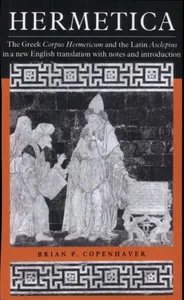
Hermetica

 74
74

Hermetica
Copenhaver's translation of the *Hermetica* is a significant scholarly achievement, presenting these ancient texts with clarity and erudition. The strength of this edition lies in its meticulous annotation and comprehensive introduction, which contextualize the fragmented corpus for contemporary readers. However, the sheer density of philosophical and theological speculation can be overwhelming; the work demands considerable concentration. A particularly compelling section is the *Poimandres*, which offers a creation narrative that influenced early Christian Gnosticism and later Renaissance thought. While the prose can be challenging, the intellectual reward is substantial for those willing to engage. This edition stands as a vital resource for understanding the roots of Western esoteric thought.
📝 Description
74
Brian P. Copenhaver's 1992 translation makes the Hermetica accessible.
The Hermetica is a collection of ancient philosophical and religious texts attributed to Hermes Trismegistus, a figure blending Greek and Egyptian divine aspects. These writings, compiled in Hellenistic Egypt over centuries, reveal a worldview that significantly shaped Western esoteric thought. Copenhaver's edition provides a clear translation and commentary, detailing the texts' discussions on cosmology, theology, ethics, and alchemy. It presents a philosophical system aiming to harmonize Platonic ideas with Egyptian mysticism. The work is crucial for understanding intellectual currents from the Hellenistic period, bridging Greek philosophy and Egyptian religious practices.
This compilation emerged from a multicultural environment, likely between the 2nd and 4th centuries CE. It shows a fusion of Greek philosophical schools like Platonism and Stoicism with Egyptian religious and magical traditions. The Hermetica offered a distinct cosmology and theology, focusing on divine knowledge and the possibility of human spiritual ascent. Its influence extended through late antiquity and the Renaissance, impacting magic, philosophy, and religious thought.
The Hermetica represents a key body of Gnostic and Neoplatonic thought from the Hellenistic period. Its syncretic nature, blending Greek philosophical concepts with Egyptian religious and magical elements, made it a central text for those seeking divine knowledge and spiritual ascent. It provided a framework that influenced early Christian thinkers, medieval alchemists, and Renaissance occultists, forming a significant thread in Western esoteric traditions.
💡 Why Read This Book?
• Gain direct access to the foundational texts of Hermetic philosophy, understanding concepts like the Nous and the principle of 'as above, so below' as presented in their original context, dating back to Hellenistic Egypt. • Explore the syncretic blend of Platonic philosophy and Egyptian mysticism that profoundly shaped Western esotericism, impacting figures like Giordano Bruno and the intellectual climate of the Renaissance. • Grasp the complex theological and cosmological ideas that provided an alternative spiritual framework during the rise of Gnosticism and mystery cults in the early CE centuries.
⭐ Reader Reviews
Honest opinions from readers who have explored this book.
❓ Frequently Asked Questions
When were the Hermetica texts likely compiled?
The Hermetica texts were likely compiled over several centuries, with most scholars placing their origins between the 2nd and 4th centuries CE in Hellenistic Egypt.
Who is Hermes Trismegistus?
Hermes Trismegistus is a legendary syncretic figure, a combination of the Greek god Hermes and the Egyptian god Thoth, credited in the Hermetica with revealing divine wisdom and occult knowledge.
What is the significance of the 'Poimandres' section?
The 'Poimandres' is the most famous part of the Hermetica, offering a creation narrative that significantly influenced early Gnosticism and later Renaissance thinkers interested in Neoplatonism and esoteric traditions.
How did the Hermetica influence later philosophical movements?
The Hermetica's emphasis on the divine Mind (Nous), the interconnectedness of the cosmos, and the pursuit of gnosis deeply influenced Neoplatonism, Gnosticism, and Renaissance Hermeticism, impacting figures like Marsilio Ficino.
What is the core principle of 'as above, so below' found in the Hermetica?
The principle 'as above, so below' suggests a fundamental correspondence between the celestial or divine realm (above) and the earthly or material realm (below), implying that understanding one can illuminate the other.
Is Brian P. Copenhaver's translation considered scholarly?
Yes, Brian P. Copenhaver's 1992 translation is widely regarded as a scholarly and comprehensive edition, featuring extensive notes and commentary that aid in understanding the complex ancient texts.
🔮 Key Themes & Symbolism
The Divine Mind (Nous)
A central concept in the Hermetica is the Nous, understood as the supreme, creative Intellect or divine Mind from which all existence emanates. The texts describe the Nous as the ultimate source of order and consciousness, guiding the cosmos. Understanding the Nous is presented as key to comprehending the divine order and one's place within it. This concept aligns with Neoplatonic ideas of emanation and the ultimate reality beyond the material world, forming a core tenet for those seeking spiritual enlightenment through reason and revelation.
Cosmic Correspondence
The principle of 'as above, so below' is a pervasive theme, highlighting the belief in a fundamental interconnectedness between the macrocosm (the universe) and the microcosm (humanity). This doctrine suggests that patterns and principles found in the celestial spheres are mirrored in the terrestrial world and within the human soul. This reciprocal relationship underpins much of Hermetic practice, including alchemy and astrology, as it provides a framework for understanding divine will and natural law through observable phenomena.
Gnosis and Ascent
The Hermetica emphasizes the pursuit of *gnosis*, or direct, intuitive knowledge of the divine, as the path to salvation and spiritual liberation. The texts outline a journey of ascent, where the soul, through purification and understanding, can overcome the limitations of the material world and the influence of lower cosmic forces. This quest for transcendent knowledge positions the Hermetica as a precursor to Gnosticism, offering a spiritual framework that prioritizes inner revelation over external dogma.
Theological Synthesis
These writings represent a profound synthesis of Greek philosophical thought (especially Plato and Stoicism) with Egyptian religious and magical traditions. The figure of Hermes Trismegistus acts as a conduit for this fusion, presenting a unified worldview that addresses cosmology, the nature of God, and humanity's relationship to the divine. This syncretic approach was crucial in creating a spiritual system that appealed to a diverse audience in the Hellenistic world and provided a rich philosophical foundation for later esoteric movements.
💬 Memorable Quotes
Direct passages from the work, attributed to the author.
“God is not silent; He has revealed Himself through His works.”
— This statement captures the Hermetic view that the divine is immanent in creation. Rather than a distant deity, God's presence and nature can be understood by observing the order and complexity of the cosmos, a key tenet for those seeking natural revelation.
“The universe is a living being, endowed with soul and intelligence.”
— This reflects the Hermetic concept of a pantheistic or panentheistic cosmos, where all of reality is infused with divine life and consciousness. It underscores the interconnectedness of all things and the presence of the sacred in the material world.
“To know oneself is to know God.”
— This aphorism highlights the Hermetic emphasis on introspection and self-knowledge as a path to divine understanding. It suggests that by exploring the depths of the human soul, one can discover the divine spark within and attain spiritual insight.
“What is below corresponds to what is above.”
— This is a direct expression of the principle of correspondence, a central to Hermetic thought. It implies that the laws and patterns governing the celestial realms are mirrored in the earthly domain, facilitating magical and divinatory practices.
“The mind is the eye of the soul.”
— This metaphorical statement emphasizes the crucial role of intellect and consciousness in spiritual perception. The mind, as the soul's faculty for understanding, is the instrument through which divine truths are apprehended and recognized.
🌙 Esoteric Significance
Tradition
The *Hermetica* is the foundational text of the Western Hermetic tradition, deeply influencing Gnosticism, Kabbalah, alchemy, and Renaissance magic. It represents a syncretic spiritual philosophy that blends Greek philosophical concepts, particularly Neoplatonism, with ancient Egyptian religious ideas. Unlike purely mystical or purely philosophical systems, it offers a comprehensive worldview encompassing cosmology, theology, ethics, and practical occult arts, positioning it as a primary source for understanding the development of Western esotericism.
Symbolism
Key symbols include the Ouroboros, representing the cyclical nature of the universe, eternal return, and the unity of all things. The figure of Hermes Trismegistus himself symbolizes divine wisdom, revelation, and the bridge between the human and the divine. The concept of the 'Nous' (Mind) functions symbolically as the ultimate divine source and ordering principle of all existence, representing pure intellect and consciousness from which reality emanates.
Modern Relevance
Contemporary practitioners of Western esoteric traditions, including Hermeticists, ceremonial magicians, and alchemists, continue to draw heavily on the *Hermetica* for its philosophical underpinnings and cosmological models. Its ideas on cosmic correspondence and the power of the mind have also found echoes in New Age thought, transpersonal psychology, and certain branches of modern occultism, demonstrating its enduring influence on spiritual seekers.
👥 Who Should Read This Book
• Students of ancient philosophy and religion: To understand the cross-cultural intellectual currents of Hellenistic Egypt and the philosophical foundations of Western esoteric thought. • Practitioners of Hermeticism and related occult arts: To engage directly with the source texts that define their traditions, exploring concepts of divine Mind, cosmic correspondence, and spiritual ascent. • Scholars of comparative religion and intellectual history: To trace the lineage of ideas that shaped Neoplatonism, Gnosticism, and Renaissance magical philosophy, and to analyze the syncretic nature of ancient spirituality.
📜 Historical Context
The *Hermetica* emerged from the vibrant intellectual milieu of Hellenistic Egypt, a period marked by the fusion of Greek, Egyptian, and Near Eastern cultures, roughly between the 2nd and 4th centuries CE. This era was characterized by intense philosophical and religious ferment, with Neoplatonism, Gnosticism, and various mystery cults vying for adherents. The *Hermetica* offered a sophisticated philosophical system that drew heavily on Platonic dialogues and Stoic physics, while integrating Egyptian concepts of divine wisdom embodied by Thoth. Its syncretic nature provided a compelling spiritual alternative to both pagan traditions and nascent Christianity. The texts were compiled anonymously, attributed to the legendary sage Hermes Trismegistus, a deified figure combining Greek Hermes and Egyptian Thoth. This collection later experienced a significant revival during the Italian Renaissance, profoundly influencing thinkers like Marsilio Ficino and Giordano Bruno, who saw it as an ancient, divinely inspired wisdom tradition that predated even Plato.
📔 Journal Prompts
The relationship between the Nous and individual human consciousness.
Reflecting on the principle of 'as above, so below' in daily life.
The path of gnosis as described in the Poimandres.
Interpreting the symbolism of the Ouroboros within the Hermetic framework.
The role of Hermes Trismegistus as a divine messenger and teacher.
🗂️ Glossary
Nous
The Greek term for Mind or Intellect. In Hermetic philosophy, it refers to the divine Mind, the ultimate creative principle and source of all existence, often seen as the first emanation from the supreme God.
Gnosis
Greek for 'knowledge'. In the context of the Hermetica and Gnosticism, it signifies direct, intuitive, or spiritual knowledge of divine mysteries, often seen as the key to salvation or liberation.
Hermes Trismegistus
A legendary figure, a syncretic combination of the Greek god Hermes and the Egyptian god Thoth. He is credited in the Hermetica with revealing divine wisdom and occult teachings to humanity.
Macrocosm
The 'great world' or the universe as a whole. In Hermetic philosophy, it is understood to be in correspondence with the microcosm.
Microcosm
The 'small world', referring to the human being. The Hermetic principle 'as above, so below' posits that the human being mirrors the structure and principles of the macrocosm.
Ouroboros
An ancient symbol depicting a serpent or dragon eating its own tail. In the Hermetica, it represents cyclicality, eternity, the unity of all things, and the self-sufficient nature of the cosmos.
Ascent
In Hermetic and Gnostic contexts, the spiritual journey of the soul moving upward through various cosmic spheres or planes towards union with the divine or ultimate reality.
🔮 Readers Also Liked
Browse all →
![The ancient fragments; containing what remains of the writings of Sanchoniatho, Berossus, Abydenus, Megasthenes, and Manetho. Also the Hermetic Creed, the Old Chronicle, the Laterculus of Eratosthenes, the Tyrian Annals, the Oracles of Zoroaster […]](/img/thumb/the-ancient-fragments-containing-what-remains-of-the-writings-of-sanchoniatho-berossus-abydenus-megasthenes-and-manetho-also-the-hermetic-creed-the-old-chronicle-the-laterculus-of-eratosthenes-the-tyr.webp)







More by Brian P. Copenhaver
All books →

More Free Alchemy & Hermeticism Books
View all →