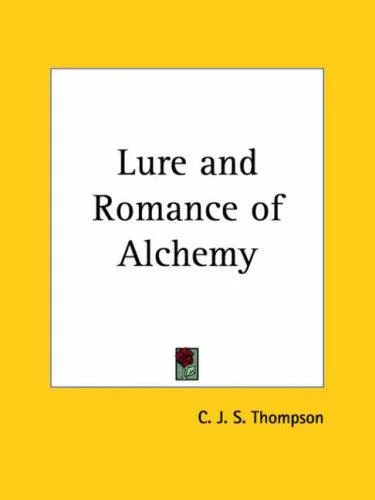
The lure and romance of alchemy
 76
76

The lure and romance of alchemy
C. J. S. Thompson's "The Lure and Romance of Alchemy" offers a grounded perspective on a subject often obscured by myth. Rather than focusing on sensational claims, Thompson meticulously traces the philosophical underpinnings and historical progression of alchemical thought. A particular strength lies in its clear explanation of alchemical symbolism, demystifying concepts like the *prima materia* for the uninitiated. The book's primary limitation, however, is its breadth; in covering such a vast historical and conceptual landscape, it sometimes lacks the depth to fully satisfy seasoned practitioners or scholars seeking nuanced interpretations of specific alchemical texts or figures. The chapter detailing the evolution of alchemical laboratories, for instance, provides a solid overview but could benefit from more specific examples of apparatus or experimental procedures. Nonetheless, for its accessibility and historical diligence, the work serves as a commendable gateway into the alchemical tradition.
📝 Description
76
C. J. S. Thompson's 1987 book examines alchemy beyond turning lead into gold.
Published in 1987, The Lure and Romance of Alchemy by C. J. S. Thompson offers a look into the historical and philosophical aspects of alchemy. The work moves past the popular image of transforming base metals into gold to discuss the spiritual and psychological motivations behind alchemical practices over centuries. Thompson details the goals of alchemists, often expressed through symbolic language, and analyzes their pursuit of transmutation, which was understood as both a physical and spiritual process.
The book is best suited for those new to esoteric studies and the history of science. Readers interested in the connections between early chemistry, philosophy, and mystical thought will find its overview of alchemical ideas useful. It also serves as a good introduction for those curious about the archetypal symbols that shaped later occult movements and psychological theories, including those of Carl Jung. Thompson places alchemy within a broad historical context, noting its origins in Hellenistic Egypt and its development through medieval and Renaissance Europe. The text touches upon the social and intellectual settings that supported alchemical investigation, from monastic settings to royal courts, and acknowledges the alchemists' position between practical craft and philosophical investigation.
This book situates alchemy within the Western esoteric tradition, tracing its lineage from ancient Hellenistic Egypt through its flourishing in medieval and Renaissance Europe. It acknowledges alchemy as a practice that bridged early scientific inquiry, philosophical speculation, and mystical aspiration. The text highlights how alchemical symbolism, such as the prima materia and the philosopher's stone, functioned as a coded language for understanding both the material world and the processes of spiritual purification, influencing later Hermetic and occult movements.
💡 Why Read This Book?
• Understand the historical evolution of alchemical thought, from its Hellenistic Egyptian roots to its European manifestations, grasping how figures like Nicolas Flamel navigated this intellectual landscape. • Decipher core alchemical symbols such as the philosopher's stone and the elements (earth, air, fire, water), recognizing their dual role as physical and spiritual concepts. • Gain insight into the psychological parallels of alchemical processes, appreciating how the quest for material transmutation mirrored an inner spiritual purification.
⭐ Reader Reviews
Honest opinions from readers who have explored this book.
❓ Frequently Asked Questions
When was 'The Lure and Romance of Alchemy' first published?
The book 'The Lure and Romance of Alchemy' by C. J. S. Thompson was first published in 1987, making it a relatively modern exploration of historical alchemical practices.
What is the philosopher's stone in alchemy?
In alchemy, the philosopher's stone is a legendary substance believed to be capable of transmuting base metals into gold or silver, and often associated with an elixir of life or immortality.
Did C. J. S. Thompson write other books on esoteric subjects?
Yes, C. J. S. Thompson was a prolific author on occult and esoteric subjects, with other notable works focusing on magic, astrology, and various historical secret societies.
What are the four elements in classical alchemy?
The four classical elements in alchemy are Earth, Air, Fire, and Water, considered fundamental components of all matter and essential symbolic forces in alchemical operations.
Is 'The Lure and Romance of Alchemy' suitable for beginners?
Absolutely. The book is designed as an accessible introduction, explaining complex historical and philosophical concepts in a clear manner suitable for readers new to alchemy and esoteric studies.
Where did alchemy originate?
Alchemy has ancient origins, with significant developments in Hellenistic Egypt (Alexandria being a major center), as well as in China and the Islamic world, before its widespread practice in medieval and Renaissance Europe.
🔮 Key Themes & Symbolism
The Great Work
The Lure and Romance of Alchemy studies the concept of the 'Great Work' (Major work), presenting it not merely as the literal transmutation of metals but as a complex, multi-stage process of spiritual purification and self-perfection. Thompson illustrates how alchemists viewed this endeavor as a path to enlightenment, involving the refinement of the soul through symbolic operations mirroring chemical processes. The book explores the stages of *nigredo* (blackening), *albedo* (whitening), and *rubedo* (reddening) as crucial phases in this transformative quest, reflecting inner spiritual states.
Alchemical Symbolism
A central theme is the intricate web of symbolism that characterized alchemical literature. Thompson examines how concepts like the Ouroboros (serpent biting its tail), the hermaphrodite (Rebis), and various celestial bodies were employed to represent cosmic principles, elemental forces, and stages of the alchemical process. The book highlights the necessity of understanding this symbolic language to grasp the true meaning behind alchemical texts, which were often deliberately obscure to protect their secrets from the uninitiated.
Historical Evolution
The work traces the historical trajectory of alchemy, from its roots in Hellenistic Egypt and its transmission through Islamic scholars to its flourishing in medieval and Renaissance Europe. Thompson discusses how alchemical practices and theories evolved in response to prevailing philosophical, religious, and scientific currents. It acknowledges figures like Geber (Jabir ibn Hayyan) and later European alchemists, charting the intellectual lineage and the societal context in which alchemical guilds and individual practitioners operated.
Alchemy and Philosophy
Thompson explores the profound philosophical underpinnings of alchemy, linking it to Hermeticism, Neoplatonism, and Gnosticism. The book elucidates how alchemists sought to understand the fundamental nature of reality, the relationship between the macrocosm and the microcosm, and the divine spark within matter. This philosophical dimension reveals alchemy as a holistic worldview, aiming for a complete understanding of creation and humanity's place within it, extending beyond mere laboratory experiments.
💬 Memorable Quotes
Direct passages from the work, attributed to the author.
“Symbolism was essential for alchemists to communicate their discoveries while concealing them from the uninitiated.”
— This highlights the coded nature of alchemical texts, where allegorical language and imagery served as a protective layer, demanding deep interpretation from serious students.
“The quest for the Philosopher's Stone represented both the transmutation of base metals and the purification of the soul.”
— This captures the allegorical significance of the ultimate alchemical goal, illustrating how the material pursuit was intrinsically linked to spiritual development and self-mastery.
“Alchemy bridged the gap between early practical chemistry and profound metaphysical speculation.”
— This interpretation emphasizes alchemy's unique position as a discipline that combined empirical observation and laboratory work with deep philosophical and spiritual inquiry.
“The stages of the Great Work, such as nigredo and albedo, mirrored stages of human psychological transformation.”
— This reflects the modern understanding of alchemical symbolism, particularly as explored by Carl Jung, where the laboratory process is seen as an externalization of internal psychic processes.
💡 Key Ideas
Editorial paraphrase of the work's core concepts — not direct quotes.
The alchemist sought to understand the hidden forces of nature and to achieve perfection through a laborious process.
This paraphrased concept underscores the dual focus of alchemy: theoretical understanding of natural laws and practical application for achieving a higher state, whether material or spiritual.
🌙 Esoteric Significance
Tradition
This work primarily engages with the Western Hermetic tradition, tracing alchemy's lineage from ancient Egyptian and Hellenistic sources through medieval Islamic and European scholasticism. It aligns with the Hermetic principle of 'As Above, So Below,' viewing alchemical operations as a microcosm reflecting macrocosmic divine processes. Thompson positions alchemy not just as a craft but as a spiritual discipline aimed at achieving a form of gnosis or divine understanding through material manipulation and symbolic contemplation.
Symbolism
Key symbols explored include the *prima materia*, the undifferentiated substance from which all is made, representing potentiality and the starting point of the Great Work. The Philosopher's Stone is central, symbolizing perfection, enlightenment, and the successful transmutation of both metals and the alchemist's own being. The recurring motif of the union of opposites, often depicted through hermaphroditic figures or celestial pairings, signifies the reconciliation of dualities necessary for achieving wholeness and cosmic balance.
Modern Relevance
Contemporary esoteric practitioners and scholars continue to draw on Thompson's accessible overview. Thinkers in Jungian psychology and archetypal studies frequently reference the symbolic language of alchemy as detailed in works like this. Modern Hermetic orders and ceremonial magicians often incorporate alchemical principles and symbolism into their practices, viewing the Great Work as a metaphor for personal transformation and spiritual evolution in the 21st century.
👥 Who Should Read This Book
• Aspiring students of Western esotericism seeking a foundational understanding of alchemy's historical and philosophical dimensions. • Researchers in comparative religion and the history of science interested in the intersection of early chemical practices and mystical thought. • Individuals curious about the psychological symbolism of transformation, particularly those exploring Jungian archetypes and their alchemical parallels.
📜 Historical Context
Published in 1987, C. J. S. Thompson's work emerged during a period of renewed scholarly and popular interest in the history of science and esoteric traditions. The mid-20th century saw significant contributions to alchemy studies, notably from figures like Titus Burckhardt and, most influentially, Carl Jung, whose psychological interpretations of alchemical symbolism brought the subject to a wider audience. Thompson's book builds upon this foundation, offering a synthesis of historical accounts and symbolic interpretations. It appeared at a time when the boundaries between historical inquiry, philosophical exploration, and occult studies were becoming more permeable in academic discourse. While competing schools of thought on alchemy's origins and purpose existed—some emphasizing its proto-scientific aspects, others its purely spiritual dimensions—Thompson's work aimed for a balanced overview accessible to the general reader, positioning alchemy as a crucial, albeit often misunderstood, precursor to modern chemistry and psychology.
📔 Journal Prompts
The alchemist's initial state of *nigredo* and its symbolic representation.
Reflect on the dual meaning of the Philosopher's Stone as presented in the text.
How did the concept of 'As Above, So Below' inform alchemical practices?
The symbolic significance of the Ouroboros in the alchemical quest.
Compare the alchemist's laboratory work with their spiritual aspirations.
🗂️ Glossary
Prima Materia
The fundamental, undifferentiated substance from which all matter is believed to originate in alchemical theory. It represents pure potentiality and the starting point of the Great Work.
Philosopher's Stone
A legendary alchemical substance capable of transmuting base metals into gold or silver, and often associated with the elixir of life or immortality. Symbolically, it represents perfection and enlightenment.
Great Work (Major work)
The entire alchemical process, encompassing the stages of material transmutation and spiritual purification, aimed at achieving perfection or the creation of the Philosopher's Stone.
Nigredo
The first stage of the Great Work, often referred to as 'blackening.' Symbolically, it represents dissolution, putrefaction, chaos, and the initial breakdown of matter or the ego.
Albedo
The second stage of the Great Work, or 'whitening.' Following the nigredo, it symbolizes purification, washing away impurities, and the emergence of a refined substance or consciousness.
Rubedo
The final stage of the Great Work, or 'reddening.' It signifies completion, integration, the union of opposites, and the attainment of the Philosopher's Stone or spiritual enlightenment.
Rebis
An alchemical symbol often depicted as a hermaphrodite, representing the union of opposites (male and female, Sun and Moon, sulfur and mercury) and the achievement of wholeness or the perfected state.
🔮 Readers Also Liked
Browse all →









More by C. J. S. Thompson
All books →




More Free Alchemy & Hermeticism Books
View all →