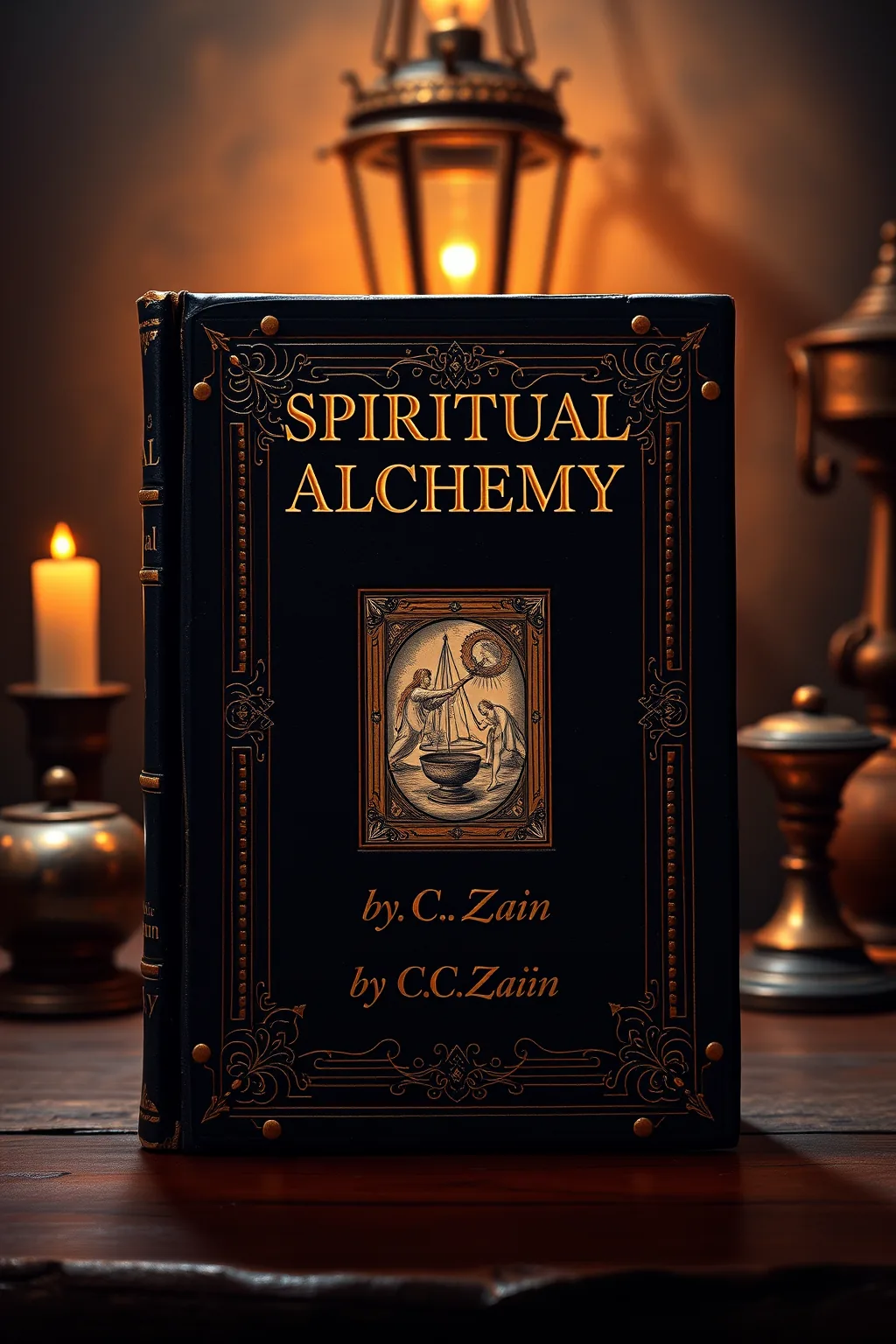
Spiritual Alchemy
 72
72

Spiritual Alchemy
C. C. Zain's *Spiritual Alchemy* attempts to demystify the alchemical tradition, presenting it as a coherent system of spiritual self-improvement rather than arcane sorcery. The book's strength lies in its organized approach, breaking down complex ideas into digestible stages. Zain's interpretation of the Magnum Opus as a process of psychic and spiritual refinement is particularly compelling, drawing clear parallels between the external laboratory and the internal human psyche. However, the work sometimes leans towards a didactic tone that can feel prescriptive rather than exploratory. A notable passage details the 'coniunctio' or union of opposites, which Zain articulates as the crucial synthesis of spiritual and material understanding, a concept fundamental to many esoteric paths. While comprehensive, the text could benefit from greater engagement with alternative interpretations or historical debates surrounding alchemical practices. Ultimately, *Spiritual Alchemy* serves as a solid, if somewhat conventional, guide to understanding alchemical philosophy for the modern seeker.
📝 Description
72
C. C. Zain's Spiritual Alchemy (2014) explains the alchemical process as a metaphor for spiritual perfection.
Spiritual Alchemy by C. C. Zain presents the ancient art of transformation, viewing it not just as metallurgy but as a discipline for perfecting the human spirit. The book details the stages, principles, and symbolic language necessary for grasping this practice. It is written for serious students of esoteric philosophy and occult traditions who are interested in spiritual development.
The text appeals to those drawn to Hermeticism, Western esotericism, and the psychological aspects of ancient mystical practices. A basic grasp of symbolic language and a willingness to engage with metaphysical ideas are beneficial for readers. Zain connects his teachings to the historical lineage of Hermeticism and Rosicrucianism, traditions with roots in Europe from the Renaissance onward.
Key concepts discussed include the Magnum Opus, or Great Work, which uses the metaphor of transforming base metals into gold to represent spiritual purification. The book also covers the roles of the four elements and their qualities, as well as the symbolic language of alchemy, such as the philosopher's stone, the serpent, and the phoenix, all interpreted as stages and forces in spiritual evolution.
Spiritual Alchemy engages with the historical lineage of Hermeticism and Rosicrucianism, traditions that developed in Europe from the Renaissance. It positions itself within a centuries-old framework of spiritual inquiry, implicitly referencing figures like Hermes Trismegistus and alchemical practitioners. The work addresses the symbolic language and principles central to these Western esoteric paths, interpreting them through a lens of spiritual development and psychological discipline.
💡 Why Read This Book?
• You will learn the symbolic language of alchemy, including terms like the Philosopher's Stone and the four elements, gaining insight into their application as metaphors for spiritual purification, as detailed in the book's foundational chapters. • You will discover the stages of the Magnum Opus as presented by C. C. Zain, understanding how this ancient process is framed as a practical path for perfecting the human spirit, distinct from historical metallurgy. • You will grasp the Hermetic principle of "As Above, So Below" through Zain's exposition, recognizing how cosmic laws are mirrored in human consciousness and the process of personal transformation.
⭐ Reader Reviews
Honest opinions from readers who have explored this book.
❓ Frequently Asked Questions
What is the primary goal of Spiritual Alchemy according to C. C. Zain?
The primary goal is spiritual perfection and self-realization. C. C. Zain presents alchemy as a science of transformation aimed at purifying the human spirit, elevating consciousness, and achieving a state of higher being, often symbolized by the transmutation of base metals into gold.
When was Spiritual Alchemy first published?
The book *Spiritual Alchemy* by C. C. Zain was first published in 2014. This modern publication makes its teachings accessible to contemporary readers interested in esoteric philosophy and spiritual development.
How does C. C. Zain interpret the alchemical process?
Zain interprets the alchemical process primarily as a metaphor for inner transformation. He details stages like 'nigredo,' 'albedo,' and 'rubedo' not as chemical reactions but as psychological and spiritual states one must pass through for enlightenment.
What is the significance of the Philosopher's Stone in Spiritual Alchemy?
In *Spiritual Alchemy*, the Philosopher's Stone is interpreted as the ultimate goal of spiritual attainment. It represents perfected consciousness, the union of opposites, and the realization of the divine within the practitioner, rather than a literal stone.
Is C. C. Zain a historical alchemist?
C. C. Zain is a modern author who wrote *Spiritual Alchemy*, first published in 2014. While the book explores historical alchemical traditions and concepts, Zain himself is not a historical figure from the traditional alchemical era but rather a contemporary interpreter.
What esoteric traditions influence Spiritual Alchemy?
The work is heavily influenced by Western Esotericism, particularly Hermeticism and Rosicrucianism. It draws upon their symbolic language and philosophical underpinnings to explain the alchemical path as a means of spiritual evolution.
🔮 Key Themes & Symbolism
The Great Work (Major work)
The central theme is the Major work, or Great Work, presented as a comprehensive process of spiritual purification and perfection. C. C. Zain elucidates this as a journey involving distinct stages, mirroring the alchemical transmutation of metals into gold. This transformation is fundamentally internal, aiming to elevate human consciousness, integrate disparate aspects of the self, and achieve a state of spiritual wholeness and enlightenment. The book details how this internal alchemy transcends mere physical processes, focusing on the evolution of the soul and mind.
Alchemical Symbolism and Language
This theme focuses on deciphering the rich symbolic language inherent in alchemy. C. C. Zain explores key symbols such as the Philosopher's Stone, the Ouroboros (serpent eating its tail), the elements (fire, water, air, earth), and various mythical creatures. These symbols are not treated literally but as allegorical representations of spiritual principles, psychological states, and stages of transformation. Understanding this lexicon is presented as crucial for comprehending the deeper esoteric meanings of alchemical texts and practices.
Hermetic Philosophy and Correspondences
The work is deeply rooted in Hermetic philosophy, particularly the principle of 'As Above, So Below.' C. C. Zain applies this concept to illustrate the interconnectedness of the macrocosm (universe) and the microcosm (human being). The book explains how cosmic laws and universal energies are reflected in human consciousness and the process of spiritual development. This correspondence highlights alchemy as a practical application of universal principles for achieving spiritual harmony and understanding one's place in the cosmos.
The Union of Opposites
A critical concept explored is the 'coniunctio,' or the union of opposites. C. C. Zain explains this as the integration of dualistic forces within the self – such as masculine and feminine, spirit and matter, light and darkness. Achieving this balance and synthesis is presented as a vital step in the alchemical journey towards wholeness and enlightenment. The book posits that true spiritual progress involves reconciling these apparent contradictions within one's being.
💬 Memorable Quotes
Direct passages from the work, attributed to the author.
“The alchemist seeks to perfect nature, not to create it.”
— This statement emphasizes the role of the spiritual alchemist as a facilitator of natural, albeit higher, processes. It suggests that alchemy works in accordance with divine or cosmic laws, guiding existing potential towards its ultimate, perfected form, rather than imposing artificial changes.
“The Major work is the purification of the soul.”
— This succinctly captures the esoteric interpretation of alchemy. It reframes the Great Work from a physical quest for gold to an internal, spiritual discipline focused on refining one's consciousness, virtues, and essential nature.
“Spirit and matter are but two aspects of the same fundamental reality.”
— This reflects the Hermetic principle of unity underlying apparent duality. It suggests that the perceived separation between the physical and the spiritual is an illusion, and that true understanding involves recognizing their interconnectedness and common source.
“Symbolism is the language of the soul.”
— This highlights the importance of symbolic understanding in esoteric traditions. It implies that abstract truths and profound spiritual concepts are best conveyed and grasped through symbols, which bypass the limitations of literal language and speak directly to the intuitive or spiritual faculty.
“The transformation begins within the laboratory of the self.”
— This interpretation firmly places the alchemical process within the individual. It asserts that the 'laboratory' is not an external workshop but the practitioner's own consciousness, where the true work of transmutation and refinement takes place.
🌙 Esoteric Significance
Tradition
This work fits squarely within the Western Esoteric tradition, drawing heavily from Hermeticism, Rosicrucianism, and Gnosticism. It interprets the ancient art of alchemy not as a literal chemical process but as a symbolic system for spiritual development and self-realization. Zain's approach aligns with the perennial philosophy, suggesting that core spiritual truths are universal and can be accessed through various symbolic languages, with alchemy being a potent vehicle for understanding divine principles and human potential.
Symbolism
Key symbols in *Spiritual Alchemy* include the Philosopher's Stone, representing perfected consciousness and spiritual attainment; the Ouroboros, symbolizing cyclical processes, eternity, and the integration of opposites; and the four elements (fire, water, air, earth), which are interpreted as fundamental forces within both the cosmos and the human psyche. These symbols function as a symbolic map, guiding the practitioner through stages of purification, illumination, and unification.
Modern Relevance
Contemporary practitioners of Western Esotericism, particularly those engaged with Hermeticism and psychological alchemy, find value in Zain's systematic approach. Modern schools of thought that explore consciousness studies, comparative mythology, and symbolic interpretation often draw upon the framework provided by alchemical symbolism, as articulated in works like this. It serves as a bridge, connecting ancient wisdom traditions to modern quests for meaning and self-understanding.
👥 Who Should Read This Book
• Students of Hermeticism seeking a structured understanding of alchemical principles as a spiritual path. • Individuals interested in comparative religion and mythology who wish to explore the symbolic language of transformation across cultures. • Seekers of personal growth and self-realization looking for esoteric frameworks to guide their inner work and consciousness development.
📜 Historical Context
While *Spiritual Alchemy* by C. C. Zain was first published in 2014, its content is deeply embedded within the historical currents of Western Esotericism, particularly the Hermetic and Rosicrucian traditions that saw significant revivals in the 19th and early 20th centuries. The work engages with concepts popularized by figures such as Manly P. Hall, who, in the same vein, sought to synthesize occult knowledge for a modern audience. Zain's approach to alchemy as a psychological and spiritual discipline aligns with interpretations prevalent in the post-Jungian era, where ancient symbolism was increasingly viewed through the lens of the psyche. The book implicitly addresses the lineage tracing back to Hermes Trismegistus and the alchemical texts that circulated in Europe from the Renaissance onwards, continuing a long tradition of interpreting these ancient arts as paths to spiritual realization, distinct from purely material pursuits.
📔 Journal Prompts
Reflect on the symbolic meaning of the Ouroboros in your own life's cycles.
Consider the stages of the Major work as outlined by C. C. Zain in relation to your personal journey.
How does the principle of 'As Above, So Below' manifest in your daily experiences?
Identify a personal 'opposite' that requires integration, akin to the coniunctio.
What 'base metal' within yourself do you wish to transmute through spiritual effort?
🗂️ Glossary
Major work
The Great Work; in spiritual alchemy, this refers to the entire process of purification, transformation, and perfection of the human spirit, leading to enlightenment or spiritual realization.
Philosopher's Stone
In esoteric alchemy, not a literal stone but the ultimate goal of the Great Work – representing perfected consciousness, spiritual wisdom, and the union of spirit and matter.
Nigredo
The first stage of the alchemical process, often symbolized by blackness. It represents dissolution, chaos, putrefaction, and the breaking down of old forms – a necessary precursor to transformation.
Albedo
The second stage, or 'whitening.' Following the Nigredo, it symbolizes purification, illumination, and the emergence of a refined essence from the initial dissolution.
Rubedo
The final stage, or 'reddening.' It represents the culmination of the Great Work, symbolizing the achievement of spiritual perfection, the integration of opposites, and the attainment of the Philosopher's Stone.
Coniunctio
The union or conjunction, often referring to the sacred marriage or the integration of opposite principles (e.g., masculine/feminine, spirit/matter) within the alchemist.
As Above, So Below
A fundamental Hermetic principle stating that the microcosm (human being) reflects the macrocosm (universe), and vice versa. It implies a universal correspondence between different levels of reality.