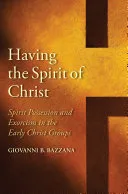
Having the Spirit of Christ
 71
71

Having the Spirit of Christ
Giovanni B. Bazzana's "Having the Spirit of Christ" confronts a persistent blind spot in early Christian scholarship: the ubiquity of possession and exorcism narratives. The author meticulously reconstructs the significance of these accounts, moving beyond their marginalization by modern critics. A particular strength lies in Bazzana's nuanced understanding of "spirit" within the Hellenistic milieu, demonstrating how these experiences were vital for the historical Jesus and his followers. However, the dense academic prose, while precise, might prove challenging for readers unfamiliar with specialized New Testament criticism or ancient history.
The exploration of how early Christians integrated and interpreted these phenomena, often drawing parallels with contemporary pagan practices, is particularly illuminating. Bazzana convincingly argues that these weren't fringe elements but core to the religion's early identity and mission. Ultimately, this book provides a vital corrective, urging a more comprehensive view of early Christianity's spiritual landscape. It is an essential, albeit demanding, contribution for specialists.
📝 Description
71
Giovanni B. Bazzana's 2018 book re-examines spirit possession and exorcism in early Christian texts.
Giovanni B. Bazzana's "Having the Spirit of Christ" offers a rigorous academic re-examination of spirit possession and exorcism narratives within early Christian texts. The work challenges the common scholarly tendency to sideline these phenomena, arguing instead for their centrality to the historical Jesus's ministry and the practices of his earliest adherents. Bazzana situates his analysis within the broader context of late antique Mediterranean religions, where spirit phenomena and their management were common. He contrasts the prevailing critical dismissal of these early Christian accounts with their evident importance in the period, a time when figures like Paul of Tarsus were actively engaged in what he described as spiritual manifestations.
Central to Bazzana's argument is the concept of "spirit" as understood in the Greco-Roman and early Jewish contexts, distinct from later theological interpretations. The work suggests these possession accounts were not merely metaphorical but reflected tangible experiences and social dynamics, integral to establishing authority and community within nascent Christian groups. This study is geared towards scholars of early Christianity, religious studies specialists, and advanced students interested in the historical Jesus and the formation of Christian practices. It will also appeal to those intrigued by the intersection of religious history, psychology, and the phenomenology of altered states of consciousness.
This book engages with the historical and textual roots of early Christian beliefs concerning spiritual influence. It examines concepts of "spirit" and possession that predate and diverge from later dogmatic formulations, situating these phenomena within a broader spectrum of late antique religious experience. By focusing on the lived reality and social function of these manifestations, Bazzana connects early Christian practices to a wider tradition of understanding altered states of consciousness and spiritual agency within the ancient world.
💡 Why Read This Book?
• Gain a fresh perspective on the historical Jesus by understanding the role of spirit phenomena in his ministry, challenging conventional interpretations. • Grasp the socio-religious context of early Christianity by examining how exorcism and possession defined community and authority in the 1st century CE. • Re-evaluate the earliest Christian texts by recognizing the integral nature of spiritual manifestations to their original meaning and practice.
⭐ Reader Reviews
Honest opinions from readers who have explored this book.
❓ Frequently Asked Questions
What distinguishes Bazzana's interpretation of early Christian spirit possession from previous scholarship?
Bazzana's work moves beyond marginalizing or allegorizing possession and exorcism, asserting their literal and functional importance for Jesus and his followers, unlike earlier scholarship that often dismissed them.
What historical period does "Having the Spirit of Christ" primarily focus on?
The book concentrates on the earliest Christian writings and the practices of the historical Jesus and his immediate followers, placing them within the broader context of the 1st century CE Mediterranean world.
Are there specific examples of possession or exorcism discussed from early Christian texts?
Yes, the work reinterprets numerous accounts found in the Gospels and Pauline Epistles, analyzing them not as later theological constructs but as reflections of early Christian experience and practice.
What is the author's view on the historical Jesus and spiritual phenomena?
Bazzana argues that spiritual phenomena, including possession and exorcism, were not peripheral but central to the activity of the historical Jesus and the self-understanding of his earliest followers.
Does the book discuss the concept of 'spirit' in early Christianity?
Absolutely. It delves into the Greco-Roman and Jewish understanding of 'spirit' prevalent in the 1st century CE, demonstrating how this informed early Christian beliefs and practices surrounding possession.
Who would most benefit from reading "Having the Spirit of Christ"?
Scholars of early Christianity, theologians, religious historians, and anyone interested in the historical Jesus and the origins of Christian practices related to spiritual phenomena will find this book invaluable.
🔮 Key Themes & Symbolism
Possession as Centrality
This work posits that spirit possession and exorcism were not marginal but foundational elements of early Christianity. Bazzana argues that these phenomena were integral to the ministry of Jesus and the identity of his earliest followers, contrasting sharply with modern scholarly tendencies to dismiss or allegorize them. The book demonstrates how these experiences shaped the social and spiritual range of nascent Christian communities.
Reinterpreting 'Spirit'
The book tackles the concept of 'spirit' by situating it within the 1st-century CE Greco-Roman and Jewish understanding. It moves beyond anachronistic theological definitions to explore how ancient peoples perceived spiritual forces, possession, and their manifestations. This contextualization is crucial for understanding the literal impact of these experiences on early Christians.
Scholarly Revisionism
Bazzana directly confronts the historiographical bias that has marginalized accounts of possession and exorcism in the study of early Christianity. The work advocates for a more inclusive and historically sensitive approach, urging scholars to reintegrate these phenomena into their reconstructions of Jesus's life and the early church's development, thereby revising established critical paradigms.
Jesus and Spiritual Dynamics
A core theme is the role of spiritual dynamics, particularly possession and its expulsion, in the activity of the historical Jesus. The book explores how these events were perceived by contemporaries and how they contributed to the formation of Jesus's reputation and the establishment of his followers' practices, highlighting their significance for understanding his mission.
💬 Memorable Quotes
Direct passages from the work, attributed to the author.
“The earliest Christian writings are filled with stories of possession and exorcism, which were crucial for the activity of the historical Jesus and for the practice of the earliest groups of his followers.”
— This opening statement frames the book's central thesis: that phenomena often dismissed by modern scholarship were, in fact, vital to the core identity and mission of early Christianity and its founder.
“Most critical scholarship, however, regularly marginalizes these topics or discards them altogether in reconstructing early Christian history.”
— This highlights the scholarly problem Bazzana addresses. He critiques the tendency within historical-critical methods to ignore or downplay possession narratives, arguing this leads to an incomplete understanding of the period.
“This innovative book approaches the study of possess”
— This incomplete phrase from the original blurb suggests the book's methodology involves a novel approach to studying possession, likely through rigorous historical and textual analysis rather than purely theological or symbolic interpretation.
💡 Key Ideas
Editorial paraphrase of the work's core concepts — not direct quotes.
The work explores how these possession accounts were not merely metaphorical but reflected tangible experiences.
This paraphrased concept emphasizes Bazzana's commitment to historical realism, suggesting he treats the described spiritual encounters as actual perceived events by early Christians, not just symbolic language.
The concept of 'spirit' as understood in the Greco-Roman and early Jewish contexts, distinct from later theological interpretations.
This paraphrased concept points to Bazzana's focus on historical linguistics and cultural context. He aims to recover the original meaning of 'spirit' before it was heavily shaped by later creedal formulations.
🌙 Esoteric Significance
Tradition
While not explicitly aligning with a single esoteric lineage, Bazzana's work speaks to traditions that emphasize direct spiritual experience and the immanence of spiritual forces within the material world. It echoes Gnostic and Hermetic interests in altered states and the nature of divine influence, though its methodology is strictly academic and historical. The focus on the historical Jesus's engagement with spiritual phenomena aligns with movements like Christian Esotericism that seek to uncover hidden or forgotten dimensions of early Christianity.
Symbolism
The primary 'symbol' explored is the concept of 'spirit' itself, understood not as an abstract theological term but as an active, often disruptive, force in the lives of early Christians. Possession by a spirit (or spirits) and the subsequent exorcism represent a potent dynamic of spiritual incursion and liberation. The 'healing' or 'cleansing' that follows exorcism symbolizes the restoration of divine order and the affirmation of Jesus's authority, a motif common in many spiritual traditions.
Modern Relevance
Contemporary esoteric practitioners and scholars interested in the roots of Western esotericism find Bazzana's work relevant for its rigorous historical grounding of spiritual phenomena. Thinkers exploring the phenomenology of religious experience, the psychology of belief, and the historical Jesus often draw upon such critical re-evaluations. It informs modern discussions on the efficacy of spiritual healing, deliverance ministries, and the psychological impact of perceived spiritual encounters, bridging historical scholarship with contemporary spiritual inquiry.
👥 Who Should Read This Book
['• Scholars of Early Christianity: Those researching the historical Jesus, the Gospels, Pauline theology, and the formation of Christian doctrine will gain a crucial corrective perspective.', '• Religious Studies Specialists: Researchers in comparative religion and the study of ancient Mediterranean religions can use this work to understand the broader context of spiritual phenomena.', '• Students of Mysticism and Esotericism: Individuals interested in the historical roots of spiritual experiences and esoteric interpretations of Christianity will find valuable context for understanding early spiritual dynamics.']
📜 Historical Context
Published in 2020, Giovanni B. Bazzana's "Having the Spirit of Christ" enters a scholarly conversation dominated by historical-critical methods that, since the 19th century, have often sought rationalistic explanations for religious phenomena. The era of late antiquity (c. 1st-4th centuries CE) was rife with diverse beliefs about spiritual forces, divine possession, and ecstatic experiences across Jewish, pagan, and nascent Christian traditions. While scholars like Walter Burkert explored parallels in Greek religion, and others debated the historicity of Jesus's exorcisms, Bazzana’s work specifically targets the marginalization of these themes within Christian origins studies. He implicitly engages with scholars like Bart Ehrman, who often focus on textual criticism and historical reconstruction, by insisting on the experiential reality of these spiritual encounters for early believers. The book's reception, though recent, contributes to ongoing debates about the nature of religious experience in the ancient world.
📔 Journal Prompts
Early Christian possession accounts as tangible experiences.
The function of exorcism in establishing authority for the historical Jesus.
Reinterpreting 'spirit' within the 1st-century CE context.
Scholarly marginalization of spiritual phenomena in historical reconstructions.
The relationship between Jesus's activity and spiritual manifestations.
🗂️ Glossary
Spirit Possession (Early Christian Context)
The state of being influenced or controlled by a spiritual entity, as described in early Christian texts. Bazzana argues this was perceived as a literal, tangible experience with social and religious implications.
Exorcism
The practice of expelling or driving out an entity believed to be possessing a person. In early Christianity, this was a key indicator of spiritual authority and power, often attributed to Jesus and his followers.
Historical Jesus
The figure of Jesus of Nazareth reconstructed through historical and critical methods, distinct from later theological interpretations. Bazzana focuses on the Jesus whose ministry involved spiritual phenomena.
Greco-Roman Context
Refers to the cultural and philosophical environment of the Mediterranean world during antiquity, which heavily influenced early Christian thought and practice, including beliefs about spirits and divine influence.
Marginalization (Scholarly)
The tendency within academic study to treat certain topics, like spirit possession in early Christianity, as peripheral or insignificant, thereby excluding them from mainstream historical narratives.
Phenomenology
The philosophical study of the structures of experience and consciousness. In this context, it relates to understanding how early Christians experienced and interpreted spiritual phenomena.
Nascent Christian Groups
The earliest communities of followers of Jesus, in the period immediately following his death and resurrection, before the religion became formalized and widespread.