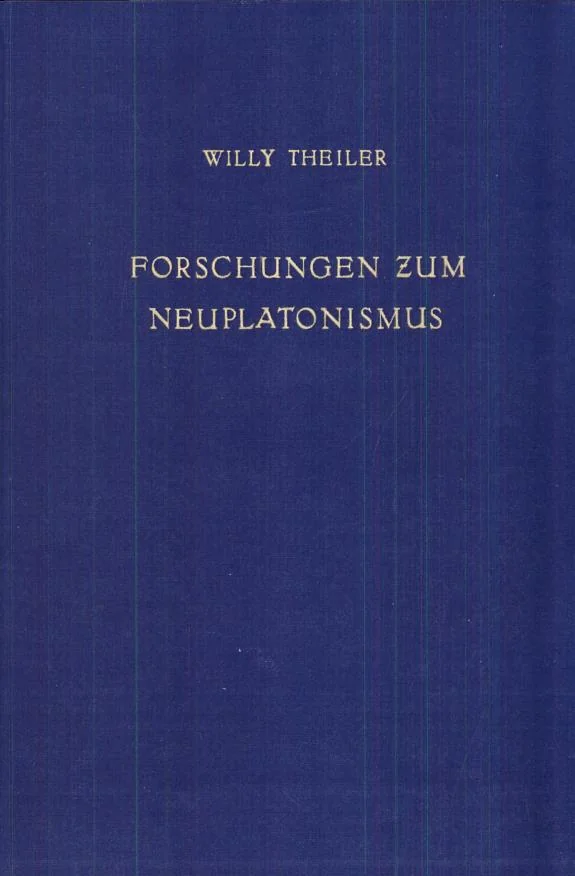
Forschungen zum Neuplatonismus
 80
80

Forschungen zum Neuplatonismus
Willy Theiler’s *Forschungen zum Neuplatonismus* offers a dense, scholarly engagement with one of antiquity’s most complex philosophical systems. The strength of this work lies in its meticulous textual analysis, providing a solid grounding for understanding the intricate doctrines of figures like Plotinus. Theiler avoids grand pronouncements, instead favoring precise philological argument. For instance, his examination of the concept of *henosis* (union with the One) is less about mystical experience and more about the philosophical articulation of achieving this state through intellectual ascent, a crucial distinction for serious study.
However, the book’s academic rigor can also be its limitation. The language and approach are decidedly scholarly, making it less accessible for casual readers or those new to Neoplatonism. It demands significant prior knowledge of Greek philosophy and requires careful, sustained attention. The absence of extensive introductory material might deter newcomers. Nevertheless, for the dedicated student of ancient thought, *Forschungen zum Neuplatonismus* remains a valuable, if demanding, resource for clarifying the philosophical underpinnings of this pivotal movement.
📝 Description
80
Published in 1966, Willy Theiler's Forschungen zum Neuplatonismus offers a detailed examination of this ancient philosophical school.
Willy Theiler's 1966 study, Forschungen zum Neuplatonismus, scrutinizes the philosophical currents and figures central to Neoplatonism. Theiler, a respected classical scholar, moves beyond simple summaries to address the core ideas of Neoplatonic thinkers. He clarifies the development and influence of this school of thought, engaging directly with its primary sources. The book was published during a time of increased academic focus on Hellenistic and late antique philosophy. Researchers were reassessing Neoplatonism not just as a predecessor to Christian thought but as a significant philosophical system. Theiler's contribution aided in developing a more precise understanding of Neoplatonism, distinguishing it from Stoic and later medieval philosophies.
This work is suited for academics, graduate students, and independent researchers interested in ancient philosophy, classical philology, and the history of Western esotericism. A strong command of Greek and Latin texts is necessary, as the book engages directly with primary sources. Readers focused on Plotinus, Porphyry, and their intellectual heritage will find this a valuable resource.
Forschungen zum Neuplatonismus investigates a philosophical tradition that profoundly influenced Western esotericism. Neoplatonism, particularly through figures like Plotinus, provided a metaphysical framework of emanation and ascent that resonated with later occult traditions. Concepts such as the divine One, the Intellect, and the Soul's journey became key elements in mystical and magical thought. Theiler's rigorous analysis of these ideas, grounded in classical texts, offers a scholarly perspective on a lineage that connects ancient Greek philosophy with subsequent Gnostic, Hermetic, and Renaissance magical philosophies.
💡 Why Read This Book?
• Gain a precise understanding of the Neoplatonic concept of 'the One' as articulated by Plotinus, moving beyond popular mysticism to the philosophical underpinnings of its emanationist cosmology. • Trace the development of key philosophical terms and ideas from Plato through Plotinus and Porphyry, as detailed in Theiler's textual analysis from 1966. • Appreciate the academic context of mid-20th-century classical scholarship, understanding how Theiler's research positioned Neoplatonism as a distinct philosophical force.
⭐ Reader Reviews
Honest opinions from readers who have explored this book.
❓ Frequently Asked Questions
What is Neoplatonism according to Willy Theiler's research?
Willy Theiler's *Forschungen zum Neuplatonismus* examines Neoplatonism as a philosophical system originating in the 3rd century CE, primarily through Plotinus, emphasizing its hierarchical structure of reality, emanation from the One, and the soul's ascent back to the divine.
Who was Plotinus and why is he central to this book?
Plotinus (c. 204/5 – 270 CE) is considered the founder of Neoplatonism. Theiler's work focuses heavily on Plotinus's *Enneads*, analyzing his metaphysical doctrines concerning the One, Nous, and the Soul as foundational to the entire Neoplatonic tradition.
What does 'emanation' mean in the context of Neoplatonism as discussed by Theiler?
In Theiler's exploration of Neoplatonism, emanation describes the process by which all reality flows or 'emanates' from a single, transcendent source (the One) without diminishing the source itself, creating a hierarchy of being.
Is Forschungen zum Neuplatonismus suitable for beginners in philosophy?
This book is primarily for advanced students and scholars. Its dense, philological approach and reliance on original Greek philosophical concepts make it challenging for those without a strong background in classical studies.
What is the significance of the year 1966 for this book?
1966 marks the original publication year of Willy Theiler's *Forschungen zum Neuplatonismus*, placing its scholarly contribution within the mid-20th century academic discourse on ancient philosophy and its reception.
How does Theiler's work connect Neoplatonism to later philosophical traditions?
While focused on antiquity, Theiler's research implicitly shows how Neoplatonism, with its concepts of transcendence and emanation, provided a philosophical framework that significantly influenced early Christian theology and later medieval thought.
🔮 Key Themes & Symbolism
The Triad: One, Intellect, Soul
Theiler meticulously dissects the core Neoplatonic triad: the ineffable One, the Intellect (Nous) containing the Forms, and the Soul which mediates between the intelligible and sensible realms. This structure, central to Plotinus's philosophy, is examined through its textual origins and logical progression. The work likely explores how these hypostases are not static entities but dynamic principles of existence, with the Soul's descent and potential ascent forming a crucial part of the Neoplatonic worldview.
Emanation and Hierarchy
A fundamental concept explored is emanation, the idea that reality proceeds from the One in a series of descending levels without depleting the source. Theiler's research investigates the philosophical mechanisms and implications of this outward flow, establishing the hierarchical order of the cosmos. This systematic ordering, from pure being to material existence, is presented not as a myth but as a rational philosophical construction designed to explain the totality of existence.
The Goal of Henosis
The ultimate aim within Neoplatonism, the union with the One (henosis), is a key focus. Theiler likely analyzes the philosophical pathways and practices proposed by figures like Plotinus and Porphyry for achieving this ecstatic, yet intellectually grounded, state. This involves understanding the soul's purification and its intellectual journey back to its divine origin, transcending the limitations of the material world.
Influence and Interpretations
The book explores how Neoplatonism was received and interpreted by later thinkers, both within pagan antiquity and by early Christian theologians. Theiler's scholarship provides context for understanding Neoplatonism not just as a standalone system but as a significant philosophical precursor that shaped subsequent Western thought, highlighting its enduring impact on metaphysical and spiritual discourse.
💬 Memorable Quotes
Direct passages from the work, attributed to the author.
“The Soul's descent into matter is a fall from its divine origin.”
— This interpretation points to the Neoplatonic view of the soul's predicament. It suggests that the soul's involvement with the material world is a deviation from its true, spiritual nature, setting the stage for the Neoplatonic emphasis on spiritual disciplines aimed at recollection and return.
“Intellect (Nous) contains the Platonic Forms.”
— This statement clarifies the role of Nous in Plotinian metaphysics. It acts as a divine mind where the archetypes or perfect models of all things reside, serving as the blueprint for the reality that emanates from the One.
“Porphyry's commentaries were crucial for the transmission of Plotinus's ideas.”
— This highlights the historical importance of Porphyry, a student of Plotinus. His editorial work and commentaries were instrumental in preserving and disseminating Plotinus's complex philosophical system, making them essential for understanding the early development of Neoplatonism.
“The goal is to return to the source.”
— This concise phrase captures the teleological drive in Neoplatonism. It refers to the ultimate spiritual and philosophical aspiration: the soul's journey of purification and recollection to achieve union with the originating principle, the One.
💡 Key Ideas
Editorial paraphrase of the work's core concepts — not direct quotes.
The One is beyond being and knowledge.
This paraphrased concept highlights the ineffable and transcendent nature of the ultimate reality in Neoplatonism. It underscores that the One cannot be grasped through ordinary discursive thought or described using positive attributes, positioning it as the absolute ground of all existence.
🌙 Esoteric Significance
Tradition
This work engages directly with the Neoplatonic tradition, a philosophical school deeply intertwined with esoteric thought in the Western lineage. While presented academically, its subject matter—the nature of reality, the soul's journey, and union with the divine—forms the bedrock of many later esoteric systems, including Hermeticism, Gnosticism, and certain streams of Kabbalah. Theiler's scholarship clarifies the philosophical underpinnings that these later traditions often drew upon or reinterpreted.
Symbolism
Central to Neoplatonic symbolism, as explored in such research, is the concept of the 'One'—not as a deity with attributes, but as an ineffable, ultimate principle beyond existence itself. Another key motif is the 'Soul's descent and ascent,' symbolizing the spiritual journey from material entanglement back to divine unity. The hierarchical structure of reality, often visualized as a series of 'emanations,' also serves as a symbolic map of the cosmos and the soul's place within it.
Modern Relevance
Contemporary esoteric practitioners and scholars of comparative religion frequently reference Neoplatonic thought for its sophisticated metaphysics and psychological insights. Thinkers in fields ranging from depth psychology to contemporary Hermetic philosophy often draw on Plotinus and his successors to articulate concepts of consciousness, transcendence, and the structure of reality, demonstrating the enduring influence of this ancient school.
👥 Who Should Read This Book
• Advanced students of classical philosophy and philology seeking rigorous, textually-based analysis of Plotinus and his school. • Researchers in comparative religion and Western esotericism needing to understand the philosophical roots of later mystical traditions. • Serious practitioners of esoteric disciplines who wish to ground their understanding in the foundational philosophical concepts of Neoplatonism.
📜 Historical Context
Willy Theiler's *Forschungen zum Neuplatonismus*, published in 1966, emerged during a significant period of academic re-engagement with late antique philosophy. The mid-20th century saw scholars moving beyond viewing Neoplatonism merely as a bridge to Christianity, instead appreciating its philosophical sophistication as a distinct intellectual tradition. Theiler’s work contributed to this shift, offering detailed textual analysis that situated thinkers like Plotinus and Porphyry within their Hellenistic philosophical milieu. This era also saw ongoing scholarly debates with figures like Werner Beierwaltes and his contemporaries regarding the interpretation of key Neoplatonic concepts. Theiler's rigorous philological approach provided a counterpoint to more speculative interpretations, reinforcing the importance of precise textual exegesis in understanding ancient thought.
📔 Journal Prompts
The Neoplatonic concept of 'the One' beyond being.
Plotinus's articulation of the Intellect (Nous).
The Soul's journey from emanation to material existence.
Porphyry's role in preserving Neoplatonic texts.
The philosophical basis for achieving 'henosis'.
🗂️ Glossary
Neoplatonism
A philosophical system flourishing from the 3rd to 6th centuries CE, founded by Plotinus, which synthesized Plato's ideas with other philosophical and mystical traditions. It emphasizes a hierarchical cosmology emanating from a transcendent One.
The One (to hen)
The ultimate, ineffable source and principle of all reality in Neoplatonism. It is beyond existence, thought, and description, serving as the origin from which all things emanate.
Intellect (Nous)
The second hypostasis in Neoplatonism, often identified with the divine mind. It contains the Platonic Forms or Ideas and is the realm where true being and thought reside.
Soul (Psyche)
The third hypostasis, mediating between the intelligible realm (Nous) and the material world. It possesses a divine origin but can descend into materiality, seeking to return to its source.
Emanation
The Neoplatonic doctrine that reality flows or proceeds from the One in a hierarchical series of levels (hypostases) without diminishing the One itself. It explains the existence of multiplicity from unity.
Henosis
The Neoplatonic goal of mystical union or ecstatic communion with the One. It represents the soul's ultimate return to its divine source through purification and contemplation.
Philology
The study of language in oral and written historical sources; it is the intersection of textual criticism, literary criticism, history, and linguistics. Crucial for analyzing ancient philosophical texts.
This book appears in 1 collection
🔮 Readers Also Liked
Browse all →









From the “Neoplatonism” Collection
View all →









More Free Occult Philosophy Books
View all →