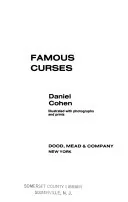
Famous Curses
 75
75

Famous Curses
Daniel Cohen's "Famous Curses" tackles a subject ripe for sensationalism, yet he maintains a commendably skeptical stance throughout. The book’s strength lies in its methodical deconstruction of popular curse narratives, particularly its examination of the "curse of the mummy's tomb" associated with the discovery of Tutankhamun's burial site. Cohen doesn't dismiss the allure of the supernatural but instead probes the historical circumstances and psychological underpinnings that give these tales their power. A notable limitation is the book's occasionally dry presentation; while factual, it sometimes lacks the narrative flair that could elevate these inherently dramatic stories. The discussion surrounding the Hope Diamond, for instance, details its provenance and alleged misfortunes with precision, but could benefit from more vivid storytelling. Ultimately, "Famous Curses" serves as a valuable corrective to unchecked credulity, offering a rational lens on enduring legends.
📝 Description
75
Daniel Cohen's 1979 book, Famous Curses, investigates the history and alleged supernatural forces behind notorious curses.
Famous Curses, published in 1979, examines historical accounts and purported supernatural forces connected to well-known curses. Daniel Cohen analyzes popular curse narratives, questioning their origins and looking into instances where misfortune seemed to follow specific objects or individuals. He approaches these stories critically, searching for rational explanations or identifiable patterns within the folklore. The book dissects stories like the curse of Tutankhamun's tomb, considering the role of coincidence and confirmation bias in their persistence. Cohen also considers the curse as a narrative device and a psychological phenomenon, touching on how media amplification can perpetuate these legends. The work reflects a broader interest in uncovering truths behind sensational tales and societal anxieties.
Cohen engages with the cultural fascination surrounding mysteries, providing a more grounded perspective than many works from his time. He scrutinizes the psychological underpinnings of belief in curses, exploring how these narratives take hold and endure. The book is suited for those interested in the intersection of history, superstition, and unexplained phenomena. It appeals to readers who enjoy dissecting myths and understanding the psychology behind belief systems. Students of folklore and cultural history will find Cohen's critical approach valuable.
Published in 1979, Famous Curses emerged during a period of heightened public interest in the paranormal and occult. While many contemporary works leaned into sensationalism, Cohen's book offered a more measured, critical examination of curse narratives. It sits within a tradition of skeptical inquiry into folklore and supernatural claims, seeking rational explanations for events often attributed to mystical forces. The book engages with how cultural anxieties and beliefs manifest in stories of misfortune, connecting historical accounts to psychological phenomena rather than purely metaphysical causes.
💡 Why Read This Book?
• Understand the psychological mechanisms that fuel curse beliefs, learning how factors like coincidence and suggestion play a role, as exemplified in the case of the Hope Diamond. • Gain historical context for famous curses, such as the alleged "curse of the mummy's tomb," and the societal anxieties prevalent during their popularization. • Develop critical thinking skills to discern fact from folklore when encountering sensational stories about misfortune and supernatural retribution.
⭐ Reader Reviews
Honest opinions from readers who have explored this book.
❓ Frequently Asked Questions
What are some of the most famous curses discussed in Daniel Cohen's book?
Daniel Cohen's "Famous Curses" delves into well-known legends such as the curse associated with King Tutankhamun's tomb, the supposed hex on the Hope Diamond, and various other historical misfortunes attributed to supernatural forces.
Does Daniel Cohen believe in the existence of curses?
Cohen adopts a skeptical approach, aiming to present the historical accounts and then critically examine them for rational explanations, psychological factors, or coincidences rather than asserting the reality of supernatural curses.
When was 'Famous Curses' by Daniel Cohen first published?
The book "Famous Curses" by Daniel Cohen was first published in 1979, reflecting a period of significant public interest in paranormal and unexplained phenomena.
What is the historical significance of the curse of King Tut's tomb?
The "curse of the mummy's tomb" gained notoriety following the 1922 discovery of Tutankhamun's tomb. Cohen explores how subsequent deaths of individuals involved in the excavation fueled this legend, examining the role of media and superstition.
Are there any specific historical figures linked to the curses in the book?
Yes, the book discusses historical figures and events, including Lord Carnarvon, who died shortly after the opening of Tutankhamun's tomb, and the various owners and handlers of the Hope Diamond, many of whom reportedly met unfortunate ends.
What approach does Cohen take to debunking curse stories?
Cohen's method involves presenting the narrative of the curse, then investigating the historical facts, identifying coincidences, exploring psychological biases like confirmation bias, and examining the role of sensationalist reporting in perpetuating the myths.
🔮 Key Themes & Symbolism
The Psychology of Belief
Cohen investigates how the human mind readily accepts and perpetuates narratives of curses, even in the absence of concrete evidence. He highlights confirmation bias, where people actively seek out and interpret events that support the idea of a curse, while ignoring contradictory information. This theme is particularly evident when examining how misfortunes befalling owners of the Hope Diamond were amplified and recorded, while positive outcomes or simple coincidences were overlooked.
Folklore and Media Amplification
The book examines how stories of curses evolve and spread, often becoming amplified by sensationalist media coverage. The "curse of the mummy's tomb" is a prime example, where newspaper reports of Tutankhamun's excavation and the subsequent deaths of involved parties were woven into a powerful narrative. Cohen explores the interplay between genuine historical events and the embellishments that transform them into enduring legends that capture the public imagination.
Rational Examination of the Supernatural
A core theme is the application of reason and historical scrutiny to alleged supernatural phenomena. Cohen doesn't dismiss the stories outright but seeks to uncover the mundane explanations behind them. This involves meticulous research into the provenance of cursed objects, the circumstances of reported misfortunes, and the historical context in which these beliefs emerged, offering a counterpoint to pure superstition.
Coincidence vs. Causation
Cohen frequently confronts the challenge of distinguishing between mere coincidence and genuine causal links, especially when dealing with historical events. Many alleged curses stem from a series of unfortunate events that happen to occur sequentially or involve people connected to a specific object or place. The book explores how easily temporal proximity can be mistaken for direct causation, leading to the widespread acceptance of curse narratives.
💬 Memorable Quotes
Direct passages from the work, attributed to the author.
“The curse of the mummy's tomb became a sensation, fueled by newspaper speculation.”
— This statement captures how media sensationalism played a critical role in popularizing the legend surrounding Tutankhamun's burial, transforming a historical discovery into a widely believed supernatural phenomenon.
“Many owners of the Hope Diamond met with misfortune, leading to its reputation as a cursed object.”
— This highlights the core narrative of the Hope Diamond's curse, suggesting that the accumulation of negative events linked to its ownership cemented its notorious reputation in popular lore.
“Cohen questions whether alleged curses are products of supernatural forces or human psychology.”
— This interpretation points to the book's central thesis: investigating whether misfortune is truly divinely or supernaturally ordained, or if it can be explained by rational factors like coincidence, psychological suggestion, and flawed reporting.
💡 Key Ideas
Editorial paraphrase of the work's core concepts — not direct quotes.
The book examines the historical context behind the belief in curses.
This paraphrase emphasizes Cohen's methodological approach, which involves situating curse narratives within their specific historical periods to understand the social, cultural, and intellectual conditions that fostered such beliefs.
Rational explanations are sought for events attributed to supernatural hexes.
This summarizes Cohen's critical stance, indicating his effort to find logical, non-supernatural reasons for misfortunes that have been popularly ascribed to curses, thereby clarifying the phenomenon.
🌙 Esoteric Significance
Tradition
While not strictly adhering to a singular esoteric tradition, "Famous Curses" engages with themes prevalent in Western esotericism, particularly concerning fate, karma, and the power of intention or belief. It touches upon the idea that certain objects or places can carry residual energies or "imprints" that influence events, a concept found in various occult philosophies. Cohen's skeptical lens, however, serves to ground these potentially metaphysical discussions in observable phenomena and historical analysis, making it accessible to a broader audience interested in the fringes of the unexplained.
Symbolism
The book implicitly explores symbolism through the objects and locations associated with curses. The "curse of the mummy's tomb" symbolizes the transgression of ancient boundaries and the potential wrath of the departed, reflecting archetypal fears of disturbing the dead. The Hope Diamond, with its deep blue hue and storied past, symbolizes not just material wealth but also the allure and danger of possessing powerful, perhaps cosmically charged, artifacts. These symbols tap into deeper human anxieties about fate, mortality, and the consequences of ambition.
Modern Relevance
In contemporary culture, where online forums and social media platforms are rife with discussions of supposed curses, haunted objects, and paranormal events, Cohen's work remains relevant. It provides a framework for critically evaluating such claims, distinguishing between myth and verifiable fact. Modern practitioners of divination or occult studies can use Cohen's approach to understand the historical roots and psychological appeal of curse narratives, informing their own studies of belief systems and the human psyche's engagement with the mysterious.
👥 Who Should Read This Book
• Skeptics and critical thinkers interested in debunking popular myths surrounding curses and unexplained phenomena. • Folklore enthusiasts and cultural historians seeking to understand the origins and perpetuation of legendary tales. • Readers fascinated by historical mysteries and the psychological underpinnings of belief in the supernatural.
📜 Historical Context
Daniel Cohen's "Famous Curses," published in 1979, emerged during a period marked by a resurgence of interest in the paranormal, occult, and unexplained phenomena. This era saw popular authors like Erich von Däniken gaining widespread attention with theories about ancient astronauts, and television programs like "In Search Of..." exploring mysteries. Cohen's work positioned itself against the tide of uncritical acceptance, offering a more rational and historically grounded perspective. While many contemporaries were content to sensationalize, Cohen engaged in the meticulous dissection of folklore. His approach can be seen as a response to the burgeoning New Age movement and the general cultural fascination with mysteries that characterized the late 1970s. The book's reception likely resonated with readers seeking a more critical examination of popular legends, distinguishing it from more purely speculative works of the time.
📔 Journal Prompts
The amplification of the "curse of the mummy's tomb" by media.
The psychological factors contributing to the belief in the Hope Diamond's curse.
The concept of coincidence versus causation in historical misfortune.
The role of specific individuals, like Lord Carnarvon, in perpetuating curse legends.
The enduring appeal of cursed objects in popular culture.
🗂️ Glossary
Confirmation Bias
The tendency to search for, interpret, favor, and recall information in a way that confirms one's pre-existing beliefs or hypotheses, while giving disproportionately less consideration to alternative possibilities.
Provenance
The history of ownership of a valued object or work of art, especially as a guide to authenticity or value. In the context of curses, it refers to the documented history of an object's owners.
Sensationalism
The use of exciting or shocking stories or details in order to get public interest or attention. Often involves exaggeration and appeals to emotion rather than fact.
Superstition
A belief or way of behaving that is based on fear of the unknown and of luck, or on a belief that certain events or objects bring bad luck.
Folklore
The traditional beliefs, customs, and stories of a community, passed through the generations by word of mouth. Curse narratives are a significant part of folklore.
Esoteric
Intended for or likely to be understood by only a small number of people with a specialized knowledge or interest. In this context, referring to hidden or mystical knowledge.
Hegemony
Leadership or dominance, especially by one country or social group over others. Can be applied to how certain narratives or beliefs become dominant.
This book appears in 1 collection
🔮 Readers Also Liked
Browse all →









From the “Incantations” Collection
View all →






More Free Occult Philosophy Books
View all →