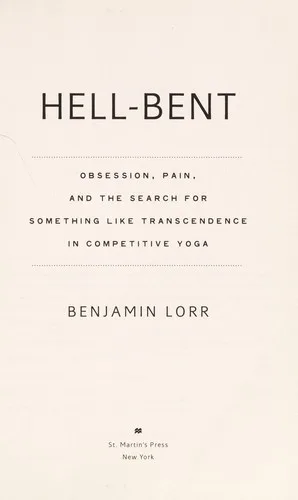
Hell-bent
 74
74

Hell-bent
Benjamin Lorr’s "Hell-bent" avoids the common pitfalls of armchair philosophizing about extreme experience. Instead, Lorr places himself directly into the crucible, reporting from within the subcultures that chase transcendence through physical and mental extremity. His immersion into practices ranging from intense martial arts to esoteric physical disciplines is commendable for its journalistic rigor. However, while Lorr excels at documenting the *what* and *how* of these pursuits, the *why* sometimes feels less developed, leaning heavily on the reader to infer deeper philosophical connections. A particularly striking section details the arduous training regimens, highlighting the sheer willpower involved. The limitation lies in the occasional lack of critical distance; a more direct engagement with the potential psychological dangers or the philosophical critiques of such single-minded pursuits would have added further depth. Ultimately, "Hell-bent" offers a vivid, if sometimes uncritical, window into humanity’s drive for the extraordinary.
📝 Description
74
### What It Is Benjamin Lorr's "Hell-bent," first published in 2016, is an exploration of extreme human experiences and the pursuit of meaning through intense physicality and altered states. It is not a theoretical treatise but a deeply reported account, following the author as he immerses himself in subcultures and practices that push the boundaries of human endurance and perception. The book investigates how individuals seek transcendence or self-discovery through disciplines often considered fringe or dangerous.
### Who It's For This work will appeal to readers interested in the psychology of extreme behavior, the anthropology of ritual, and the diverse ways humans have historically sought spiritual or personal liberation. It is suited for those who enjoy investigative journalism that ventures into unconventional territories, particularly concerning the body's role in consciousness and belief systems. Individuals curious about the intersection of pain, pleasure, and purpose will find this material compelling.
### Historical Context Published in 2016, "Hell-bent" emerges from a contemporary landscape where interest in mindfulness, wellness, and altered states has surged, often alongside a resurgence of interest in older, more rigorous, or even extreme spiritual practices. Lorr's work can be seen in dialogue with a lineage of writers who have chronicled such pursuits, from Aldous Huxley's "The Doors of Perception" (1954) exploring psychedelics, to contemporary ethnographies of ecstatic dance or intense physical disciplines. The book arrives at a time when scientific inquiry into consciousness and the body's limits is also expanding, offering a counterpoint of lived experience to empirical study.
### Key Concepts The book centers on the concept of "hell-bent" as a metaphor for an all-consuming pursuit, often involving significant personal sacrifice or transgression. It examines how individuals, through disciplines like extreme sports, asceticism, or ritualistic practices, attempt to break through perceived limitations of ordinary consciousness. Lorr probes the psychological and philosophical underpinnings of these quests, questioning whether the pursuit itself, rather than any specific outcome, is the primary driver of meaning. The role of the body as a vessel for transformation, and the fine line between ecstasy and agony, are recurring motifs.
💡 Why Read This Book?
• You will learn how individuals in contemporary subcultures seek altered states and personal meaning through extreme physical disciplines, as demonstrated by Lorr's reporting from within these communities. • You will gain insight into the psychological drive behind pushing human limits, particularly the blurred lines between pain, pleasure, and transcendence, a concept explored through various practices documented in the book. • You will discover specific examples of intense training and ritual, such as those Lorr experienced firsthand, offering a tangible understanding of how the body is used as a tool for consciousness expansion.
⭐ Reader Reviews
Honest opinions from readers who have explored this book.
❓ Frequently Asked Questions
What is the primary focus of Benjamin Lorr's "Hell-bent"?
"Hell-bent" focuses on individuals who pursue extreme physical and altered states of consciousness in their search for meaning and transcendence, exploring the subcultures and practices involved.
When was "Hell-bent" by Benjamin Lorr first published?
The book "Hell-bent" by Benjamin Lorr was first published in 2016.
What kind of practices does "Hell-bent" explore?
The book explores a range of intense practices, including extreme sports, martial arts, asceticism, and various ritualistic or physical disciplines aimed at pushing human endurance and consciousness.
Does "Hell-bent" offer a theoretical analysis of these extreme pursuits?
While it touches on the psychological and philosophical aspects, "Hell-bent" is primarily an investigative journalism piece, focusing on immersive reporting of the practices and the people involved rather than abstract theory.
Who is the author, Benjamin Lorr?
Benjamin Lorr is an author and investigative journalist known for his deep dives into unconventional human experiences and subcultures.
What is the central metaphor or concept in "Hell-bent"?
The central concept is 'hell-bent,' representing an all-consuming, often transgressive pursuit of meaning or self-discovery through extreme means.
🔮 Key Themes & Symbolism
The Body as a Gateway
The work meticulously details how the physical body, often perceived as a limitation, becomes the primary vehicle for achieving altered states and profound self-understanding. Lorr immerses the reader in the visceral experiences of extreme physical exertion, pain, and endurance. He illustrates how disciplines, from intense martial arts to ascetic practices, are employed not merely for fitness but as deliberate tools to break down ordinary consciousness and access deeper layers of self. The body is presented as a site of profound transformation, where limits are tested and redefined to unlock new perceptions of reality and purpose.
The All-Consuming Quest
Central to "Hell-bent" is the idea of a 'hell-bent' pursuit—an all-encompassing drive that often involves significant sacrifice, obsession, and even transgression of societal norms. The book explores why individuals dedicate themselves so intensely to specific practices, often to the exclusion of other life aspects. This drive is examined not just as a personal quirk but as a fundamental human impulse to seek meaning and transcendence beyond the mundane. Lorr investigates the psychological underpinnings of this relentless striving, questioning the nature of obsession and its role in self-discovery.
Transcendence Through Extremity
Lorr investigates the hypothesis that by pushing human capacities to their absolute limits, individuals can achieve states of consciousness that feel transcendent or revelatory. The book documents various subcultures and practices that aim to induce such states, whether through extreme physical challenge, sensory deprivation, or intense focus. It questions the nature of these experiences: are they genuine breakthroughs in consciousness, elaborate self-deceptions, or something else entirely? The fine line between ecstatic experience and profound suffering is a recurring theme, suggesting that extremity itself might be the catalyst for perceived spiritual or psychological liberation.
Subcultures of Intensity
A significant portion of "Hell-bent" is dedicated to exploring the distinct subcultures that form around these extreme pursuits. Lorr provides an ethnographic perspective, detailing the codes, rituals, and shared philosophies that bind these groups. He examines how shared intensity creates community and identity, offering a social dimension to the individual quest for meaning. These communities often operate on the fringes of mainstream society, developing their own unique languages and value systems centered around the pursuit of extreme experience. The book sheds light on the social construction of what constitutes 'meaningful' or 'transcendent' experience.
💬 Memorable Quotes
Direct passages from the work, attributed to the author.
“The relentless pursuit of a singular, extreme goal.”
— This captures the essence of the 'hell-bent' mentality. It's not just about striving, but about an all-consuming, almost obsessive dedication that defines an individual's existence.
“Pushing the body beyond its perceived limits to alter consciousness.”
— This highlights the core thesis: that extreme physical discipline is a deliberate pathway to accessing altered states of mind and potentially new levels of self-awareness.
“The fine line between ecstatic breakthrough and agonizing failure.”
— This points to the inherent risk and precariousness of the extreme paths explored in the book, where the same intensity can lead to profound revelation or utter collapse.
“Finding meaning in the intensity of the struggle itself.”
— This suggests that for many, the value lies not in the destination or the outcome, but in the process of rigorous, demanding engagement with their chosen practice.
“Subcultures forming around shared experiences of extremity.”
— This emphasizes the social dimension, showing how intense personal quests can forge unique communities with their own norms and shared understanding of extreme experience.
🌙 Esoteric Significance
Tradition
While "Hell-bent" does not adhere strictly to a single esoteric lineage, its exploration of the body as a primary tool for consciousness alteration aligns with certain Hermetic and Gnostic principles that emphasize the microcosm reflecting the macrocosm and the potential for liberation through rigorous self-discipline. The pursuit of transcending ordinary perception through intense practice echoes Gnostic ideals of gnosis (knowledge) as a means of salvation. Lorr’s work, however, grounds these concepts in empirical, observable phenomena and contemporary subcultures, offering a secularized, yet deeply spiritual, inquiry into transformative practices.
Symbolism
The primary symbolic motif is the "hell-bent" pursuit itself, representing an all-consuming dedication that can be both destructive and redemptive. The concept of the "limit"—be it physical, mental, or spiritual—serves as a symbolic threshold. Crossing this threshold, often through intense pain or exertion, symbolizes a death of the old self and the potential birth of a new one. The body, in its raw, tested state, becomes a symbol of resilience and the ultimate vessel for profound experience, a tangible representation of the inner journey.
Modern Relevance
Contemporary practitioners of various disciplines, from high-intensity interval training (HIIT) and extreme endurance sports to certain forms of ecstatic dance and martial arts, can find resonance with Lorr's depiction of disciplined, transformative physical engagement. Thinkers and groups exploring the intersection of neuroscience, psychology, and spirituality, particularly those interested in the phenomenology of altered states achieved through non-ordinary means, draw upon the empirical observations within "Hell-bent." The book's exploration of intense commitment also speaks to modern discussions around motivation, purpose, and the search for meaning in a secularized world.
👥 Who Should Read This Book
• Individuals fascinated by the psychology of extreme athletes and practitioners of intense physical disciplines, seeking to understand their motivations and experiences. • Anthropologists and sociologists interested in contemporary subcultures that revolve around altered states and the pursuit of transcendence through unconventional means. • Readers exploring the role of the body in spiritual or personal development, who are looking for firsthand accounts of pushing human limits for self-discovery.
📜 Historical Context
Benjamin Lorr's "Hell-bent," published in 2016, arrived during a period of heightened public interest in mindfulness, extreme fitness, and altered states of consciousness, often fueled by celebrity endorsements and popular media. This context made Lorr's immersive journalistic approach particularly relevant. The book can be seen as part of a long tradition of Western writers exploring the boundaries of human experience, from Baudelaire’s engagement with hashish in the 19th century to the counter-cultural explorations of psychedelics in the 1960s, exemplified by Timothy Leary's work with psilocybin. However, "Hell-bent" distinguishes itself by focusing on physically demanding, often non-pharmacological, practices. It also emerged in an era where scientific research into the brain and consciousness, including studies on pain and endurance, was rapidly advancing, providing a backdrop against which Lorr’s ethnographic accounts could be considered. While not a direct engagement, the work implicitly dialogues with contemporary self-help movements and the burgeoning wellness industry by presenting a more arduous, less commodified path to perceived enlightenment or self-discovery.
📔 Journal Prompts
The "hell-bent" pursuit as a chosen path.
Body as a crucible for consciousness.
The threshold between ecstasy and agony.
Meaning found in the intensity of struggle.
Community forged through shared extremity.
🗂️ Glossary
Hell-bent
A state of extreme, all-consuming dedication to a particular pursuit, often involving significant personal sacrifice or transgression of norms.
Altered States of Consciousness
Mental states that differ noticeably from normal waking consciousness, often induced by practices like extreme physical exertion, meditation, or sensory deprivation.
Transcendence
The state of existing beyond the limits of ordinary experience, often associated with spiritual or profound psychological breakthroughs.
Asceticism
A lifestyle characterized by abstinence from worldly pleasures and material possessions, often in the pursuit of spiritual goals or self-discipline.
Phenomenology
The philosophical study of the structures of experience and consciousness as experienced from the first-person point of view.
Microcosm/Macrocosm
The concept that a smaller system (microcosm, e.g., the human body) reflects or contains the characteristics of a larger system (macrocosm, e.g., the universe).
Gnosis
In esoteric traditions, particularly Gnosticism, refers to a special, intuitive knowledge of spiritual mysteries, often seen as the key to salvation.
🔮 Readers Also Liked
Browse all →









More by Benjamin Lorr
All books →
More Free Occult Philosophy Books
View all →