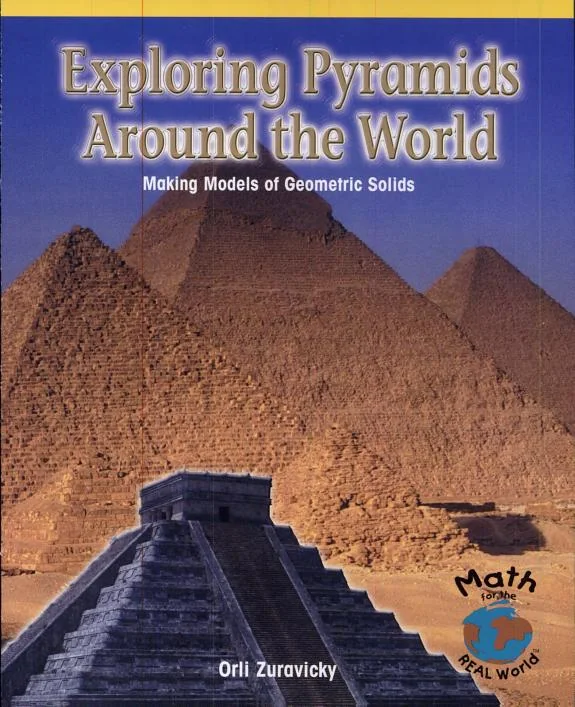
Exploring Pyramids Around the World
 83
83

Exploring Pyramids Around the World
Orli Zuravicky’s *Exploring Pyramids Around the World* offers a competent, if somewhat pedestrian, survey of its subject. The book’s strength lies in its ambitious scope, attempting to link disparate structures from Egypt to the Americas under a common architectural umbrella. Its inclusion of practical model-building instructions, a departure from purely academic texts, is a novel touch that might appeal to younger readers or educators. However, the work falters in its lack of deep engagement with the more profound symbolic or spiritual dimensions often associated with these sites. For instance, the discussion of the Mayan El Castillo pyramid in Chichen Itza, while factually presented, omits the rich calendrical and astronomical significance integral to its design and ceremonial use. The prose, while clear, rarely transcends a descriptive level, leaving the reader with a solid overview but little in the way of startling revelation or critical analysis. It serves as a useful primer but not a definitive exploration of the pyramid's place in human consciousness.
📝 Description
83
Orli Zuravicky's 2010 book examines pyramid structures worldwide beyond Egypt.
Published in 2010, Orli Zuravicky's book offers a comparative study of monumental pyramid structures found across the globe. It moves beyond the well-known Egyptian pyramids to consider edifices in Mesoamerica and other lesser-discussed locations, analyzing their architectural similarities and differences. The work provides a clear, accessible overview of these ancient constructions.
This volume is suitable for amateur historians, students of comparative architecture, and anyone with a basic interest in ancient civilizations. Readers looking for an introductory understanding of different pyramid types, without engaging deeply in complex archaeological debates or esoteric interpretations, will find it a helpful starting point. It also appeals to hobbyists interested in building models of these structures.
Zuravicky's work acknowledges earlier scholarship, particularly the foundational methodologies established by Flinders Petrie's late 19th and early 20th-century Egyptian excavations. However, her approach prioritizes broader accessibility, aligning with a contemporary public interest in ancient mysteries that saw books on topics like the Nazca lines and pre-dynastic Egypt gain popularity.
While Zuravicky's work focuses on architectural typology and practical construction, it touches upon themes that resonate within esoteric traditions. The sheer scale and precision of ancient pyramid construction often invite speculation about lost knowledge or advanced civilizations, subjects frequently explored in esoteric literature. By presenting a broad survey of these structures, the book implicitly engages with the mystique surrounding their origins and purpose, a common thread in discussions of ancient mysteries.
💡 Why Read This Book?
• Gain a foundational understanding of diverse pyramid architectures, from the Step Pyramid of Djoser in Egypt (c. 2670 BCE) to Mesoamerican examples, and learn to construct scale models. • Explore the practical engineering challenges and solutions employed by ancient builders across different cultures, appreciating the logistical feats required for structures like the Great Pyramid of Giza. • Discover how architectural forms can serve as tangible links to past civilizations, allowing for hands-on engagement through model building, fostering a deeper appreciation for historical construction techniques.
⭐ Reader Reviews
Honest opinions from readers who have explored this book.
❓ Frequently Asked Questions
What is the primary focus of 'Exploring Pyramids Around the World'?
The book primarily examines famous pyramid structures globally, comparing their architectural styles and construction methods. It also provides guidance on how to build models of these pyramids.
Does the book only cover Egyptian pyramids?
No, while Egyptian pyramids are discussed, the work extends its scope to include pyramids from other regions, notably Mesoamerica, offering a broader comparative perspective.
What kind of practical advice does the book offer?
It includes instructions and guidance for readers interested in building their own scale models of various pyramids mentioned in the text.
Who is the intended audience for this book?
The book is suitable for students, hobbyists, and anyone with a general interest in ancient architecture and civilizations who wants an accessible introduction to pyramids worldwide.
When was 'Exploring Pyramids Around the World' first published?
The book by Orli Zuravicky was first published on January 1, 2010.
Does the book explore the esoteric or symbolic meanings of pyramids?
While touching on the broad subject of pyramids, the book's focus is primarily on architectural comparison and model building. Deep esoteric interpretation is not its main emphasis.
🔮 Key Themes & Symbolism
Architectural Typology
The book categorizes global pyramids based on their distinct construction techniques and structural designs. It contrasts the smooth-sided, precise masonry of Egyptian monuments like the Great Pyramid of Giza (completed c. 2584 BCE) with the stepped, often rubble-filled cores of Mesoamerican structures such as El Castillo at Chichen Itza. This comparative approach highlights the diverse engineering solutions and aesthetic principles employed by different ancient cultures in their monumental building endeavors, emphasizing form and function across continents.
Comparative Civilizations
By juxtaposing pyramids from disparate geographical locations and historical periods, the work implicitly draws connections between ancient peoples. It moves beyond a singular focus on Egypt, exploring how distinct societies independently developed similar monumental forms. This encourages readers to consider the universal human impulse for grand construction and its varied manifestations, prompting reflection on shared cultural aspirations and differing technological capacities.
Practical Application & Education
A significant theme is the translation of complex architectural knowledge into practical, hands-on activity. The detailed guidance on building pyramid models serves an educational purpose, making abstract concepts of scale, proportion, and construction tangible. This approach aims to foster a deeper understanding and appreciation for the physical challenges and ingenuity involved in erecting these ancient marvels, appealing to a desire for direct engagement with history.
Global Monumental Architecture
The core subject matter revolves around the global phenomenon of pyramid construction. It showcases the sheer scale and ambition inherent in these structures, from the Egyptian pyramids built for pharaohs to the ceremonial platforms of Mesoamerican city-states. The book presents these edifices not merely as historical artifacts but as testaments to human organizational capacity, architectural innovation, and the enduring drive to create lasting monuments.
💬 Memorable Quotes
Direct passages from the work, attributed to the author.
“Pyramids exist on multiple continents, sharing foundational geometric principles.”
— This statement highlights the book's central thesis: that despite geographical separation, many ancient pyramid structures adhere to fundamental mathematical and geometric rules in their design and layout.
“Understanding construction requires examining both the finished form and the building process.”
— This emphasizes the book's dual approach, not only describing the final appearance of pyramids but also studying the methods, materials, and labor involved in their creation.
“Model building offers a tangible connection to ancient architectural achievements.”
— This captures the pedagogical element of the work, suggesting that the act of constructing a miniature pyramid provides a practical and educational way to engage with the principles of ancient engineering.
“The scale of these structures necessitates significant societal organization.”
— This highlights the socio-political dimension of pyramid construction, underscoring that the ability to erect such monumental buildings reflects sophisticated planning, resource management, and labor coordination within ancient societies.
💡 Key Ideas
Editorial paraphrase of the work's core concepts — not direct quotes.
Comparing the pyramids of Egypt and the Americas reveals distinct cultural expressions of a common form.
This paraphrase points to the book's comparative nature, illustrating how different civilizations adapted the pyramid motif to their unique needs, beliefs, and technological capabilities.
🌙 Esoteric Significance
Tradition
While the book itself is primarily architectural and historical, its subject matter—pyramids—has deep roots in various esoteric traditions. Ancient Egyptian pyramids, particularly those of the Old Kingdom, are often viewed through a lens of Hermeticism and ancient Egyptian religion, seen as vehicles for ascension or gateways to the afterlife. Mesoamerican pyramids, while having distinct cultural contexts, are also interpreted esoterically through their astronomical alignments and calendrical functions, connecting to concepts of cosmic order found in Gnostic or Pythagorean thought.
Symbolism
The pyramid form itself is a potent symbol across traditions. In Hermeticism, it can represent the manifested universe or the journey from the material to the divine. The apex symbolizes unity or the divine source, while the base signifies the material world. The Great Pyramid of Giza, with its precise alignments to cardinal directions and astronomical phenomena, is often seen as embodying sacred geometry and cosmic harmony. In Mesoamerican contexts, pyramids like El Castillo are imbued with symbolism related to the sun, the calendar, and the underworld.
Modern Relevance
Contemporary interest in pyramid symbolism persists in various New Age and spiritual circles. Practitioners of sacred geometry often study the proportions and alignments of ancient pyramids as exemplars of divine architectural principles. The concept of pyramids as energy amplifiers or healing devices, though lacking historical or scientific basis, remains popular in certain alternative wellness communities. Furthermore, the architectural and engineering marvels continue to inspire discussions in comparative mythology and architectural history, bridging ancient achievements with modern fascination.
👥 Who Should Read This Book
• Students of comparative architecture and ancient civilizations seeking a factual overview of global pyramid structures. • Hobbyists and educators interested in learning about pyramid construction and engaging with the subject through hands-on model building. • Readers new to the study of ancient monuments who desire an accessible introduction that covers a range of examples beyond just Egypt.
📜 Historical Context
Orli Zuravicky's *Exploring Pyramids Around the World*, published in 2010, entered a field of popular archaeology and comparative ancient studies that had seen significant resurgence. The early 20th century, marked by figures like Sir Flinders Petrie and his meticulous excavations in Egypt, had laid much of the groundwork for understanding pyramid construction. By 2010, the field was not only academic but also heavily influenced by popular authors and television documentaries that often leaned towards speculative theories. Zuravicky’s work positions itself as a more grounded, descriptive approach, distinct from the more esoteric or pseudohistorical accounts that often gained traction in the popular press. While not engaging directly with contemporaries like Graham Hancock, whose works explored alternative histories of ancient civilizations, Zuravicky’s book tapped into a public appetite for understanding global ancient sites, offering a more structured, comparative overview.
📔 Journal Prompts
The geometric principles connecting the Step Pyramid of Djoser and El Castillo.
Comparing the labor organization required for the Great Pyramid of Giza versus other examples.
The architectural function of pyramids in their respective cultural contexts.
Reflecting on the educational value of building pyramid models.
The symbolic representation of the pyramid form across different societies.
🗂️ Glossary
Mastaba
An early form of Egyptian tomb, characterized by a rectangular, flat-roofed structure with sloping sides, built over a subterranean burial chamber. It preceded the development of true pyramids.
Step Pyramid
A type of pyramid that consists of a series of stacked, progressively smaller levels or steps. The earliest Egyptian pyramids, such as the Pyramid of Djoser, were step pyramids.
Smooth-sided Pyramid
A pyramid with four triangular sides that meet at a point, characteristic of later Egyptian royal tombs like those at Giza and many Mesoamerican pyramids.
Mesoamerica
A historical and cultural region of the Americas, encompassing central Mexico and parts of Central America. It was home to several advanced pre-Columbian civilizations, including the Maya and Aztec.
Cairn
A mound of rough stones built as a memorial or landmark. While not strictly a pyramid, it represents a basic form of monumental stone construction.
Sacred Geometry
The study of geometric shapes, patterns, and proportions that are considered sacred or symbolic, often believed to reflect universal principles or divine order. Frequently applied to ancient structures.
Typology
The study or analysis of types. In architecture, it involves classifying buildings based on shared characteristics, such as form, function, or construction method.
This book appears in 1 collection
🔮 Readers Also Liked
Browse all →









From the “Pyramids” Collection
View all →




More Free Occult Philosophy Books
View all →