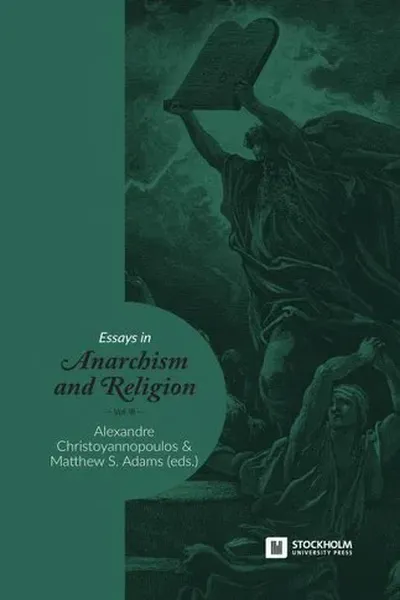
✍️ Author Biography
Alexandre Christoyannopoulos
📅 1609 – 1676
🌍 American
📚 1 free book
Christian anarchism views anarchism as inherent in Christianity, rejecting state authority in favor of divine will.
Christian anarchism is a political theology that posits anarchism as an intrinsic element of Christianity and the Gospels. Adherents believe that ultimate authority resides solely with God, as embodied in Jesus's teachings, and therefore reject the legitimacy of human governments. Christian anarchists perceive the state as inherently violent, deceitful, and idolatrous, advocating instead for horizontal, compassionate relationships within the "Kingdom of God." This perspective often includes pacifism and a rejection of war and militarism.
The movement draws foundational support from biblical texts, particularly the Sermon on the Mount and the Beatitudes, which are seen as illustrating Jesus's core teachings of love and forgiveness. Early Christian communities are sometimes cited as examples of anarchist communism, characterized by shared resources and mutual care. The perceived corruption of Christianity through its association with state power, particularly after the conversion of Emperor Constantine, is a significant point of critique for Christian anarchists.
Biblical Foundations
Christian anarchism finds its roots in interpretations of both the Old and New Testaments. The Old Testament is examined for periods where Israel lacked a centralized government, with figures like Jacques Ellul and Dave Andrews highlighting a decentralized tribal federation where God was the sole authority and resources were more equally distributed. The people's later desire for a king is seen as a rejection of divine rule, accompanied by warnings of militarism and oppressive taxation. In the New Testament, the Sermon on the Mount is considered paramount, with Alexandre Christoyannopoulos noting its emphasis on love and forgiveness, which directly contrasts with the state's foundation in violence. The temptation of Jesus in the desert, where Satan offers him all earthly kingdoms, is interpreted by Christian anarchists as evidence that all human governments are under Satanic influence, a temptation Jesus famously refused.
Early Church and Persecution
Alexandre Christoyannopoulos suggests that early Church Fathers' writings hint at anarchism as a divine ideal. Early Christians' resistance to state authority, exemplified by the biblical injunction to 'obey God rather than men,' is seen as a rejection of human governments. Some early Christian communities, like the one in Jerusalem described in Acts, are believed to have practiced a form of anarchist communism, sharing resources and labor. Roman Montero, using anthropological frameworks, argues for the plausibility and prevalence of such communal practices. Christian anarchists, such as Kevin Craig, emphasize that these communities were centered on genuine love and mutual care, not mere ritual. Persecution of early Christians is attributed not to their worship of Jesus, but to their refusal to participate in the Imperial cult and swear allegiance to the Roman Empire, thereby rejecting human idols claiming divine status.
Post-Reformation and Modern Developments
The "Constantinian shift," beginning with Emperor Constantine's conversion and the legalization of Christianity, is viewed by Christian anarchists as a pivotal moment marking Christianity's degeneration from a bottom-up sect to an authoritarian institution aligned with state power. This shift is seen as leading to religious justifications for violence, as in the Crusades. In the post-Reformation era, figures like Gerrard Winstanley and his Diggers movement are recognized for anticipating anarchist thought through radical Christianity, protesting economic inequality and establishing communities based on shared land and goods. Winstanley equated Christ with 'universal liberty' and saw property as a source of unfreedom. In the modern era, 19th-century Christian abolitionists like Adin Ballou and William Lloyd Garrison criticized human governments, advocating for nonresistance and believing a new order guided solely by divine love would emerge.
Key Ideas
- Rejection of state authority in favor of God's sole authority.
- The inherent non-violent and compassionate nature of Christianity.
- The state as a violent, deceitful, and idolatrous institution.
- The "Kingdom of God" as a model for horizontal, egalitarian society.
- Pacifism and rejection of militarism.
- Biblical interpretations supporting anarchist principles.
- Critique of state-church entanglement (Constantinian shift).