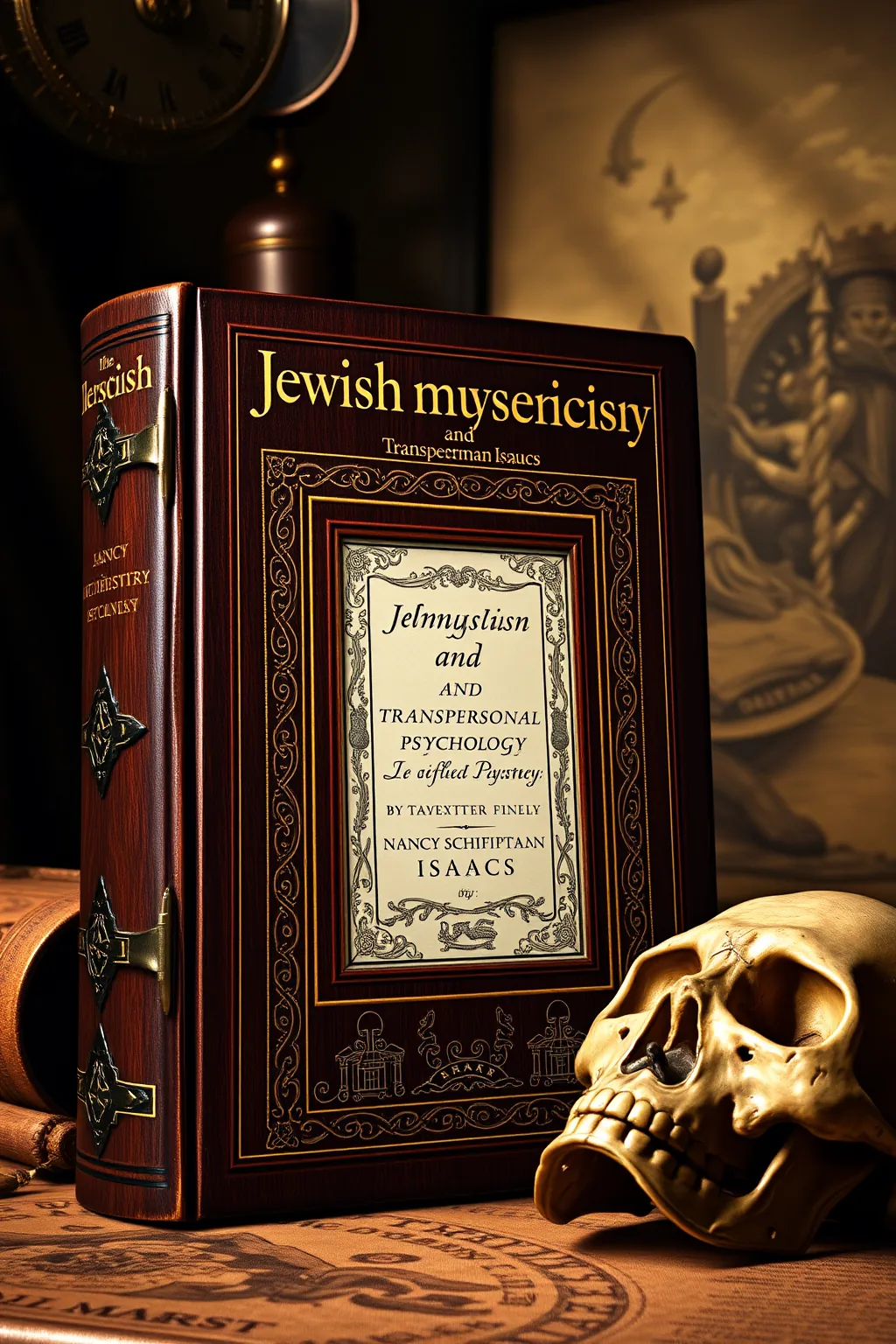
Jewish mysticism and transpersonal psychology
 61
61

Jewish mysticism and transpersonal psychology



By Evander Ashcroft (Alchemy & Hermeticism Editor) — Nancy Schiffman Isaacs' 'Jewish Mysticism and Transpersonal Psychology' is a revelation. It elegantly excavates the profound psychological underpinnings embedded within Kabbalistic thought, revealing a sophisticated system for spiritual growth and self-understanding. Isaacs' ability to translate esoteric concepts into accessible psychological language is commendable, making this rich tradition available to a broader audience. The book’s strength lies in its insightful exploration of concepts like the divine spark, soul journeys, and the Tree of Life as archetypal maps of consciousness. This work is essential for anyone interested in the intersection of spirituality and psychology, particularly those drawn to the luminous wisdom of Jewish mysticism.
📝 Description
61
Nancy Schiffman Isaacs' 2002 book connects Kabbalah's spiritual concepts to transpersonal psychology.
This book examines the parallels between Jewish mysticism, specifically Kabbalah, and transpersonal psychology. Isaacs analyzes Kabbalistic texts to show how their symbolic language provides structures for understanding the soul's development and the search for meaning. The work aims to bridge these two fields, demonstrating that ancient mystical traditions can offer valuable perspectives for contemporary psychological exploration and personal growth.
The author deciphers the complex symbolism found in Kabbalistic literature. She illustrates how these ancient teachings can inform modern understandings of consciousness and the human psyche. The book invites readers to consider how spiritual aspirations and psychological well-being can be integrated, suggesting a path toward a more complete sense of self. It is written with an academic respect for the source material while encouraging personal reflection.
This work situates itself within the study of Jewish mysticism, a tradition with roots stretching back centuries. Kabbalah, the primary focus, is an esoteric system of thought that explores the divine, the creation of the universe, and the human soul's relationship to God. By examining its rich symbolic language and conceptual frameworks, the book connects these ancient ideas to contemporary psychological theories that address consciousness and human potential beyond the ego. It draws on specific Kabbalistic concepts to illustrate points of resonance with modern thought.
💡 Why Read This Book?
Uncover the ancient secrets of Jewish mysticism and their profound relevance to modern psychological exploration. This book offers a unique synthesis, revealing Kabbalistic symbolism as a potent language for understanding the inner life and spiritual development. Ideal for seekers of wisdom, scholars of comparative mysticism, and practitioners of transpersonal psychology looking to deepen their practice with timeless esoteric insights.
⭐ Reader Reviews
Honest opinions from readers who have explored this book.
❓ Frequently Asked Questions
What is Kabbalah and how does it relate to psychology?
Kabbalah, the esoteric tradition of Jewish mysticism, offers a rich symbolic language and a cosmology that can be interpreted as a profound map of the human psyche, detailing spiritual ascent and the nature of consciousness, which resonates deeply with transpersonal psychology's focus on expanded states of awareness.
Is this book suitable for beginners in Jewish mysticism?
Yes, while it delves into complex concepts, Isaacs provides clear explanations and contextualizes the mystical elements, making it accessible to those new to Kabbalah who are interested in its psychological dimensions.
What are the key psychological themes explored in the book?
The book explores themes such as the nature of the soul, divine consciousness, the journey of transformation, self-realization, and the integration of the spiritual and material realms, all viewed through a Kabbalistic lens.
How does transpersonal psychology benefit from Jewish mysticism?
Transpersonal psychology gains a historically rich and symbolically dense framework for understanding altered states of consciousness, spiritual experiences, and the quest for meaning, offering ancient wisdom that complements modern psychological theories.
What makes this book unique?
Its unique contribution lies in the seamless integration of two seemingly disparate fields, demonstrating how the ancient, esoteric wisdom of Jewish mysticism offers profound, practical insights for contemporary psychological and spiritual exploration, fostering holistic growth.
🔮 Key Themes & Symbolism
The Kabbalistic Tree of Life as a Psychological Map
The Tree of Life, a central symbol in Kabbalah, is presented not merely as a mystical diagram but as a profound map of consciousness, detailing the emanation of the divine, the structure of the soul, and the pathways of spiritual development. Isaacs elucidates how each Sephirah represents archetypal energies and psychological states, offering a framework for understanding individuation, integration, and the journey towards self-realization. This interpretation bridges ancient esoteric symbolism with modern psychological models of the psyche, revealing a sophisticated system for inner exploration and transformation.
Divine Consciousness and the Human Psyche
This theme examines the Kabbalistic understanding of Ein Sof (the Infinite) and its manifestation through the Sefirot, exploring how this divine emanation is mirrored within the human consciousness. Isaacs examines the concept of the divine spark within each individual and the soul's innate yearning to reconnect with its source. The exploration highlights how Kabbalistic ideas about interconnectedness and the divine immanence offer a powerful perspective for transpersonal psychology, fostering a sense of unity, purpose, and transcendence in the human experience.
Symbolism and the Language of the Soul
The book emphasizes the vital role of symbolism in Jewish mysticism as a vehicle for conveying profound spiritual truths that transcend ordinary language. Isaacs deciphers the rich allegorical and symbolic language found in Kabbalistic texts, such as the Zohar and the Sefer Yetzirah, demonstrating how these symbols act as keys to unlocking hidden knowledge about the self and the cosmos. This understanding of symbolism as a direct conduit to the unconscious and the soul provides a powerful tool for psychological insight and spiritual awakening, aligning with transpersonal psychology's focus on symbolic representation.
💬 Memorable Quotes
Direct passages from the work, attributed to the author.
“Within the silence of the divine, the elements of our true selves reside.”
— This evocative phrase points to the inherent spiritual essence within each individual, suggesting that profound self-discovery is found by connecting with the silent, transcendent aspect of existence.
“Each symbol is a doorway, inviting us to step beyond the veil of ordinary perception.”
— This emphasizes the power of esoteric symbols to unlock deeper levels of understanding and consciousness, encouraging readers to look beyond superficial appearances.
“The journey inward is the greatest odyssey the soul can undertake.”
— This expresses the central theme of self-exploration as the ultimate spiritual quest, underscoring the value and profundity of introspection within mystical traditions.
“Transcendence is not an escape, but an integration of the divine within the mundane.”
— This reframes spiritual transcendence not as a denial of worldly existence, but as a process of realizing the sacredness that permeates all aspects of life.
💡 Key Ideas
Editorial paraphrase of the work's core concepts — not direct quotes.
The Kabbalistic Tree of Life is not just a diagram; it is a living map of the soul's journey.
This quote highlights the dynamic and personal nature of the Kabbalistic cosmology, suggesting it offers practical guidance for inner exploration rather than being a static, abstract concept.
🌙 Esoteric Significance
Tradition
This book primarily draws from the rich esoteric tradition of Kabbalah, a mystical interpretation of Judaism that explores the nature of God, the universe, and the human soul. It examines concepts like the Sefirot, divine emanations, the structure of the cosmos, and the path of spiritual ascent. The work highlights Kabbalah's role as a potent system of gnosis, offering hidden knowledge for self-transformation and communion with the divine, and positions it as a profound psychological and spiritual map.
Symbolism
The esoteric significance is deeply rooted in the symbolic language of Kabbalah. Key symbols like the Tree of Life, the Hebrew letters, and the divine names are explored not just for their literal or theological meaning, but as potent archetypes and metaphors for psychological states, cosmic processes, and the structure of consciousness. Isaacs illustrates how these symbols function as keys to unlock hidden dimensions of reality and the self, serving as vehicles for spiritual insight and transformation.
Modern Relevance
The modern relevance of this work lies in its ability to demonstrate the enduring power of ancient esoteric wisdom to address contemporary psychological and spiritual needs. By bridging Kabbalah with transpersonal psychology, it offers a sophisticated framework for understanding consciousness, self-realization, and the search for meaning in a secularizing world. It provides tools for personal growth, healing, and the integration of spiritual experiences, showing that these ancient traditions offer practical guidance for reading through the complexities of modern life and fostering a deeper connection to the sacred.
👥 Who Should Read This Book
This book is a valuable resource for a diverse audience. **Seekers of spiritual wisdom** will find a profound exploration of Jewish mysticism that offers useful insights into the nature of existence and the soul's journey. **Scholars of comparative religion and mysticism** will appreciate the rigorous interdisciplinary approach, bridging Kabbalah with modern psychological theory. **Practitioners of transpersonal psychology** will discover a rich, ancient tradition that provides a robust symbolic language and conceptual framework for understanding expanded states of consciousness and spiritual development. **Individuals exploring their Jewish heritage from a mystical perspective** will find a contemporary lens through which to understand their tradition's profound esoteric depths.
📜 Historical Context
Written in the late 20th century, 'Jewish Mysticism and Transpersonal Psychology' emerged during a period of burgeoning interest in both esoteric traditions and the human potential movement. The post-war era saw a growing dissatisfaction with purely materialistic worldviews, leading many to seek deeper meaning and spiritual fulfillment. Transpersonal psychology, emerging in the 1960s and 70s, explicitly focused on spiritual, transcendent, and peak experiences, making it a fertile ground for integrating ancient wisdom. Nancy Schiffman Isaacs' work tapped into this zeitgeist, offering a bridge between the deeply rooted, symbolic language of Jewish mysticism, which had been largely confined to scholarly or religious circles, and the more secular, psychological exploration of consciousness gaining traction in the West. Her synthesis provided a valuable resource for those looking to understand the psychological depth inherent in religious and mystical traditions.
📔 Journal Prompts
How does the concept of the divine spark within you resonate with your understanding of self-worth and potential?
Reflect on a time you experienced a moment of profound interconnectedness; how might this relate to Kabbalistic ideas of unity?
Consider the 'Tree of Life' as a map of your own life journey: where do you see yourself on its branches?
What personal symbols or metaphors have guided your own inner exploration or psychological growth?
In what ways can embracing esoteric wisdom enhance your perception of the 'mundane' aspects of your daily life?
🗂️ Glossary
Kabbalah
The esoteric tradition of Jewish mysticism, concerned with the nature of God, the creation of the universe, and the path of spiritual ascent. It uses a rich symbolic language and cosmology.
Sefirot
The ten divine emanations or attributes through which God (Ein Sof) is understood to have created and sustains the universe, forming the Kabbalistic Tree of Life.
Ein Sof
The Kabbalistic term for the absolute, unknowable, and infinite aspect of God, beyond all comprehension and description.
Transpersonal Psychology
A branch of psychology that focuses on the spiritual, transcendent, and peak experiences of human beings, integrating them with conventional psychological frameworks.
Gnosis
Spiritual knowledge, often of a mystical or esoteric nature, perceived as direct insight or intuition rather than empirical observation.
This book appears in 1 collection
🔮 Readers Also Liked
Browse all →









From the “Kabbalah” Collection
View all →







More Free Kabbalah & Jewish Mysticism Books
View all →