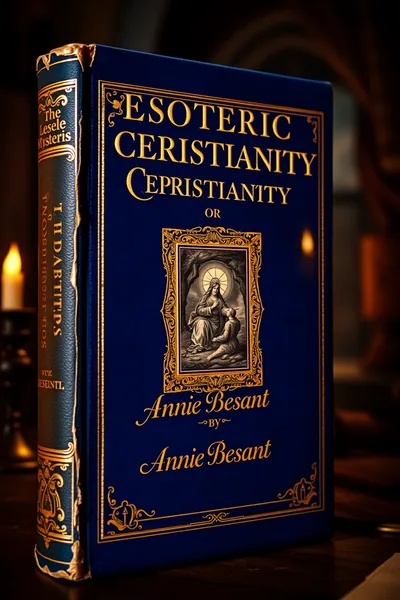
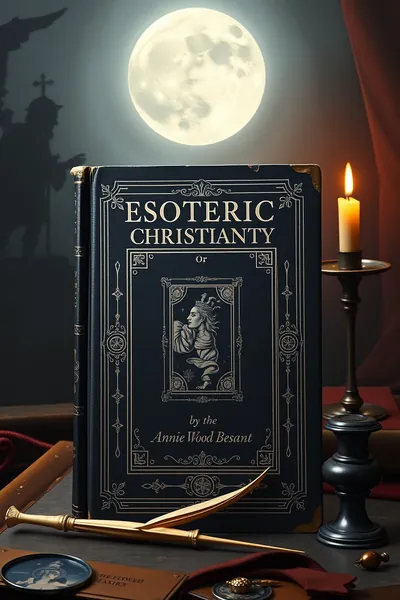
Esoteric Christianity, Or the Lesser Mysteries

 82
82

Esoteric Christianity, Or the Lesser Mysteries
Annie Besant’s *Esoteric Christianity* is less a historical account and more a systematic reinterpretation of Christian dogma through the Theosophical framework. Her strength lies in her systematic approach, rendering complex symbolic systems accessible to her followers. The work effectively reframes the Christ narrative as a blueprint for individual spiritual ascension, a compelling idea for those seeking a mystical dimension to faith. However, its reliance on Theosophical tenets means it presupposes a familiarity with concepts like karma, reincarnation, and the subtle bodies, which can be a barrier for those outside that specific lineage. A particularly striking section discusses the Eucharist, interpreting it not as a literal sacrifice but as a ritual of spiritual nourishment and union with the divine consciousness. While it offers a unique perspective, readers should be aware that it is a highly selective and interpretive reading of Christianity, rather than a neutral scholarly analysis.
📝 Description
82
Annie Besant's 1901 book reinterprets Christian doctrine through an occult lens.
Annie Besant's Esoteric Christianity, Or the Lesser Mysteries examines Christian doctrines from an occult perspective. The work seeks to uncover hidden meanings and symbolic layers within New Testament stories and early Christian practices. Besant frames these teachings as initiatory, meant for individuals prepared for spiritual development and a deeper understanding.
This book is for those already acquainted with or investigating Theosophy or other Western esoteric paths. It appeals to readers who view Christianity as a system for spiritual evolution, not just a theological or historical subject. A willingness to consider non-literal scripture interpretations and an interest in mystical symbolism are beneficial.
Published in 1901, amidst a growing interest in spiritualism and occultism, Besant's book originated within the Theosophical Society. The late 19th and early 20th centuries saw a questioning of orthodox religion and a search for older wisdom traditions. Esoteric Christianity engaged with movements like Gnosticism and Hermeticism, proposing an interpretation distinct from mainstream theology and some secular historical views of early Christianity.
This work situates itself within the broader Theosophical movement, co-founded by Helena Blavatsky. Esoteric Christianity, Or the Lesser Mysteries aligns with the Theosophical aim of reviving ancient wisdom and presenting a universal spiritual teaching. It draws parallels with classical mystery religions and engages with contemporary esoteric currents, offering a path to understanding Christian teachings through principles of spiritual evolution and hidden symbolism.
💡 Why Read This Book?
• Gain an understanding of Christian narratives as symbolic representations of inner spiritual processes, as detailed in Besant's exploration of the 'Lesser Mysteries.' • Discover how concepts like the Christ archetype and spiritual evolution are presented as central to achieving higher consciousness, drawing from Theosophical interpretations. • Learn about the reinterpretation of Christian sacraments and miracles as symbolic rituals and demonstrations of spiritual law, offering a unique perspective beyond literal dogma.
⭐ Reader Reviews
Honest opinions from readers who have explored this book.
❓ Frequently Asked Questions
What is the core idea behind 'Esoteric Christianity' as presented by Annie Besant?
Besant presents Esoteric Christianity as the hidden, inner meaning of Christian doctrines and practices, accessible through spiritual understanding rather than dogma. It views Christ as an exemplar of spiritual attainment and scripture as a guide to inner transformation.
How does Annie Besant's work relate to Theosophy?
This book is deeply rooted in Theosophical principles. Besant, a prominent leader of the Theosophical Society, interprets Christian teachings through its framework, incorporating concepts like reincarnation, karma, and spiritual evolution.
What are the 'Lesser Mysteries' mentioned in the title?
The 'Lesser Mysteries' refer to the exoteric, or outward, teachings of Christianity that are symbolically presented. Besant contrasts these with hypothetical 'Greater Mysteries' which represent deeper, initiatory spiritual knowledge.
Is this book suitable for someone with no prior knowledge of Theosophy?
While it introduces concepts, the book assumes some familiarity with esoteric thought. Readers new to Theosophy might benefit from reading foundational texts alongside it to grasp the full context of Besant's interpretations.
What is Besant's view on the historical Jesus?
Besant emphasizes the Christ as a spiritual principle and archetype more than a purely historical figure. She sees Jesus as a unique embodiment of the Christ principle, a master who demonstrated the path to spiritual enlightenment.
When was Esoteric Christianity originally published?
The original publication date for Annie Besant's 'Esoteric Christianity, Or the Lesser Mysteries' was July 22, 2017, though the ideas presented draw from her earlier work and the broader Theosophical movement.
🔮 Key Themes & Symbolism
The Christ as Archetype
Besant posits the Christ not solely as a historical person but as the divine ideal within humanity, the perfected spiritual self. This archetype serves as a blueprint for individual spiritual development, a goal attainable through dedicated practice and inner realization. The book explores how this divine principle is symbolically represented throughout Christian scripture, urging readers to recognize its potential within themselves.
Symbolism of Christian Rituals
The work meticulously reinterprets key Christian sacraments and rituals, such as baptism and the Eucharist, as symbolic representations of profound spiritual processes. Baptism is seen as the death of the old self and rebirth into spiritual awareness, while the Eucharist is depicted as a communion with divine consciousness and nourishment for the soul's journey. These are not mere ceremonies but active conduits of spiritual energy.
The Path of Initiation
Besant frames Christianity as a system of initiation, akin to ancient mystery schools. The 'Lesser Mysteries' are the exoteric teachings, while the true esoteric wisdom is revealed through a process of inner purification and spiritual growth. This path involves overcoming lower desires and aligning the personal will with divine will, leading to a state of spiritual mastery.
Spiritual Evolution and Rebirth
Central to Besant's thesis is the concept of spiritual evolution, guided by the Christ principle. She integrates Theosophical ideas of reincarnation and karma, suggesting that the Christian path is one of repeated earthly lives aimed at spiritual refinement. The ultimate goal is the union of the individual soul with the divine, a culmination of this ongoing evolutionary process.
💬 Memorable Quotes
Direct passages from the work, attributed to the author.
“The Christ is not an individual, but a divine principle.”
— This statement expresses Besant's core argument: that the Christ represents a universal spiritual force or ideal, attainable by all, rather than being confined to a single historical figure.
“Miracles are not violations of natural law, but expressions of higher spiritual law.”
— Besant reframes miraculous events not as supernatural interventions, but as demonstrations of forces and principles that operate beyond ordinary human perception and understanding within the spiritual realm.
“The sacraments are symbols of inner spiritual processes.”
— This highlights the book's approach to Christian ritual, viewing ceremonies like baptism and communion as outward signs representing profound internal transformations of consciousness and spiritual connection.
“The true Christian is one who follows the inner Christ.”
— This emphasizes the personal, inner journey of spiritual realization as the defining characteristic of Christianity, prioritizing individual awakening over adherence to external religious structures.
“The Lesser Mysteries prepare the way for the Greater.”
— This suggests a graded system of spiritual knowledge, where the publicly accessible teachings of Christianity serve as an introduction to deeper, more profound esoteric truths available to the initiated.
🌙 Esoteric Significance
Tradition
This work is firmly situated within the Theosophical tradition, which itself draws heavily from Hermeticism, Gnosticism, and Neoplatonism. Besant's interpretation of Christianity aims to reveal its esoteric underpinnings, presenting it as a system of spiritual evolution and initiation that aligns with the broader Theosophical worldview. It departs from orthodox Christianity by emphasizing reincarnation, karma, and a universal Christ principle over literal dogma and historical accounts.
Symbolism
Key symbols include the figure of Christ, interpreted not just as a historical person but as the divine archetype within all humanity. The cross is understood as a symbol of the union of spirit and matter, or the divine descending into the material plane. Water, often associated with baptism, symbolizes purification and the birth of the new, spiritual self, representing a transition from the lower to the higher consciousness.
Modern Relevance
Besant's work continues to influence contemporary esotericists, New Age thinkers, and those exploring comparative mysticism. Modern practitioners of spiritual development and self-realization often draw upon her reinterpretation of religious symbols as metaphors for psychological and spiritual transformation. Her emphasis on the Christ principle as an inner potential speaks to movements focused on personal divinity and awakened consciousness.
👥 Who Should Read This Book
• Students of Theosophy seeking to understand Annie Besant's specific interpretation of Christian doctrine and its symbolic meanings. • Comparative religion scholars interested in how esoteric movements reinterpret established faiths, particularly Christianity during the late 19th and early 20th centuries. • Spiritual seekers looking for mystical perspectives on Christian narratives and practices, aiming to find deeper, non-literal meanings beyond conventional religious dogma.
📜 Historical Context
Annie Besant's *Esoteric Christianity, Or the Lesser Mysteries*, first published in 2017 but drawing on earlier concepts, emerged within the fertile ground of late 19th and early 20th-century esoteric revival. This era saw a significant public interest in spiritualism, Theosophy, and alternative interpretations of religion, largely as a reaction against the perceived materialism of the age. Besant, a leading figure in the Theosophical Society alongside Helena Blavatsky, sought to synthesize Eastern and Western mystical traditions. Her work engaged with the burgeoning field of comparative religion and occult philosophy, offering a Theosophical interpretation that stood apart from orthodox Christian theology and secular historical critiques. While figures like Rudolf Steiner, who also emerged from Theosophy, explored similar themes, Besant's specific approach aimed to reclaim Christianity's mystical heritage for a modern, spiritually seeking audience.
📔 Journal Prompts
The Christ Principle as an inner guide: How does Besant's concept of the Christ archetype challenge conventional views of faith?
Symbolic interpretation of sacraments: Reflect on the spiritual meaning Besant assigns to baptism or the Eucharist.
The concept of spiritual evolution: Consider how the idea of progress through multiple lives, as presented here, reshapes the Christian journey.
The Lesser Mysteries versus Greater Mysteries: What distinguishes these levels of teaching in Besant's framework?
Personal application of esoteric teachings: Identify one symbolic meaning from the book that speaks to your own spiritual path.
🗂️ Glossary
Theosophy
A spiritual philosophy founded in the late 19th century, seeking to synthesize wisdom from various world religions and esoteric traditions, emphasizing universal brotherhood and spiritual evolution.
Lesser Mysteries
In esoteric traditions, refers to the exoteric, or outward, teachings and practices accessible to the general populace, as opposed to deeper, initiatory knowledge.
Christ Principle
In Theosophical thought, the divine consciousness or ideal spiritual nature inherent within humanity, exemplified by Jesus, which all individuals can potentially manifest.
Spiritual Evolution
The concept that the soul progresses through various stages of development, often across multiple lifetimes, towards higher consciousness and spiritual perfection.
Initiation
A ritual or process conferring a higher degree of spiritual knowledge or status, often involving trials and the revelation of esoteric truths.
Archetype
A universal, inherited pattern of thought or imagery derived from the collective unconscious, functioning as a symbol or motif.
Sacrament
A Christian rite recognized as a sign and an effective channel of God's grace, interpreted here symbolically as representing inner spiritual states or actions.
This book appears in 1 collection
🔮 Readers Also Liked
Browse all →







From the “Esoteric Christianity” Collection
View all →


More Free Occult Philosophy Books
View all →