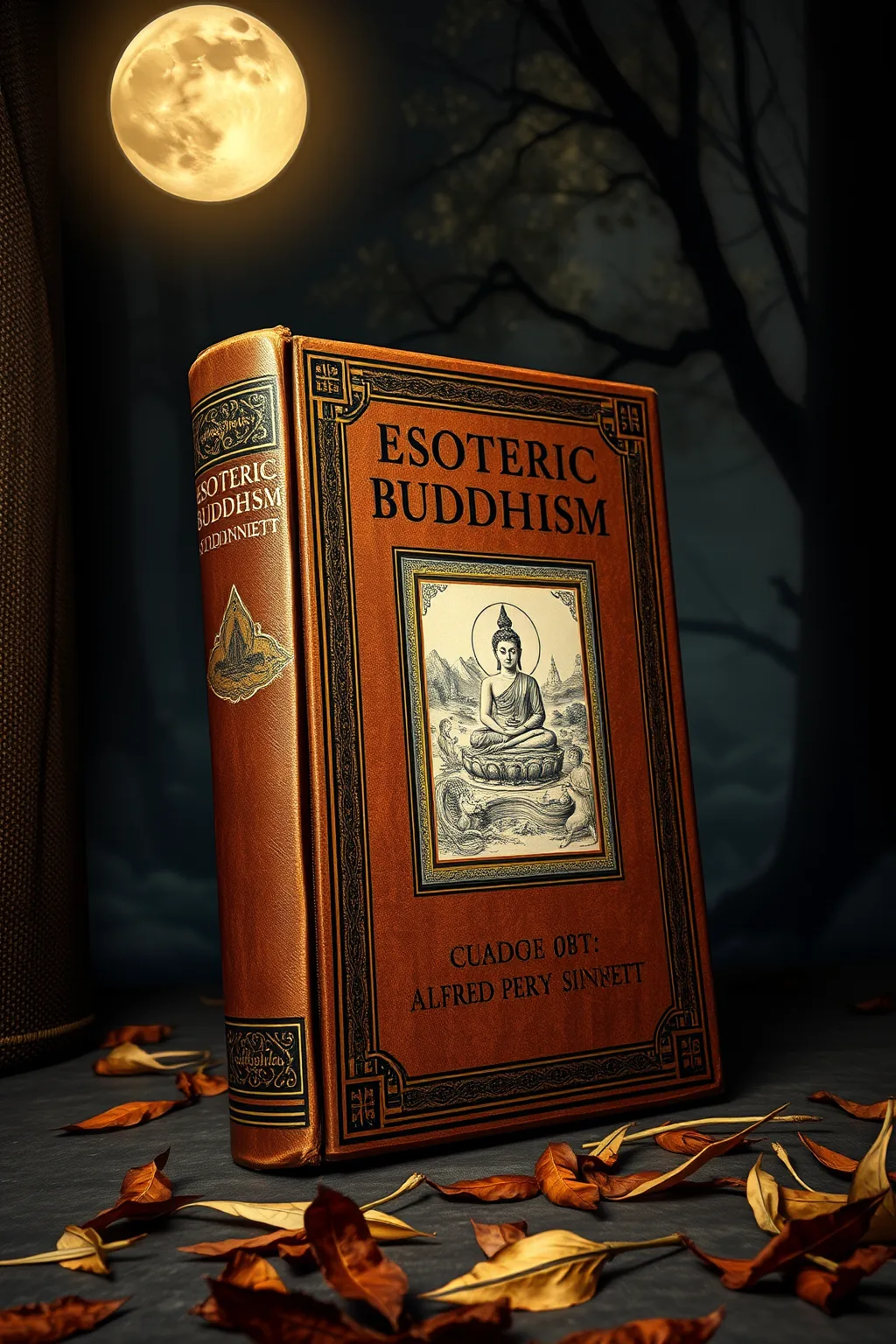
Esoteric Buddhism
 72
72

Esoteric Buddhism
Alfred Percy Sinnett’s "Esoteric Buddhism," with later contributions by Desmond Gahan, presents a fascinating, if sometimes opaque, interpretation of Buddhist doctrines through a distinctly Theosophical lens. The strength of the work lies in its ambitious attempt to synthesize Eastern philosophy with esoteric Western traditions, particularly evident in its discussion of karma as a cosmic law governing spiritual evolution across lifetimes. However, its primary limitation is the dense, often jargon-laden prose that can make accessing its core ideas a significant challenge for those not already steeped in Theosophical terminology. The exploration of the "seven principles" of man, while central to its esoteric framework, requires considerable interpretive effort.
Despite these hurdles, "Esoteric Buddhism" remains a significant text for understanding the early esoteric interpretations of Eastern thought in the West.
📝 Description
72
Alfred Percy Sinnett's 1886 book argues for a hidden initiatory science within Buddhist philosophy.
Originally published in 1886, "Esoteric Buddhism" by Alfred Percy Sinnett and Desmond Gahan proposes that Buddhism contains a deeper, initiatory science beyond its commonly understood exoteric teachings. The authors suggest that while the public received ethical and philosophical frameworks, a more profound spiritual path existed. This work was written for individuals interested in comparative religion, occult philosophy, and the Western interpretation of Eastern traditions. It aims to move past superficial dogma, showing the potential for inner transformation and spiritual growth as understood by specific esoteric schools.
The book emerged during a period of heightened Western fascination with Eastern spirituality, particularly within the intellectual currents of the Theosophical Society. It sought to present Buddhist concepts through a unique esoteric lens, distinguishing itself from solely academic or devotional analyses. By engaging with these developing esoteric movements, the text contributed to a discourse that blended ancient wisdom with concepts of hidden spiritual hierarchies.
This book is situated within the late 19th-century Theosophical movement, which actively sought to uncover and disseminate 'hidden' spiritual teachings from various world religions. Sinnett and Gahan interpreted Buddhist doctrines through this esoteric framework, emphasizing concepts like spiritual evolution and hidden hierarchies. Their work contributed to a Western understanding of Buddhism that differed significantly from purely academic or traditional religious approaches, aligning with a broader interest in occultism and non-Western mysticism.
💡 Why Read This Book?
• Gain a nuanced understanding of karma and reincarnation as cosmic forces governing spiritual evolution, as presented through the esoteric framework established by Alfred Percy Sinnett. • Explore the concept of spiritual adeptship and the stages of human evolution, as detailed in the book's treatment of Buddhas and Bodhisattvas as advanced beings. • Grasp the foundational Theosophical interpretations of Buddhist cosmology, offering a specific historical perspective on how Eastern ideas were adapted for Western esoteric audiences in the late 19th century.
⭐ Reader Reviews
Honest opinions from readers who have explored this book.
❓ Frequently Asked Questions
When was "Esoteric Buddhism" by Alfred Percy Sinnett first published?
The foundational text of "Esoteric Buddhism" by Alfred Percy Sinnett was first published in 1886, a period of significant Western engagement with Eastern spiritual philosophies.
What is the primary focus of "Esoteric Buddhism"?
The book focuses on presenting a hidden, esoteric dimension of Buddhist teachings, exploring concepts like karma, reincarnation, and spiritual evolution through an esoteric and Theosophical lens.
Who were the key figures associated with the ideas presented in "Esoteric Buddhism"?
Alfred Percy Sinnett was the primary author, and the work is strongly associated with the Theosophical Society and its early proponents, contributing to the broader discourse initiated by figures like Helena Blavatsky.
Does "Esoteric Buddhism" discuss the concept of the soul or consciousness?
Yes, the work explores the nature of consciousness and the subtle bodies within its esoteric framework, positing complex ideas about spiritual development and human principles.
Is "Esoteric Buddhism" considered a primary source for traditional Buddhist teachings?
No, it is an esoteric interpretation influenced by Theosophy, offering a specific Western esoteric perspective rather than representing traditional, orthodox Buddhist doctrines.
What makes the book's approach to Buddhism 'esoteric'?
Its esoteric approach involves interpreting Buddhist concepts as symbols for deeper spiritual truths and inner development, rather than solely as philosophical or ethical doctrines for the general public.
🔮 Key Themes & Symbolism
Karma and Reincarnation
The work frames karma not just as a law of cause and effect, but as a complex, intelligent force guiding spiritual evolution across multiple lifetimes. It posits that reincarnation is a fundamental mechanism for the soul's progress through various stages of existence, influenced by actions and desires. This perspective moves beyond a simple ethical accounting to a cosmic process of refinement and learning, essential for understanding the esoteric path.
Spiritual Evolution and Adeptship
A central theme is the concept of spiritual evolution, depicting humanity's journey towards higher states of being. The book discusses the idea of 'Buddhas' and 'Bodhisattvas' as individuals who have achieved advanced stages of this evolution, embodying profound wisdom and compassion. It suggests a structured path, often involving initiations and disciplined effort, leading to adeptship and the capacity to guide others.
The Seven Principles of Man
Sinnett elaborates on a model of human constitution comprising seven distinct principles or bodies, ranging from the physical to the purely spiritual. This framework is crucial for understanding how consciousness interacts with different planes of existence and how karma operates across these levels. The interplay of these principles is presented as key to comprehending the process of birth, death, and rebirth.
Esoteric Cosmology
Beyond the physical world, the book outlines an esoteric cosmology that includes subtle planes of existence and unseen forces. It describes a universe imbued with consciousness and governed by higher laws, accessible through inner perception and spiritual discipline. This view positions Buddhism as a system that, when understood esoterically, reveals profound truths about the universe and humanity's place within it.
💬 Memorable Quotes
Direct passages from the work, attributed to the author.
“The Law of Karma is the most important of all laws governing the universe.”
— This statement highlights the foundational role of karma in the book's esoteric interpretation of Buddhism, presenting it as the ultimate principle dictating cosmic order and individual destiny across lifetimes.
“Reincarnation is not a punishment but a necessary school for the soul's development.”
— This interpretation reframes reincarnation from a potentially negative concept into a positive, educational process essential for spiritual growth and the unfolding of consciousness through various life experiences.
“Buddhas and Bodhisattvas represent perfected human evolution.”
— This concept positions enlightened beings not as divine entities, but as advanced stages of human potential, attainable through dedicated spiritual practice and understanding of esoteric principles.
“The physical body is but one of the seven principles through which consciousness operates.”
— This highlights the esoteric view of human nature as multi-layered, emphasizing that the physical form is a temporary vehicle for a more complex, enduring spiritual entity that functions across various planes.
“True Buddhist wisdom lies hidden, accessible only to the initiated.”
— This suggests a dual nature to Buddhist teachings: an exoteric, public presentation and an esoteric, inner doctrine reserved for those who undertake the path of inner development and spiritual study.
🌙 Esoteric Significance
Tradition
This work is firmly rooted in the Theosophical tradition, which itself draws from Hermeticism, Neoplatonism, and Eastern philosophies like Hinduism and Buddhism. "Esoteric Buddhism" specifically attempts to reframe Buddhist concepts within the Theosophical cosmology, emphasizing a hidden science of spiritual development and universal laws that govern existence across multiple planes and lifetimes.
Symbolism
Key symbols include the Wheel of Dharma, representing the cyclical nature of existence and the path of spiritual evolution, and the concept of the "Buddha" as a perfected human being who has transcended ordinary limitations. The number seven, frequently appearing in discussions of human principles and cosmic planes, symbolizes completeness and spiritual order within the esoteric framework.
Modern Relevance
Contemporary esotericists, comparative religion scholars interested in Western appropriations of Eastern thought, and students of Theosophy continue to engage with "Esoteric Buddhism." Its framework influences modern interpretations of karma, reincarnation, and consciousness within New Age spirituality and various occult revival movements.
👥 Who Should Read This Book
• Students of Theosophy: Individuals seeking to understand the foundational texts and interpretations of the Theosophical movement, particularly its engagement with Buddhism. • Comparative Religion Researchers: Scholars interested in how Eastern religious ideas were filtered, adapted, and synthesized within Western esoteric traditions in the late 19th century. • Esoteric Philosophy Enthusiasts: Those exploring concepts of karma, reincarnation, spiritual evolution, and hidden cosmic laws from an occult or metaphysical perspective.
📜 Historical Context
Alfred Percy Sinnett's "Esoteric Buddhism," first published in 1886, emerged during the late Victorian era's fervent fascination with spiritualism, occultism, and Eastern philosophies. It was deeply intertwined with the Theosophical Society, founded by Helena Blavatsky, Annie Besant, and others, which aimed to revive ancient wisdom traditions. Sinnett, a prominent Theosophist, sought to present Buddhist concepts through an esoteric lens, differentiating his work from both academic Indology and popular spiritualism. This period saw numerous attempts to synthesize Western esoteric thought with Eastern religions; "Esoteric Buddhism" contributed significantly to this discourse, offering a specific interpretation of karma, reincarnation, and spiritual evolution. Its reception was enthusiastic within Theosophical circles, though it also drew attention from those questioning its interpretations of established Buddhist doctrine, a common challenge for works engaging with esoteric traditions.
📔 Journal Prompts
The Law of Karma as presented in "Esoteric Buddhism": how does its cosmic scope differ from common understandings?
Analyze the concept of spiritual adeptship and its relation to the "seven principles of man."
Reflect on the esoteric interpretation of Buddhas and Bodhisattvas as perfected human beings.
Consider the implications of reincarnation as a "school" for the soul's development.
Examine the book's description of subtle planes of existence and their role in human evolution.
🗂️ Glossary
Karma
In this esoteric context, karma is not merely a law of cause and effect, but a cosmic, intelligent force that governs spiritual evolution across multiple lifetimes and planes of existence.
Reincarnation
The process by which the spiritual essence or soul takes on a new physical body after death, serving as a crucial mechanism for learning, development, and karmic resolution.
Buddha
Within this text's esoteric framework, a Buddha signifies an individual who has achieved the highest stages of spiritual evolution, embodying supreme wisdom and compassion.
Bodhisattva
An enlightened being who delays their own final liberation to assist humanity in its spiritual progress, embodying compassion and wisdom on the path.
Seven Principles of Man
A Theosophical concept describing the multi-layered constitution of a human being, comprising physical, energetic, emotional, mental, and spiritual components across various subtle bodies.
Adeptship
The state of advanced spiritual attainment, characterized by profound wisdom, mastery over lower nature, and often the ability to influence subtle energies and guide others.
Exoteric
Pertaining to teachings or doctrines that are publicly known or intended for general understanding, as opposed to esoteric or hidden knowledge.
🔮 Readers Also Liked
Browse all →








More by Alfred Percy Sinnett, Desmond Gahan
All books →
More Free Occult Philosophy Books
View all →