Allen's Keynotes & Characteristics

 73
73

Allen's Keynotes & Characteristics
Henry C. Allen's *Keynotes & Characteristics* is less a gentle guide and more a rigorous training manual for the homeopathic prescriber. The opening paragraph, with its stark emphasis on "constant comparison and differentiation," sets the tone: this is not for the faint of heart. Allen's strength lies in his relentless focus on the signal symptoms, the 'keynotes' that unlock a remedy's essence. He presents these with an almost cryptographic clarity, demanding intense study. However, the sheer density of information can feel overwhelming; the text assumes a significant prior knowledge of homeopathic principles and extensive familiarity with the Materia Medica. A particular passage detailing the differentiating symptoms between Phosphorus and Bryonia, for instance, highlights both Allen's precision and the challenge for newcomers. Ultimately, this book is a crucial, albeit demanding, tool for the dedicated homeopath seeking mastery over subtle distinctions.
📝 Description
73
Allen's Keynotes & Characteristics, published in 1917, details the precise differentiation of homeopathic remedies.
First published in 1917, Allen's Keynotes & Characteristics is a detailed compendium for homeopathic practitioners. The book focuses on differentiating remedies by their characteristic symptoms, emphasizing meticulous observation and comparison to find the most accurate simile for a patient's condition. It is particularly useful for those studying classical homeopathy and engaging with the Materia Medica.
The volume helps practitioners refine their diagnostic skills. It moves beyond superficial symptom matching to a deeper grasp of the subtle distinctions between remedies. Readers will find value in understanding the historical development of medical symbolism within esoteric traditions.
This work emerged from late 19th and early 20th-century American homeopathy, a period of significant development in both scientific medicine and esoteric thought. Allen's approach reflects the rigorous, comparative method championed by Hahnemann's followers, aiming to systematize the understanding of drug provings and their application.
Allen's work is situated within the esoteric tradition of homeopathy, which views the practice as more than just a material science. This perspective often draws on philosophical and spiritual ideas to understand the deeper workings of remedies and the human constitution. The emphasis on 'keynotes' and subtle differentiating features aligns with an esoteric understanding of finding the essential essence or signature of a substance's effect on the vital force.
💡 Why Read This Book?
• Gain the ability to discern subtle symptom differences crucial for accurate homeopathic prescribing, as detailed in the 'keynote' concept for remedies like Arsenicum album, as presented in the book. • Develop a refined analytical framework for case-taking, moving beyond generalities to identify the most characteristic symptoms, a method Allen championed since the 1917 publication. • Understand the historical evolution of Materia Medica study in homeopathy, appreciating the rigorous comparative analysis that distinguished early 20th-century practice, exemplified by Allen's structured approach.
⭐ Reader Reviews
Honest opinions from readers who have explored this book.
❓ Frequently Asked Questions
What is the primary purpose of Allen's Keynotes & Characteristics?
The book's main goal is to equip homeopathic practitioners with the ability to differentiate between similar remedies by focusing on their most characteristic symptoms, or 'keynotes,' as outlined in the text.
When was Allen's Keynotes & Characteristics first published?
The original publication date for Allen's Keynotes & Characteristics was 1917, a significant year for the consolidation of homeopathic Materia Medica study.
Who is Henry C. Allen?
Henry C. Allen was a prominent American homeopathic physician and author, known for his contributions to the study and systematization of the homeopathic Materia Medica.
What does 'Materia Medica' refer to in homeopathy?
In homeopathy, Materia Medica refers to the body of knowledge describing the effects of substances (remedies) on the healthy human body, derived from provings.
How does this book help differentiate remedies?
It achieves this by isolating and detailing the most distinctive symptoms ('keynotes') for each remedy, enabling practitioners to make precise comparisons.
Is this book suitable for beginners in homeopathy?
While valuable, the book's dense detail and assumption of prior knowledge make it more suitable for intermediate to advanced students and practicing homeopaths.
🔮 Key Themes & Symbolism
The Art of Symptom Differentiation
This theme dissects the fundamental homeopathic principle of distinguishing between remedies based on their unique symptom profiles. Allen's work meticulously isolates the 'keynotes'—the most striking and peculiar symptoms—that serve as a remedy's signature. The text stresses that true healing lies not in matching generalities but in precisely identifying the simillimum through careful comparison, a core part of Samuel Hahnemann's teachings since the early 19th century.
Characteristic Symptoms as Signatures
Allen elevates 'characteristic symptoms' to the status of a remedy's unique identifier. These are not merely common ailments but the peculiar, striking, and often strange manifestations that a substance produces in a proving. The book functions as a lexicon for these signatures, guiding the practitioner to recognize the individual essence of each remedy, moving beyond broad categories to the specific energetic imprint.
The Homeopathic Materia Medica
This theme addresses the structure and application of the Materia Medica itself, as understood in the early 20th century. Allen's contribution is to organize and present this vast knowledge in a manner conducive to rapid recall and comparative analysis. The work emphasizes the necessity of deep familiarity with provings and the understanding that symptoms are not isolated events but part of a remedy's overall picture, as developed through extensive clinical experience.
The Homeopath's Observational Acuity
Central to Allen's method is the cultivation of the homeopath's observational skills. The text implicitly trains the reader to look for the minute details, the nuances of sensation, location, modality, and concomitant symptoms that differentiate one remedy's action from another. This requires a disciplined mind, capable of holding multiple symptom pictures simultaneously and discerning the most vital points for selection.
💬 Memorable Quotes
Direct passages from the work, attributed to the author.
“The life-work of the student of the homeopathic Materia Medica is one of constant comparison and differentiation.”
— This opening statement captures the book's core thesis: the essential task of a homeopath is not rote memorization but the active, analytical process of distinguishing between remedies based on subtle symptomatic variations.
“He must compare the pathogenesis of a remedy with the recorded amanuensis of the patient.”
— This highlights the direct correlation required between the known drug effects (pathogenesis) and the patient's reported symptoms (amanuensis), emphasizing the need for precise matching.
“He must differentiate the similar symptoms.”
— This points to the challenge and necessity of distinguishing between remedies that present overlapping or superficially similar symptom pictures, requiring a deeper level of analysis.
“The keynote is the soul of the remedy.”
— This metaphorical statement underscores the critical importance of the most characteristic symptom, suggesting it holds the essential essence or 'soul' of the remedy's action.
“The characteristics are the language of the disease and the remedy.”
— This emphasizes that the specific symptoms observed in both the patient and the remedy's proving are the means by which their respective conditions can be understood and matched.
🌙 Esoteric Significance
Tradition
While primarily a work of homeopathic materia medica, Allen's text implicitly aligns with the broader tradition of vitalism that influenced many esoteric movements of the late 19th and early 20th centuries, including Theosophy and certain Hermetic streams. The emphasis on a 'vital force' and the 'simillimum' reflects a worldview that posits an underlying energetic principle governing health and disease, distinct from purely materialistic explanations.
Symbolism
The 'keynotes' themselves function as symbolic shorthand within the homeopathic system. For instance, the keynote of Arsenicum album often involves symbolism of restlessness, anxiety, and a desire for warmth, representing a state of internal turmoil and fear. Similarly, the characteristics of Phosphorus, such as its association with bleeding and burning pains, can be seen as symbolic representations of a vital fluid or energetic state under duress.
Modern Relevance
Contemporary practitioners of classical homeopathy continue to rely on foundational texts like Allen's. His method of identifying and prioritizing characteristic symptoms remains a core teaching in many homeopathic colleges and study groups. Thinkers in the field of consciousness studies and alternative healing modalities also find value in the text's exploration of subtle symptomology and the holistic understanding of the individual.
👥 Who Should Read This Book
['• Practicing homeopaths seeking to deepen their diagnostic precision by mastering the art of differentiating between similar remedies through characteristic symptoms.', '• Students of homeopathy needing a rigorous guide to the Materia Medica, focusing on the foundational principles of symptom analysis and remedy selection.', '• Researchers and historians interested in the development of 20th-century American medical thought and the specific methodologies of classical homeopathy.']
📜 Historical Context
Henry C. Allen's *Keynotes & Characteristics*, first published in 1917, emerged during a key period for American homeopathy. The late 19th and early 20th centuries saw figures like James Tyler Kent solidifying homeopathic doctrine, often integrating philosophical and spiritual concepts. This era was marked by a strong adherence to the principles laid down by Samuel Hahnemann, emphasizing the individualized approach and the meticulous study of provings. Allen’s work served to systematize this knowledge, providing a practical tool for practitioners facing the challenge of differentiating between increasingly well-documented remedies. It stood in contrast to the burgeoning fields of allopathic pharmacology and bacteriology, which were developing their own distinct methodologies. While mainstream medicine focused on pathological anatomy and chemical interventions, homeopathy, as exemplified by Allen, continued to refine its energetic and symptomatic approach, maintaining a distinct intellectual current.
📔 Journal Prompts
The concept of 'keynotes' as the soul of the remedy.
Differentiating between the pathogenesis of a remedy and the amanuensis of the patient.
The role of characteristic symptoms in identifying the simillimum.
Comparing the methodology presented here with other Materia Medica approaches.
Reflecting on the importance of constant comparison and differentiation in your own studies.
🗂️ Glossary
Keynote
The most characteristic, peculiar, striking, and unusual symptom(s) of a drug or disease, which serve as its identifying signature for homeopathic prescribing.
Characteristics
The collection of symptoms that define a remedy's action or a patient's condition, encompassing generalities, particulars, and modalities, but less distinct than keynotes.
Materia Medica
A comprehensive body of knowledge detailing the physiological effects of medicinal substances, particularly as used in homeopathy, based on provings.
Pathogenesis
The totality of symptoms produced by a drug when administered to healthy individuals, as determined through homeopathic provings.
Amanuensis
In this context, refers to the patient's own description and record of their symptoms and suffering.
Simillimum
The homeopathic remedy that most closely matches the totality of the patient's symptoms, based on the principle of 'like cures like'.
Provings
A process in homeopathy where healthy volunteers ingest substances to record the symptoms they experience, thereby establishing the Materia Medica.
This book appears in 1 collection
🔮 Readers Also Liked
Browse all →








From the “Homeopathy” Collection
View all →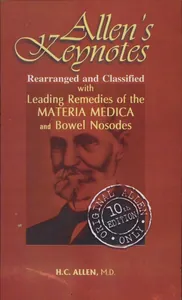








More Free Occult Philosophy Books
View all →