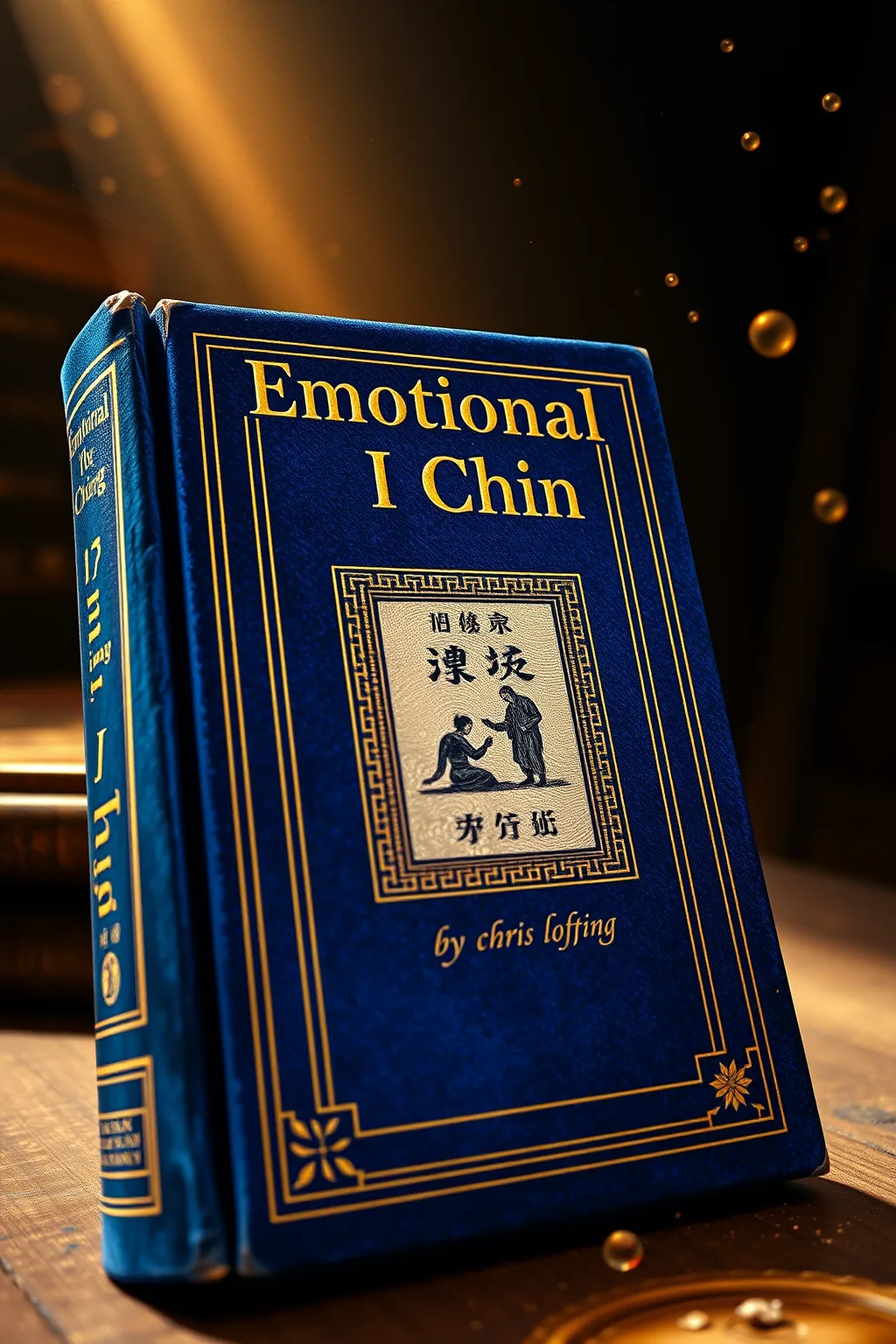
Emotional I Ching
 61
61

Emotional I Ching



By Balthazar Finch (Senior Critic, Occult Philosophy) — Lofting's 'Emotional I Ching' is a rare gem, an illumination for those who seek the profound depths of the 'Book of Changes.' It transcends the superficial, offering a truly esoteric interpretation that resonates with the soul's deepest currents. The author's insightful prose unveils the archetypal emotional states inherent within each hexagram, transforming a complex divinatory system into a powerful tool for psychological and spiritual growth. This work is indispensable for serious students of the occult, providing a nuanced understanding of the I Ching's symbolic language and its application to the human condition. A masterful contribution to the field, highly recommended for practitioners and scholars alike.
📝 Description
61
Chris Lofting's 'Emotional I Ching' (2023) reinterprets the classic Chinese oracle through an emotional lens.
Chris Lofting's 'Emotional I Ching' presents a new approach to the ancient Chinese text, the Yi Jing. This work moves beyond traditional divination, focusing instead on the emotional and psychological dimensions embedded within the hexagrams. Lofting suggests that the I Ching reflects the patterns of human experience, offering insights into inner states and personal transformation.
The book details specific correspondences within the hexagrams, interpreting them as a form of emotional language. It examines concepts of balance, change, and the cyclical nature of life. Lofting aims to illuminate the philosophical foundations of the oracle, making it accessible for self-reflection and personal growth. The intention is to foster a connection between internal emotional states and the wider universe, using the I Ching as a guide for understanding.
This interpretation is intended for those interested in the I Ching's potential for self-understanding, not solely for fortune-telling. It invites readers to explore the oracle's wisdom for insight into their own emotional lives and the unfolding of their personal journeys.
This work engages with the tradition of the I Ching, a foundational text in Chinese philosophy and esoteric practice. While historically used for divination and ethical guidance, Lofting's interpretation situates it within a broader framework of emotional and psychological understanding. It connects the oracle's symbolic language to the inner life, drawing parallels between cosmic patterns and human sentiment. This approach aligns with modern esoteric thought that seeks to integrate ancient systems with contemporary psychological insights, viewing traditional texts not just as historical artifacts but as living tools for personal development.
💡 Why Read This Book?
Unveil the profound emotional and psychological dimensions of the ancient I Ching. This book offers a unique lens for self-discovery, emotional intelligence, and spiritual growth. Ideal for seekers of hidden wisdom, practitioners of divination, and scholars of esoteric traditions yearning for a deeper, more personal connection to this timeless oracle.
⭐ Reader Reviews
Honest opinions from readers who have explored this book.
❓ Frequently Asked Questions
What is the primary focus of 'Emotional I Ching'?
This work focuses on the emotional and psychological resonances within the I Ching, presenting it as a tool for understanding inner states and personal transformation, rather than solely for predictive divination.
Is this book suitable for beginners in I Ching study?
Yes, while offering profound depth, the accessible language and clear explanations make it an excellent starting point for newcomers interested in the I Ching's emotional and symbolic layers.
How does this interpretation differ from traditional I Ching readings?
It shifts the emphasis from external events to internal emotional landscapes, exploring the hexagrams as archetypal expressions of human feeling and psychological processes.
What kind of mystical insights can one expect?
Readers can expect insights into emotional alchemy, self-awareness, the cyclical nature of feelings, and the interconnectedness of the inner world with the cosmic order.
Can 'Emotional I Ching' be used for practical guidance?
Absolutely. By understanding the emotional currents of a situation, readers can gain deeper wisdom for navigating life's challenges and making more aligned decisions.
🔮 Key Themes & Symbolism
The Alchemical Heart of the Yi Jing
This book explores the Yi Jing not as a mere system of fortune-telling, but as a profound alchemical text for the transformation of the human spirit. It reveals how the seventy-two hexagrams act as catalysts, guiding the reader through the crucible of emotional experience. Each hexagram becomes a stage in a sacred process, where base emotions are transmuted into higher understanding, leading to a more balanced and integrated self. Lofting illuminates the symbolic language of the I Ching, showing how its patterns mirror the soul's journey towards enlightenment and inner harmony. This theme emphasizes the book's unique ability to unlock the hidden potential for spiritual evolution embedded within the ancient wisdom.
Emotional Archetypes and the Human Psyche
Chris Lofting masterfully maps the archetypal patterns of human emotion onto the framework of the I Ching. This exploration goes beyond surface feelings, plumbing the depths of primal psychological states that govern our experiences. The hexagrams are presented as dynamic representations of these archetypes, offering a profound mirror to our inner world. By understanding these emotional currents, readers gain a powerful tool for self-awareness, enabling them to identify and read through the complex interplay of feelings that shape their lives. This theme highlights the book's contribution to the understanding of the human psyche through the lens of ancient esoteric knowledge.
Divination as Inner Dialogue
In 'Emotional I Ching,' the act of divination is re-envisioned as a sacred dialogue with one's own inner wisdom and the universe. Lofting guides the reader to approach the I Ching not as an external arbiter of fate, but as a profound conversational partner. The insights gained are not predictions of external events, but rather illuminations of internal states, motivations, and the emotional energies at play in any given situation. This perspective empowers the reader to engage with the oracle as a source of profound self-reflection and guidance, fostering a deeper connection to their intuition and the subtle forces that shape their reality. This theme underscores the book's transformative approach to ancient divinatory practices.
💬 Memorable Quotes
Direct passages from the work, attributed to the author.
“To know the I Ching is to know the field of the human heart.”
— This highlights the book's central thesis: that the ancient wisdom of the Yi Jing provides a profound map for understanding our emotional lives and inner journeys.
“In the stillness of the oracle, we find the echo of our own soul's unfolding.”
— This speaks to the introspective and self-discovery aspect of using the I Ching, suggesting it facilitates a connection to one's inner truth and spiritual growth.
“Emotions are the currents upon which the ship of destiny sails.”
— This poetic metaphor underscores the power and influence of emotions in shaping our life's trajectory, framing the I Ching as a guide to navigating these vital forces.
“Seek not to conquer the shadows, but to understand their dance within.”
— This encourages acceptance and insight into our darker emotions, suggesting that true wisdom lies in comprehending their role rather than suppressing them.
💡 Key Ideas
Editorial paraphrase of the work's core concepts — not direct quotes.
The hexagrams are not mere pronouncements, but the breathing archetypes of our deepest feelings.
This quote emphasizes the dynamic and living nature of the I Ching's symbolism, portraying the hexagrams as active manifestations of our emotional core.
🌙 Esoteric Significance
Tradition
This work is deeply rooted in the Taoist and Neo-Confucian esoteric traditions of China, particularly those that view the I Ching as a microcosm of the universe and a guide to cosmic harmony. It also speaks to universal esoteric principles of correspondence between the macrocosm (universe) and the microcosm (human being), and the transformative power of symbolic language for spiritual development.
Symbolism
Key symbols include the Yin and Yang (duality and balance), the eight trigrams (fundamental forces of nature), and the sixty-four hexagrams (complex interactions of these forces). Lofting imbues these with profound emotional and psychological significance, revealing how they represent archetypal human experiences, inner states, and stages of transformation.
Modern Relevance
In an era often marked by emotional dysregulation and a search for meaning, 'Emotional I Ching' offers a timeless framework for understanding and working through the human heart. Its emphasis on introspection, self-awareness, and the cyclical nature of life provides invaluable tools for personal growth, emotional intelligence, and finding balance in a chaotic world. It bridges ancient wisdom with contemporary psychological needs.
👥 Who Should Read This Book
This book is a treasure for the introspective soul. Beginners to the I Ching will find it an accessible yet profound introduction to its deeper layers. Scholars of divination and Eastern philosophies will appreciate its unique interpretive lens. Practitioners of tarot, astrology, and other divinatory arts will discover a complementary system that enriches their understanding of archetypes and symbolic language. Seekers of personal growth and emotional wisdom will find it an indispensable guide to navigating their inner landscapes with clarity and compassion.
📜 Historical Context
The 'Book of Changes' (I Ching) emerged from ancient Chinese shamanistic practices and philosophical inquiry, evolving over millennia into a core part of Chinese thought. Its earliest roots lie in divination rituals dating back to the Shang Dynasty (c. 1600-1046 BCE), with its philosophical interpretations flourishing during the Zhou Dynasty (1046-256 BCE) and reaching a peak of synthesis during the Han Dynasty (206 BCE – 220 CE) with the Ten Wings commentary. Throughout its history, the I Ching has served as a divinatory tool, a philosophical text, a guide for governance, and a source of profound spiritual insight, influencing Confucianism, Taoism, and various esoteric schools. Chris Lofting's 'Emotional I Ching' situates itself within this rich historical range, drawing upon the enduring power of this ancient oracle and reinterpreting it for a contemporary audience seeking deeper psychological and spiritual understanding.
📔 Journal Prompts
Reflect on a recent emotional challenge. Which hexagrams from this book might represent the energies at play, and what emotional insights do they offer?
Consider a recurring emotional pattern in your life. How can the symbolic language of the I Ching help you understand its origins and potential transformations?
Choose a hexagram that speaks to your current state of being. Journal about its core emotional message and how it applies to your immediate circumstances.
How can the concept of 'emotional alchemy' as presented in this book be applied to a specific area of your life where you feel stuck?
Explore the connection between the external world and your internal emotional landscape as depicted through the I Ching. How do they influence each other?
🗂️ Glossary
Hexagram
A figure composed of six stacked horizontal lines, where each line is either Yang (unbroken) or Yin (broken). There are 64 unique hexagrams in the I Ching, each representing a specific situation or state of being.
Trigram
A figure composed of three stacked lines, either Yin or Yang. There are eight basic trigrams, each representing fundamental forces of nature and archetypal concepts.
Yi Jing
The ancient Chinese classic also known as the 'Book of Changes,' a foundational text for divination, philosophy, and cosmology.
Yang
In I Ching philosophy, the active, masculine, light, and assertive principle, represented by an unbroken line.
Yin
In I Ching philosophy, the passive, feminine, dark, and receptive principle, represented by a broken line.
This book appears in 3 collections
🔮 Readers Also Liked
Browse all →







More by chris lofting
All books →
From the “Tarot” Collection
View all →








More Free Divination & Tarot Books
View all →