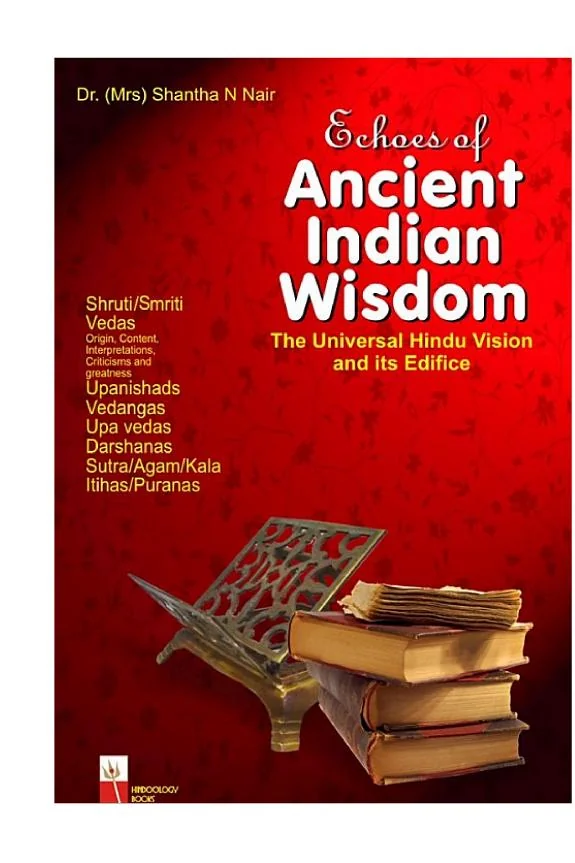
Echoes of Ancient Indian Wisdom
 80
80

Echoes of Ancient Indian Wisdom
Shantha N. Nair's "Echoes of Ancient Indian Wisdom" attempts to chart the deep currents of pre-literate Indian spiritual thought, focusing on its transmission and foundational role in Hinduism. The author commendably highlights the significance of oral tradition before scriptural inscription, a crucial aspect often overlooked. A particular strength is the detailed exposition of the guru-shishya parampara, illustrating how knowledge was preserved across generations. However, the work occasionally feels more like a descriptive catalog than an analytical critique. For instance, while the concept of Sanatan Dharma is introduced, its philosophical nuances could have been further dissected. Nair's discussion on the earliest scriptural traditions, while informative, sometimes lacks the critical engagement found in more specialized academic works. Despite these limitations, the book provides a solid overview for those new to the subject. It succeeds in its aim to connect ancient wisdom with its enduring legacy.
📝 Description
80
Shantha N. Nair's 2008 book traces Hindu philosophy from oral traditions to inscribed texts.
Published in 2008, Shantha N. Nair's "Echoes of Ancient Indian Wisdom" examines the foundational texts and oral traditions that shaped Hindu philosophy. The book follows these teachings from their pre-literate transmission over millennia to their eventual inscription. It highlights the continuing importance of these ancient scriptures in forming Sanatan Dharma, a spiritual system known for its wide scope and inclusivity.
The work is suited for scholars of comparative religion, students of Vedic studies, and anyone interested in the philosophical roots of Hinduism. It is especially helpful for those wanting to grasp the development of religious thought in ancient India and its ties to modern spiritual practices. Readers who wish for a deeper understanding of the various schools of thought within Hinduism will find its detailed discussion useful.
The origins of "Echoes of Ancient Indian Wisdom" are tied to the extensive history of Indian philosophical thought, a lineage that began with the Indus Valley Civilization and was formalized in Vedic texts. The oral passing down of these ideas began thousands of years before written records, showing the advanced memory techniques used by ancient Indian thinkers. The book places these teachings within the wider story of early human spiritual growth, emphasizing their part in the creation of what is now Hinduism.
This book sits within the study of Hindu sacred texts and Gnosticism, a field concerned with spiritual knowledge and liberation. It examines the lineage of teachings that form Sanatan Dharma, often viewed as an eternal spiritual path. The emphasis on oral transmission and the guru-shishya parampara highlights a system of knowledge preservation that relies on direct experience and lineage, a common characteristic in esoteric traditions where direct transmission is valued over purely textual study. The work connects these ancient Indian concepts to broader patterns of early human spiritual development.
💡 Why Read This Book?
• Gain insight into the guru-shishya parampara, understanding how ancient Indian knowledge was preserved and transmitted orally before the advent of written scriptures, a method critical to its longevity. • Explore the foundational concepts of Sanatan Dharma as presented in early Indian texts, appreciating its inherent diversity and tolerance, which shaped one of the world's oldest religions. • Understand the historical trajectory of Indian wisdom, tracing its origins from millennia of oral tradition to its eventual inscription, providing context for its subsequent development and influence.
⭐ Reader Reviews
Honest opinions from readers who have explored this book.
❓ Frequently Asked Questions
When was "Echoes of Ancient Indian Wisdom" first published?
Shantha N. Nair's "Echoes of Ancient Indian Wisdom" was first published in 2008, offering readers a contemporary exploration of ancient Indian philosophical traditions.
What does 'Sanatan Dharma' refer to in the context of the book?
In "Echoes of Ancient Indian Wisdom," Sanatan Dharma is presented as the 'eternal way,' representing the diverse and inclusive spiritual and religious traditions that originated in ancient India.
How does the book describe the transmission of knowledge in ancient India?
The book details the crucial role of the guru-shishya parampara, the lineage of teacher and disciple, emphasizing its importance in transmitting complex spiritual teachings orally for generations before they were written down.
What is the primary focus of "Echoes of Ancient Indian Wisdom"?
The primary focus is on tracing the origins and transmission of ancient Indian wisdom, highlighting its foundational role in Hinduism and its deep roots in oral traditions predating written scriptures.
What historical period does the book primarily cover?
The book covers the period from the earliest, pre-literate oral traditions of ancient India, extending through the development and inscription of foundational scriptures that shaped Hinduism.
Who is the author of "Echoes of Ancient Indian Wisdom"?
The author is Shantha N. Nair, who first brought "Echoes of Ancient Indian Wisdom" to the public in 2008.
🔮 Key Themes & Symbolism
Oral Tradition's Primacy
The work emphasizes the profound significance of oral transmission in ancient Indian culture, predating written scriptures by millennia. Knowledge, particularly spiritual and philosophical doctrine, was passed from guru to shishya through dedicated mnemonic practices. This highlights a sophisticated system of knowledge preservation that underscores the auditory and experiential nature of learning in its earliest forms, laying the groundwork for the vast philosophical range of Hinduism.
Sanatan Dharma's Foundation
This theme explores the concept of Sanatan Dharma, the 'eternal way,' as the unifying principle behind the diverse spiritual expressions of ancient India. The book details how the foundational scriptures and oral teachings established a framework characterized by remarkable tolerance and adaptability. It traces the lineage of these teachings, showing how they fostered a rich intellectual and spiritual environment that continues to influence global thought.
Scriptural Evolution
The book examines the transition from purely oral teachings to their eventual inscription on materials like palm leaves. This section addresses the development of early Indian scriptures, positioning them as crucial milestones in codifying and disseminating spiritual and philosophical insights. It illustrates how this process of recording contributed to the wider accessibility and study of ancient wisdom, while acknowledging the continuity with the preceding oral traditions.
Guru-Shishya Parampara
Central to the transmission of ancient Indian wisdom is the concept of the guru-shishya parampara, the unbroken lineage of teacher and disciple. This theme illustrates the deeply personal and relational method through which complex philosophies and practices were imparted. It underscores the role of the guru not just as an instructor but as a guide, ensuring the integrity and living essence of the teachings were passed down effectively.
💬 Memorable Quotes
Direct passages from the work, attributed to the author.
“Teachings were passed from generations to generations, from the teachers to the disciples in their oral form.”
— This highlights the primary mode of knowledge dissemination in ancient India, emphasizing the importance of spoken word and direct mentorship before widespread literacy and scripture.
“These works are amongst the oldest of humanity.”
— This statement positions the ancient Indian scriptures discussed in the book as foundational texts within the broader scope of human intellectual and spiritual history.
“They laid the foundation of one of the most tolerant and diverse religions in the world, the Sanatan Dharma or Hinduism.”
— This interpretation emphasizes the inclusive nature and vast scope of Hinduism, attributing its origins and enduring characteristics to the early scriptural and oral traditions explored.
“Even thousands of years before they were written down on palm leaves, the teachings were passed on...”
— This underscores the immense antiquity of Indian wisdom, stressing that its core principles existed and were actively transmitted long before their formal inscription, revealing a deep historical lineage.
“The elements of ancient Indian wisdom can be heard from the oldest of scriptures...”
— This metaphorical opening suggests that the clear insights of ancient Indian thought are still discernible and relevant today, emanating from its most ancient written records.
🌙 Esoteric Significance
Tradition
This work primarily engages with the esoteric dimensions embedded within the Sanatan Dharma tradition, which forms the bedrock of Hinduism. While not strictly adhering to Western esoteric lineages like Hermeticism or Kabbalah, it explores the profound philosophical and spiritual underpinnings that often intersect with esoteric thought globally. Nair's exploration of ancient Indian wisdom reveals concepts of consciousness, cosmology, and the nature of reality that resonate with perennial philosophies found across diverse esoteric traditions, emphasizing inner knowing and spiritual realization.
Symbolism
Key symbols explored include the 'Om' (Aum) mantra, representing the primordial sound and the essence of the universe, and the concept of the guru as a divine guide. The guru-shishya parampara itself functions as a symbolic representation of the transmission of spiritual light and knowledge. The book also implicitly touches upon the symbolism inherent in early Vedic rituals and the philosophical interpretations of cosmic cycles, all of which are rich with layered meanings within the Indic spiritual framework.
Modern Relevance
Contemporary thinkers and practitioners in fields such as yoga, meditation, and various schools of Eastern philosophy often draw implicitly or explicitly on the ancient Indian wisdom discussed by Nair. Modern interpretations of Vedanta, the resurgence of interest in Vedic chanting, and the global adoption of yogic practices all find their roots in the traditions detailed in the book. Gurus and spiritual teachers worldwide continue to employ the guru-shishya parampara, demonstrating its enduring relevance as a model for spiritual pedagogy and the transmission of living wisdom.
👥 Who Should Read This Book
• Students of comparative religion and philosophy seeking to understand the origins and evolution of Hindu thought and its foundational scriptures. • Individuals interested in the concept of oral tradition and its role in preserving ancient knowledge, particularly within non-Western cultural contexts. • Seekers exploring the philosophical underpinnings of practices like yoga and meditation, wanting to connect with their historical and spiritual roots in ancient India.
📜 Historical Context
Shantha N. Nair's "Elements of Ancient Indian Wisdom" emerges from a scholarly landscape deeply engaged with the origins of religious and philosophical thought, particularly within the context of South Asia. The work was published in 2008, a period when academic interest in Vedic studies and the comparative analysis of ancient texts was robust. The intellectual currents of the time included ongoing debates regarding the dating of Vedic literature and the socio-political influences on its interpretation. Nair's focus on the oral transmission of knowledge aligns with scholarship that recognizes the limitations of relying solely on textual evidence for periods predating widespread literacy. While the book doesn't directly engage with specific contemporary authors or reception events, its subject matter places it within dialogues concerning the historical development of Hinduism, contrasting with the more monolithic interpretations that sometimes arise from purely textual analyses. The work implicitly addresses the vastness of Indian philosophical traditions, which include schools like Nyaya and Vedanta, by grounding their origins in a much earlier, orally transmitted wisdom.
📔 Journal Prompts
The guru-shishya parampara and its role in preserving ancient Indian wisdom.
Reflect on the concept of Sanatan Dharma as an 'eternal way'.
The significance of oral transmission versus written scriptures.
Ancient Indian concepts of knowledge and their modern interpretations.
The foundational nature of these teachings for contemporary Hinduism.
🗂️ Glossary
Sanatan Dharma
Often translated as the 'eternal way' or 'eternal order,' it refers to the diverse and continuous traditions of spiritual, religious, and philosophical practices originating in ancient India, commonly known today as Hinduism.
Guru-Shishya Parampara
The traditional Indian lineage of spiritual teachers (guru) and disciples (shishya), emphasizing the direct, oral transmission of knowledge and wisdom from one generation to the next.
Oral Tradition
The method of transmitting knowledge, cultural beliefs, and stories through spoken language rather than written texts, a primary means of education in ancient India.
Vedic Scriptures
The oldest body of sacred texts in Hinduism, originating in ancient India, believed by adherents to be divinely revealed and forming the foundation of much subsequent Indian philosophy and religion.
Palm Leaf Manuscripts
Ancient documents created by writing on dried palm leaves, a common medium for recording texts in South and Southeast Asia before the widespread use of paper.
Hinduism
A major world religion originating in the Indian subcontinent, encompassing a wide range of beliefs, philosophies, and practices rooted in Sanatan Dharma and Vedic traditions.
Esoteric
Relating to or accessible only by a relatively small number of people with a specialized knowledge or interest; pertaining to inner, mystical, or spiritual truths.
This book appears in 1 collection
🔮 Readers Also Liked
Browse all →









From the “Upanishads” Collection
View all →







More Free Occult Philosophy Books
View all →